Manufacturing custom silicone products since 2012

Silicone Mold Manufacturer

Silicone molds for chocolate, candy, cake, ice, soap and industrial use. Custom shapes, cavities, food-grade materials, molded logos and retail packaging.

silicone mold2 2

What Is a Silicone Mold?

A silicone mold is a flexible, heat-resistant tool molded from food-grade silicone rubber that shapes chocolate, candy, cake batter, ice, soap or resin and releases the finished item without sticking. A custom (OEM/ODM) silicone mold is the same product built to your own shape, cavity layout, size, color, logo and packaging for resale or promotion.

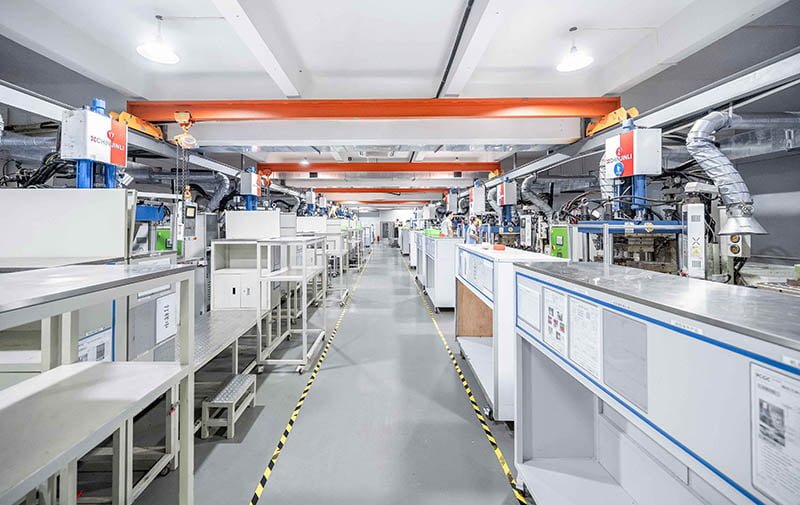
RY Silicone is a custom silicone manufacturer based in China, established in 2012. The factory covers 10,000+ m², runs 30+ machines and can produce up to 100,000 silicone products per day. We supply OEM/ODM silicone molds to brands, distributors and wholesalers across North America, Europe and other international markets.

Silicone Mold Manufacturing at a Glance

MOQ

From 500 pieces for an existing mold with custom branding, or 3,000 pieces for a new custom-molded design.

Lead Times

Samples in 5–10 working days, custom molds in 10–20, and mass production in 15–25 after approval.

Material & Performance

Food-grade platinum- or peroxide-cured silicone, 30–60 Shore A, stable from -40°C to 230°C.

Branding & Packaging

Embossed or debossed molded logos, plus OPP/PE bags, header cards, blister packs and printed retail boxes.

Who We Manufacture Silicone Molds For

Start with the sales channel, then define the mold, branding and packaging.

Kitchenware Bakeware Brands

Kitchenware & Bakeware Brands

Build a coordinated mold collection around your brand shapes, colors and target price level.Existing designs suit faster market entry, while custom molds create a more distinctive product identity.

Distributors & Wholesalers

Distributors & Wholesalers

Buy silicone molds wholesale and in bulk for kitchen, baking, confectionery and homeware channels.As a direct factory supplier, we support standard retail shapes, seasonal ranges and promotional molds across your customer base.

Chocolatiers Bakeries Confectioners

Chocolatiers, Bakeries & Confectioners

Produce molds for signature shapes, logos and portion-controlled products used in professional production.Food-grade materials, easy release and repeatable cavity dimensions matter most for these customers.
Event Promotional Companies

Event & Promotional Companies

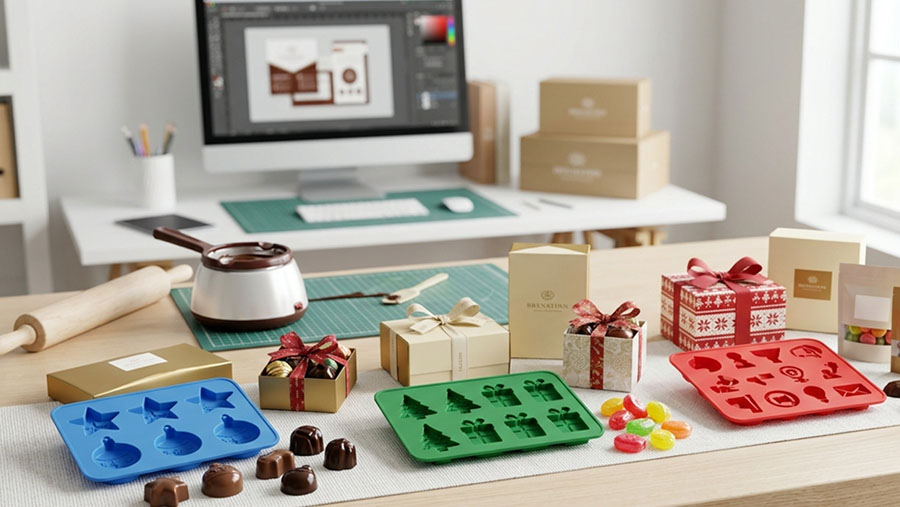
Create branded molds for holidays, campaigns, corporate gifts and sponsored events.Existing molds and molded artwork give an efficient route when visibility and delivery control are the priority.

Retail Ecommerce Sellers

Retail & Ecommerce Sellers

Add branded packaging, barcode labels, SKU information, recipe cards and product inserts.Molds arrive ready to list in stores, marketplaces and private-label or white-label websites.

Industrial Craft Makers

Industrial & Craft Makers

Tool molds for soap, candle, resin, concrete and other craft or light-industrial applications.We evaluate cavity structure, draft angle, wall thickness and demolding behavior together during sampling.
Silicone Mold Types We Can Develop

Silicone Mold Customization

Custom mold projects start with shape, size, color and packaging.

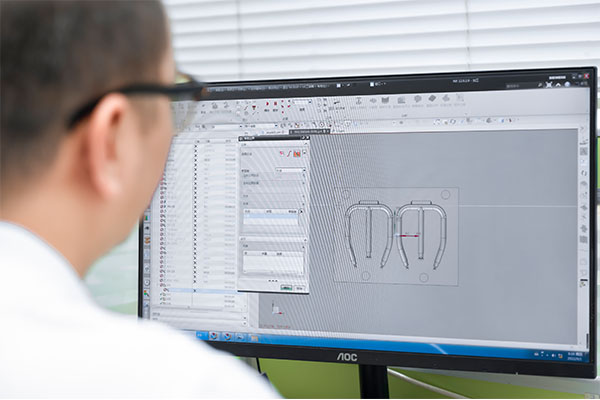
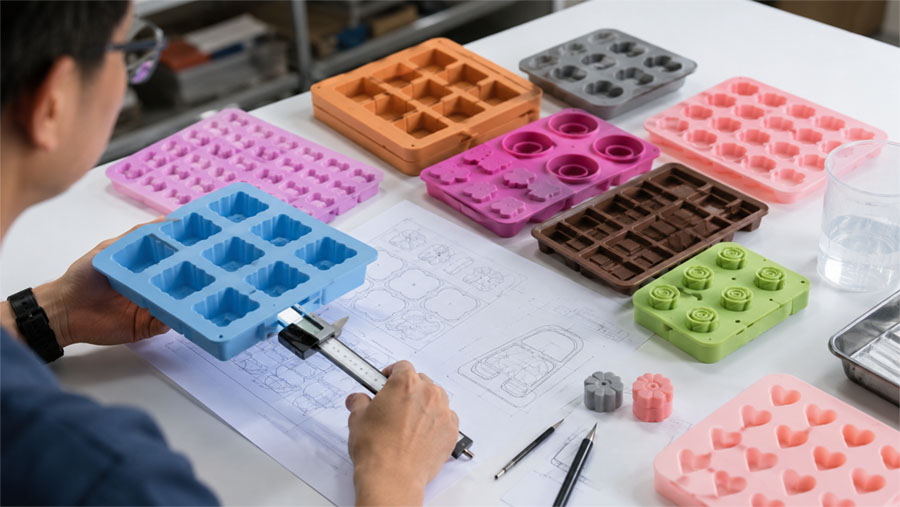
Custom silicone mold shape and cavity layout planning with sample molds and technical drawing

This is the starting point of the project because the shape and cavity arrangement decide how the mold will be tooled, filled, released and packed. You can start from an existing mold when speed and lower tooling cost matter, or develop a new mold when your product needs a unique shape, size or branded cavity design.

Available options include:

  • Existing cavity shapes
  • New custom silhouettes
  • Single-cavity or multi-cavity layouts
  • Custom grid arrangements
  • Portion-controlled cavity sizes
  • Molded-in logos or product shapes
  • Chocolate, candy, cake, ice, soap, candle, resin or craft applications

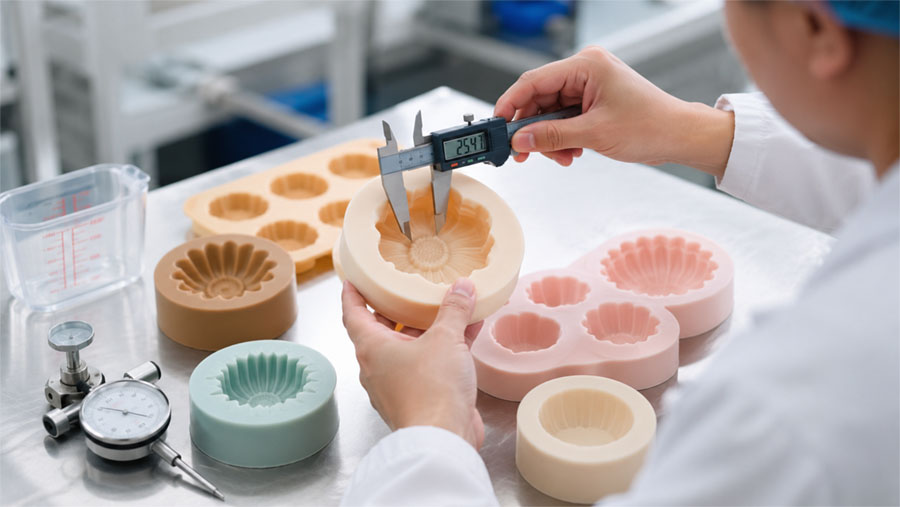
Technician measuring silicone mold cavity size wall thickness and structure with digital calipers

After the shape is confirmed, we define the technical structure of the mold. The goal is to balance flexibility, support, easy release and long-term durability, so the mold is not only attractive but also practical for filling, moving, demolding, cleaning and repeated use.

Available options include:

  • Custom cavity dimensions
  • Target cavity volume
  • Mold thickness
  • Wall thickness adjustment
  • Rim reinforcement
  • Draft angle for easier release
  • Flexible or firmer structure
  • Stackable or lid-compatible structure when required

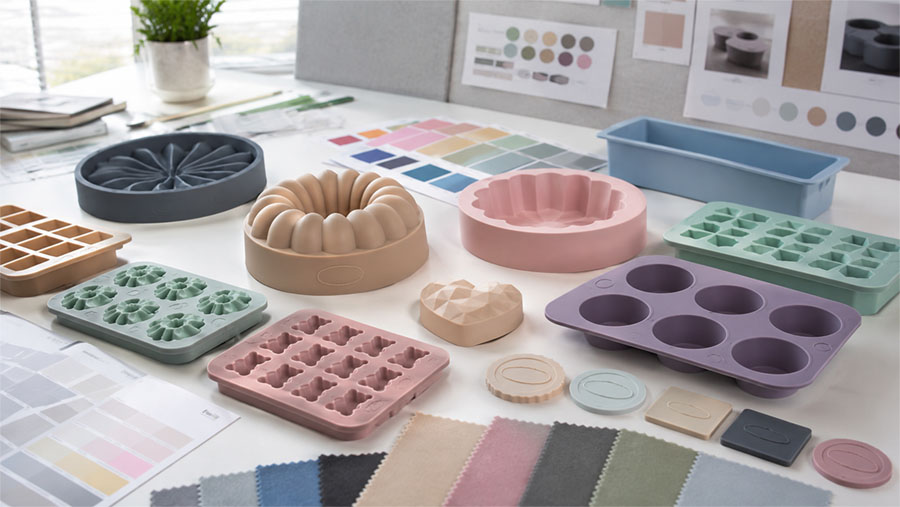
Silicone mold color surface finish and logo branding samples with color swatches

Color and surface details affect how the product looks on shelf, how it fits your brand system and how the finished mold feels in the user’s hand. Branding can be built into the mold or added to non-contact areas, depending on the logo design, durability requirement and food-contact position.

Available options include:

  • Standard silicone colors
  • Custom Pantone color matching
  • Glossy surface finish
  • Matte surface finish
  • Fine molded texture
  • Embossed logos
  • Debossed logos
  • In-cavity logos
  • Pad printing or screen printing on suitable non-contact areas

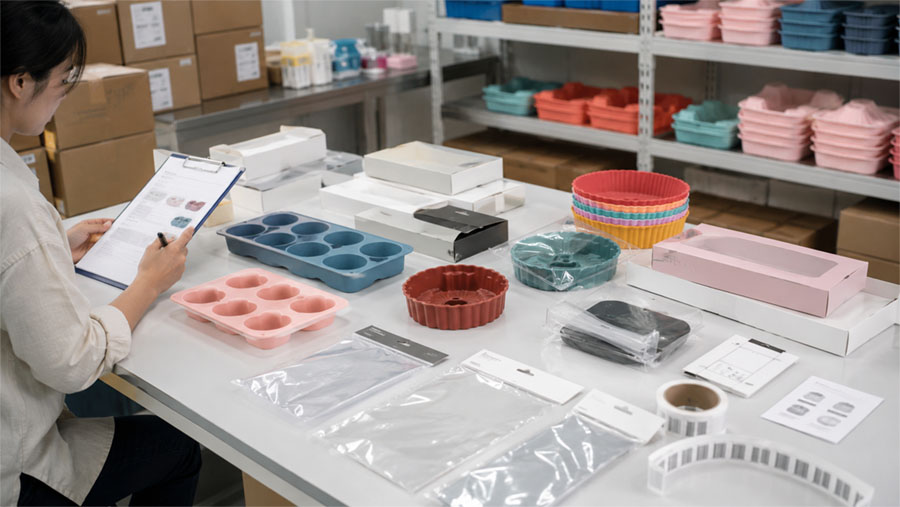
Custom silicone molds prepared with retail packaging barcode labels and shipping cartons

Packaging should be planned before mass production because printed bags, header cards, boxes, barcode labels and inserts may need their own artwork approval and production lead time. We match the packaging plan to your sales channel, order quantity, SKU structure and destination market.

Available options include:

  • Bulk packaging
  • Individual OPP or PE bags
  • Header cards
  • Blister packs
  • Printed paper boxes
  • Barcode and SKU labels
  • Recipe cards or instruction inserts
  • Ecommerce-ready packaging
  • Premium retail gift packaging

Start Your Custom Silicone Mold Project

Send your quantity, mold type, logo artwork and packaging requirements. RY Silicone will review the project and recommend a suitable mold, material, branding method and production plan.

How to Specify a Better Silicone Mold

Clean release and durability come from getting a few things right together, all confirmed on an approved sample:

  • Hardness — commonly 30–60 Shore A, matched to the product
  • Draft angle — enough taper for the item to release cleanly
  • Wall thickness — thin enough to flex, thick enough to hold shape
  • Rim stability — a stable rim that survives repeated filling and flexing
  • Cavity detail — resolution matched to your design
  • Surface finish — glossy or matte, suited to the item

A thicker or harder mold is not automatically better.


Full specification guide

How to Specify a Better Silicone Mold — hardness ranges, draft angle, wall thickness, cavity detail, food-grade materials and a complete specification checklist.

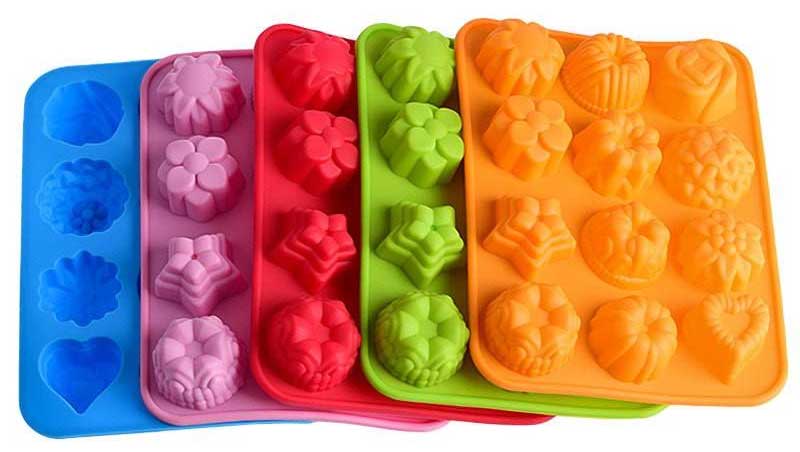
Bear and Heart Chocolate Silicone Mold5

Silicone Mold Logo and Branding Methods

Choose the branding method that fits the logo, surface and tooling plan.

Screen Printing

Strong, clean coverage for simple one- or two-color logos in bulk orders.

Pad Printing

Prints small or curved areas that flat screen printing cannot easily reach.

In-Cavity Logos

A logo built into the cavity so the brand or shape appears on the finished chocolate, candy or ice.

Embossed & Debossed

A raised, ink-free brand mark formed in the mold for a premium look.

Silicone Mold Material and Performance Options

We match the compound, curing system, pigment and documentation to the project.

Best for chocolate, candy, cake, ice and other food-contact molds.

Platinum-cured food-grade silicone is the standard choice for food molds. Any food-grade claim should be supported by the selected material and production controls.

Material comparison

Silicone vs Latex: Which Is Best? — durability, fit, waterproofing, allergies, price and which material to choose.

Allows the same mold to move between freezer and oven.

Food-grade silicone performs from -40°C to 230°C, so one mold covers freezing, refrigeration and baking without turning brittle or losing shape. The exact ceiling follows the chosen compound and wall thickness.

Reduces breakage and speeds up production.

A flexible mold lets the finished item pop out without cracking, so hardness, draft angle and cavity detail work together for the intended product. As a selection guide, a softer, lower-hardness silicone (around 30–40 Shore A) suits detailed chocolate, candy and soap molds where fine features must release intact, while a firmer compound (around 50–60 Shore A) holds its shape better for ice trays, large cake molds and multi-cavity trays that are filled, moved and stacked.

Keeps cavities accurate over repeated use.

Thin rims and fine details are where molds fail first, so we match the material, wall thickness and rim structure to how often the mold will be filled, flexed and stacked.

A fast screen for filler or curing problems.

A strong chemical odor or oily residue may indicate issues with fillers, curing or material selection. Visual and sensory screening can flag obvious risks, although laboratory testing is required for formal compliance claims.

Available documents may include:

  • Material data sheets
  • Material declarations
  • FDA-related documentation
  • LFGB-related documentation
  • REACH-related reports
  • Project-specific test reports

The scope must match the selected silicone, pigment, printing ink and intended market.

A raw-material report should not be presented as proof for every finished product configuration.

Silicone molds last longer when washed after each use, dried fully, kept away from sharp utensils, and stored flat and dry.

Care guide

How to Clean & Care for Silicone Molds — cleaning steps, odor and residue fixes, drying, storage and stain prevention.

How Custom Silicone Molds Are Manufactured

1. Requirement Review

STEP 1: Requirement Review

Every project begins by confirming the mold type, target market, order quantity, dimensions, cavity count, hardness, color, branding method, packaging and requested documentation.
2. Mold Evaluation

STEP 2: Mold Evaluation

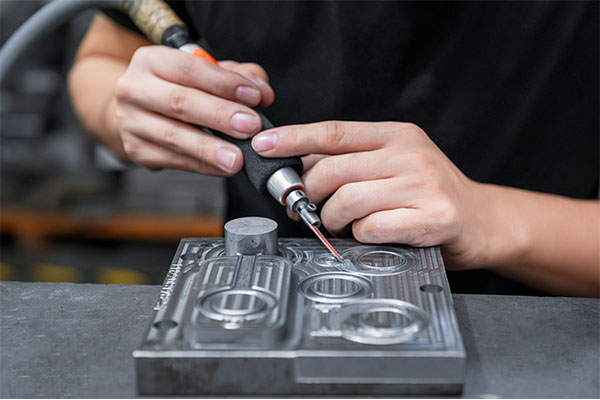
Our team checks whether an existing mold is suitable.Custom shapes, new cavity layouts, molded branding and structural changes may require new tooling.
3. Material and Color Preparation

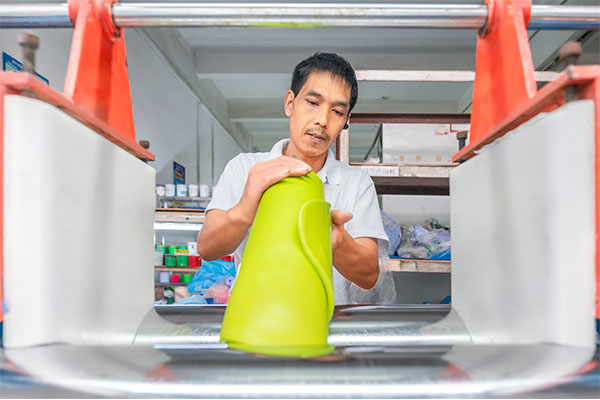
STEP 3: Material and Color Preparation

The approved food-grade silicone compound is then blended with the confirmed pigment to the agreed formulation.
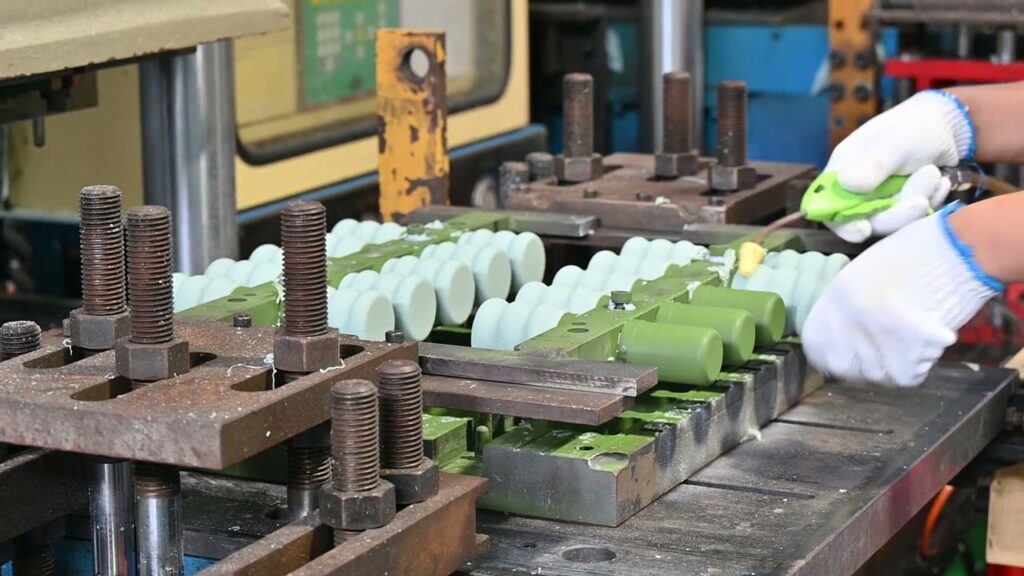
4. Silicone Molding

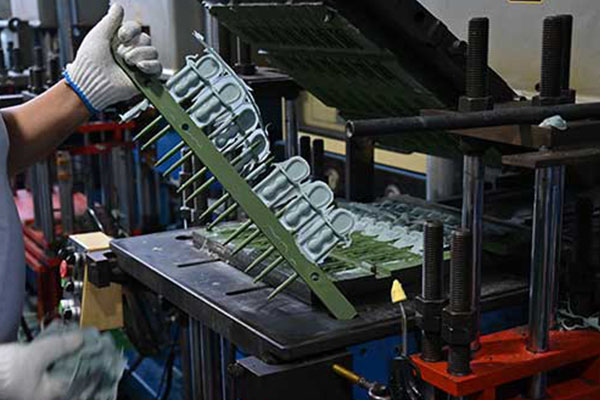
STEP 4: Silicone Molding

The compound is molded using the approved compression-molding or liquid-silicone process.The right process is chosen to match cavity structure, material, tooling and production volume.

5. Demolding and Trimming

STEP 5: Demolding and Trimming

Once cured, each product is demolded and trimmed, then the cavities and rim are checked for damage or irregular edges.
6. Logo and Surface Processing

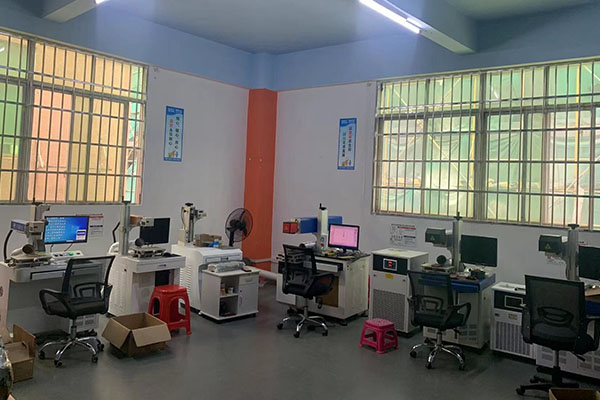
STEP 6: Logo and Surface Processing

Embossing, debossing, printing and other surface treatments follow the approved artwork and positioning standard.
7. Quality Inspection

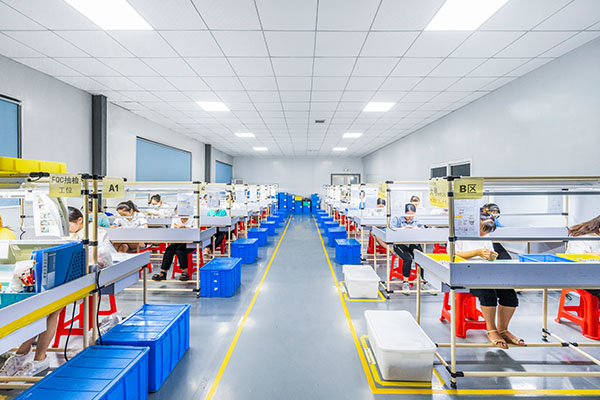
STEP 7: Quality Inspection

Our QC team checks the finished mold against the approved sample, specification and purchase order.
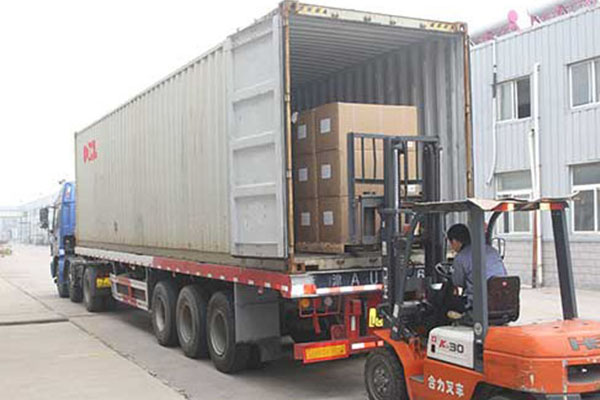
8. Packaging and Shipment

STEP 8: Packaging and Shipment

Finally, the molds are counted, packed, labeled and carton-marked, then prepared for the agreed shipping method.
Silicone Mold Quality Control

Quality control is not limited to checking the silicone material. You also need consistent color, stable cavity dimensions, clean surfaces, accurate branding and dependable packaging.

AQL 2.5 / 4.0 Standard Inspection

We run final random sampling plans to verify batch consistency:

AQL 2.5

Critical / Major Defects

AQL 4.0

Minor Visual Flaws

Another inspection standard can be used when specified in the purchase order.

The approved sample becomes the reference for:

  • Shape
  • Color
  • Weight
  • Surface finish
  • Logo position
  • Printing quality
  • Packaging presentation

Silicone compounds, pigments and relevant supplier documents are checked against the confirmed project requirements.

Operators review molding completeness, rim condition, visible color variation and surface defects during production.

Products are checked for:

  • Tears
  • Contamination
  • Severe bubbles
  • Incomplete molding
  • Surface damage
  • Irregular edges

Dimensions and weight are checked against the approved specification.

A standard 56 g design may use a target tolerance of ±1 g when confirmed during sampling.

Production colors are compared with the approved sample under controlled viewing conditions.

The inspection covers:

  • Position
  • Size
  • Edge definition
  • Color coverage
  • Missing ink
  • Blurred printing
  • Visible adhesion problems

Stretch and recovery can be reviewed using an agreed internal method or customer test protocol.

Product quantity, labels, barcodes, inserts, bags, boxes and carton marks are verified before shipment.

Silicone Mold Packaging Options

Plan packaging early because printed items need separate schedules.

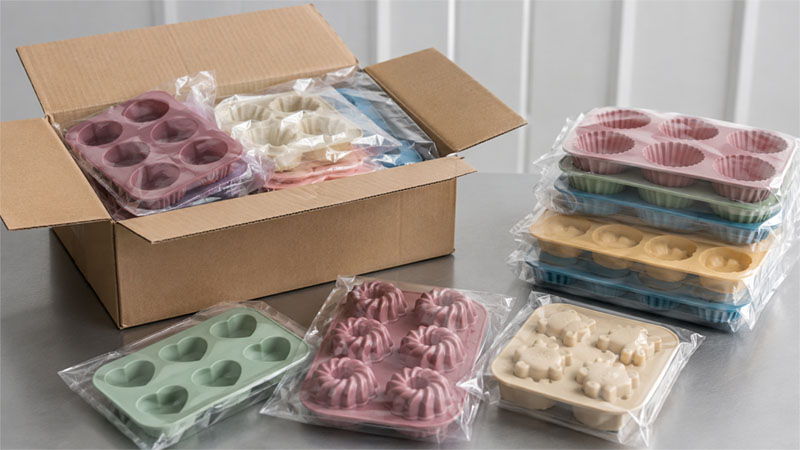
Silicone molds in pastel packaging

Bulk Packaging

Simple individual bags or multi-piece packaging help control cost for distributors, professional users and promotional distribution.
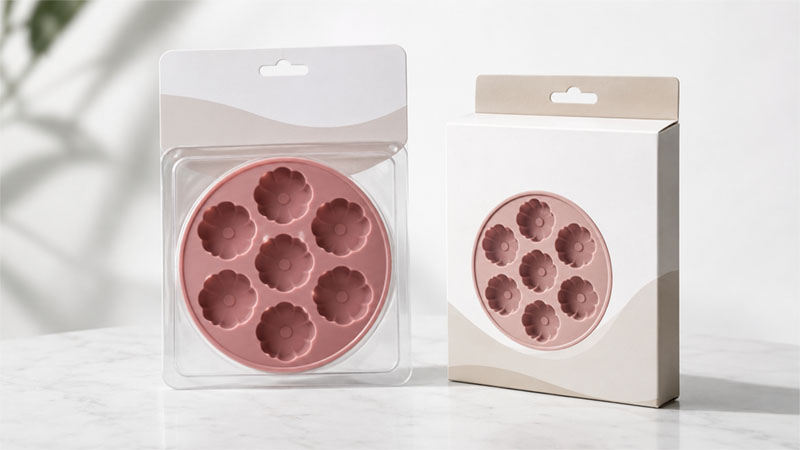
Minimalist baking mold display

Retail Packaging

Header cards, blister packs, reusable bags and printed paper boxes provide space for branding, recipes and barcode information.
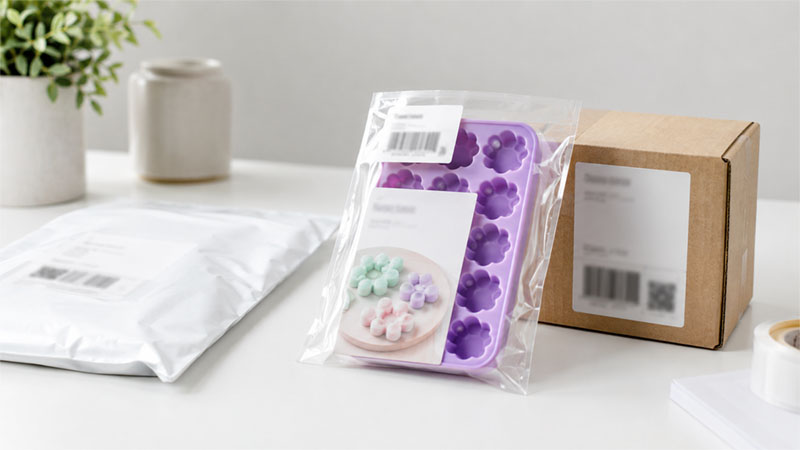
Ecommerce product prep setup

Ecommerce Packaging

We prepare SKU labels, scannable barcodes, product inserts and marketplace-specific outer labels according to your packaging file.

Minimalist baking essentials in soft hues

Premium Brand Packaging

Custom boxes, printed sleeves, recipe inserts and coordinated brand presentation can support higher-value retail products.

Typical Custom Silicone Mold Specifications

SpecificationTypical Reference
ProductCustom silicone mold
ApplicationsChocolate, candy, cake, ice, soap, candle, resin and craft molds
MaterialFood-grade platinum- or peroxide-cured silicone
Hardness range30–60 Shore A
Temperature range-40°C to 230°C, depending on compound
Cavity layoutSingle or multi-cavity, custom grid arrangements
ColorsStandard colors or custom Pantone matching
SurfaceGlossy, matte or fine molded texture
Logo methodsEmbossed, debossed, in-cavity, pad or screen printing
Molding processCompression molding or an approved liquid-silicone process
Product typesChocolate, candy, cake, ice, soap and custom-shaped molds
PackagingOPP bag, PE bag, header card, blister, paper box or custom retail packaging
Existing-style order quantityFrom 500 pieces for existing-mold branding
Custom-molded order quantityFrom 3,000 pieces
Standard sample lead time5–10 working days
Custom mold lead time10–20 working days
Mass-production lead time15–25 working days after approval
InspectionApproved sample plus agreed AQL or customer inspection standard
OEM and ODMAvailable

Final specifications are confirmed according to the selected mold, material, artwork and approved sample.

Why Work with RY Silicone

RuiYang Silicone factory

Silicone Manufacturing Experience Since 2012

RY Silicone is a China-based factory that has focused on custom silicone product manufacturing since 2012.

We support overseas clients from product evaluation and sampling through bulk production, inspection and delivery.

Video Image1

10,000+ m² Production Facility

Our in-house silicone mold factory supports tooling, molding, finishing, branding, inspection and packaging.

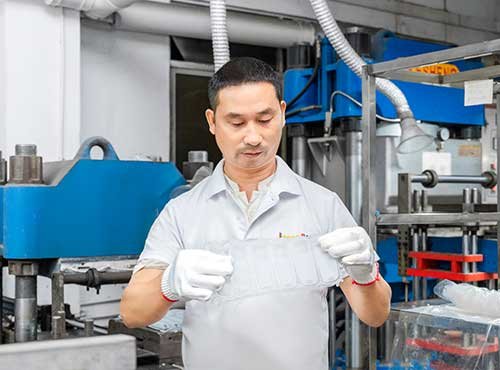
silicone machine

30+ Production Machines

Multiple production machines support different silicone mold structures and scalable order volumes.

ruiyang silicone compression mol

Up to 100,000 Silicone Products per Day

That headroom is what lets us take on repeat orders and five- to six-figure runs without pushing out your delivery date.

Actual mold capacity depends on cavity configuration, cycle time and inspection requirements.

silicone Products Design

Engineering Review Before Quotation

We do not quote only from a product name or image.

Instead, our engineers walk through the mold shape and cavity count, then the material, dimensions, color, logo and packaging — and we check the destination market too, since a mold headed for the EU and one headed for the US can call for different documentation. Only then do we confirm the manufacturing proposal.

Rysilicone quality control

Sample-Based Production

Everything is locked to one approved sample before mass production — the cavity dimensions and color first, then surface finish, logo position and packaging. On the floor that sample outranks any spec sheet: if the two disagree, we pause the run and confirm with you.

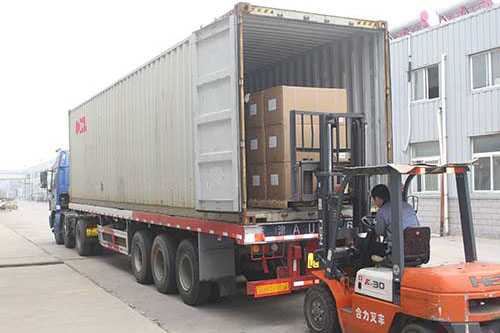
Shipping

Export Project Support

As a China-based silicone mold factory and supplier, RY Silicone serves clients in North America, Europe and other international markets.

Our team supports product documentation, commercial communication, packaging coordination and shipment preparation.

Silicone Mold FAQ and Final RFQ

The MOQ is from 500 pieces for an existing mold shape with custom branding, and from 3,000 pieces for a new custom-molded design. The exact minimum depends on the shape, cavity count, color and packaging required. If 3,000 feels high for a first custom run, we can sometimes split it — a smaller first batch to test sell-through, the balance once the design proves out — as long as the combined order covers the tooling cost.

Yes.

Many clients begin with an existing shape to test the market, reduce tooling investment and confirm product positioning.

A custom mold can be developed later when a unique shape, cavity layout or molded logo is required.

Yes.

We offer food-grade platinum-cured silicone for chocolate, candy, cake and ice molds. The applicable documentation depends on the selected material, pigment and destination market.

Yes.

Provide the Pantone reference and approve a physical color sample before mass production.

Thickness and surface finish may affect the way the final color appears.

A new tool is usually required for:

  • Unique shapes
  • Custom cavity dimensions
  • New cavity layouts
  • Molded-in logos
  • Special textures
  • Portion or volume changes

AI, EPS, SVG or vector PDF files are preferred.

The artwork should include the required logo size, depth or color, position and Pantone reference.

Embossed and debossed molded logos provide permanent, ink-free branding.

In-cavity logos transfer the brand or shape onto the finished item.

Pad and screen printing suit small logos on non-contact areas.

The best option depends on the artwork, appearance, durability requirement and tooling plan.

Yes.

We can review existing shapes or discuss custom tooling according to the intended product, required dimensions and product positioning.

A well-designed mold with the right hardness and draft angle releases most products cleanly.

It should not be marketed as guaranteeing perfect release for every recipe because the result also depends on the material poured, temperature and handling.

Available reports depend on the selected silicone, pigment, printing ink and destination market.

Please provide the exact standard or document requirement so that we can confirm whether an existing report is suitable.

Please provide:

  • Target order quantity
  • Mold type and application
  • Reference dimensions, cavity count or physical sample
  • Target hardness or wall thickness
  • Pantone color
  • Logo artwork
  • Branding position
  • Packaging requirements
  • Destination country
  • Required reports or tests
  • Target delivery date

Ask For A Quick Quote

If you fail to submit the form, please write to us directly at [email protected]