Silicone mold safety and regulations are often reduced to a list of logos: FDA, LFGB, REACH, RoHS, or ISO 10993. That approach is unreliable because these references do not cover the same product, market, or risk.
A silicone mold is safe only when its formulation, finished-part processing, intended contact conditions, and compliance evidence match the actual application and destination market. A raw-material certificate alone does not establish finished-product compliance.
The first question is not “Is this silicone certified?” It is: what will the mold contact, at what temperature, for how long, and in which market will it be sold?
What Makes a Silicone Mold Safe?
A safe mold must remain suitable under its declared conditions of use. That includes the food type, contact duration, temperature, cleaning cycle, and expected number of uses.
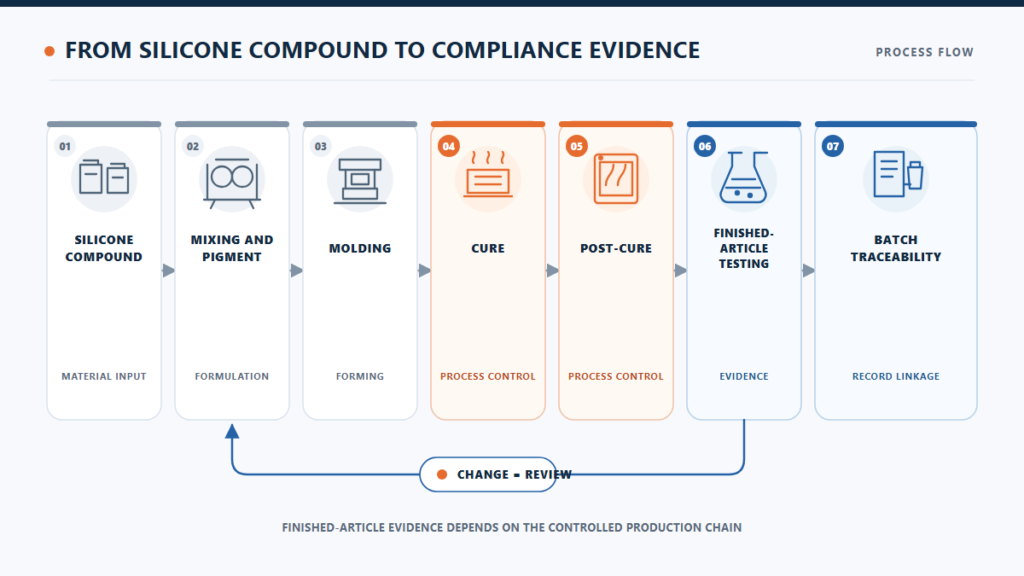
Four controls matter:
- Formulation: Base polymer, catalyst, pigment, filler, processing aid, and other additives must fit the intended use.
- Conversion: Mixing, molding, curing, and any required post-curing must be controlled.
- Finished-article testing: The molded article—not only the raw compound—must meet the applicable extractables, migration, biological, or restricted-substance requirements.
- Traceability: Batch records must connect the finished mold to its material lot, production parameters, inspection results, and test report.
“100% silicone,” “platinum cured,” and “food grade” do not replace this evidence. Platinum curing can reduce peroxide-related by-products, but the curing system alone does not prove compliance.
Which Silicone Mold Safety and Regulations Apply?
The applicable framework depends on intended use. A baking mold, a silicone tool used to cast a medical component, and an industrial production mold do not follow one universal standard.
| Intended use | Main regulatory or technical references | What the evidence should cover |
|---|---|---|
| Repeated food contact in the United States | 21 CFR 177.2600 | Permitted formulation ingredients, intended food type, extractables, and repeated-use conditions |
| Food contact in the European Union | Regulation (EC) No 1935/2004 and Regulation (EC) No 2023/2006 | General safety, organoleptic suitability, GMP, traceability, and applicable national requirements |
| Food contact in Germany | German LFGB plus BfR Recommendation XV as a technical reference | Silicone formulation, volatile components, migration or extraction, and sensory requirements under the intended use |
| Medical-device contact | ISO 10993 series and the device-market regulatory route | Biological evaluation based on body-contact type, contact duration, finished device, and risk management |
| General products sold in the EU | REACH; RoHS only where the product is within electrical/electronic equipment scope | Restricted substances, SVHC communication duties, and material declarations appropriate to the product |

These references are not interchangeable. REACH is not a food-contact approval. RoHS is not a general silicone safety certificate. ISO 10993 does not certify every product made from a tested medical-grade compound.
Does FDA 21 CFR 177.2600 Cover Silicone Baking Molds?
It can apply to rubber articles intended for repeated food contact, including appropriately formulated silicone articles. It controls permitted ingredients and sets extractives requirements for repeated-use rubber articles.
The compliance question must still specify the contact medium. A report covering aqueous food does not automatically cover repeated contact with fatty food. The test conditions and extraction limits differ.
A buyer should check:
- whether the tested sample was raw material or the finished molded article;
- whether testing covered aqueous and/or fatty-food conditions;
- the tested color and formulation;
- whether curing and post-curing matched mass production;
- the report date, laboratory, method, and sample identification.
A supplier statement that says only “FDA approved silicone” is too vague. FDA generally does not issue a product approval certificate for an individual baking mold under this section. The useful evidence is a documented compliance assessment against the applicable requirements.
What Do EU 1935/2004 and LFGB Require for Silicone Molds?
Regulation (EC) No 1935/2004 provides the EU-wide framework. Under normal or foreseeable use, a food-contact article must not transfer constituents to food at levels that endanger health, cause an unacceptable change in food composition, or impair taste and odor.
Regulation (EC) No 2023/2006 adds good manufacturing practice requirements. In production, this means controlled formulations, documented instructions, quality-control procedures, and records that can support traceability.
There is no fully harmonized EU-specific measure for silicone comparable to the plastics regulation. Regulation (EU) No 10/2011 is written for plastic materials and should not be presented as the universal legal standard for silicone elastomer bakeware. National rules and recognized technical recommendations may also be relevant.
For Germany, LFGB is the legal framework, while BfR Recommendation XV provides detailed technical guidance for silicones. Calling a product “LFGB certified” can hide important details. The test report should identify the exact recommendation, test conditions, simulants, repeat exposures, volatile-component assessment, and sensory testing where applicable.
The common online claim that LFGB requires “zero migration” is incorrect. Compliance is determined against defined requirements and test limits, not an absolute promise that no substance can ever be detected.
Is a Pinch or “Biting” Test Valid Compliance Evidence?
No. Whitening when silicone is pinched, stretched, or twisted is not a regulatory test for purity, fillers, migration, or food-contact compliance.
Color change under strain can result from light scattering, pigment behavior, fillers, and the geometry of the part. A product that does not whiten can still fail migration or volatile-component testing. A product that does whiten is not automatically unsafe.
Procurement teams should reject this shortcut. Use accredited laboratory reports tied to a defined sample and production specification.
Why Do Curing and Post-Curing Affect Safety?
Curing creates the crosslinked elastomer network. Post-curing, when required by the compound supplier or application, can reduce volatile residues and curing by-products and stabilize the material before testing or use.
The correct cycle is formulation-specific. “200°C for four hours” is a common production reference for some silicone compounds, but it is not a universal recipe. Part thickness, oven airflow, loading density, pigment, catalyst system, and supplier instructions can change the required process.
This is where teams often misjudge compliance. They qualify a laboratory plaque or a lightly loaded trial oven, then change the mass-production cycle. Thick sections heat more slowly. Closely packed parts restrict airflow. A shortened cycle can leave a finished mold with higher volatiles or odor even though the incoming compound certificate remains unchanged.
The control plan should record:
- material and pigment lot numbers;
- mix ratio and mixing time where applicable;
- cure temperature and time;
- post-cure oven temperature, exposure time, airflow, and loading pattern;
- cleaning and conditioning before testing;
- any change to formulation, color, thickness, or process.
Does Heat Resistance Prove a Silicone Mold Is Food-Safe?
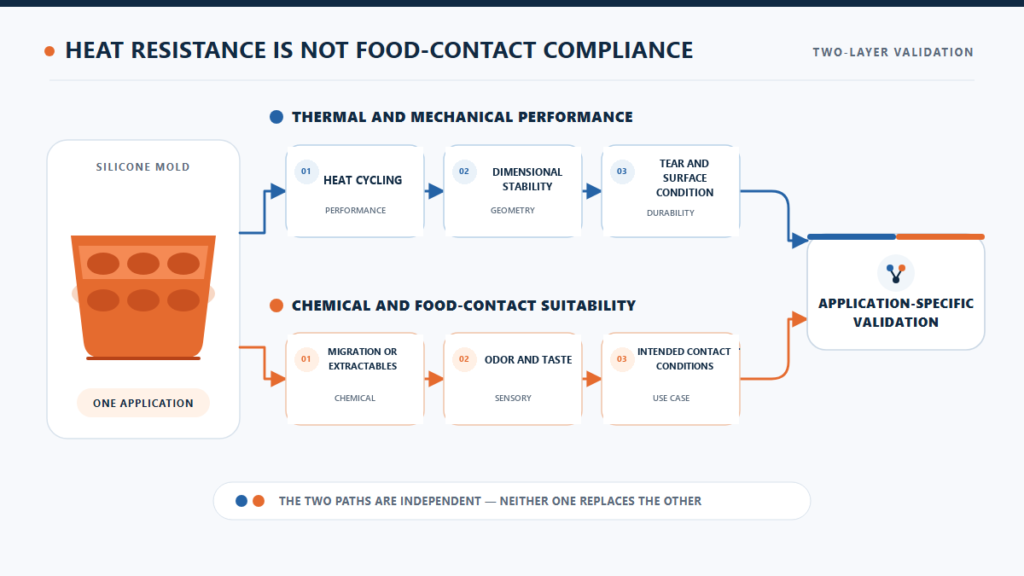
No. Thermal resistance and food-contact compliance answer different questions.
A compound may retain shape at an elevated temperature yet still be unsuitable for a specific food-contact condition. The declared service-temperature range must come from the exact material supplier and should be validated on the finished design.
Thin ribs, sharp internal corners, and highly stretched areas can age faster than a standard test slab. Repeated oven and dishwasher cycles can also change tear strength, surface condition, and dimensional stability. Safety review therefore needs both chemical-compliance evidence and performance testing under the intended cycle.
| Validation area | Typical question | Suitable evidence |
|---|---|---|
| Chemical suitability | Can constituents transfer under the declared food and temperature conditions? | Migration or extractables report |
| Thermal performance | Does the mold retain dimensions and mechanical properties after repeated heat cycles? | Heat-aging and dimensional test data |
| Mechanical durability | Do corners, gates, or thin sections tear after repeated demolding? | Cycle testing and tear inspection |
| Sensory suitability | Does the article affect food odor or taste? | Organoleptic test report where required |
| Cleaning durability | Does repeated washing change the surface or create residue traps? | Dishwasher or cleaning-cycle validation |
Do ISO 10993 and USP Class VI Make a Silicone Mold Medical-Grade?
Not by themselves. ISO 10993 is a biological-evaluation framework for medical devices. The required evaluation depends on the nature and duration of body contact and must be integrated into device risk management.
As of 2026, ISO 10993-1:2025 is the current edition, replacing the 2018 edition. A legacy report should be reviewed for relevance rather than accepted by name alone.
USP Class VI addresses defined biological-reactivity tests for materials. It can support material selection, but it does not replace the finished device’s biological evaluation, chemical characterization, sterilization validation, or market-specific submission requirements.
The distinction is especially important when “silicone mold” means production tooling used to cast another medical material. In that case, the risk assessment must consider whether substances can transfer from the mold surface, release agent, cleaning process, or prior casting cycle into the finished medical component. A certificate for the mold rubber does not automatically establish compliance of the cast device.
When Do REACH and RoHS Apply?
REACH can affect silicone articles placed on the EU market through restrictions, Candidate List obligations, and supply-chain communication. It should be checked against the current product composition and the current ECHA lists. A generic statement issued years ago may no longer cover the latest Candidate List.
RoHS has a narrower scope. It restricts specified hazardous substances in electrical and electronic equipment. A silicone keypad, seal, or molded component used in in-scope equipment may require RoHS evidence. A standalone baking mold does not become safer for food contact because it has a RoHS report.
For industrial molds, additional requirements may come from the cast material, workplace exposure, flammability, customer specifications, or the regulated end product. “Industrial grade” is a use description, not a single regulatory class.
What Should Buyers Request From a Silicone Mold Supplier?
The evidence package should match the finished article and its intended use.
| Document or record | What to verify |
|---|---|
| Material technical data sheet | Exact grade, cure system, service conditions, and processing instructions |
| Supplier declaration | Regulation, revision, restricted substances, and applicable market |
| Finished-product test report | Sample identity, color, test method, simulant, temperature, duration, and result |
| Bill of materials | Base compound, pigment, additives, inserts, coatings, and release agents |
| Batch traceability | Link between finished goods, material lots, production date, and process records |
| Cure and post-cure record | Actual time, temperature, airflow, and load configuration |
| Change-control procedure | Retesting triggers after material, color, supplier, tooling, or process changes |
Three checks expose most weak files:
- Does the report identify the exact article or only a generic silicone grade?
- Do the test conditions match the actual food, temperature, contact time, and reuse cycle?
- Can the supplier connect the shipped batch to the tested formulation and controlled process?

If any answer is missing, the compliance claim is incomplete.
Common Compliance Mistakes
Accepting a Raw-Material Certificate as Finished-Product Proof
Pigments, additives, release agents, contamination, and curing conditions can alter the finished article. Material documentation is the starting point, not the full file.

Using One Report for Every Color
A new pigment masterbatch can introduce different substances or change migration behavior. Color families should be covered by a justified worst-case plan or separate testing.
Treating One Market’s Test as Global Approval
A U.S. 21 CFR 177.2600 report does not automatically establish EU or German compliance. The legal basis and test design differ.
Ignoring Intended Use
Frozen-water contact, repeated baking with fatty food, confectionery casting, and medical-device processing expose the mold differently. The test plan must follow the most severe foreseeable declared use.
Frequently Asked Questions
Is all platinum-cured silicone food-safe?
No. Platinum curing describes the crosslinking system. Food-contact suitability still depends on the complete formulation, processing, intended conditions, and applicable test evidence.
Can the same silicone mold be used for food and resin casting?
It should not return to food use after contact with resin, release agents, pigments, or other non-food materials. Cross-contamination and absorbed residues cannot be ruled out through normal washing alone.
How often should compliance testing be repeated?
There is no universal interval. Retesting should be triggered by changes to material grade, supplier, pigment, additives, tooling, cure cycle, intended use, regulatory requirements, or evidence that production no longer matches the qualified sample.
Define the Use Before Requesting a Quote
A supplier cannot specify a defensible compliance route from the words “food-grade silicone mold” alone. The request should state the destination market, food or body-contact type, maximum temperature, contact duration, repeated-use cycle, cleaning method, color range, and required documentation.
Those inputs determine the compound, cure process, test plan, and cost. Without them, a certificate list is only paperwork—not proof that the finished mold is safe for its intended use.