Silicone usually survives the dishwasher. The more common problems are poor loading, trapped water, detergent film, and non-silicone components.
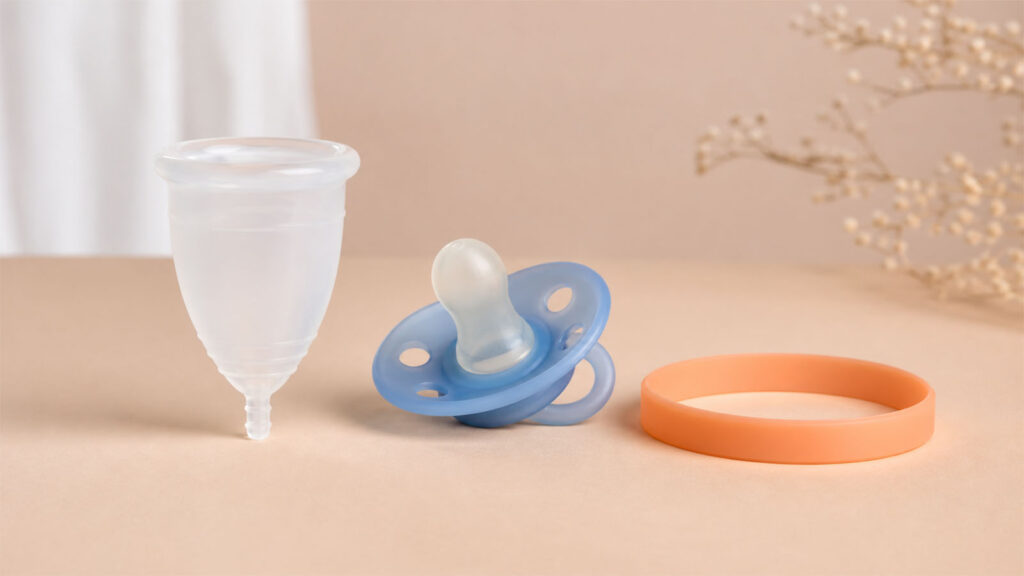
Yes. Most one-piece silicone kitchenware can go in the dishwasher, including molds, mats, spatulas, lids, and baby feeding items marked dishwasher-safe. Place light or flexible parts securely on the upper rack, keep them away from exposed heating elements, and hand-wash products with wood, adhesive joints, electronics, or delicate printing.
This guide deals only with dishwasher use: loading, cycle choice, detergent residue, odor, and repeated-wash validation. For oven, microwave, air-fryer, and general food-contact limits, see Is Silicone Safe in the Kitchen?.
Can Silicone Go in the Dishwasher on Any Cycle?
For a one-piece product made from properly cured silicone, a normal residential cycle is not a difficult thermal condition. Even an NSF/ANSI 184 sanitizing cycle reaches a final rinse temperature of 150°F / 65.6°C, according to NSF. That is far below the temperature range normally used for silicone bakeware.
The cycle name is not the main decision. Product construction is.
| Silicone item | Dishwasher? | Loading position | Main limitation |
|---|---|---|---|
| One-piece spatula or spoon | Yes | Upper rack or utensil basket | Secure thin handles so they cannot drop through |
| Silicone baking mold | Yes | Upper rack, open side downward or angled | Do not fold tightly or nest with another mold |
| Silicone baking mat | Usually | Upper rack, loosely curved | Do not block the spray arm or let the mat touch a heater |
| Silicone lid or stretch cover | Yes | Upper rack, held between rack tines | Prevent pooling and contact with sharp objects |
| Baby plate, bowl, or bib | Yes, if labeled | Upper rack | Open all folds and separate removable parts |
| Bottle nipple, valve, or straw | Yes, if labeled | Closed small-parts basket | Small channels may need pre-rinsing |
| Silicone tool with stainless core | Usually | Follow product label | Water can remain inside a damaged seal |
| Silicone tool with wood handle | Usually no | Hand-wash | Wood swelling and joint damage set the limit |
| Printed or bonded silicone part | Check label | Upper rack if approved | Ink, adhesive, or coating may fail before the silicone |
| Unknown rubber-like product | Do not assume | Check material and care mark | TPE, PVC, and silicone are not interchangeable |
A “dishwasher-safe” claim applies to the finished article, not just the silicone compound. A silicone head may tolerate the cycle while its adhesive, decoration, metal insert, valve, or handle does not.
Should Silicone Go on the Top or Bottom Rack?
Use the upper rack as the default. This is mainly a loading precaution, not a claim that dishwasher water is too hot for silicone.
Flexible items can sag through wide rack openings. Lightweight lids can turn over under spray pressure. Large mats can move far enough to interfere with a spray arm. In dishwashers with an exposed bottom heating element, a loose edge may also contact a much hotter surface than the circulating water.
Use the bottom rack only when all three conditions are met:
- The product manufacturer permits it.
- The part is heavy or rigid enough to stay in position.
- No edge can reach the heater or obstruct the spray arm.
Whirlpool notes that there is no single industry definition of “dishwasher safe”; manufacturers determine suitability for their own products and normally mark the article accordingly. Its general care guide also lists silicone utensils as dishwasher-safe but still tells users to follow the product instructions: What Is and Isn’t Dishwasher Safe?.
How Should Silicone Molds, Mats, and Lids Be Loaded?
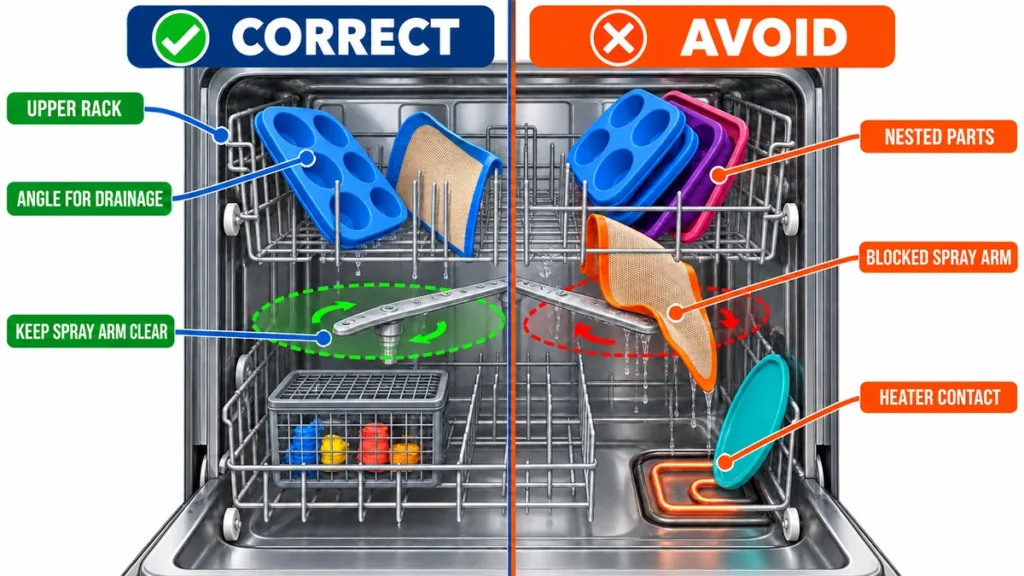
Water must reach the food-contact surface and then drain away. That sounds basic, but flexible geometry makes it easy to create folds and pockets that a rigid plate does not have. Frigidaire’s loading guidance gives the same operating rule: face open items downward and keep the spray arm clear.
Silicone molds
Place the cavity side downward at a slight angle. A completely flat position can trap water in deep cavities, while a loosely angled position exposes the surface to the spray and allows drainage. Do not stack two molds together. Nested cavities shield grease and batter residue from both detergent and rinse water.
Silicone baking mats
A mat should be loosely curved between rack tines, not rolled tightly. Check that the lower spray arm rotates freely before starting the machine. If the mat is too large to secure without blocking the rack or spray arm, hand-washing is the more reliable option.
Silicone lids and stretch covers
Stand them vertically between rack tines or secure them in the upper rack. Do not leave a thin lid flat over cups or bowls; it can behave like a cover and prevent those items from washing properly.
Valves, nipples, straws, and small parts
Separate removable components. Put them in a closed dishwasher basket. Narrow channels still need a visual check after the cycle because spray access, not material resistance, determines whether they are clean.
Why Does Silicone Smell or Taste Like Dishwasher Detergent?
A soapy smell after washing usually points to detergent or fragrance remaining on the surface, often together with a thin grease film. It does not automatically mean the silicone has melted or become unsafe.
Silicone is hydrophobic. Cooking oils spread easily over its surface, and scented compounds can remain with that film. Repeated washing does not fix the problem if the detergent dose is too high, the items are nested, the filter is dirty, or the rinse cannot reach the full surface.

| Symptom after washing | Likely cause | Corrective action |
|---|---|---|
| Strong perfume smell | Highly scented detergent or excessive dose | Switch to an unscented detergent and follow the machine’s dose guidance |
| Bitter or soapy taste | Incomplete rinse or detergent film | Rewash without detergent and use an extra rinse |
| Greasy feel | Oil film remained on the surface | Wash separately with hot water and a grease-cutting dish soap, then rinse fully |
| Odor only in folds or cavities | Poor spray access or trapped water | Open the part, change its loading angle, and dry it completely |
| Odor affects the whole load | Dishwasher filter, drain, or interior needs cleaning | Clean the machine according to its manual before blaming the silicone |
| Odor returns immediately after contact with food | Existing oil or aroma has migrated back to the surface | Hand-wash and air-dry; replace the part if the odor remains unacceptable |
Do not add vinegar, bleach, or another cleaner directly to a cycle that already contains dishwasher detergent. The CDC warns against mixing household bleach or disinfectants with other cleaners because the combination can release dangerous vapors. Start with detergent dose, loading, filter condition, and an extra water-only rinse. For routine washing methods and stain-removal steps, see how to clean silicone products. If odor remains after the surface is fully rinsed, use a separate protocol to remove smells from silicone kitchenware.
Does the Sanitize Cycle Damage Silicone?
A residential sanitize cycle should not damage a one-piece silicone item that is already approved for dishwasher use. NSF/ANSI 184 requires certified residential machines to achieve a 5-log bacterial reduction and a final rinse of 150°F / 65.6°C. The thermal load is modest for silicone.
The sanitize setting can still expose weaknesses elsewhere in the product:
- Printed measurement marks may fade.
- Bonded joints may lose adhesion.
- A hollow handle with a damaged seal may take in water.
- A thin part may deform temporarily if loaded under stress.
- Mixed-material products may be limited by plastic, wood, or coating rather than silicone.
This is why material heat resistance and finished-product dishwasher resistance are separate specifications.
When Should Silicone Be Hand-Washed Instead?

Hand-wash the item when the manufacturer says so or when the finished construction has a component that has not been validated for mechanical dishwashing.
The main exceptions are:
- Wood, bamboo, cork, or unsealed natural-fiber handles
- Adhesive-bonded decorations or inserts with no dishwasher claim
- Electronics, temperature sensors, or battery compartments
- Hand-painted markings and unverified surface printing
- Torn valves, split seams, exposed cores, or water-filled hollow handles
- Large flexible mats that cannot be secured without blocking the spray arm
- Industrial silicone parts not sold as food-contact kitchenware
Damage changes cleanability. A cut edge or separated joint can trap food and rinse water even when the silicone itself remains chemically stable. At that point, replacement is usually more reliable than continued cleaning.
Will Repeated Dishwasher Cycles Wear Out Silicone?
Repeated cycles should not make a validated silicone product melt, but “dishwasher-safe” should be supported by a cycle count rather than one successful wash. For the wider aging and replacement framework, see silicone product service-life evaluation in kitchen use.
For EU-facing products, the BS EN 12875 series provides reference methods for assessing the mechanical dishwashing resistance of domestic utensils. The test applies combined chemical, thermal, and mechanical stress, followed by inspection. Silicone and other non-metallic articles are within the inspection scope.
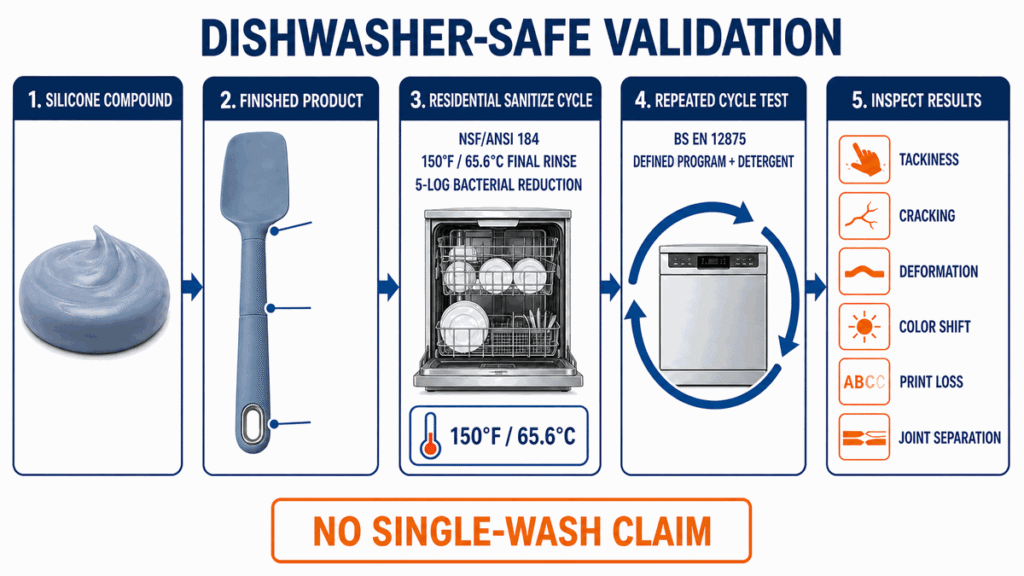
In product development, we separate three questions:
- Does the silicone compound remain stable?
- Does the complete product retain its shape, color, markings, and joints?
- Can the brand support its claimed number of dishwasher cycles?
A useful validation plan defines the dishwasher program, detergent, loading fixture, number of cycles, and acceptance criteria before testing. Typical inspection points include tackiness, cracking, permanent deformation, color shift, print loss, joint separation, and retained odor. Without those conditions, “tested in a dishwasher” is not a repeatable claim.
How Can You Tell When a Silicone Item Should Be Replaced?
Replace it when the finished product can no longer be cleaned or used as designed. Color change alone may be cosmetic; structural or surface change matters more.
Look for:
- Cuts or tears that open under bending
- A permanently sticky or powdery surface after proper cleaning
- Separation around a metal insert, handle, or bonded joint
- Water trapped inside a hollow component
- Distortion that prevents a lid, valve, or seal from working
- Printing that flakes from a food-contact surface
- Persistent detergent or food odor that affects the next use
Do not use the pinch test as proof of food safety or dishwasher resistance. Whitening under stretch can vary with pigment, filler, wall thickness, and surface texture. Supplier documentation and finished-product cycle testing provide better evidence.
Can Commercial Dishwashers Clean Silicone Products?
Sometimes, but a residential dishwasher claim does not automatically cover commercial warewashing.
Commercial machines use shorter, more aggressive cycles and may combine higher rinse temperatures with stronger chemical dosing. NSF distinguishes residential dishwashers under NSF/ANSI 184 from commercial warewashing equipment under NSF/ANSI 3. A product intended for restaurants, bakeries, hospitals, or central kitchens needs validation against the actual machine and chemical program.
For a B2B specification, record:
- Machine type and cycle duration
- Maximum wash and rinse temperature
- Detergent and sanitizer chemistry
- Expected cycles per day
- Required service life in cycles
- Pass/fail criteria for color, print, dimensions, joints, and odor
“Dishwasher-safe” is too broad for a food-service procurement document.
FAQ
Can silicone baking mats go in the dishwasher?
Usually yes, if the care label permits it. Secure silicone baking mats on the upper rack and make sure they cannot block a spray arm or touch an exposed heating element.
Can silicone baby plates go in the dishwasher?
Most one-piece silicone baby plates marked dishwasher-safe can go on the upper rack. Separate suction bases, valves, lids, and other removable parts so every surface receives wash and rinse water.
Can silicone go in the dishwasher with pots and pans?
Yes, but do not trap it beneath heavy cookware or place it where sharp edges can cut it. Flexible lids and mats also need enough space to drain and remain clear of the spray arms.
Why is silicone still greasy after the dishwasher?
The usual cause is an oil film combined with poor spray access, nesting, or incorrect detergent dosing. Rewash the item separately, expose all surfaces, and check the dishwasher filter and spray arms.
What a Dishwasher-Safe Silicone Specification Should State
For household use, the practical answer is simple: one-piece silicone can normally go in the dishwasher. The specification behind that answer should still identify the exceptions.
Before approving packaging copy or a care symbol, confirm:
- Finished-product construction, including inserts, inks, and adhesives
- Approved rack position and prohibited heater contact
- Domestic or commercial dishwasher scope
- Test method and completed cycle count
- Inspection limits for deformation, color, print, joints, and odor
If those details are missing, the claim describes the base material rather than the product the customer will actually wash.
References
- Dishwasher Certification — NSF, residential NSF/ANSI 184 and commercial NSF/ANSI 3 requirements.
- NSF/ANSI 184-2019: Residential Dishwashers — ANSI Webstore standard preview.
- BS EN 12875: Mechanical Dishwashing Resistance of Utensils — British Standards Institution.
- FprEN 12875-1 Reference Test Method — Hellenic Organization for Standardization; stage date July 5, 2026.
- Cleaning and Disinfecting with Bleach — CDC; reviewed April 24, 2024.
- Dangers of Mixing Bleach with Cleaners — Washington State Department of Health.
- Dishwasher Loading Guide — Frigidaire; updated August 16, 2026.
- How to Load a Dishwasher — Bosch Home Appliances.