A watch band collects sweat, skin oil, soap, sunscreen, lotion, lint, and dust every day. Most residue is easy to remove, but the wrong cleaner can fade printing, dull a finish, corrode hardware, or damage a bonded connector.
The key is to identify the band first. Many flexible bands described as “silicone” are actually TPU, fluoroelastomer, rubber, textile, or a multi-material assembly. Follow the instructions for the exact brand and model whenever they differ from this guide.
What Is the Safest Way to Clean a Silicone Watch Band?
Quick answer: If the band is designed to be removed, detach it from the watch. Clear away loose grit, then wipe the band with fresh water and a soft, nonabrasive, lint-free cloth; rinse only when the manufacturer permits rinsing. Use a small amount of mild soap only when the manufacturer permits it. Remove all cleaner residue and dry the band completely at room temperature before reattaching it. Do not treat alcohol, bleach, peroxide, baking soda, boiling, or machine washing as universal silicone-band methods.
This article covers detachable silicone watch bands used with watches, smartwatches, and fitness trackers. Other flexible band types appear only to help you identify the material and find the correct manufacturer instructions. It does not cover the watch body, screen, sensors, charging contacts, leather, fabric, braided, nylon, or metal-band cleaning. For the principles that apply across other product types, see How to Clean Silicone.
Before Cleaning, Confirm the Band Material and Construction
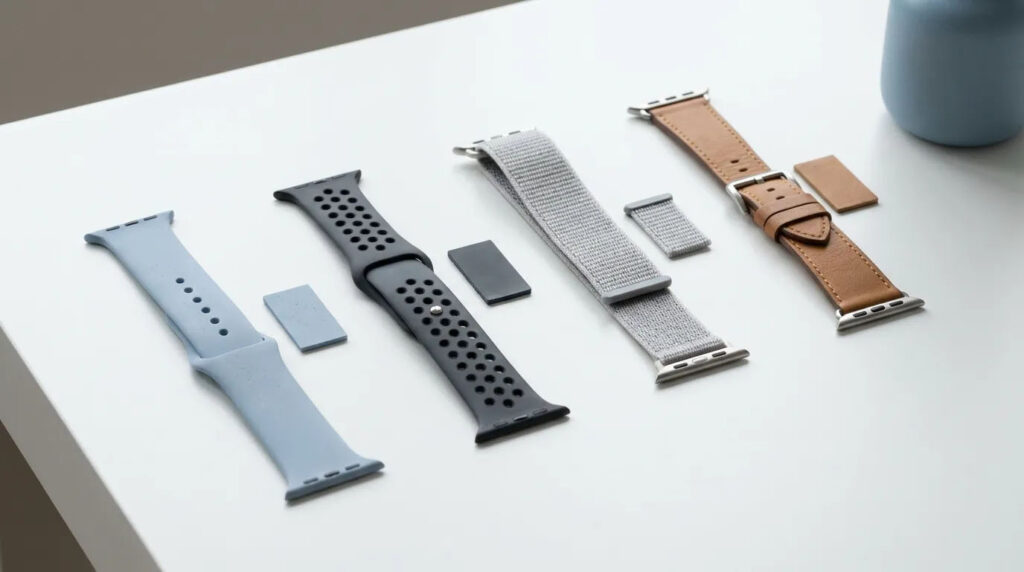
“Silicone watch band” is a useful search phrase, not a reliable material specification. Check the product page, packaging, model number, care label, or manufacturer support page. If the material is unknown, start with fresh water and a soft cloth and avoid soaking or chemicals.
| Band type | Possible material | Safest starting point | Main caution |
|---|---|---|---|
| True silicone band | Solid or liquid silicone rubber | Fresh water and a soft lint-free cloth | Printing, coatings, adhesives, connectors, and metal hardware may set stricter limits |
| Flexible sport band | Silicone, TPU, fluoroelastomer, TPE, or rubber | Follow the exact model’s instructions | Appearance alone cannot identify the polymer |
| Apple Solo Loop | Silicone | Apple’s band-care instructions | Do not apply Apple’s permissions to an unrelated third-party band |
| Apple Sport Band or Ocean Band | Fluoroelastomer, not silicone | Apple’s instructions for that band | These are often called “silicone bands” in everyday searches |
| Woven, braided, nylon, or leather band | Textile or leather, sometimes with elastomer parts | Use the material-specific method | Water, soap, or soaking may damage fibers, dyes, leather, or adhesive |
| Band with electronics or a battery | Multi-material electronic assembly | Device-maker instructions only | Do not rinse or immerse unless expressly authorized |
Apple’s current band-material list identifies the Solo Loop as silicone and the Sport Band and Ocean Band as fluoroelastomer. They are all smooth and flexible, but they are not the same material. For a broader comparison, see Silicone vs. TPU.
Should You Remove the Band From the Watch?
Remove the band when it is designed for user removal and the manufacturer explains how to release it. Detaching it protects the watch’s speaker, microphone, sensors, buttons, charging contacts, and connector slots while making both sides of the band accessible.
Before removal:
- Turn off the watch and disconnect it from the charger.
- Work over a clean towel so a spring bar or pin cannot roll away.
- Release the connector according to the model instructions.
- Never force a stuck pin or pry a connector slot with a sharp tool.
If the band is not intended to detach, use the device maker’s low-moisture method. A watch’s water-resistance rating is not permission to soak it in soap or cleaning chemicals.
What You Need—and What to Avoid
For routine care, prepare:
- fresh water;
- two soft, nonabrasive, lint-free cloths;
- a clean absorbent towel;
- a very soft brush only if the manufacturer permits one; and
- mild, fragrance-free or hypoallergenic soap only when approved for that exact band.
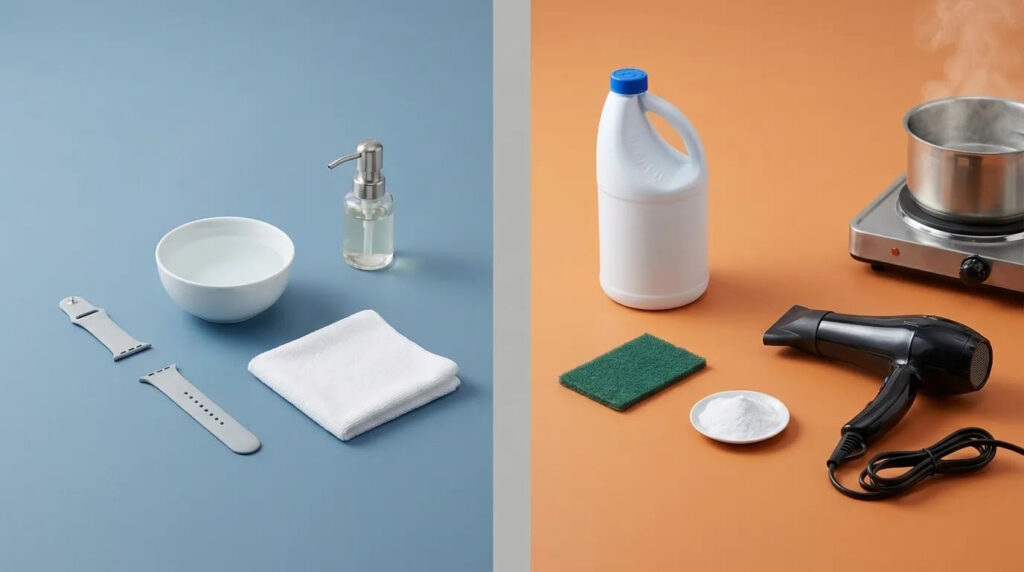
Avoid rough sponges, scouring pads, stiff toothbrushes, metal picks, melamine foam, solvents, and household surface cleaners. A specialized “silicone cleaner” is rarely necessary for normal sweat and body soil.
How to Clean Silicone Watch Bands in Five Steps
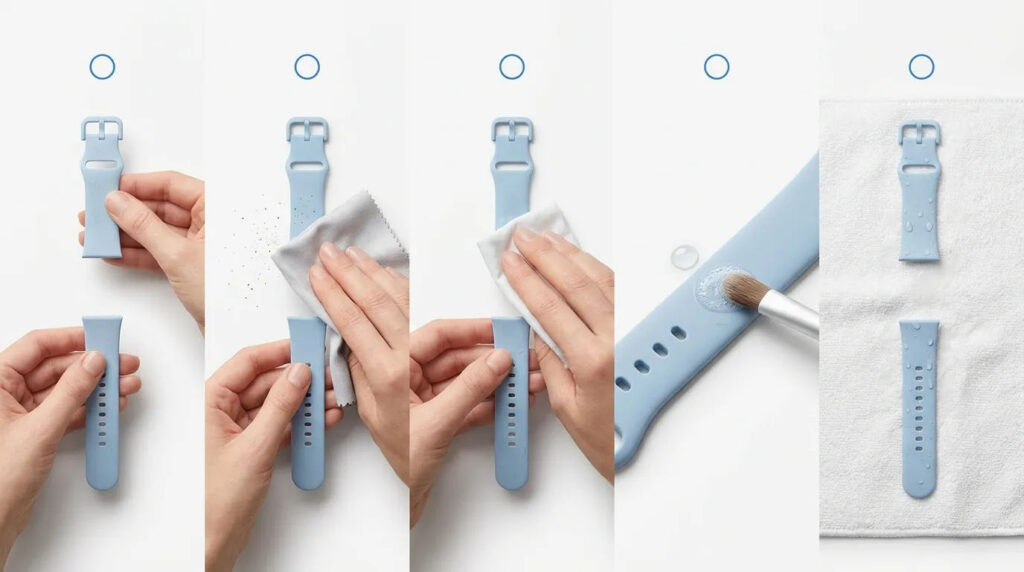
1. Detach and Inspect the Band
Remove the band when permitted. Leave permanently installed pins, decorative inserts, molded connectors, and bonded parts in place.
Inspect the underside, holes, keeper, buckle, lugs, and connector ends. A tear near a lug, an enlarged adjustment hole, a loose connector, exposed adhesive, corrosion, swelling, or permanent tackiness is not a cleaning problem. Replace a structurally compromised band rather than trying to restore it with a stronger cleaner.
2. Remove Loose Dust, Salt, and Grit
Wipe the dry band with a lint-free cloth. Pay attention to adjustment holes, the underside of the keeper, buckle, molded channels, and connector recesses.
If the maker permits rinsing, use a gentle stream of fresh water. Do not use a high-pressure spray. Removing grit before wiping reduces the chance of scratching a coating or pushing particles into a connector.
3. Clean Both Sides With Water
Dampen a clean cloth with fresh water and wipe the skin-facing surface first, followed by the outer surface and edges. Use repeated light passes instead of aggressive scrubbing.
Clean water is the conservative general starting point. Samsung advises using clean water on a rubber watchband and drying it thoroughly. Its guidance also warns against soap, cleaning agents, abrasives, chemicals, compressed air, ultrasonic cleaning, and external heat for the watch. Brand-specific limits like these take priority over generic advice.
4. Treat Remaining Residue Only as the Maker Allows
If the exact band instructions allow mild soap, dilute a small amount in water and apply it with the cloth rather than pouring it directly onto the band. Gently work over body oil, sunscreen, or soap film.
Apple permits mild hypoallergenic hand soap on several named Apple bands, Fitbit permits hypoallergenic soap when needed for applicable non-leather bands, and Google gives a similar model-specific method for its fluoroelastomer Pixel Watch Active Band. Follow Google’s separate care procedure for that band. Other manufacturers specify water only. Use the corner of the cloth—or an approved very soft brush—for uncoated holes and grooves. Do not scrub printed graphics, painted buckles, metallic finishes, or soft-touch coatings unless their instructions permit it.
5. Remove Residue and Dry Completely
Rinse the detached band with fresh water when rinsing is allowed. Otherwise, wipe it several times with a second cloth dampened only with water. Continue until no foam or slippery film remains around holes, the buckle, or the keeper.
Pat dry and leave the band flat in a ventilated indoor area. Let the connector ends, channels, holes, and underside of the buckle dry completely before reinstalling the band. Do not use a hair dryer, radiator, oven, open flame, or prolonged direct sunlight.
How Often Should You Clean the Band?
Use and exposure matter more than a rigid calendar. Wipe or rinse the band after heavy sweating, swimming, or contact with sunscreen, lotion, cosmetics, insect repellent, salt water, or chlorinated water, following the maker’s instructions. For ordinary wear, clean it when you see residue, notice odor, or feel discomfort.
Frequent gentle care is safer than waiting for a thick buildup and then scrubbing aggressively. Garmin’s fit-and-care guidance recommends rinsing silicone or TPU elastomer bands with water and letting them dry before wear.

How to Remove Sweat, Body Oil, Soap Film, and Odor
Sweat and Salt
Clean the band soon after a workout. Dried sweat leaves salt and body soil on the skin-facing surface, around holes, and under the keeper. Use the approved water method, then dry both the band and your wrist. For frequent training, a quick clean and complete drying after each workout is usually more useful than occasional deep cleaning.
Body Oil, Lotion, and Sunscreen
Wipe fresh residue promptly with water. If soap is allowed, use a small amount and remove it completely. Remove the watch while applying sunscreen, lotion, insect repellent, perfume, or similar products. Keep these products off the band and the skin directly beneath it when practical, and promptly clean accidental transfer according to the manufacturer’s instructions.
Do not generalize a chemical permission from one brand to another. The complete band may include colorants, printing, coatings, adhesive, plastic connectors, and metal hardware that have different limits from silicone rubber itself.
Soap or Detergent Film
A slippery, waxy, or irritating feel after washing may mean cleaner remains on the band. Do not add more detergent. Rinse the detached band when allowed, or wipe it repeatedly with a cloth dampened only with water. Check embossed lettering, holes, the keeper, and the underside of the buckle.
Odor
Odor often persists because sweat, oil, soap, or moisture remains in small recesses. Clean both sides, clear the holes and keeper, remove all cleaner, and dry the band fully. Do not cover the smell with perfume, essential oil, or fragranced sanitizer.
If odor returns quickly after correct cleaning and complete drying, inspect for cracking, permanent tackiness, separating layers, corrosion, or trapped material in an inaccessible seam. Replacement may be safer than repeated chemical treatment.
How to Clean a White or Stained Silicone Watch Band
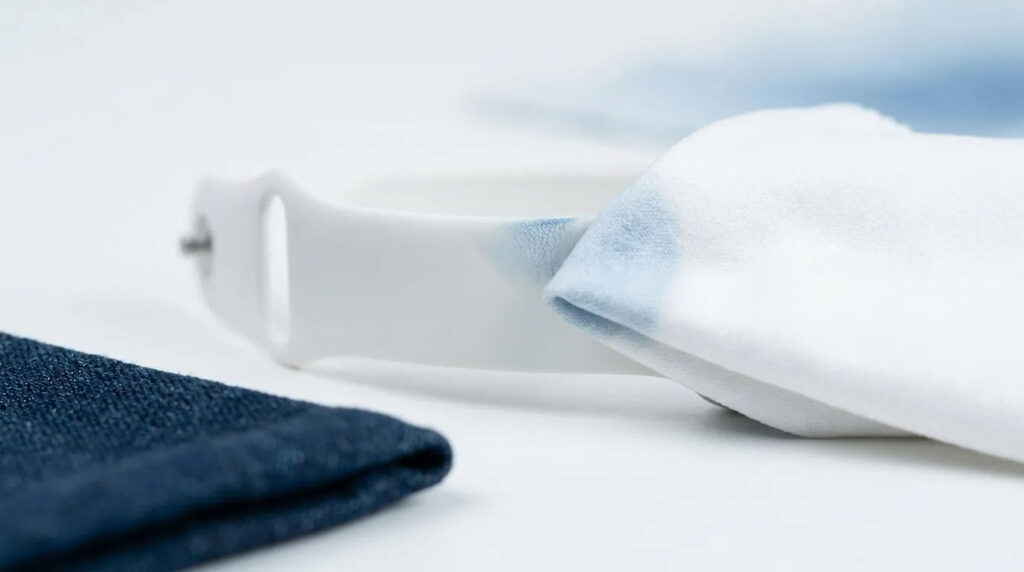
White and pastel bands show transferred color easily. Common sources include denim, dark sleeves, makeup, self-tanner, ink, hair dye, food, and sunscreen. Fitbit specifically notes that light-colored bands can pick up color through extended contact with dark clothing.
Start with the standard water method. If the manufacturer permits soap, repeat several gentle passes with diluted mild soap, remove all residue, and dry the band. Treat a fresh mark promptly, but do not increase pressure when the color stops transferring to the cloth.
Avoid assuming that baking soda, toothpaste, a magic eraser, bleach, or peroxide will restore a white band. Abrasion can create a lighter patch by removing or roughening the surface finish. Oxidizing cleaners can change pigments, printing, metal parts, or adhesives.
If a clean, dry band remains discolored but is otherwise intact, dye may have migrated into the polymer or the material may have changed through wear and exposure. Cleaning removes surface contamination; it cannot reliably reverse absorbed dye or permanent yellowing.
How to Clean a Silicone Apple Watch Band—and Why Material Matters
Remove an Apple-branded band from the Apple Watch before cleaning it. Apple states that its instructions apply to Apple-branded bands only; use the maker’s instructions for a third-party band.
For Solo Loop, Sport Band, Nike Sport Band, Ocean Band, and several other named bands, Apple says to wipe with a nonabrasive, lint-free cloth, lightly dampen it with fresh water if necessary, and allows mild hypoallergenic hand soap. Dry the band before reattaching it.
Material identification still matters:
- Solo Loop is silicone.
- Sport Band, Nike Sport Band, and Ocean Band are fluoroelastomer.
- Braided Solo Loop, Sport Loop, Alpine Loop, and Trail Loop contain textile structures and should not be treated as solid silicone.
Apple currently permits a gentle wipe with a 70% isopropyl alcohol wipe, 75% ethyl alcohol wipe, or Clorox Disinfecting Wipe on certain named bands, including Solo Loop, Sport Band, Nike Sport Band, and Ocean Band. It says not to use those wipes on fabric or leather bands and not to use products containing bleach or hydrogen peroxide.
That authorization is narrow. Garmin separately allows specific rubbing-alcohol or 70% isopropyl-alcohol-wipe uses on its silicone or TPU bands, followed by rinsing and drying as directed. Samsung tells users to avoid chemicals and cleaning agents on its watch and band. Fitbit and Pixel’s current band-care pages do not provide a general alcohol-cleaning permission. None of these brand-specific rules makes alcohol a universal method for third-party “Apple Watch silicone bands,” especially products with unknown polymers, coatings, printed designs, glued connectors, or plated hardware.
Are Alcohol, Baking Soda, Bleach, or Heat Safe?
| Method | Practical boundary | Main concern |
|---|---|---|
| Fresh water and a lint-free cloth | Best general starting point | Protect the watch body and dry every part completely |
| Mild hypoallergenic soap | Use only when the exact band maker permits it | Residue can remain in holes and irritate skin |
| Rubbing alcohol or 70% isopropyl alcohol wipe | Apple and Garmin authorize specified uses on named bands; do not generalize them | May affect printing, coatings, color, adhesive, or another elastomer |
| Baking soda, toothpaste, or melamine foam | Not a universal stain treatment | Abrasion can dull, roughen, or remove a finish |
| Vinegar or another acidic cleaner | Use only under explicit product instructions | May affect hardware, finishes, adhesives, or leave skin-contact residue |
| Hand sanitizer | Not a substitute for an approved cleaning method | Gel, fragrance, and moisturizer can leave residue |
| Bleach or hydrogen peroxide | Avoid unless the exact band maker expressly authorizes the method | Color, finish, hardware, adhesive, and skin-contact risks; Apple excludes both |
| Boiling, dishwasher, ultrasonic cleaner, or external heat | Do not use as a general watch-band method | Can deform the band or damage connectors, coatings, inserts, and electronics |
Never mix cleaning chemicals. If product instructions conflict with a generic tip, the product-specific instructions control.
Drying, Fit, and Skin Comfort
A clean band can still be uncomfortable when it is wet, too tight, or coated with soap. Dry the band, the watch connection, the back of the watch, and your wrist before wearing the device again. Wear the band snugly enough for the watch to function, but not so tightly that it leaves no room for the skin to breathe.
Apple, Fitbit, Garmin, and Samsung all emphasize keeping wearables and skin clean and dry. If redness, itching, swelling, or discomfort develops, remove the watch. If the reaction persists or worsens, seek advice from a qualified healthcare professional instead of trying progressively stronger cleaners. For a material-focused overview, see Can You Be Allergic to Silicone?.
When Should You Replace the Band?
Replace a band when cleaning cannot correct a safety, fit, or material problem. Warning signs include:
- a tear near a lug, buckle, or adjustment hole;
- a stretched or loose connector;
- a buckle or spring bar that no longer locks securely;
- permanent swelling, warping, or loss of elasticity;
- exposed adhesive or separating layers;
- severe corrosion on skin-contact hardware;
- permanent tackiness after correct cleaning and drying;
- recurring odor from an inaccessible seam; or
- recurring irritation: stop wearing the band; if symptoms persist or worsen, consult a healthcare professional and consider a different band material after recovery.
Do not use glue, heat, or an improvised pin to repair a load-bearing connector. A damaged band can release the watch without warning.

Frequently Asked Questions
Can I Wash a Silicone Watch Band With Soap?
Only if the exact band instructions permit it. Apple and Fitbit allow mild hypoallergenic soap for specified bands, while Samsung’s guidance for rubber watchbands starts with clean water. Use very little soap, remove every trace, and dry the band completely.
Can I Use Rubbing Alcohol on a Silicone Watch Band?
Only when the manufacturer authorizes the concentration and application method. Apple permits specified alcohol wipes on certain Apple-branded bands, and Garmin permits specific alcohol uses on its silicone or TPU bands. Samsung tells users to avoid chemicals and cleaning agents, while Fitbit and Pixel do not provide a general alcohol-cleaning permission in their current band-care pages. None of these rules covers every silicone, TPU, fluoroelastomer, print, coating, adhesive, or third-party connector.
How Do I Clean a White Silicone Watch Band?
Start with fresh water and a soft lint-free cloth. Use diluted mild soap only if allowed, then remove all residue and dry thoroughly. Avoid aggressive whitening methods. Absorbed dye, coating wear, and age-related discoloration may be permanent.
How Do I Remove Sweat Smell From the Band?
Clean both sides, the adjustment holes, keeper, buckle, and connector ends using the approved method. Remove all soap and allow more drying time. If odor returns quickly with tackiness, cracking, corrosion, or layer separation, replace the band.
Is an Apple Watch Sport Band Made From Silicone?
No. Apple identifies the Sport Band as fluoroelastomer. The Solo Loop is Apple’s silicone band. Searchers often call both “silicone,” but the correct material determines which care instructions apply.
Can I Boil a Silicone Watch Band or Put It in the Dishwasher?
Do not use boiling or a dishwasher as a general method. A band may contain pigments, coatings, metal hardware, plastic connectors, adhesives, or another elastomer even when its main strap is silicone. Heat and mechanical action can deform or weaken the complete assembly.
How Do You Clean Silicone Wristbands and Bracelets?
The water-first principle is similar, but a simple molded wristband may have no connector, buckle, electronics, coating, or adhesive. Follow the item’s own care instructions. For product types, customization, and construction, see the Silicone Wristbands Guide.
Designing Custom Silicone Watch Bands for Easier Cleaning
For an OEM band, cleanability begins with the product specification. Define the complete assembly, likely contaminants, approved cleaning method, and validation criteria before tooling.
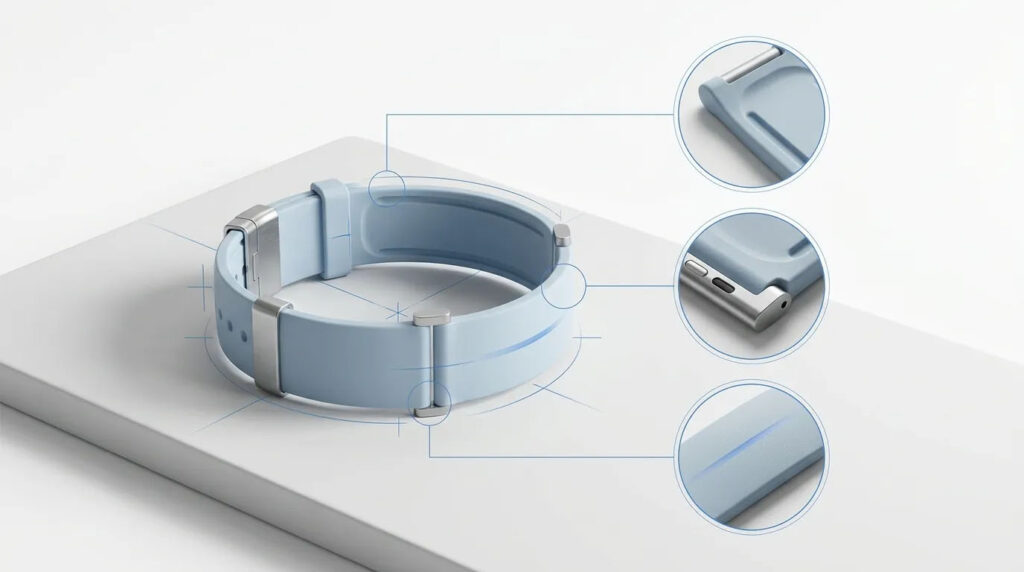
Important design checks include:
- Material identification: State the silicone grade and cure system, or clearly identify TPU, fluoroelastomer, or another elastomer.
- Cleanable geometry: Use accessible radii and drainage paths; deep blind grooves and narrow undercuts can trap sweat and detergent.
- Connector design: Evaluate molded-in plastic or metal inserts, spring bars, adhesives, and overmold interfaces together with the strap.
- Surface and decoration: Validate matte, gloss, texture, coating, printing, and laser marks against repeated cleaning and abrasion.
- Color performance: Test light colors against denim, cosmetics, sunscreen, artificial sweat, and the approved cleaner.
- Care validation: Test the stated cleaner concentration, contact time, rinse, drying method, and expected number of wear-and-clean cycles.
- Replacement guidance: Define acceptable appearance change and clear rejection criteria for cracks, stretched connectors, tackiness, corrosion, and delamination.
Brands developing silicone band watches can review RuiYang’s Silicone Band Watch category. For custom watch band options, see Custom Silicone Watch Bands. Brands planning a broader branded merchandise campaign can also explore Custom Silicone Promotional Products for additional product formats and customization ideas.
References
- Apple Support: How to Clean Your Apple Watch and Band
- Apple Support: Apple Watch and Band Materials
- Fitbit Product Care
- Fitbit Help: Wear and Care Guidance
- Google Pixel Watch Help: Clean and Care for Google Pixel Watch
- Google Pixel Watch Help: Band Materials
- Garmin: Watch Fit and Care
- Samsung: Properly Wear and Clean Your Galaxy Watch