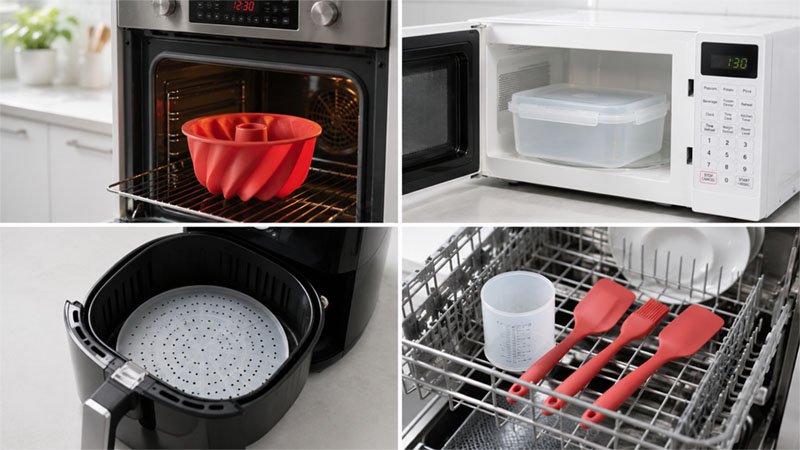
Customers ask the same kitchen-safety question every week, and every week the answer comes down to the same five-line table. The problem is the table rarely makes it into consumer-facing content. What does make it in is “silicone is safe up to 500 °F” — a number lifted from a technical datasheet for a grade that may or may not be the part on your counter.
Food-grade silicone certified to FDA 21 CFR 177.2600 and LFGB §30/§31 is kitchen-safe under standard residential use: ovens up to 230 °C / 446 °F, microwaves at any power, air fryers up to 200 °C / 392 °F, and dishwashers on any household cycle. Industrial-grade silicone, peroxide-cured grades without post-cure, and parts with no compliance label carry no such guarantee.
This is the compliance-and-temperature reference we hand to procurement teams and DTC kitchen brands before they spec a silicone product into a SKU.
What “Food-Safe Silicone” Actually Means
“Food grade” is not one test. It is a basket of regulations, and the basket varies by destination market.
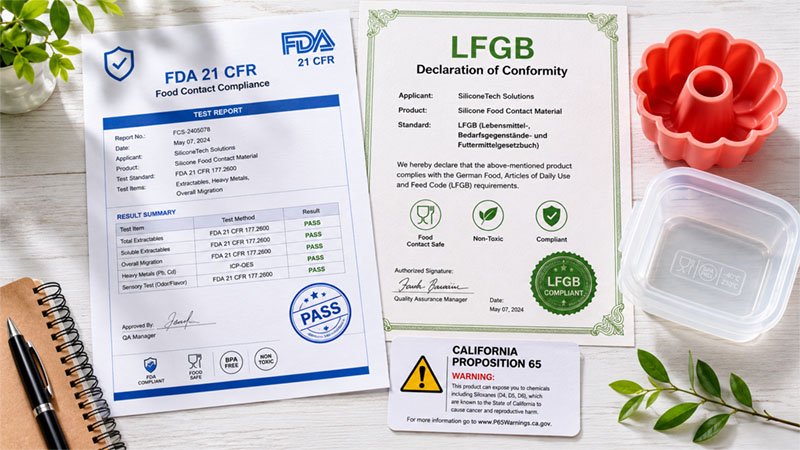
| Region | Standard | What It Tests | Required Documentation |
|---|---|---|---|
| United States | FDA 21 CFR 177.2600 | Extractables into water (7-hr reflux) and n-hexane | Migration report from an ISO 17025-accredited lab |
| European Union | LFGB §30/§31 (BfR Rec. XV) | Sensory + migration test against simulant foods | LFGB Declaration of Conformity |
| France | DGCCRF 25-11-1992 | Peroxide and platinum residue limits | FR-specific conformity statement |
| California | Prop 65 | Heavy metals, phthalates, BPA disclosure | Warning label or compliance certificate |
| Japan | MHLW Notification No. 370 | Material-specific migration test | Japanese conformity report |
A silicone part labeled “food grade” without naming the regulation is not food grade in any actionable sense. Ask which standard, which test report number, which lab — and the year of the report, because batches expire. If the supplier can’t produce a specific certificate, the certification does not exist for legal purposes. For the difference between food-grade and medical-grade silicone, see Food-Grade vs Medical-Grade Silicone and Food Grade Silicone.
Is Silicone Safe in the Oven?
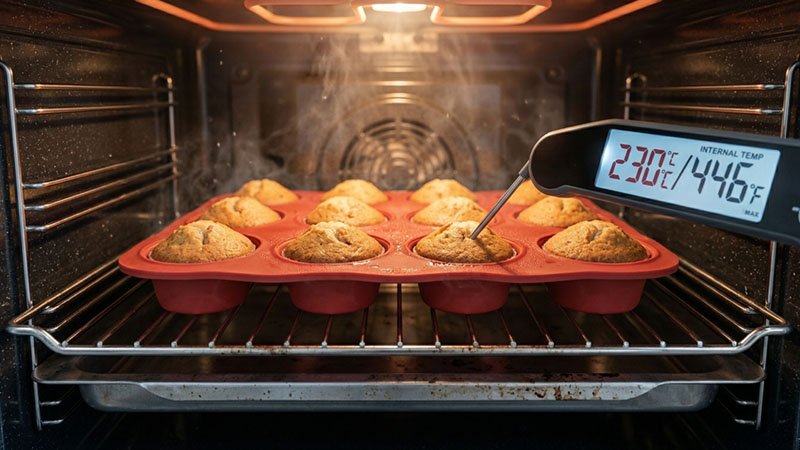
Yes — within a defined range.
A food-grade, platinum-cured silicone bakeware part is rated for continuous use at −60 °C to +230 °C (−76 °F to +446 °F). The number assumes standard convection-oven conditions in a residential or commercial bakery.
What actually fails at the upper limit is not the polymer chain — silicone does not melt. The Si-O-Si backbone holds until roughly 350 °C, when it decomposes back into silica (SiO₂), a white ash. Long before that, however, you see the following at 230–260 °C with prolonged dwell:
- Surface gloss disappears (loss of low-molecular-weight siloxane)
- Compression set rises and the part loses elastic recovery
- A faint “first-bake” odor develops in the first 30 minutes of new use — residual platinum-cure byproducts burning off
Use limits in practice:
- Bake at 180–220 °C (356–428 °F) for cake, bread, or pastry — full safety margin
- Use at 220–230 °C (428–446 °F) for short broils or top-browning — acceptable, expect faster wear
- Above 230 °C is outside FDA migration data and is not recommended in any residential context
- Never under a direct broiler element or open gas flame
For application-level reference, How to Bake in Silicone Mold, and Silicone Baking Molds Temperature.
Is Silicone Safe in the Microwave?
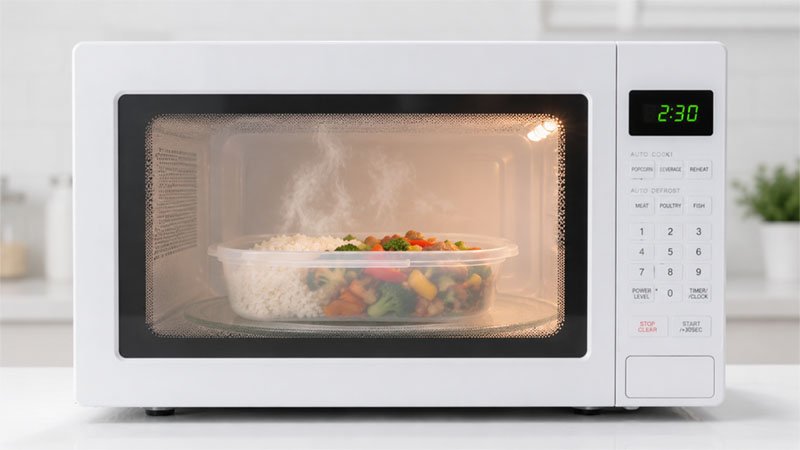
Yes — under any normal power setting.
Silicone is a microwave-transparent polymer. It contains no free water, no metallic filler (unless explicitly a conductive grade), and no polar groups in the backbone that couple strongly to 2.45 GHz radiation. The container itself does not heat up; only the food inside does.
The exceptions are narrow:
- Conductive or carbon-loaded silicone (gray-black, used in EMI gaskets and keypads): contains carbon black or silver filler. Will arc in a microwave. Do not microwave.
- Silicone-and-metal hybrid bakeware: some molds have a stainless stiffener ring. Treat the part as metal — no microwave.
- Silicone with sublimation-printed images at the food-contact surface: pigment migration risk under sustained high heat. Stick to laser-engraved or pad-printed marks below the food line.
A fully-silicone mold full of food in a 1,000 W microwave for ten minutes is a non-event from a material standpoint. Migration data under FDA 21 CFR 177.2600 already covers wet, heated extraction at the temperatures the food actually reaches.
Is Silicone Safe in the Air Fryer?
Yes — within the same temperature limits as oven use, with one airflow caveat.
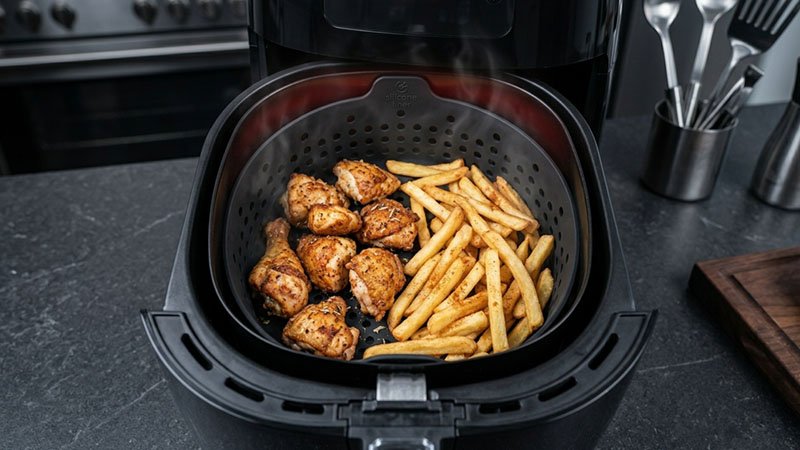
Air fryers run at 150–200 °C (302–392 °F) with high-velocity forced convection. The temperature stays well inside silicone’s safe window. What changes is airflow.
A loose silicone liner or mat without weight on top can lift into the heating element. Result: localized scorching, surface yellowing, and a smell that does not come out. Use silicone air-fryer accessories that fit the basket geometry, or use perforated/weighted designs.
For the parchment alternative, see Parchment Paper vs Silicone Mats for Air Fryer.
Do not exceed the manufacturer’s stated rating — most consumer air-fryer silicone is rated to 230 °C / 446 °F, which is the same FDA/LFGB-bound figure as oven bakeware. The mechanical concern (airflow) is the real limit, not the polymer.
Is Silicone Safe in the Dishwasher?
Yes — all residential cycles, including sanitize.
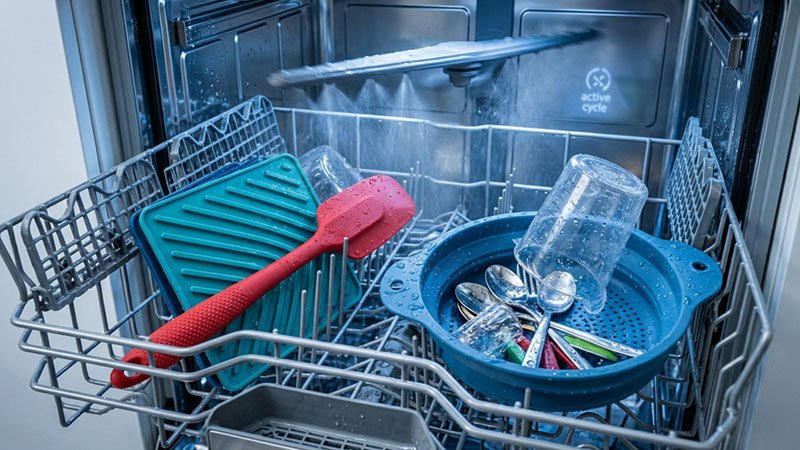
A typical home dishwasher cycles between 60 °C and 75 °C (140–167 °F) during wash, with a final rinse that can reach 85 °C (185 °F) on sanitize. All of this is well inside silicone’s continuous-use envelope. Detergent pH (typically 9–11.5) does not degrade silicone — alkaline aqueous environments are one of the conditions where silicone is most stable.
What can stain or odor-load silicone over time:
- Curry and turmeric pigments (carotenoid staining — semi-permanent)
- Tomato-based sauces (lycopene staining — fades with sun exposure)
- Strong garlic and seafood oils (porous-feeling odor retention)
Staining is cosmetic, not migration. The part is still food-safe. For rack placement, cycle selection, detergent residue, and product exceptions, see Can Silicone Go in the Dishwasher?. For removal protocols, see How to Clean and Care for Your Silicone Kitchen Products.
Do not soak silicone in concentrated chlorine cleaners for hours. Short dishwasher cycles with bleach-pack detergents are fine; soaking parts in 5% sodium hypochlorite overnight is not.
How to Verify Your Silicone Is Actually Food-Grade
Three checks, in order:
- Ask for the migration test report. A real food-grade supplier sends a PDF with the lab name, accreditation number, test date, batch ID, and the specific clauses tested (e.g. “21 CFR 177.2600(e) extractives — water, 7 hr at reflux: 12.4 mg/in², limit 20 mg/in², PASS”). Vague “FDA approved” copy without a number is not a certificate.
- Pinch and twist the part. Real platinum-cured silicone does not show white stress marks under sharp bend. Filler-loaded fake “silicone” — often a blended TPR or PVC compound — will whiten or chalk at the bend line. This is a field test, not a regulatory test, but it filters obvious fakes.
- Smell after first 30-minute bake. A faint baby-powder note is normal platinum-cure burn-off. A petroleum, burnt-rubber, or chemical-sweet smell signals peroxide-cure residue or non-silicone filler. Peroxide grades are acceptable for industrial use but should not be the default for kitchen items without a 4-hour post-cure at 200 °C to drive off residues.
For more background, see Are Silicone Toxic? and Is Silicone Safe for Food Storage.
When Silicone Is NOT Safe in the Kitchen
Five conditions remove the food-safe claim:
- The part is industrial-grade. Industrial seals, gaskets, oven-door strips, and mat liners are not food-grade unless explicitly certified. They often carry no migration data and may use pigments outside the FDA-approved list.
- The part is peroxide-cured and not post-cured. Residual byproducts (2,4-dichlorobenzoic acid, benzoic acid) are odor-active and outside any FDA migration approval. Platinum cure is the kitchen default for a reason.
- The surface is damaged. Cuts, tears, or burn-marks expose filler-side material that was not tested for food contact. Replace, do not repair.
- The part is past its compliance window. Migration certificates apply to a specific raw-material batch and a specific compound formula. After 12–24 months of heavy kitchen use, the part is still chemically inert but no longer falls under a current certification. For food-service operations subject to inspection, re-verify.
- The grade has been re-pigmented or recolored at retail. Silicone receives pigment at the mill, not at home. Aftermarket dyes introduce non-approved colorants and void the original certificate.
For durability-side context, see Silicone Products Service Life Evaluation in Kitchen Use and Are Silicone Baking Molds Safe?.
Kitchen-Use Temperature Summary
| Appliance / Condition | Typical Operating Temp | Silicone Safe? | Caveat |
|---|---|---|---|
| Oven (convection bake) | 150–230 °C / 300–446 °F | Yes | Avoid direct broiler element |
| Oven (broil) | 250–290 °C / 482–554 °F | No | Exceeds 230 °C rating |
| Microwave | ~100 °C food temp | Yes | No conductive grades; no metal-rim hybrids |
| Air fryer | 150–200 °C / 302–392 °F | Yes | Secure liner against airflow lift |
| Dishwasher (residential) | 60–85 °C / 140–185 °F | Yes | No prolonged bleach soak |
| Stovetop direct contact | Up to 300 °C / 572 °F | No | Open flame or hot pan exceeds limit |
| Freezer | −18 °C / 0 °F | Yes | Well inside −60 °C lower limit |
FAQ
Does silicone leach chemicals into food?
Properly food-grade, platinum-cured silicone shows extractables well below FDA 21 CFR 177.2600 limits. Migration is below detection thresholds for most simulants. Uncertified, peroxide-cured, or industrial grades may leach measurable byproducts.
Can silicone bakeware go from freezer to oven directly?
Yes. Food-grade silicone is rated −60 °C to +230 °C continuously. Thermal-shock cracking is a stainless or glass concern, not a silicone concern.
Why does my new silicone mold smell when I first bake it?
Residual cure byproducts and trace low-molecular-weight siloxanes burning off. Bake empty at 180 °C for 30 minutes before first use to clear it. Smell that persists past the second bake indicates non-platinum cure or non-silicone filler.
Is black silicone less safe than colored or clear silicone?
No. Black silicone is colored with carbon black, which is on the FDA-approved colorant list for food contact. Conductive (EMI) carbon-loaded silicone is a separate material entirely — those are not food-grade and should not enter the kitchen.
What This Article Does Not Cover
This is the kitchen-safety reference, not the sourcing playbook. Three boundaries before generalizing any answer here to your specific situation:
- Compliance certificates expire by batch, not by part. A bakeware brand that bought certified silicone three years ago does not automatically have current paperwork. Inspect your supplier’s certificate date and lot traceability on every shipment.
- Commercial kitchen and food-service use is stricter than residential. Health inspectors may require LFGB or NSF/ANSI 51 documentation beyond the home-use FDA basis above. Verify with your local jurisdiction.
- Temperature numbers above assume an undamaged, unmodified part. A silicone mold with a cut, a burn-through, or pigment retouching is no longer the part the certificate was issued for.
For the upstream context — what silicone actually is, how it’s manufactured, and where each grade fits — read the Complete Silicone Material Guide. For the full property reference, read Properties of Silicone: Complete Material Guide.
Before sourcing kitchen-grade silicone, lock down four inputs in writing:
- Cure system (platinum, not peroxide)
- Compliance scope (FDA 21 CFR 177.2600 + LFGB §30/§31 at minimum for global SKUs)
- Maximum operating temperature for the intended use (oven vs air fryer vs dishwasher)
- Pigment compliance (FDA-approved colorants only, no aftermarket dyes)
A kitchen-safety claim without those four lines on the spec sheet is a marketing statement, not a regulatory one.