Most outdoor specs that reach us say “UV resistant” or “suitable for outdoor use” and stop there. No exposure geography, no service life, no test reference. Silicone almost never fails the way that phrasing implies — it does not crack in the third sunny week. It drifts: a gasket loses a few points of seal load over five summers, a black part chalks grey on the south-facing edge, a translucent lens hazes. By the time anyone notices, the drawing that said “UV resistant” is three revisions back and no one remembers what it was supposed to guarantee.
Silicone’s weathering advantage is real and it comes from the Si-O backbone — but “outdoor grade” only means something when it is tied to a named accelerated test, an exposure environment, and a target service life. Without those, it is a feeling, not a spec.
Executive Summary
- Silicone resists UV and ozone because of chemistry, not additives. The Si-O backbone is saturated and high-energy, so it lacks the C=C double bonds and weaker C-C links that make natural rubber and many organics crack and embrittle outdoors.
- The real failure mode is slow drift, not sudden cracking. Over 10–20 years the realistic changes are surface chalking, a few points of durometer rise, pigment fade, and seal-load loss — usually traceable to fillers, pigments, or the cure system, not the base polymer.
- Accelerated-aging numbers mean nothing without their parameters. ASTM G155, ISO 4892, and ASTM D1149 each stress the material differently, and there is no universal “X hours = Y years” multiplier — quoting a bare hour count is the most common way these reports get misread.
Why Silicone Resists UV and Ozone
The weathering story starts at the backbone. Organic rubbers — natural rubber, SBR, and to a lesser degree EPDM — are built on carbon chains. The carbon-carbon bond sits around 346 kJ/mol, and unsaturated rubbers also carry C=C double bonds that ozone attacks directly. The energy in terrestrial UV-A and UV-B photons is high enough to break those organic bonds over time, which is why an exposed natural-rubber part crazes and cracks within a season or two.

Silicone is not a carbon-backbone rubber. Its chain is alternating silicon and oxygen (the siloxane, Si-O, bond), which sits near 444 kJ/mol — well above the energy most ground-level UV delivers. The backbone is also fully saturated, so there are no double bonds for ozone to cleave. That single structural fact is the reason silicone holds elasticity outdoors for decades while organics on the same assembly have to be replaced. It is also why you should be suspicious of any datasheet that credits silicone’s UV resistance to a stabilizer package: for the base polymer, the resistance is inherent, not added.
This is the part buyers get right and then over-extend. “UV-stable backbone” does not mean “nothing changes outdoors.” It means the chain itself does not unzip. Everything compounded around that chain — fillers, pigments, process aids, and the cure chemistry — still ages, and that is where real-world drift comes from.
What Actually Changes Over 20 Years Outdoors
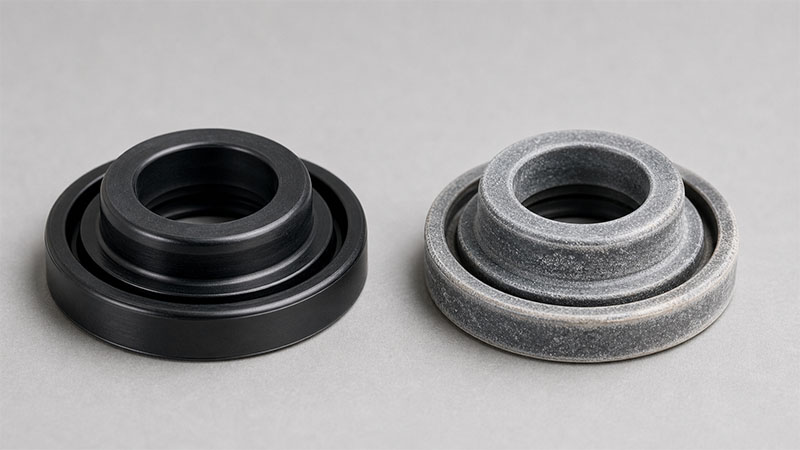
When a silicone part underperforms after long exposure, the post-mortem rarely points at the siloxane backbone. It points at the compound and the conditions. These are the drift modes we actually see, and the reasons teams underestimate them:
- Surface chalking and color shift. Pigments and surface fillers degrade before the polymer does. A part can be mechanically sound and still look weathered. Teams underestimate this because it is cosmetic until a customer rejects it on appearance.
- Durometer creep. Exposed parts can gain a few points of Shore A over years as residual crosslinking and volatile loss continue — a slow extension of what a 200°C post-cure starts. A seal designed with no hardness margin loses compliance and then loses seal load.
- Additive and plasticizer loss. Lower-cost compounds carrying extenders or non-reactive fluids lose them to heat and UV, which is felt as gradual stiffening or surface tackiness. The base polymer is fine; the formulation was the weak link.
- Cure-system reversion. Condensation-cure (tin-catalyzed RTV) systems can revert — soften and degrade — under sustained heat and humidity in a way that addition-cure (platinum) systems largely resist. The same “silicone” label hides very different outdoor outcomes depending on cure chemistry.
None of these are catastrophic on day one, which is exactly the problem. The decision that allowed a cheap filler or a condensation cure looks fine through commissioning and the first year. The cost shows up as warranty drift in year five, long after the spec was signed.
Worth noting on the other side of the ledger: high-voltage silicone insulators are specified outdoors precisely because of an aging behavior that works for you — hydrophobicity recovery, where the surface migrates low-molecular-weight chains back to recover water repellency after pollution or arcing. That is the kind of long-term behavior a generic “UV resistant” claim never captures.
Accelerated Aging Tests and What They Actually Measure

Mode-3 reality: most disputes about outdoor durability are not failures of the material, they are misreadings of the test. Each standard isolates a different stressor, and a report is only interpretable if its parameters travel with the number.
| Standard | Stressor simulated | What it tells you | What it does not |
|---|---|---|---|
| ASTM G155 / ISO 4892-2 (xenon-arc) | Full-spectrum sunlight + heat + moisture cycles | General weathering: color, gloss, surface, broad property retention | An exact field lifetime; spectrum match depends on filters |
| ASTM G154 / ISO 4892-3 (fluorescent UV, QUV) | UV-A or UV-B only, with condensation | UV-driven surface degradation, often harsher/faster on UV | Visible/IR and full solar balance; can over-stress UV vs reality |
| ASTM D1149 (ozone chamber) | Ozone at set concentration on a strained sample | Ozone-cracking resistance (where silicone excels) | UV or thermal aging behavior |
| ASTM D573 (heat aging in air) | Elevated-temperature oven exposure | Thermal aging: hardness and tensile change over time | Photo-degradation or ozone effects |
Reading xenon-arc and QUV data without fooling yourself
A G155 or ISO 4892-2 result is only comparable to another when the irradiance (for example, the set point at 340 nm), the black-panel temperature, the filter type, and the light/dark/spray cycle match. Two labs can both run “G155” and report different outcomes because one ran a hotter panel or a wetter cycle. Before comparing a supplier’s number to your own, confirm the cycle, not just the standard name.
QUV (fluorescent UV) is not interchangeable with xenon-arc. It concentrates UV and skips most of the visible and infrared spectrum, so it is good at surfacing UV-sensitive failures quickly but can exaggerate degradation that the full solar spectrum would not drive as hard. Use it to rank candidates and stress surfaces, not to predict appearance under real sun.
Why “2000 hours” is not “X years”
The single most common misjudgment with accelerated data is treating chamber hours as a fixed multiple of field years. There is no universal conversion. The acceleration factor depends on the failure mechanism, the local UV dose (a part in Arizona sees a very different annual dose than one in northern Europe), temperature, and wet time. Accelerated testing is strongest as a comparative tool — ranking compound A against compound B, or against a control with known field history — not as a calendar. If a datasheet converts hours straight to years with no stated correlation basis, treat that as marketing, not data.
Ozone testing where it matters

ASTM D1149 holds a strained specimen in a controlled-ozone atmosphere and looks for cracking. For unsaturated rubbers this is a real qualifier; for silicone it usually confirms what the saturated backbone already predicts — no cracking. It earns its place when a part replaces NR or SBR near ozone sources (electrical equipment, outdoor HV gear) and the buyer needs documented proof rather than a chemistry argument.
Silicone vs EPDM vs Natural Rubber Outdoors
Weathering choice is usually a three-way conversation. The backbone chemistry sorts them quickly, but each has a real boundary.

| Property | Silicone | EPDM | Natural Rubber |
|---|---|---|---|
| UV resistance | Excellent (inherent) | Very good | Poor — crazes and cracks |
| Ozone resistance | Excellent (saturated backbone) | Excellent (saturated backbone) | Poor — stress-cracks |
| Continuous temperature | Approx. −60 to +230°C | Approx. −50 to +150°C | Approx. −50 to +80°C |
| Typical exposed outdoor life | 20+ years | 10–20 years | 1–5 years exposed |
| Main weathering-context weakness | Oil/fuel (use fluorosilicone), tear strength, cost | Oil/fuel, upper temperature ceiling | UV, ozone, and heat together |
The honest read: if the part only ever sees weather, EPDM is often the cost-effective answer and silicone is over-spec. Silicone earns its premium when weather combines with a second demand — wide temperature swing, repeated thermal cycling, food/medical contact, optical clarity, or HV insulation — where EPDM’s ceiling or NR’s chemistry runs out first.
Where Silicone’s Weathering Advantage Breaks Down
The backbone is durable; the system around it sets the boundary. The places an “outdoor silicone” claim quietly fails:
- Cure chemistry mismatch. Condensation-cure RTV outdoors in hot, humid service is a different risk profile from addition-cure. If long-term heat-and-moisture stability matters, the cure system is a spec input, not a supplier detail.
- Cheap fillers and extenders. Non-reinforcing fillers and process oils added to hit a price degrade or migrate under sun and heat. The certificate said “silicone”; the field behavior was set by what was blended in.
- Pigment and color stability. Color retention is a pigment question, not a polymer one. An outdoor part with a tight appearance requirement needs weather-stable pigments specified explicitly.
- Chemical and fuel exposure. Standard silicone swells in fuels, oils, and aromatic/chlorinated solvents. Outdoors plus hydrocarbons is a fluorosilicone conversation, not a standard-silicone one.
- Low-temperature service is a separate question. Cold embrittlement and brittle point are governed by the grade’s low-temperature behavior, not its UV resistance — do not let one stand in for the other.
What I Need to Confirm an Outdoor Service Life
An outdoor-life commitment is only as good as the inputs behind it, and “UV resistant” is not one of them. To put a number and a test behind a part I need: the exposure environment and geography (UV dose differs by climate); the continuous and peak temperature range; whether ozone, fuels, or solvents are also present; the target service life and what “failure” means for this part (appearance, seal load, or mechanical); any required test reference (ASTM G155, ISO 4892, ASTM D1149) and the pass criteria; cure-system or regulatory constraints; and color/appearance tolerance if it is visible.
Give me those and I will commit to a grade, a cure system, and a documented test cycle. Send “make it UV resistant” with none of them, and the resistance does not disappear — it just stays unquantified until the first part chalks or a seal relaxes in year five, when the fix is a requalification, not a reformulation note.
Weathering is only one dimension of how this material behaves; it sits inside the bigger picture in our properties of silicone overview.