Most people meet RTV silicone as a tube of sealant from the hardware store — which hides how much the chemistry underneath actually varies. Pick the wrong RTV type and you get a vinegar smell corroding electronics, a mold that never fully cures, or a seal that won’t stick. The label “RTV silicone” covers several very different systems, and the right one depends entirely on the job.
RTV (room temperature vulcanizing) silicone is a silicone that cures at room temperature without added heat — either as a one-part system triggered by air moisture, or a two-part system mixed with a tin (condensation) or platinum (addition) catalyst — forming a flexible rubber.
Below: how RTV cures, how it differs from HTV and LSR, what it’s good at, and how to spec the right type.
How RTV Silicone Cures: RTV-1 vs RTV-2
RTV splits into two families by how it’s packaged and triggered.
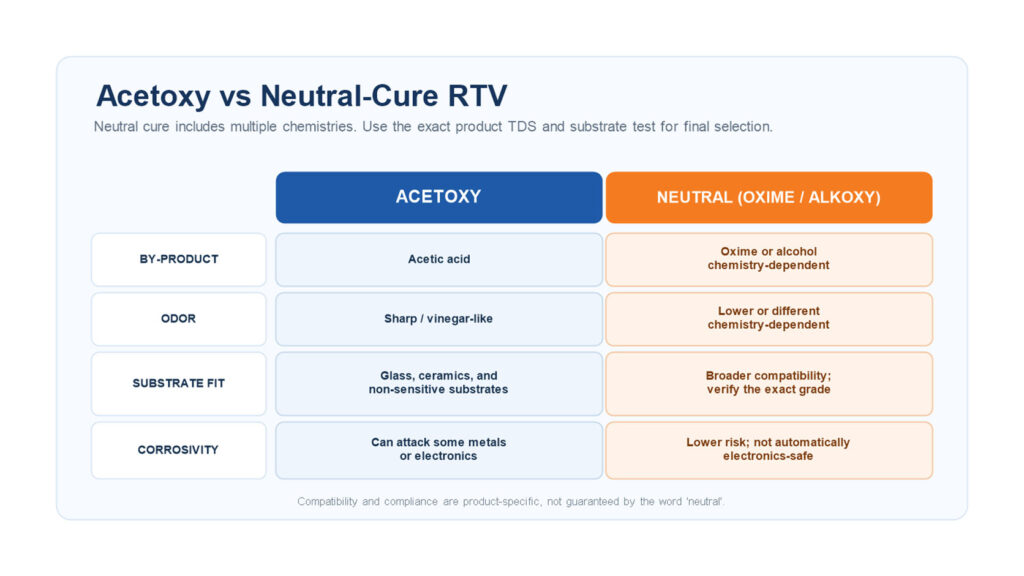
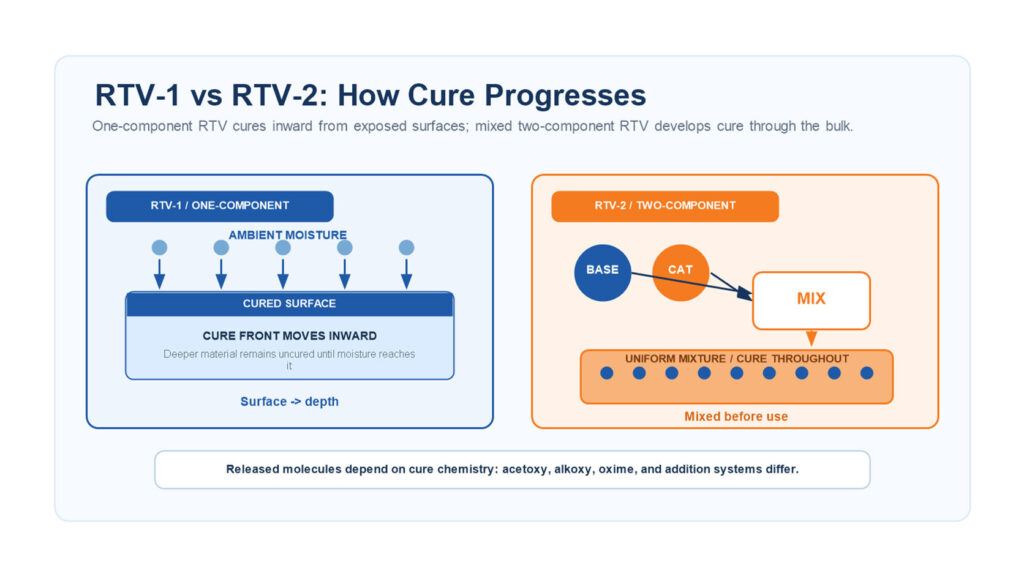
One-part (RTV-1) is a ready-to-use silicone that cures in a single step as moisture in the air reacts with it, setting from the surface inward. The by-product it releases defines the type:
- Acetoxy — fast and strongly adhesive, but releases acetic acid (the “vinegar” smell) and can corrode metals and electronics.
- Oxime and alkoxy (neutral cure) — slower, low odor, and non-corrosive; preferred on sensitive substrates and electronics.
Because RTV-1 cures from the outside in, it’s limited by section thickness — a thick bead can stay uncured in the middle.
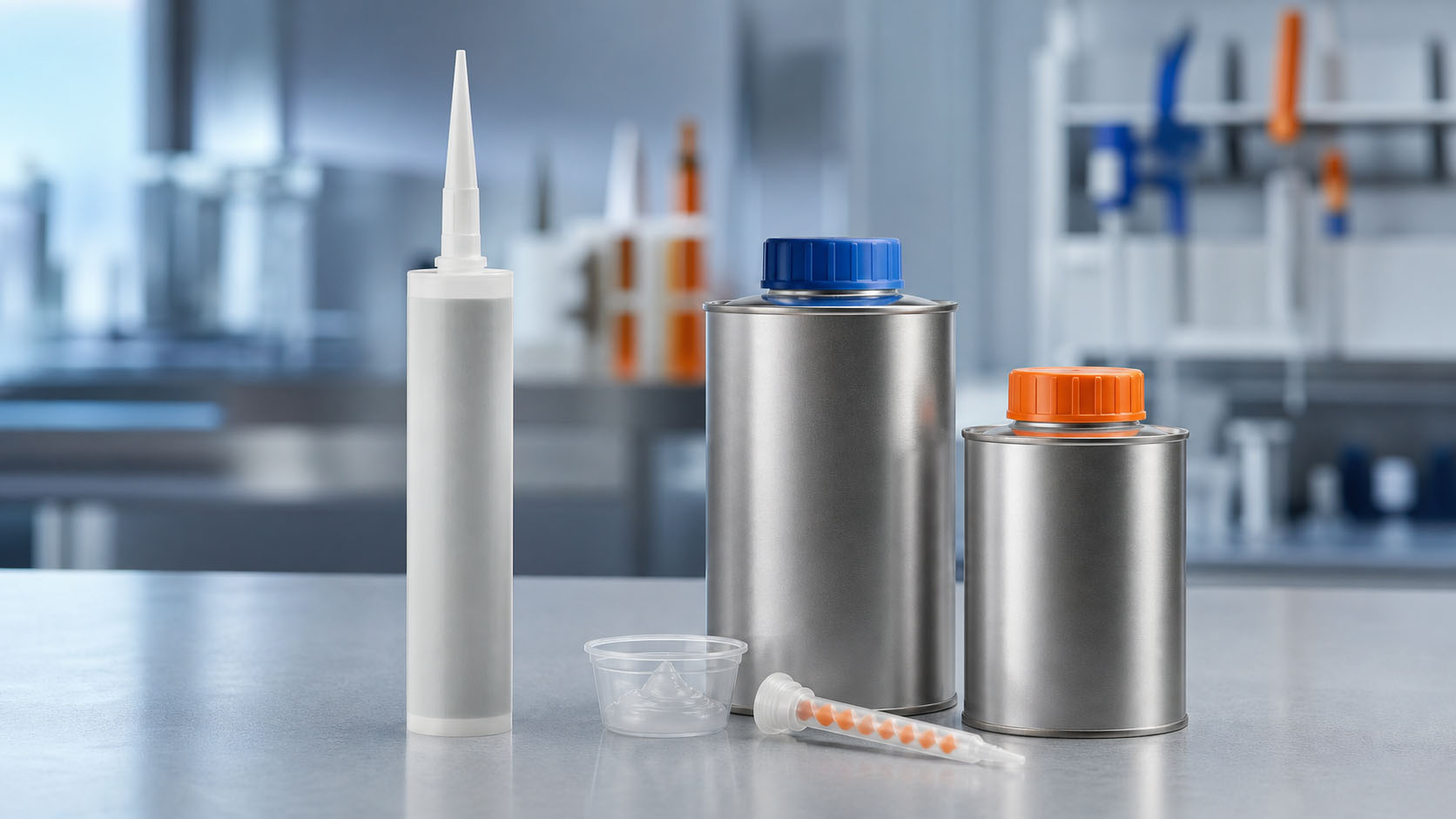
Two-part (RTV-2) is a silicone supplied as a separate base and catalyst that cures uniformly all the way through once the two are mixed, independent of air. It comes in two chemistries:
- Condensation (tin) cure — tolerant and economical, the workhorse for mold making, but it releases a small alcohol by-product and shrinks slightly.
- Addition (platinum) cure — no by-product, almost no shrinkage, and food- and medical-grade capable, but sensitive to contamination that can inhibit the cure.
RTV vs HTV vs LSR: How the Forms Differ
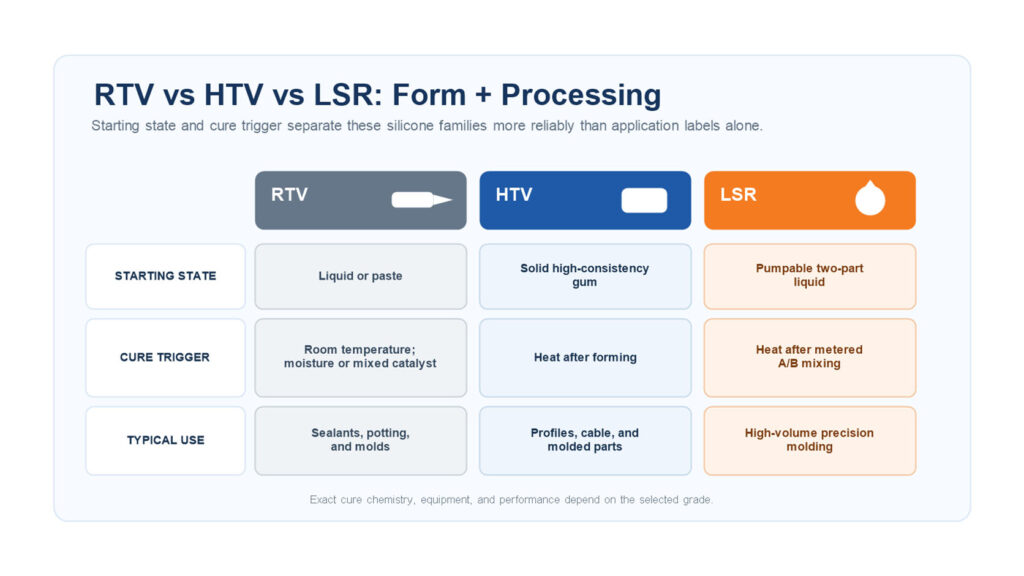
RTV is the room-temperature member of the silicone family — its siblings HTV and LSR both need heat to cure.
| Form | Cures at | Typical use |
|---|---|---|
| RTV | Room temperature | Sealing, bonding, potting, mold making |
| HTV (HCR) | Heat, ~150–200°C | Extruded profiles, cable, high-strength parts |
| LSR | Heat, injection molded | High-volume, precision molded parts |
For heat-cured production parts, our LSR vs HTV guide compares those two side by side.
Key Properties of RTV Silicone
- No heat or tooling needed: cures at ambient temperature with minimal equipment.
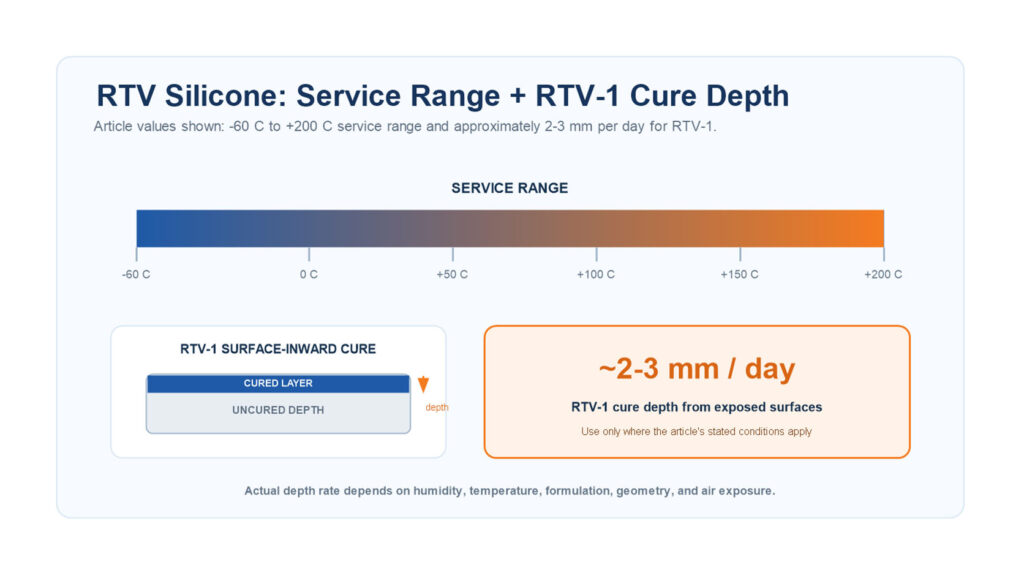
- Wide service temperature: roughly −60°C to +200°C once cured.
- Weather, UV, and ozone resistance: stays stable outdoors for years.
- Electrical insulation: dielectric properties suit potting and encapsulation.
- Flexibility and elongation: absorbs movement and vibration without cracking.
Where RTV Silicone Is Used
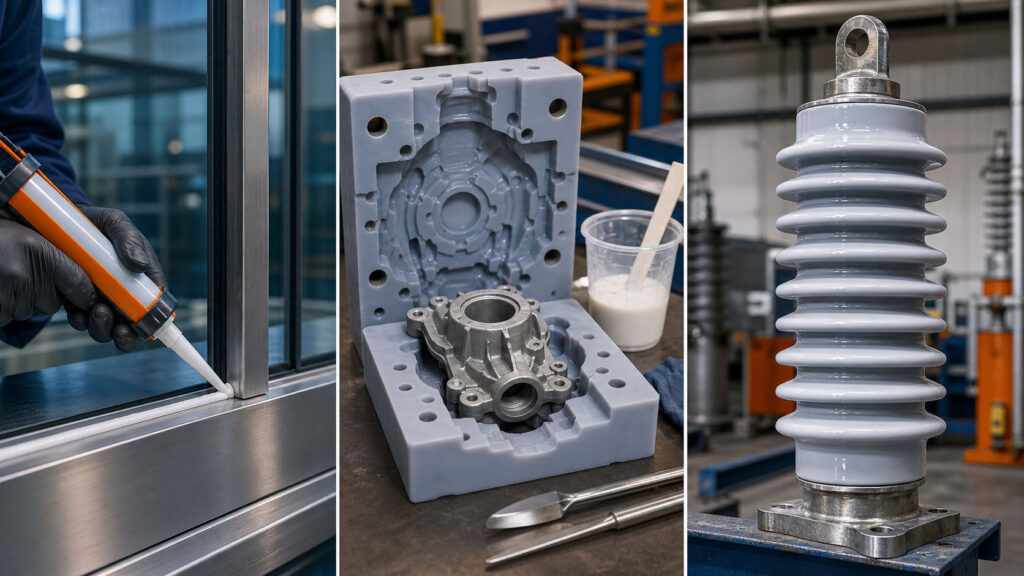
- Sealants: construction joints, glazing, sanitary, and weatherproofing.
- Adhesives: bonding glass, metal, and plastic, often with a primer.
- Electronics: potting, encapsulation, and conformal coatings (neutral-cure grades).
- Mold making: tin condensation RTV-2 for casting resin, wax, plaster, and concrete.
- Gaskets: form-in-place gaskets (FIPG) in automotive and equipment assembly.
- High-voltage insulator coatings: RTV coatings restore surface hydrophobicity on outdoor ceramic and glass insulators.
What to Check When Specifying RTV
- One-part or two-part: RTV-1 for convenience and thin beads; RTV-2 for full-depth cure and larger volumes.
- Cure chemistry: acetoxy is fast but corrosive — use neutral (oxime/alkoxy) on metal and electronics.
- Tin vs platinum (RTV-2): platinum for low shrinkage, food, and medical; tin for economical mold making.
- Section thickness: moisture-cured RTV-1 can’t cure thick sections — switch to RTV-2.
- Substrate and primer: clean, dry surfaces and the right primer decide whether it sticks.
- Pot life and cure speed: RTV-1 skins over in minutes but cures deep slowly (roughly 2–3 mm per day); RTV-2 pot life and cure time are tunable through catalyst level.
- Hardness and physical properties: match Shore A hardness, tensile strength, and elongation to the job — softer grades for flexible molds, firmer grades for structural seals.
- Certification: for food-contact or medical use, specify platinum-cure RTV-2 with the relevant FDA or ISO 10993 compliance.
Frequently Asked Questions
What does RTV stand for?
RTV stands for room temperature vulcanizing — silicone that cures at room temperature without added heat.
What’s the difference between RTV-1 and RTV-2?
RTV-1 is one-part and cures with air moisture; RTV-2 is two-part, mixed with a catalyst, and cures all the way through regardless of air.
Why does some RTV silicone smell like vinegar?
That’s acetoxy-cure RTV-1 releasing acetic acid as it cures. Neutral-cure (oxime or alkoxy) grades avoid the odor and won’t corrode metal or electronics.
Does RTV silicone need heat to cure?
No. It cures at room temperature; heat isn’t required, though warmth and humidity can speed up a moisture-cured grade.
For how RTV fits within silicone curing overall, see What Is Silicone Vulcanization.
References
- Silicone rubber — Encyclopædia Britannica, RTV and HTV forms.
- RTV silicone — overview of acetoxy cure and acetic-acid corrosion.
- An overview of the chemistry of condensation curing silicone sealants and adhesives — peer-reviewed review (tin/titanium catalysts).
- Crosslinking and modification of silicones — University of Wuppertal, addition vs condensation vs peroxide curing.
- IEEE 1523-2018 — RTV Silicone Rubber Coatings for Outdoor Ceramic Insulators — IEEE Standards Association.
- Synthesis and Characterization of Room Temperature Vulcanized Silicone Rubber — peer-reviewed study, U.S. National Library of Medicine (PMC).