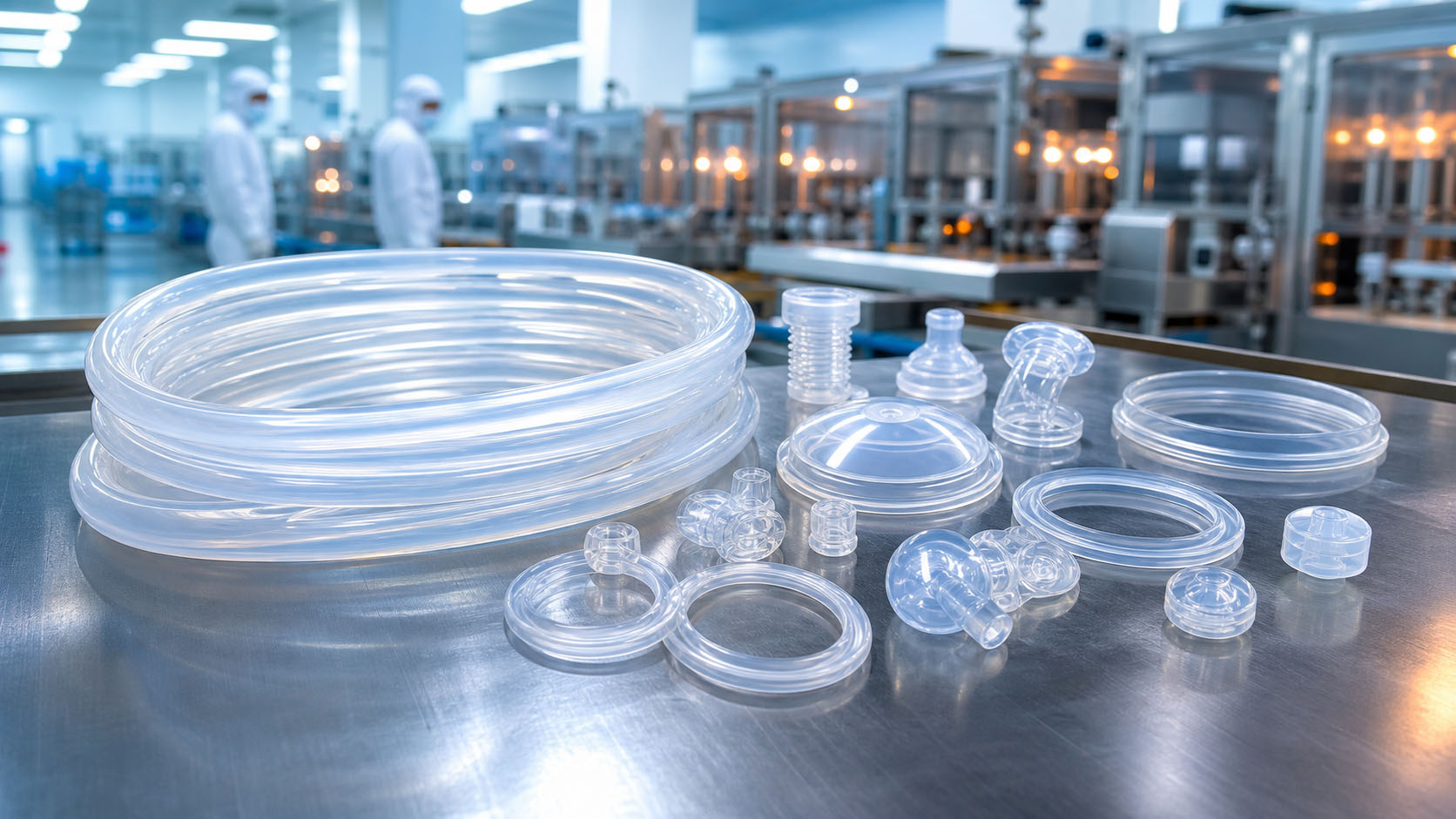
Buyers pick platinum cure because it reads like the safe default — “food-grade, medical-grade, no by-products” — and assume that box is closed the moment they spec it. The failure, when it comes, doesn’t look like a bad decision. It looks like a batch that won’t fully cure: tacky surfaces, soft spots, parts that passed last lot and fail this one. The platinum is almost never the problem. What went wrong is contamination the platinum system is uniquely allergic to.
Platinum vulcanization (also called addition or platinum cure) is a method of curing silicone in which a platinum catalyst drives a hydrosilylation reaction between Si–H and vinyl groups, cross-linking the polymer with no by-products, no mandatory post-cure, and very low shrinkage.
Executive summary
- Platinum vulcanization is addition cure: platinum catalyzes a hydrosilylation reaction (Si–H + vinyl) with no by-products, no mandatory post-cure, and very low shrinkage — the reasons it dominates FDA 21 CFR 177.2600 food-contact and ISO 10993 medical parts.
- Its defining weakness is cure inhibition: trace sulfur, amines, and tin catalysts from condensation-cure silicone deactivate the platinum and leave parts under-cured or sticky.
- You pay a premium for platinum cure — spend it where purity, clarity, and dimensional precision actually matter, not on industrial parts a peroxide cure would serve for less.
How Platinum Vulcanization Actually Works
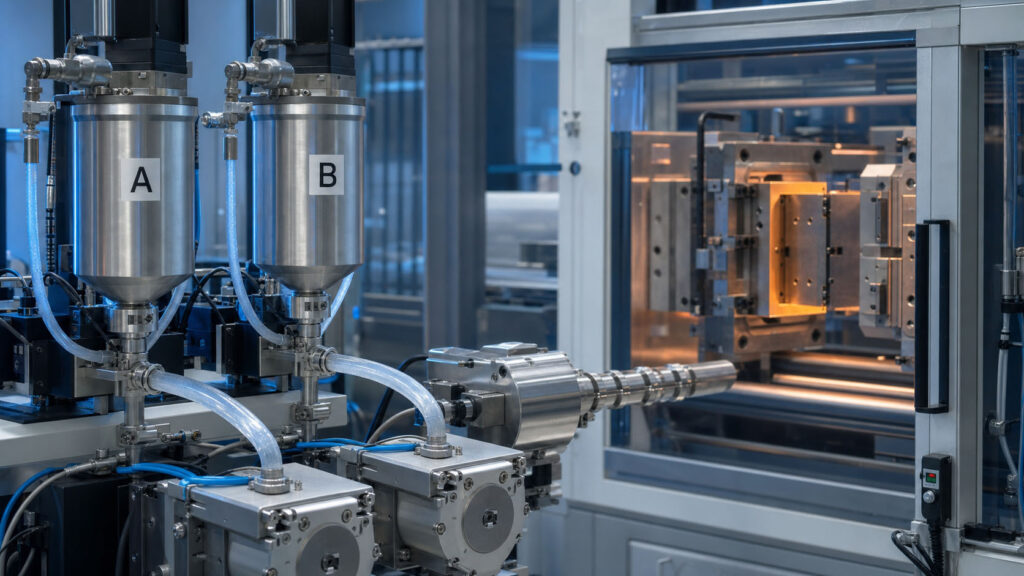
Platinum vulcanization is an addition-cure reaction. A platinum complex — typically Karstedt’s catalyst — drives hydrosilylation: silicon-bonded hydrogen (Si–H) on a crosslinker adds across the vinyl groups on the polymer, knitting the chains into a network. Nothing is released in the process. No water, no alcohol, no acidic fragments — which is exactly why the cured part comes out clean.
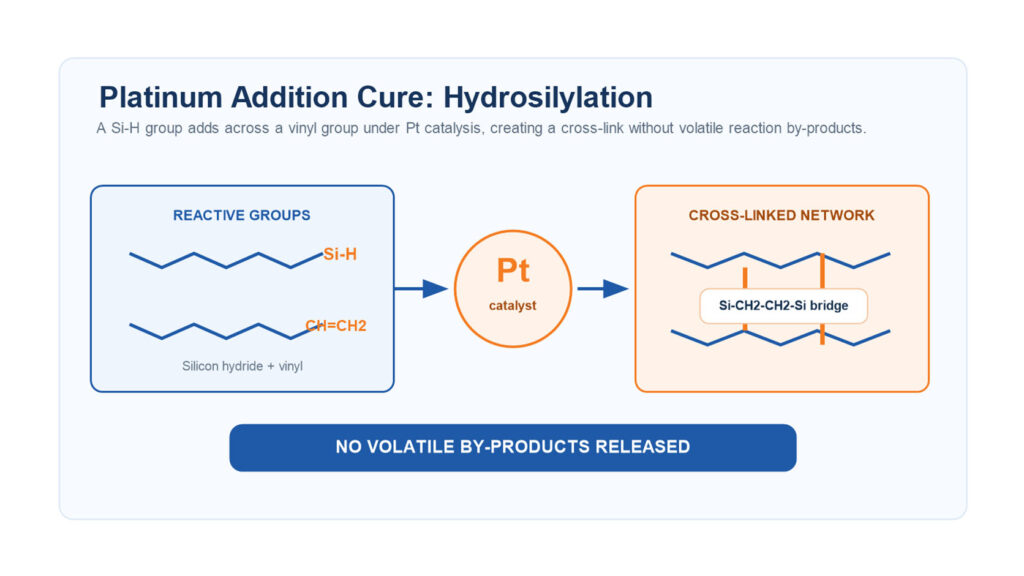
The system ships as two parts (A/B): one carries the vinyl polymer and platinum, the other the Si–H crosslinker. Mix them and cure begins; heat simply accelerates it. That holds for both LSR (liquid silicone rubber) injection molding and HTV solid silicone.
- No by-products to bake out, so post-cure is optional for most parts, not mandatory.
- Low shrinkage, which is why platinum LSR can hold tight tolerances.
- Optical clarity that peroxide and condensation cures can’t match.
Platinum cure isn’t tied to one form factor. It’s the standard chemistry behind most LSR (liquid silicone rubber) and much HTV solid silicone, and it appears in some RTV systems too — though RTV is just as often condensation (tin) cured. Choosing between the two most common production forms? LSR vs HTV breaks down the processing and cost trade-offs.
Where Platinum Cure Quietly Fails: Inhibition and Poisoning
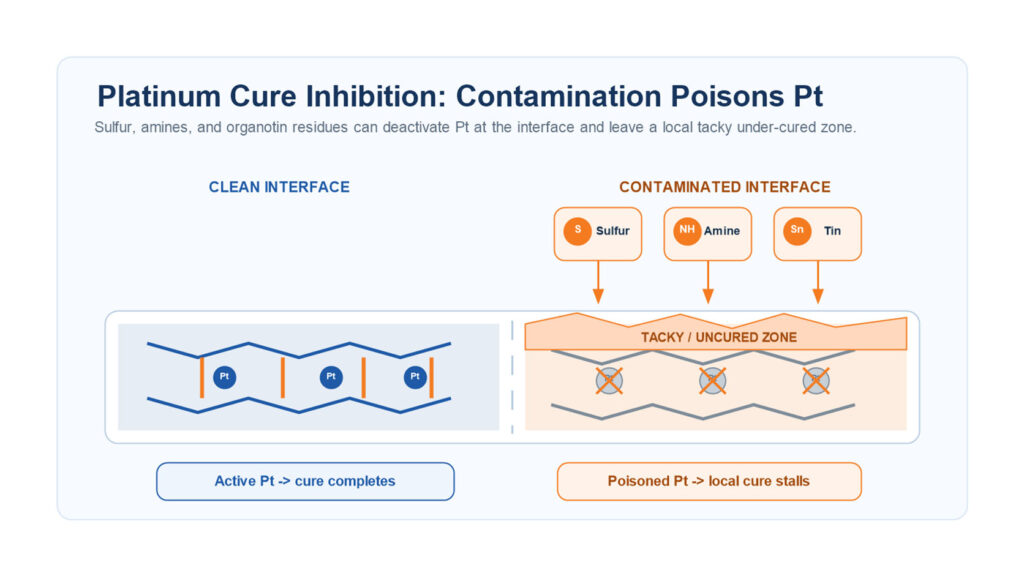
This is the part that catches teams out. The platinum catalyst is extremely sensitive to trace contaminants — parts per million are enough to stall the reaction, a failure mode called cure inhibition or catalyst poisoning.
The usual poisons on a real line:
- Sulfur — from peroxide-cured rubber, some gloves, and shop dust.
- Amines — from epoxies, urethanes, and certain adhesives.
- Tin — residue from condensation-cure (tin-catalyzed) silicone sharing the same tooling.
- Plasticizers and some tapes or plastics in contact with the part during cure.
The symptoms aren’t a clean reject — they’re subtle: a tacky or uncured skin, soft inner sections, durometer that drifts batch to batch. That ambiguity is what makes it expensive; the parts look fine until they’re in assembly or already in the field.
Prevention is process discipline, not a better catalyst:
- Segregate platinum tooling and workstations from any condensation-cure or peroxide work.
- Validate every adhesive, tape, mold release, and substrate for compatibility before production.
- Keep the line clean and control who handles the material.
What You Actually Pay For
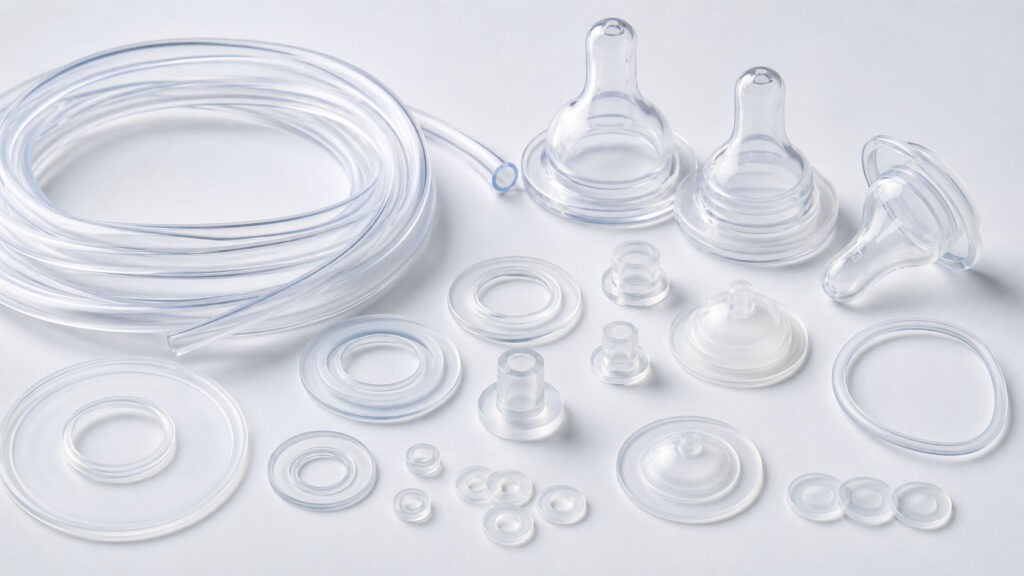
Platinum-cured silicone costs more — the catalyst is platinum, and the process demands cleaner handling. What the premium buys:
- Purity: no cure by-products or residues, so it clears FDA 21 CFR 177.2600 and supports ISO 10993 biocompatibility work without fighting extractables.
- Dimensional precision: low shrinkage and repeatability, essential for sealing geometry and fine molded LSR detail.
- Clarity and neutrality: water-clear parts, no cure odor, no yellowing — critical for medical, optical, and consumer goods.
- No mandatory post-cure for many parts, which offsets some of the cost in oven time versus a peroxide cure.
Where Platinum Cure Is Worth It — and Where It Isn’t
| Part / use case | Platinum cure fit |
|---|---|
| Medical tubing, implants, LSR device parts (ISO 10993) | ✅ Purpose-built |
| Baby & food-contact products (FDA 21 CFR 177.2600) | ✅ Strong fit |
| Optically clear or precision LSR molded parts | ✅ Strong fit |
| High-volume industrial seals/gaskets, non-contact | ⚠️ Often overspec — peroxide is cheaper |
| Lines that can’t isolate contamination sources | ⚠️ Inhibition risk may outweigh the benefit |
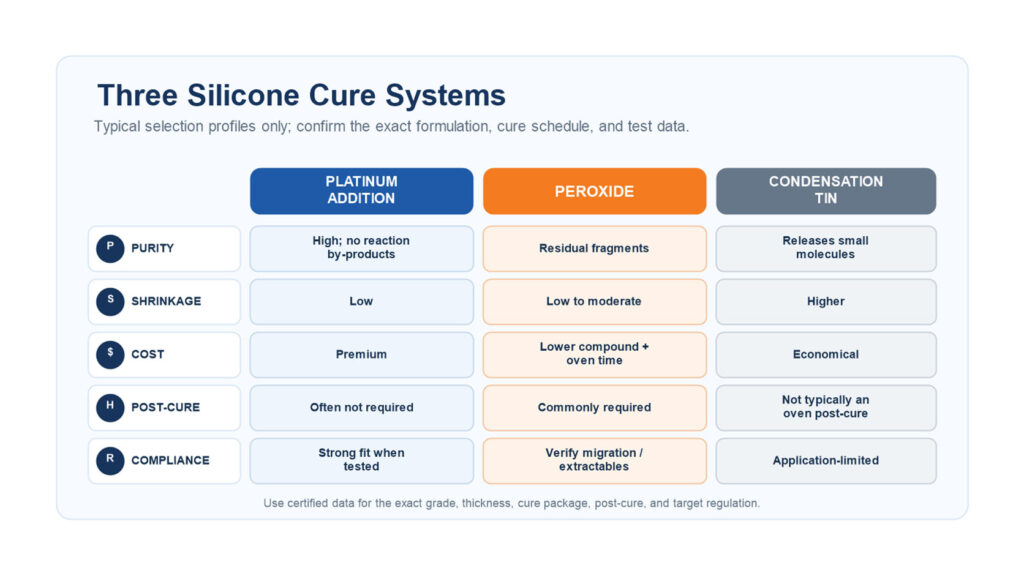
If the part doesn’t need purity, clarity, or tight tolerance, you’re paying for properties it won’t use — that’s the case a peroxide cure usually serves better. When the decision is genuinely close, our platinum-vs-peroxide selection guide walks the trade-offs side by side.
What to Confirm Before You Commit
Platinum vulcanization is the right default for anything touching a body, food, or an optical path — but only if the line can protect it. Before you lock it in:
- Contamination control: can the shop isolate platinum work from sulfur, tin, and amine sources, and who owns that on the floor?
- Material compatibility: has every adhesive, overmold substrate, tape, and release agent been checked for inhibition?
- Form: LSR for high-volume precision, or HTV for extruded and compression parts — the cure chemistry is shared, the processing isn’t.
- Cost vs. requirement: is the premium buying a property the part actually needs?
For the full method overview and how platinum sits against the other cure systems, see What Is Silicone Vulcanization.
References
- Platinum-Catalyzed Hydrosilylation in Polymer Chemistry — peer-reviewed review, U.S. National Library of Medicine (PMC).
- Karstedt’s catalyst — reference overview of the platinum(0) complex used in addition cure.
- Guarding against cure inhibition in addition-cure silicones — Dow technical FAQ.
- FDA 21 CFR 177.2600 — rubber articles for repeated food contact — U.S. Code of Federal Regulations (eCFR).
- ISO 10993-1 biological evaluation of medical devices — U.S. FDA guidance.