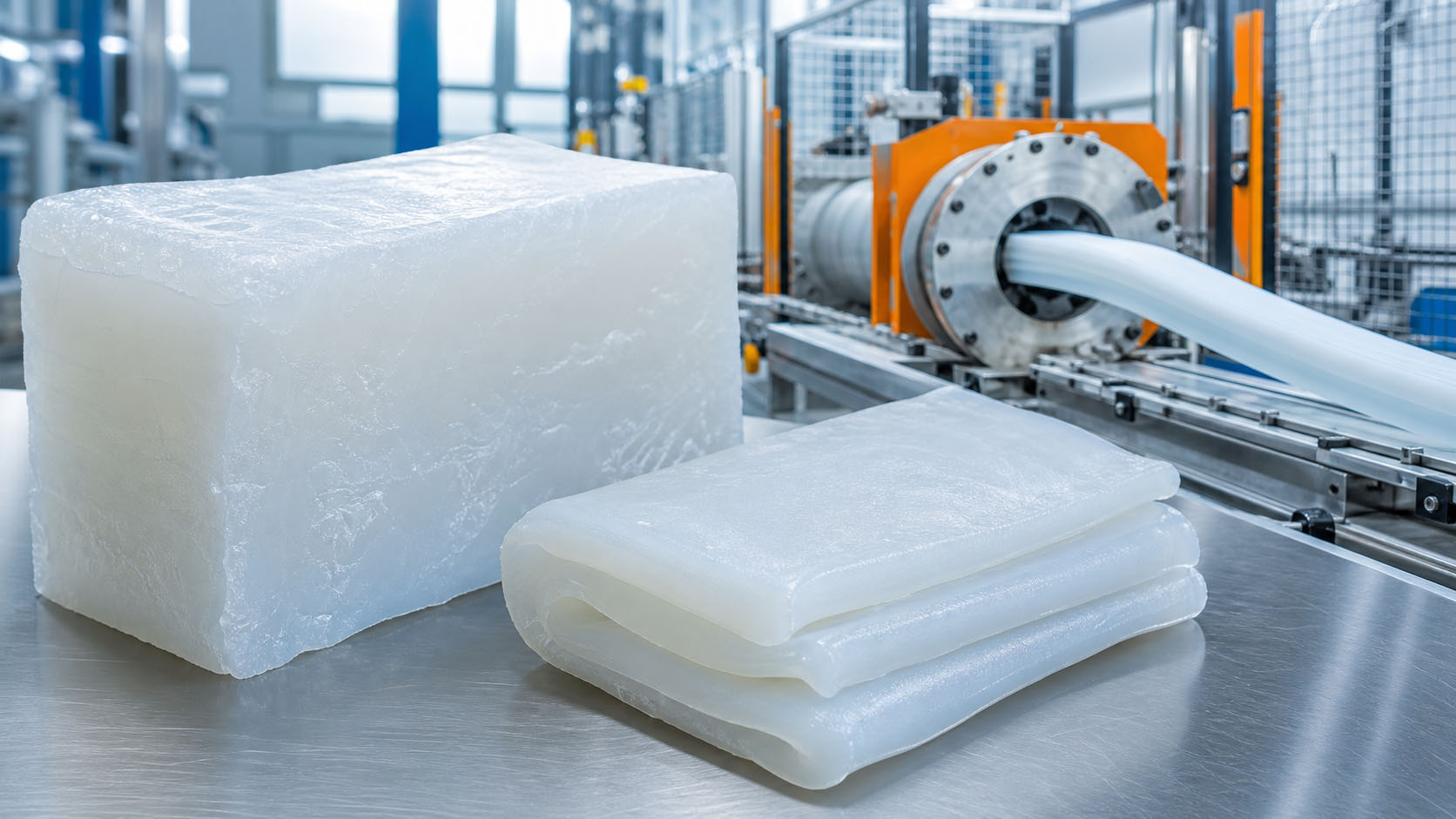
“Silicone rubber” on a drawing doesn’t tell your molder much. The biggest fork is the form the material starts in — and HTV is the solid, dough-like form behind most extruded and high-strength molded silicone parts. Pick the wrong form and you’ve locked in the wrong process, tooling, and cost before the first sample runs.
HTV (high temperature vulcanizing) silicone rubber is a solid, high-consistency silicone — also called HCR or gum — that is shaped and then cured with heat, usually above 150°C, using a peroxide or platinum system to cross-link it into a durable elastomer.
The rest of this page covers how HTV is cured, how it differs from LSR and RTV, what properties it brings, and where it’s the right choice.
How HTV Silicone Rubber Is Cured
HTV arrives as a stiff, high-consistency gum (HCR) — much closer to modeling clay than the pourable liquid of LSR. Turning that gum into a finished part runs roughly like this:
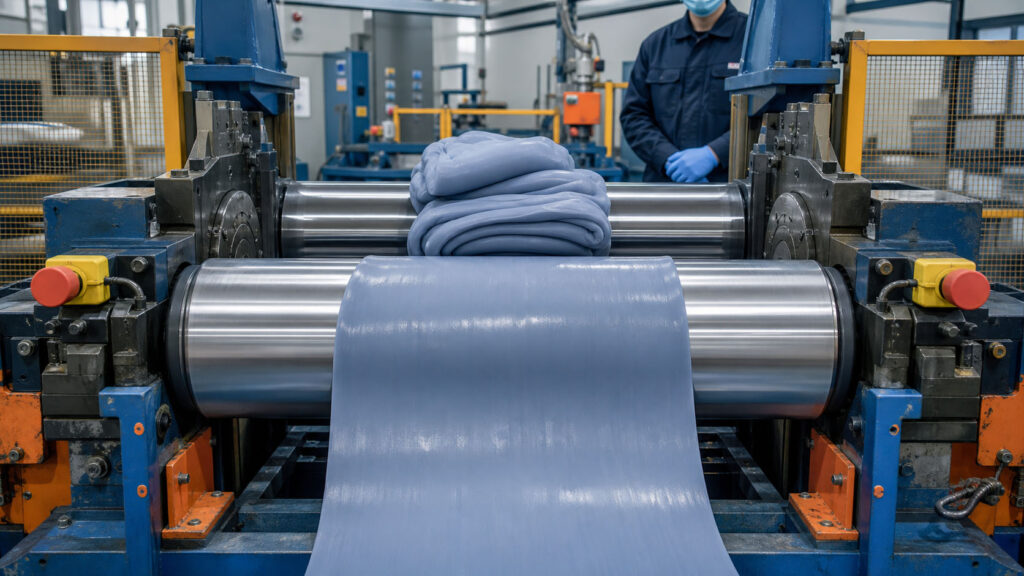
- Compounding: the gum is blended with reinforcing filler, pigment, and a curing agent, typically on a two-roll mill.
- Forming: the compound is compression molded, transfer molded, or extruded into shape.
- Vulcanizing: heat — usually 150–200°C — drives cross-linking; extruded profiles run through continuous hot-air vulcanization (HAV).
- Post-curing: a secondary oven bake, especially for peroxide-cured parts, drives off residues and stabilizes the final properties.
HTV can be cured by either of the two main silicone chemistries:
- Peroxide cure — the traditional route for extruded and hot-air-vulcanized profiles. Low cost, but it leaves residues and makes post-curing effectively mandatory.
- Platinum (addition) cure — cleaner, with no by-products, used where purity, clarity, or food- and medical-grade compliance matter.

HTV vs LSR vs RTV: How the Forms Differ
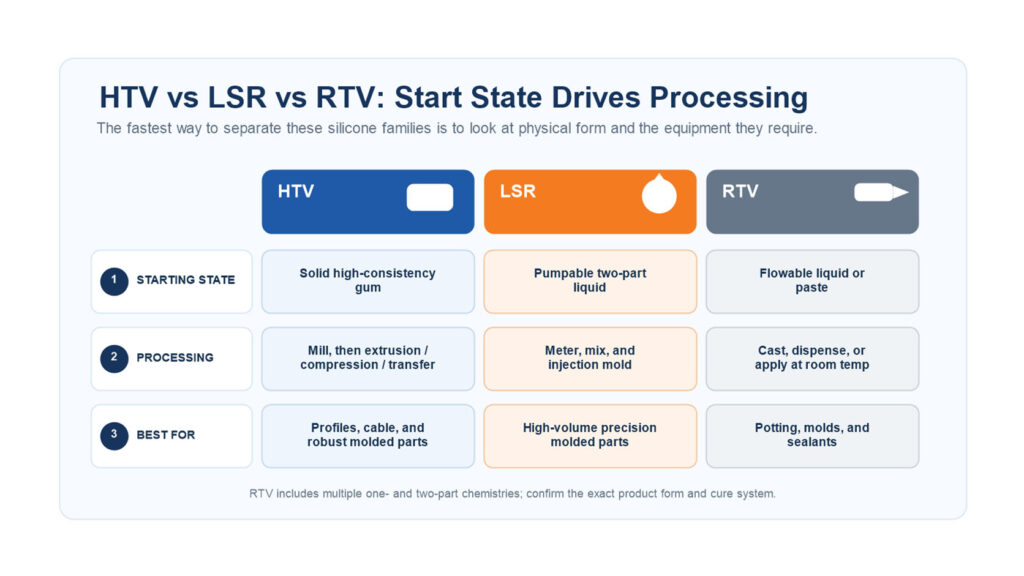
HTV is one of three common silicone forms — alongside LSR and RTV. They share similar base chemistry but behave completely differently on the floor.
| Form | Starting state | Typical processing | Best for |
|---|---|---|---|
| HTV (HCR) | Solid gum | Milling, compression/transfer molding, extrusion | Extruded profiles, cable, high-strength & high-durometer parts |
| LSR | Pourable liquid | Automated liquid injection molding | High-volume, precision, small-to-medium parts |
| RTV | Pourable / paste | Cures at room temperature | Molds, prototyping, sealing, low-volume |
If your decision is really HTV against liquid silicone for a production part, our LSR vs HTV guide breaks down the processing and cost trade-offs.
Key Properties of HTV Silicone Rubber
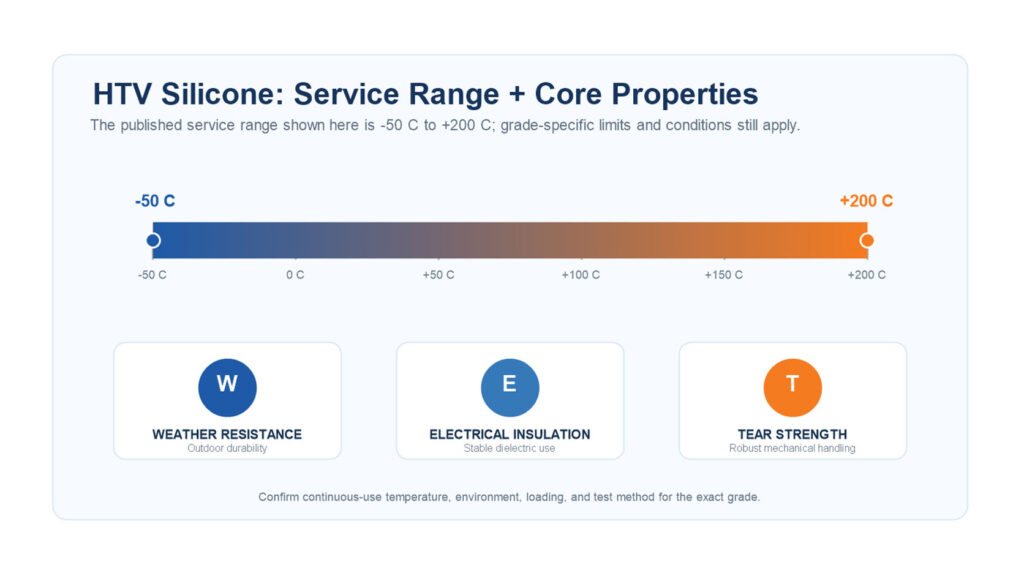
- Wide service temperature: roughly −50°C to +200°C continuous, with short excursions higher.
- Strong mechanicals: available in high-tear and high-tensile grades, and in high Shore A durometers.
- Electrical insulation: a mainstay for wire, cable, and high-voltage insulators.
- Chemical, weather, and UV resistance: stable outdoors and against many oils and solvents.
- Formulation range: reinforced, flame-retardant, and specialty grades (e.g., phenyl-based PVMQ for extreme cold).
Where HTV Silicone Rubber Is Used
Because it can be milled, molded, and extruded into tough, heat-stable parts, HTV shows up across electrical, industrial, automotive, and medical work:
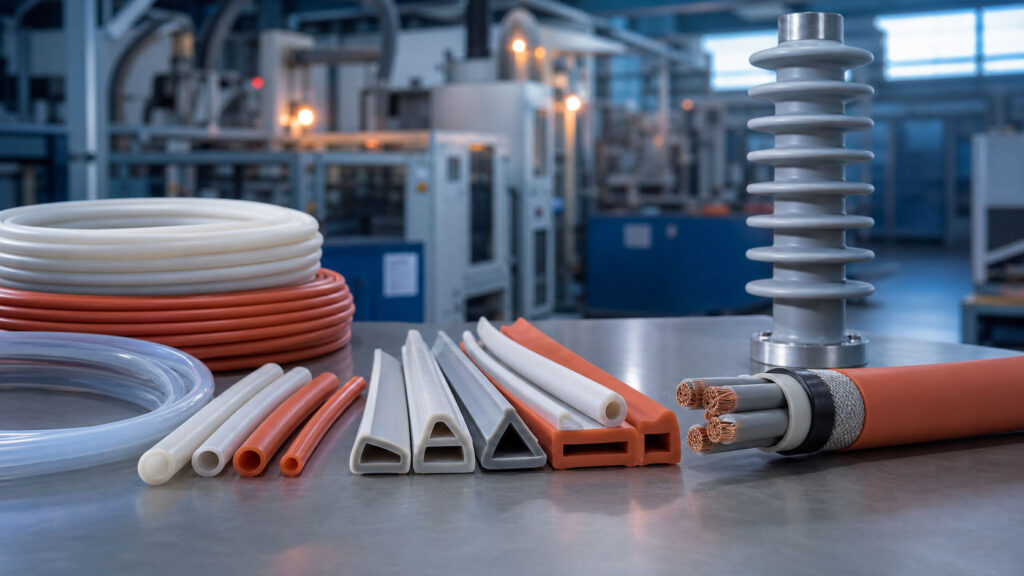
- Wire & cable insulation: primary insulation and jacketing for power and control cables, plus high-voltage insulator sheds and housings that resist heat and surface tracking.
- Extruded profiles, tubing & hoses: continuous hot-air-vulcanized seals, gaskets, U-channels, sponge/foam profiles, and reinforced hoses produced in long, uninterrupted runs.
- Keypads, membranes & switches: durable, tactile compression-molded controls for equipment, remotes, and appliances — for example high-tactile-response and waterproof silicone keypads.
- Automotive & e-mobility: turbo and spark-plug boots, ignition components, radiator and coolant hoses, and EV battery seals that live with heat and vibration.
- Molded industrial parts: high-durometer grommets, bushings, O-rings, seals, and anti-vibration mounts where tear strength and dimensional stability matter.
- Appliance, lighting & electronics: oven-door and steam-iron gaskets, LED lenses and gaskets, and encapsulation exposed to repeated heat cycling.
- Medical & food contact: platinum-cured, post-cured HTV for tubing, seals, and repeated-contact parts that must meet food- and medical-grade compliance.
- Consumer & wearable goods: compression-molded solid-silicone items such as silicone wristbands and rugged straps that need toughness and colorfastness.
What to Check When Specifying HTV
- Cure system: peroxide or platinum? This drives odor, residues, post-cure need, and food/medical compliance.
- Post-cure: is a secondary bake budgeted into lead time?
- Process: molded or extruded — the two need different tooling and grade choices.
- Durometer and grade: match hardness, tear, and any flame-retardant or cold-flex requirement to the part.
- Form fit: for high volumes and tight tolerances, weigh HTV against LSR before committing.
Frequently Asked Questions
What does HTV stand for?
HTV stands for high temperature vulcanizing — silicone rubber that is cured with heat, typically above 150°C.
Is HTV the same as HCR?
Effectively yes. HTV is often called HCR (high consistency rubber) because it starts as a stiff, solid gum rather than a liquid.
Does HTV silicone rubber need post-curing?
Peroxide-cured HTV almost always needs a post-cure to drive off residues and reach stable properties. Platinum-cured HTV often does not.
HTV or LSR — which should I choose?
Use HTV for extrusion, cable, and high-strength or high-durometer parts; choose LSR for high-volume, precision molded parts. See our LSR vs HTV guide for the full comparison.
For how HTV fits within silicone curing overall, see What Is Silicone Vulcanization.
References
- High-temperature-vulcanizing silicone rubber — Encyclopædia Britannica, definition of the HTV form.
- Vulcanization — Encyclopædia Britannica, cross-linking of elastomers.
- ASTM D2240 — Standard Test Method for Rubber Property, Durometer Hardness — ASTM International.
- IEC 62217 — Polymeric HV insulators: definitions, test methods and acceptance criteria — International Electrotechnical Commission.
- A Proposal for the Evaluation of HTV Silicone Rubber Composite Insulators — peer-reviewed study, U.S. National Library of Medicine (PMC).
- High Consistency Silicone Rubber Foams — peer-reviewed review noting continuous hot-air/infrared vulcanization (PMC).