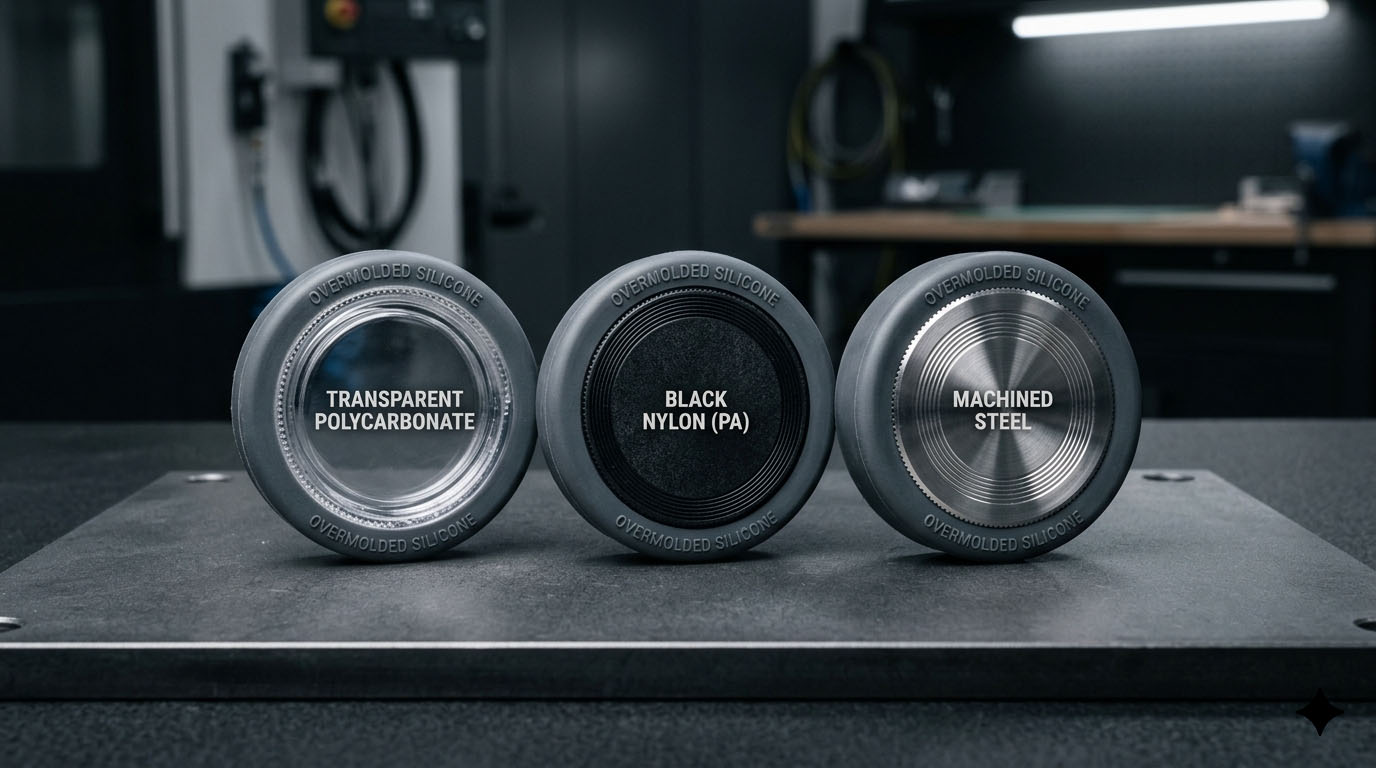
Most silicone overmolding programs don’t fail because silicone “won’t stick.” They fail because the team treated the substrate like a standard insert-molding job and assumed the bond was locked the moment the part left the tool.
It isn’t. Silicone overmolding adhesion is a process state, not a material property. On day one, a hand-pull test passes. Thirty days later—after thermal cycling, humidity, and repeated compression—the edge lifts.
The gap almost always shows up after tooling is already paid for.
Executive Summary
- Adhesion is a process outcome, not a material spec. The same substrate can bond or peel depending on surface state, timing, and cure control.
- Each substrate fails in its own way. PC drifts with surface aging, PA fails with reabsorbed moisture, metal fails only when prep is rushed.
- Validate bonding under production timing—not ideal-lab timing—before locking tooling. Bonds that only hold when inserts are molded immediately do not hold in a real second shift.
Silicone Overmolding Adhesion Is Three Problems, Not One
When people say silicone doesn’t stick, they compress three separate mechanisms into one complaint:
- Chemical compatibility between the silicone cure system and the substrate.
- Surface energy and cleanliness at the moment of molding.
- Mechanical constraint while the silicone cures and shrinks.
Miss any one and the bond can look fine on day one and peel on day thirty. That is why early prototypes pass and field parts don’t. Addition-cure (platinum) silicone, which most overmolding uses, is especially sensitive here: it inhibits against surface contaminants that peroxide systems tolerate.
Silicone-to-PC Bonding: A Narrow Process Window
What works
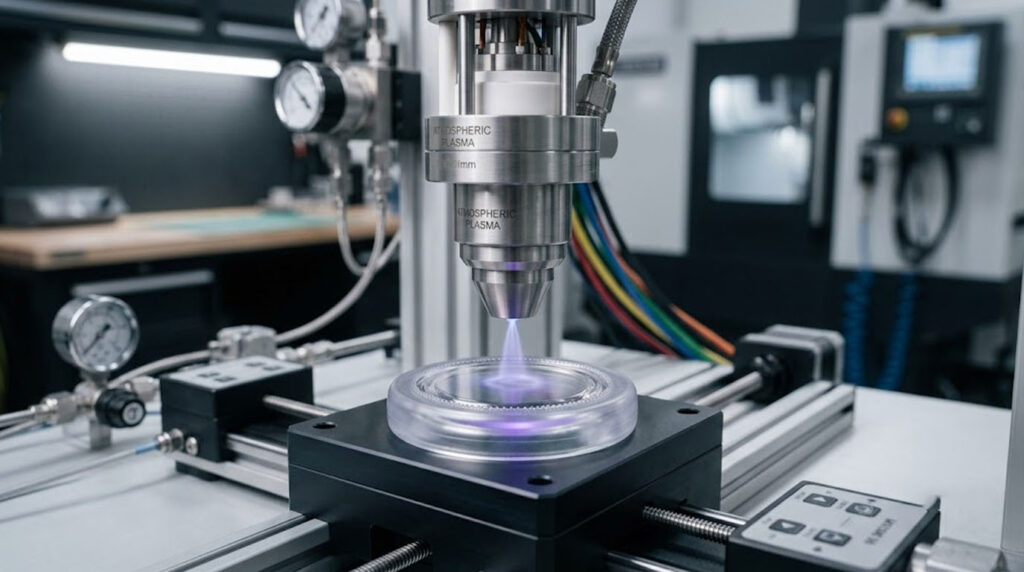
Silicone bonds to polycarbonate, but inside a tight window. PC has moderate surface energy and responds to atmospheric plasma or corona activation. Once activated, an addition-cure silicone or a silane-based primer will chemically anchor to it.
In production this bond is process-sensitive, not material-sensitive.
What drifts
Three things move the window without anyone noticing:
- Mold temperature creeping above its setpoint (LSR typically cures around 120–180°C in-tool).
- Activation aging—plasma-treated PC surfaces re-oxidize within hours to a few days, so parts that wait lose surface energy.
- Release-agent vapor migrating from adjacent tools and re-contaminating the surface.
Once the surface re-oxidizes, adhesion drops fast and non-linearly. Teams underestimate this because PC is “easy” in plastics terms, so they expect stable behavior. Silicone punishes that assumption.
Silicone-to-PA (Nylon) Bonding: Moisture Is the Hidden Variable
PA looks promising on paper—higher polarity than PC, better initial wetting, stronger lab pull results. Then it introduces the one variable silicone hates: water.
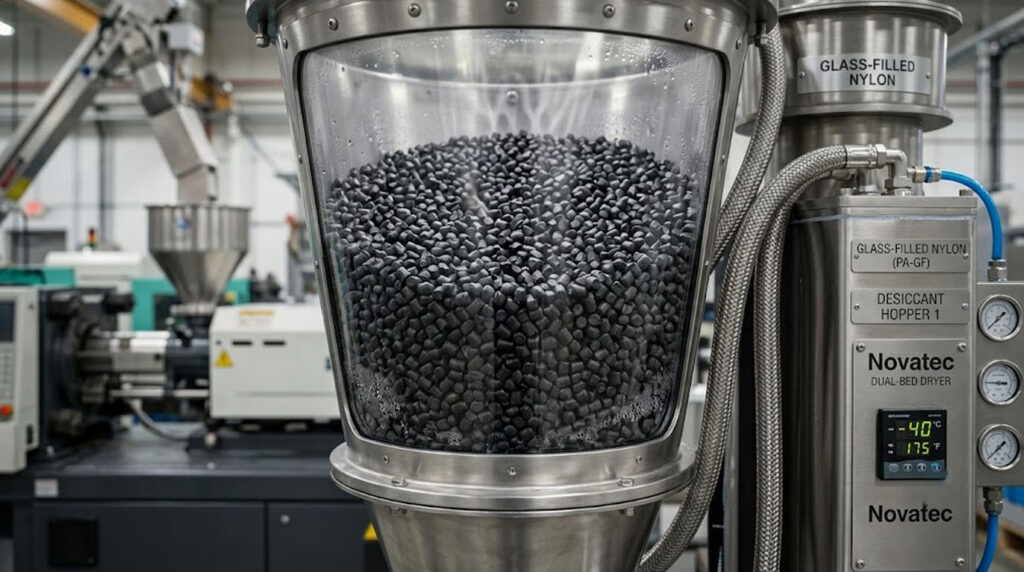
Even “dry” nylon reabsorbs moisture from ambient air. Unfilled PA6 can hold 1–3%+ moisture at equilibrium, and molders typically need it dried below ~0.2% before overmolding. That reabsorbed moisture:
- Interferes with interfacial bonding.
- Causes micro-voiding at the bond line during cure.
- Shifts bond strength batch to batch.
Glass-filled grades (e.g. PA6-GF30) make it worse: inconsistent surface resin exposure, fiber print-through, and local stress risers along the bond line.
The trap is timing. Samples molded straight out of the dryer perform well. Production parts that sit 24–72 hours before molding do not. This is a scheduling failure disguised as a material failure.
Silicone-to-Metal Bonding: Predictable If You Respect Surface Prep
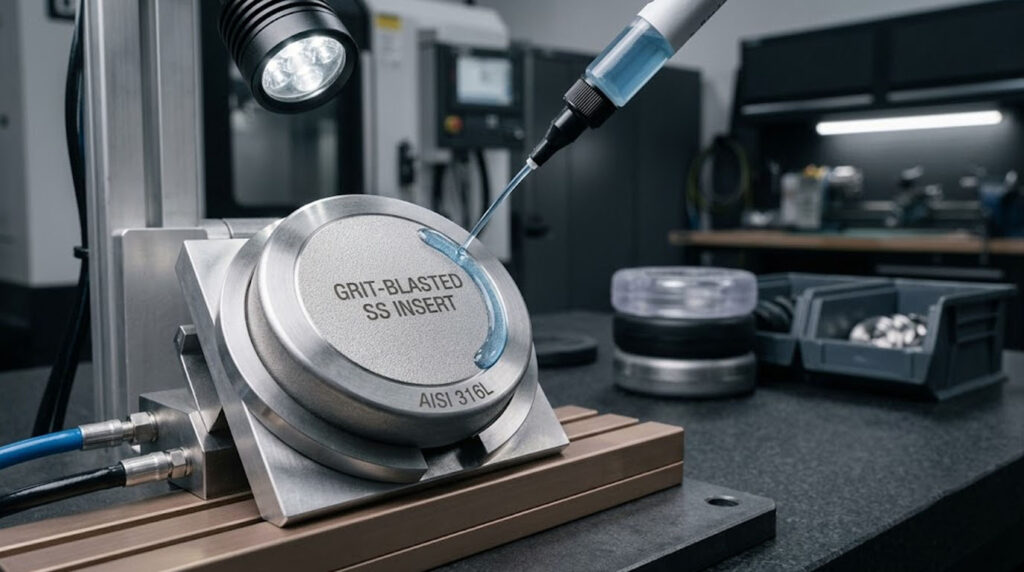
Metal—steel, aluminum, stainless—is where silicone bonding is most predictable, provided surface prep is treated as a controlled process and not a single step.
Stable bonds usually require:
- Grit blasting to a defined roughness (commonly Ra ~2–5 µm) or a controlled chemical etch.
- A controlled oxide layer.
- A primer matched to the silicone chemistry, applied at controlled thickness.
Once locked, these bonds survive thermal cycling, long-term compression set, and repeated mechanical load. Unlike PC or PA, metal bonds don’t drift over time when controlled.
But shortcuts fail quietly: “light” blasting to save cycle time, finger oils after cleaning, and primer thickness variation across cavities. Metal doesn’t forgive inconsistency—it just fails later instead of louder.
PC vs PA vs Metal: Silicone Overmolding Bonding at a Glance
| Substrate | Primary bond mechanism | Typical surface prep | Reliability | Dominant failure mode | Time-drift risk |
|---|---|---|---|---|---|
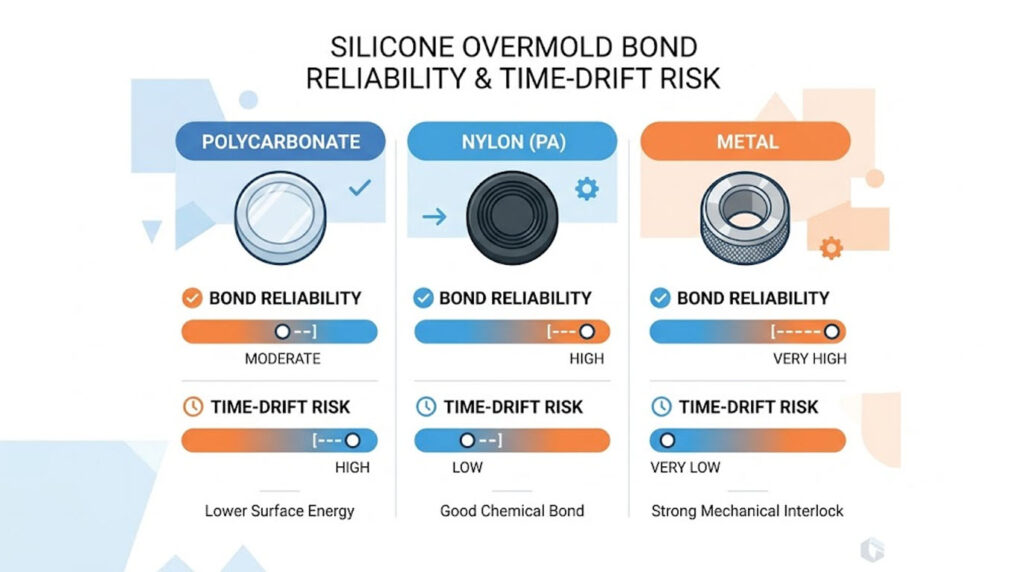
| PC (Polycarbonate) | Chemical (activated surface + addition-cure silicone) | Atmospheric plasma / corona; mold within activation window | Moderate, process-sensitive | Surface re-oxidation, release-agent contamination | High if parts wait after activation |
| PA / Nylon (incl. GF) | Chemical + partial mechanical | Dry below ~0.2% moisture; primer; plasma | Unstable batch-to-batch | Moisture micro-voiding, fiber print-through | High with ambient reabsorption |
| Metal (steel / aluminum / stainless) | Chemical (primer) + mechanical | Grit blast to Ra ~2–5 µm or etch; matched primer | Highest, when prep is controlled | Under-blasting, finger oils, primer variance | Low once locked |
Mechanical Locking Is Not a Substitute for Adhesion
Design teams often assume geometry will hold the silicone if chemistry fails. That is optimistic.
Mechanical retention works with chemical bonding, not instead of it. Without adhesion, silicone cold-flows under compression, edges lift first, and micro-movement grows with every cycle—over months, not weeks. Good overmold designs assume both: a chemical bond for sealing, mechanical features (undercuts, through-holes, keyed geometry) for load sharing. Bad ones assume geometry alone solves a chemistry problem.
Where Adhesion Actually Fails on the Floor
From a manufacturing standpoint, bonding problems surface at predictable points, and almost never during first-article approval:
- Cavity-to-cavity variation in a multi-cavity tool.
- Second-shift changeovers, where prep timing and handling discipline slip.
- Insert handling outside the mold—bare hands, staging bins, wait time.
Silicone cure hides these. You don’t see delamination until environmental aging, assembly stress, or repeated compression exposes it. By then the argument between design, molding, and quality is already happening.
Feasibility Is a Process-Control Question
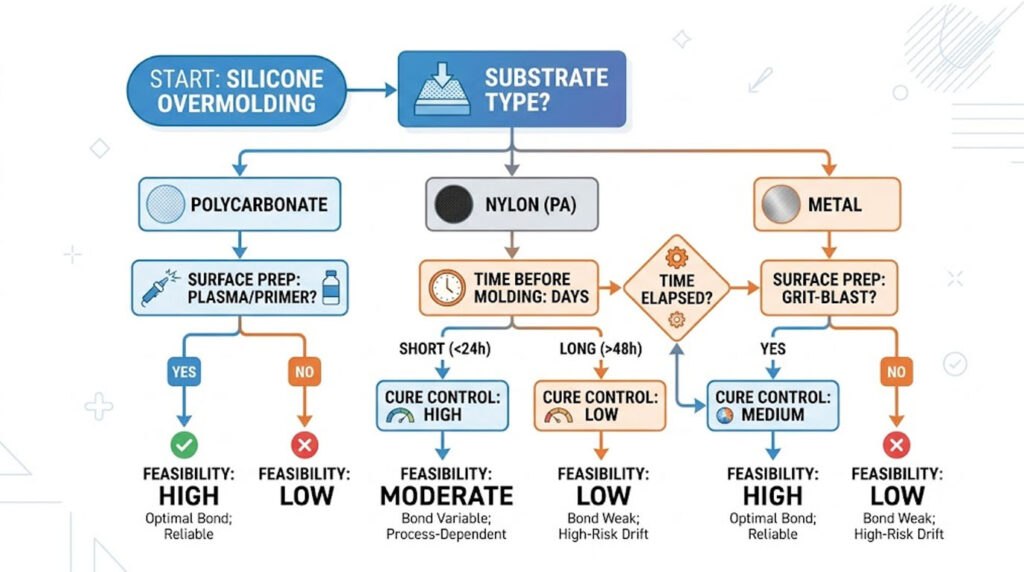
Can silicone be overmolded onto PC, PA, or metal? Yes—all three. Feasibility depends on whether the program can control the variables that never appear in the CAD model:
- Surface state at the moment of molding.
- Elapsed time between prep/activation and molding.
- Cure profile consistency across cavities and shifts.
- Insert handling discipline.
Most feasibility studies ignore these because they aren’t in the geometry. That is where the misjudgment starts—and where tooling gets locked too early.
What We Need Before Committing Tooling
This is where the useful conversation begins, not ends. To judge whether a bond will hold in production rather than in a sample tray, we need:
- Substrate grade, not just family (e.g. PA6 vs PA6-GF30, PC grade and any release additives).
- Target silicone cure system and hardness (Shore A range, platinum vs peroxide).
- Service environment—temperature range, compression, chemical exposure, expected life.
- Compliance scope if relevant (FDA 21 CFR 177.2600, LFGB, or ISO 10993 for medical), since these constrain primers and cure systems.
- Realistic floor timing between insert prep and molding.
Without those, any adhesion promise is a lab result waiting to drift. Silicone doesn’t fail loudly. It waits—and when it goes, it peels slowly, quietly, and expensively.