The polymer on your BOM says “silicone.” It doesn’t say how it’s cured — and that single choice, platinum or peroxide, decides odor, compliance, clarity, and cost more than the base material does. Teams that leave it to the factory usually find out which one they got after the first complaint.
“It depends” is the wrong answer here, because the decision is mostly binary and mostly irreversible once tooling and material are locked. Here’s the hard version.
The Short Answer
- If the part touches food, skin, or the body, or needs high clarity — it’s platinum cure. No trade to discuss.
- If it’s an industrial or general-purpose part where cost leads and odor/clarity don’t matter — peroxide cure wins on price.
- The expensive mistake is using peroxide on a sensitive part to save material cost, then paying it back in odor complaints, post-cure time, and failed migration tests.
How to Choose in One Question
Start here before any trade-off table:
- Contact with food / skin / body, or high transparency required → Platinum.
- Industrial, non-contact, cost-driven, odor-tolerant → Peroxide.
Most parts resolve on this line alone. The trade-offs below only matter when a part sits near the boundary.
Platinum vs Peroxide: Side-by-Side Comparison
| Factor | Platinum (addition) | Peroxide |
|---|---|---|
| Odor / by-products | None, odorless | Trace residue; needs post-cure to remove |
| Clarity / yellowing | High clarity, low yellowing | Average clarity, more yellowing |
| Compliance fit | FDA 21 CFR 177.2600, LFGB, USP Class VI / ISO 10993 | General industrial; hard to pass strict food/medical migration |
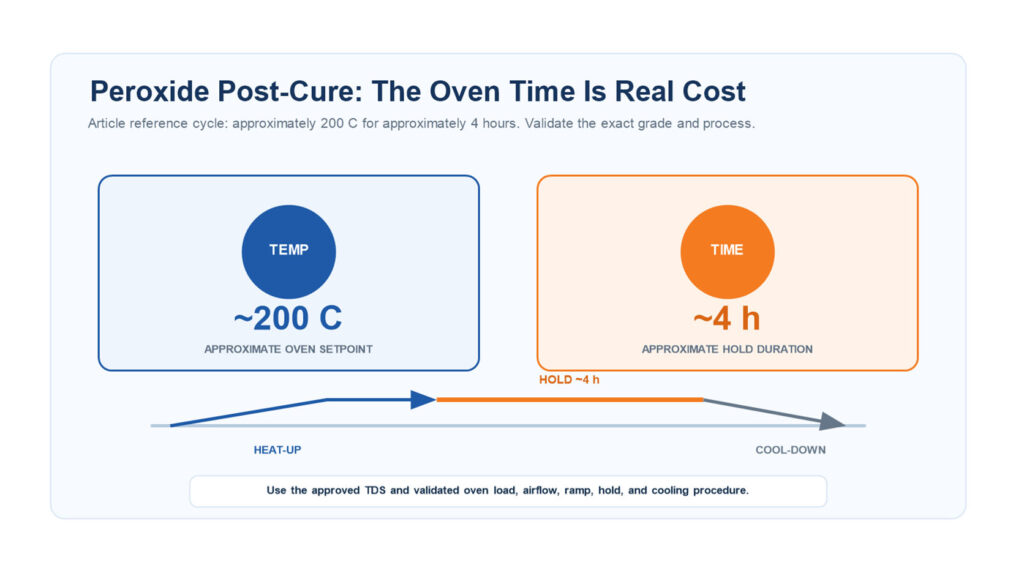
| Post-curing | Often minimal | Effectively mandatory (~200°C, ~4h) |
| Material / catalyst cost | Higher (platinum catalyst) | Lower |
| True landed cost | Fewer downstream steps | Add oven time + scrap risk |

Read the last two rows together: peroxide’s raw-material savings shrink once you add post-cure oven time and the scrap from residual odor. On sensitive parts, peroxide is often not cheaper — just cheaper on paper.
What Drives the Cost Difference
Peroxide’s material savings are real, but three costs move the decision:
- LFGB-grade silicone runs about 20–30% higher than standard FDA-grade. It needs a better base polymer and a longer post-cure, not just a different catalyst.
- Medical grade (USP Class VI / ISO 10993) must be molded in a Class 100,000 cleanroom. That is fixed overhead a peroxide industrial part never carries.
- Peroxide post-cure adds oven time (~200°C, ~4h), energy, and handling. See Silicone Products Post Cure.
Price the landed cost, not the material line: material + post-cure + scrap or rework from odor and migration rejects + re-quote risk if the part fails compliance.

How Molding Process and Volume Affect Cure Choice
The cure system rarely stands alone — it follows the process:
- LSR (liquid injection) is almost always platinum addition cure. High precision (tolerance to ±0.02mm), high cleanliness, no flash, but high tooling cost and higher MOQ.
- HTV (solid compression) runs platinum or peroxide. Cheaper tooling, looser tolerance, better for low-to-mid volume. See HTV Silicone.
So picking a cure system also locks your process and minimum order. A low-volume platinum part usually means HTV, not LSR.

Platinum Cure Inhibition: Check for Contamination
Addition (platinum) cure has one failure mode peroxide does not: inhibition. Contact with sulfur, amines, tin (condensation-cure catalyst residue), or some plasticizers can stall the cure. The result is incomplete cure and a tacky surface.
This matters when:
- The part is overmolded onto another substrate or adhesive.
- Tooling or the line is shared with tin (condensation-cure) silicone.
If that contamination can’t be controlled, tighten process isolation or move to Peroxide Vulcanization where the part allows it.
Cure System by Product Type
Most categories resolve cleanly:
| Product type | Cure system |
|---|---|
| Pacifiers, teethers, feeding sets (bib / bowl / spoon / plate) | Platinum |
| Medical tubing, menstrual cups, optical parts | Platinum |
| Industrial seals and gaskets, silicone sheet and strip | Peroxide |
| General non-contact daily parts | Peroxide |
If a part spans both — an industrial seal that later contacts food — default to platinum and confirm the compliance standard before tooling.
Common Mistakes When Choosing
The common failure is treating this as a pure cost line. A buyer picks peroxide to shave material cost on a part that ends up near food or skin. It molds fine. Then:
- Odor complaints arrive after parts sit in sealed packaging
- Extractables/migration testing (LFGB overall migration, USP Class VI) fails
- The “cheaper” run gets re-quoted in platinum anyway — now with lost time
The second misjudgment is over-specifying: paying for platinum on a hidden industrial gasket that never needed it. Platinum is the safe default for contact parts, not a universal upgrade.
When Cure Type Doesn’t Matter
For low-spec, non-contact, opaque industrial parts with no odor sensitivity, either system works and peroxide wins on cost. Don’t burn engineering time debating cure chemistry on a part with no compliance or sensory requirement.
What to Confirm Before Quoting
The cure system follows from three specs, so pin these first: contact context (food / skin / body / none), required compliance standard (FDA 21 CFR 177.2600 / LFGB / USP Class VI), and clarity/odor tolerance. With those set, the choice is usually already made — and so is the cost.
For system-level detail, see Platinum Vulcanization and Peroxide Vulcanization; for post-cure specifics see Silicone Products Post Cure; for the definition and method overview see What Is Silicone Vulcanization.