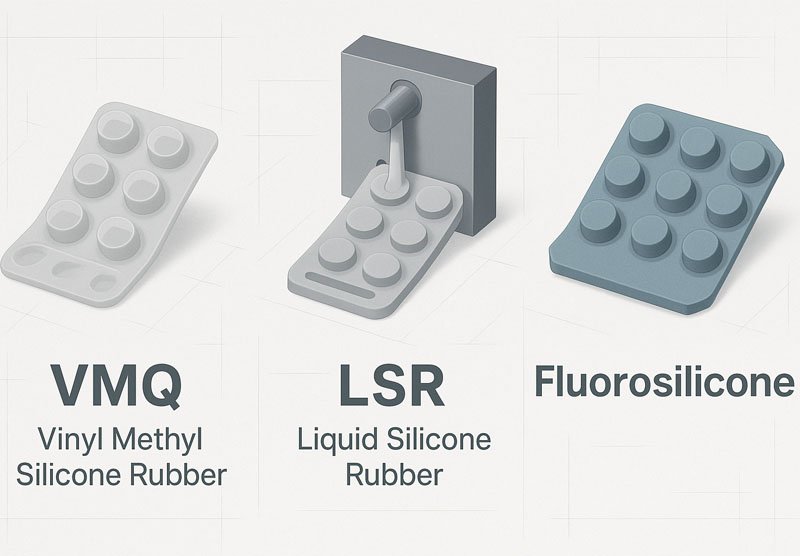
Choosing between HCR vs LSR is not a simple material decision. It locks in the molding process, tool architecture, labor content, flash-control method, and the economics of future volume.
Generic advice usually ends at “HCR is cheaper” and “LSR is more precise.” That is too shallow for a production decision. A low-cost HCR tool can become expensive when every part needs trimming. An LSR tool can be overbuilt for a simple product that will never reach enough volume to use its automation.
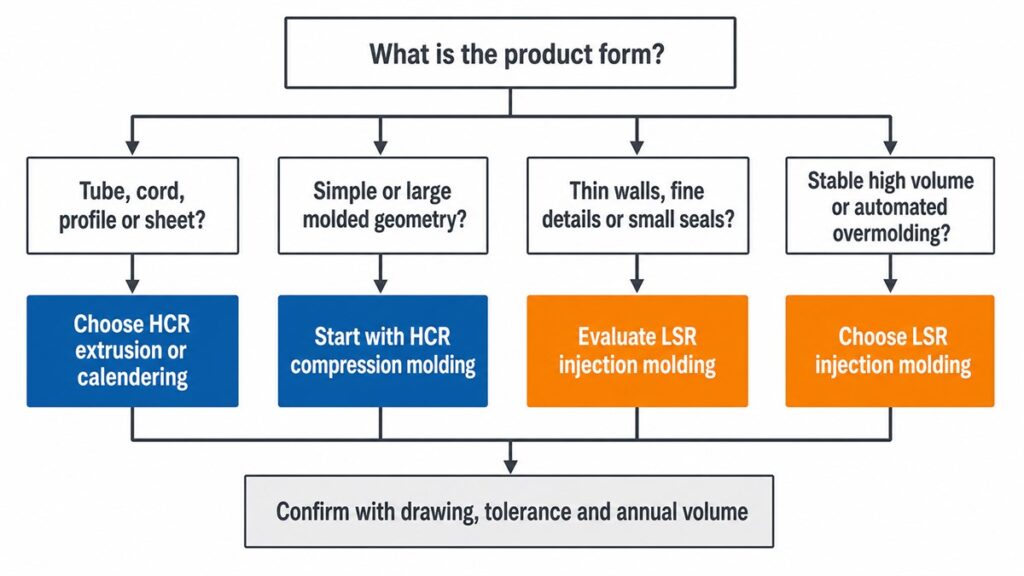
Choose HCR for simpler geometry, lower or variable volumes, extrusion, and projects where lower tooling investment matters. Choose LSR for thin walls, small features, automated multi-cavity production, repeatable dosing, and integrated overmolding. The final choice must still be checked against the exact grade, tolerance, cure system, and annual demand.
Executive Summary
- HCR usually gives more process flexibility and a lower tooling entry point, but compression-molded parts often carry more labor, flash, and secondary finishing.
- LSR requires specialized metering equipment and tighter mold construction, but its closed two-component system is better suited to repeatable, automated production.
- Do not choose by material price alone. Compare total cost across tooling, cavities, cycle time, trimming, scrap, inspection, post-curing, and expected annual volume.
HCR vs LSR Comparison
| Decision factor | HCR | LSR |
|---|---|---|
| Uncured material form | Solid or gum-like compound | Pumpable two-component liquid |
| Common cure systems | Peroxide or platinum | Usually platinum addition cure |
| Common processes | Compression, transfer, gum injection, extrusion, calendering | Liquid injection molding (LIM), coating, overmolding |
| Material handling | Cut, weighed, milled, or preformed; more open handling | Pumped, metered, mixed, and injected through a closed system |
| Tooling entry cost | Usually lower for compression tooling | Usually higher due to precision, gating, venting, and cold-runner requirements |
| Automation potential | Low to medium for compression; higher with HCR injection | High |
| Geometry | Good for simple or large molded parts and continuous profiles | Strong for thin walls, fine details, small parts, and complex flow paths |
| Flash and trimming | More likely with compression molding | Can be very low with a well-built tool and stable process |
| Volume fit | Prototype, low-to-medium volume, or variable demand | Medium-to-high volume with stable demand |
| Overmolding | Possible, but less common in fully automated cells | Common for plastic, metal, and multi-component assemblies |
| Post-cure | Grade- and application-dependent; common for some peroxide-cured systems | Grade- and application-dependent; not eliminated by the word “platinum” |
| Main cost risk | Labor, charge variation, trimming, and secondary operations | Tooling, equipment, process setup, and underused capacity |
This table describes typical manufacturing routes, not a universal property ranking. HCR can be injection molded. LSR can be used outside injection molding. The part drawing and production system decide whether those alternatives are practical.
What Is the Main Difference Between HCR and LSR?
The main difference is their consistency before curing and the equipment required to process them.
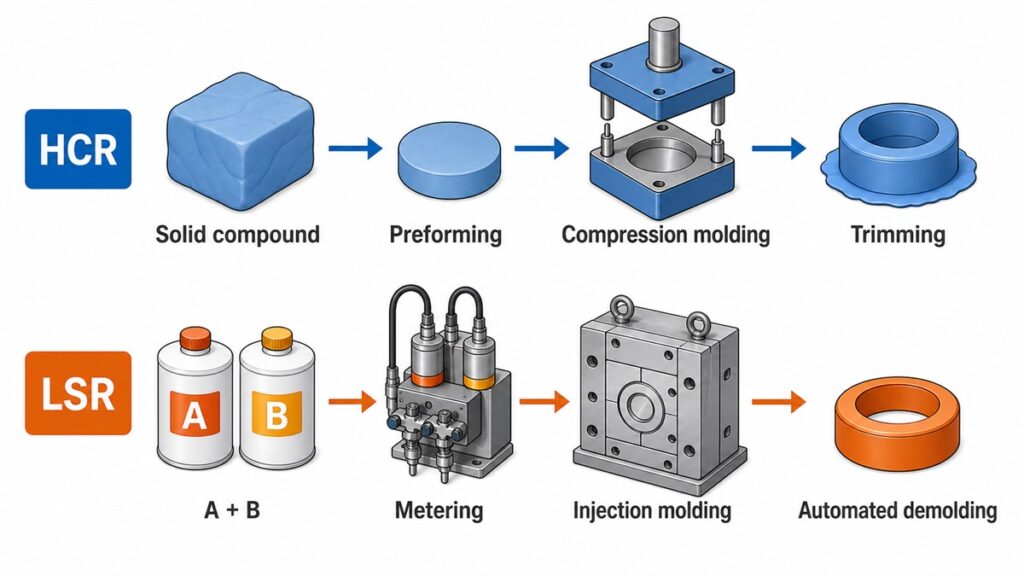
High Consistency Rubber is a solid, dough-like silicone compound. A factory may mill in pigment or additives, cut a measured charge, place it into a heated compression mold, or feed it through transfer, injection, extrusion, or calendering equipment.
Liquid Silicone Rubber (LSR) is normally supplied as two components. A and B are pumped at a controlled ratio, mixed, and injected into a heated mold. Its pumpability and controlled A/B metering distinguish LSR from gum-like HCR on the production floor.
Once cured, both are silicone elastomers. Their final tensile strength, tear resistance, elongation, hardness, compression set, optical properties, and regulatory status depend on the specific formulation. “LSR” does not automatically mean softer, safer, or mechanically superior. “HCR” does not automatically mean stronger. Compare supplier TDS values from candidate grades under the same test methods.
When Should You Choose HCR Over LSR?
Choose HCR when the part and business case benefit more from process flexibility than from maximum automation.
Lower or Uncertain Production Volume
Compression tooling is generally simpler than a multi-cavity LSR tool with a cold-runner system. That lower entry cost matters when demand is uncertain, the design is still changing, or the program only needs periodic batches.
The common mistake is to compare tool quotations without including the expected number of parts. A cheaper tool can still produce a higher total cost if manual loading, demolding, trimming, and inspection remain in every cycle. HCR only keeps its cost advantage when the geometry and quality requirements do not create excessive secondary work.
Simple or Large Molded Geometry
HCR compression molding works well for parts that can tolerate a visible parting line, straightforward venting, and some flash removal. Large industrial silicone parts, including gaskets and keypads, often fit this route.
Compression molding fills an open mold from a pre-measured charge. That makes charge placement important. If the charge is poorly sized or positioned, flow distance changes across the cavity. Over repeated cycles, this can show up as inconsistent flash, short fill, knit lines, or trapped air.
Extruded Profiles, Tubes, Cords, and Sheets
HCR is the practical route for continuous extrusion and calendering. Tubing, hose, cord, oven seals, profiles, wire insulation, and silicone sheet are not natural LSR injection-molding projects. Elkem lists extrusion and calendering among the standard HCR transformation processes (Elkem).
This boundary is often missed because buyers compare only “silicone materials.” The required product form may already have selected the process before hardness, color, or cure chemistry is discussed.
Formulation and Cure-System Flexibility
HCR is available with peroxide and platinum cure systems. That gives engineers more formulation and processing options, but it also creates more specification work.
Peroxide-cured HCR may require post-curing to reduce volatile by-products, odor, or extractables, depending on the grade and end-use requirement. Platinum-cured HCR avoids some peroxide by-products, but it needs contamination control because sulfur, amines, organotin compounds, and some adhesives or pigments can inhibit cure.
Do not write “platinum cured” on a drawing and assume the compliance question is finished. Cure chemistry is only one part of the material and process definition.

When Should You Choose LSR Over HCR?
Choose LSR when geometry, repeatability, and production scale justify dedicated silicone injection molding.
Thin Walls and Fine Features
LSR flows through narrow sections and small gates more easily than gum-like HCR. This supports thin membranes, small sealing features, detailed textures, micro-components, and complex cavity layouts.
That flowability also creates a tooling penalty. LSR will find small gaps at parting lines, inserts, ejector interfaces, and shutoffs. Flash control therefore depends on mold precision, clamp behavior, vent depth, material viscosity, and process pressure. A complex CAD model is not enough; the tool must control where the liquid is allowed to flow.
Stable Medium-to-High Volume
A closed metering and mixing system reduces manual charge variation. Multi-cavity tools, automatic demolding, robots, and in-line inspection can reduce labor per part when volume is high enough.
In production, LSR’s typical advantage comes from repeatable dosing, automation, lower secondary operations, and scalable cavity-to-cavity filling. The trade-off is higher equipment and tooling entry cost.
The common misjudgment is assuming that automation creates savings at any volume. It does not. If a program runs only a few short batches per year, the cost of tool validation, setup, purging, preventive maintenance, and idle capacity may dominate the unit price.
Overmolding and Part Integration
LSR is often the stronger route when silicone must be molded over a thermoplastic or metal insert. It also supports two-shot designs that remove separate assembly steps.
The process is not automatically bonded. The team must define whether retention comes from chemical adhesion, primer, self-bonding LSR, or mechanical interlock. Insert material, surface contamination, mold temperature, thermal expansion, and undercut geometry all affect the result.
Teams frequently underestimate this because a successful hand-pulled sample can look fully bonded. Repeated flexing, sterilization, heat aging, or fluid exposure may reveal weak interfaces later. Bond testing must reflect the real load direction and use environment.
Cleaner Material Handling
LSR is pumped from sealed containers through a closed mixing system. This reduces open handling and can support cleaner production.
It does not make the finished part inherently clean or compliant. Mold release, tool maintenance, demolding, post-cure, washing, inspection, and packaging still affect contamination. For medical or food-contact products, process controls and finished-part evidence matter more than the material acronym.
Is LSR Always More Precise Than HCR?
No. LSR normally offers better repeatability for small, intricate, high-volume molded parts, but achievable tolerance depends on the exact dimension and process.
Silicone is an elastomer. Dimensions change with cure shrinkage, post-cure, temperature, measurement force, storage time, and whether the feature crosses a parting line. A tolerance that is realistic on a steel insert interface may be unrealistic on a free-standing soft wall.
Use ISO 3302-1 as a framework for molded-rubber dimensional tolerances, then review critical dimensions individually during DFM. The drawing should identify:
- Which dimensions affect sealing, assembly, or function
- The measurement method and conditioning time
- Whether dimensions are measured before or after post-cure
- Datum strategy for a flexible part
- Allowed flash, mismatch, gate vestige, and parting-line location
The common mistake is applying plastic-part tolerances to every silicone dimension. That forces unnecessary tooling corrections and inspection rejects without improving function.
How Do HCR and LSR Affect Tooling and Unit Cost?
HCR usually lowers initial tooling cost. LSR can lower recurring labor and secondary-operation cost. Neither statement is sufficient by itself.
| Cost element | HCR cost behavior | LSR cost behavior |
|---|---|---|
| Mold construction | Simpler for basic compression tools | Higher precision; runner, gate, vent, and thermal control are critical |
| Material preparation | Weighing, cutting, milling, or preforming may add labor | Automated A/B pumping and mixing |
| Cycle labor | Manual loading and demolding are common | Automated cycles are practical |
| Flash removal | Often a recurring operation | Lower when tooling and parameters are stable |
| Scrap risk | Charge placement, contamination, trapped air, and trimming damage | Ratio error, cure inhibition, flash, short fill, and start-up losses |
| Inspection | More operator-dependent variation may need attention | Repeatability supports automated or cavity-based inspection |
| Maintenance | Simpler tool, but parting-line wear still changes flash | Cold-runner, seals, valves, vents, and metering system require disciplined maintenance |
| Capacity risk | More labor can be added gradually | Dedicated equipment becomes expensive when utilization is low |
Request quotations at realistic annual volumes, not only one order quantity. The quote should separate tooling, material, molding, post-cure, trimming, inspection, packaging, and any insert-loading operation. That exposes where the cost moves when volume changes.

Does HCR or LSR Determine Food-Contact or Medical Compliance?
Neither HCR nor LSR is compliant by name. Compliance attaches to a defined material grade, formulation, manufacturing process, test scope, and intended use.
For repeated-use rubber articles in food contact, 21 CFR 177.2600 addresses permitted substances and extractives conditions. It includes silicone basic polymers, but that does not mean every silicone part automatically complies (eCFR 21 CFR 177.2600).
For a food-contact project, verify:
- Exact supplier grade and color formulation
- Applicable market: FDA 21 CFR 177.2600, LFGB/BfR, or another jurisdiction
- Finished-part test scope and food simulants
- Cure and post-cure conditions
- Traceability from raw-material lot to finished batch
- Whether pigments, additives, primers, and insert materials are included in the evidence
For medical devices, “medical-grade silicone” is also incomplete. Biocompatibility evaluation, sterilization compatibility, extractables and leachables, cleanliness, packaging, and process validation depend on the device’s contact type and risk classification.
HCR vs LSR: A Practical Selection Matrix
| Project condition | Preferred starting route | Reason |
|---|---|---|
| Prototype or uncertain demand | HCR compression molding | Lower tooling commitment and easier design changes |
| Simple molded part with tolerant cosmetics | HCR compression molding | Automation may not repay its cost |
| Tubing, cord, profile, or sheet | HCR extrusion or calendering | Continuous process matches the product form |
| Large, simple molded component | HCR compression molding | Practical cavity filling and lower tool complexity |
| Small seals or thin membranes | LSR injection molding | Flow behavior supports fine features and thin sections |
| Stable high annual volume | LSR injection molding | Multi-cavity automation can reduce labor per part |
| Plastic or metal overmold | LSR injection molding | Better fit for automated insert and bonding strategies |
| Very low flash requirement | LSR, after tool feasibility review | Precision tooling can reduce secondary trimming |
| Special peroxide-cured formulation | HCR | Wider cure-system and compound flexibility |
| Regulated food or medical use | Either, after grade and process validation | Compliance is not determined by HCR or LSR alone |
What Information Is Needed Before Requesting a Quote?
A supplier cannot select HCR or LSR reliably from a product photo. Send the following information:
- 2D drawing with critical dimensions, tolerance classes, and cosmetic zones
- 3D model in STEP format
- Annual volume, order quantity, and expected program life
- Hardness, color, transparency, and mechanical-property targets
- Operating temperature, fluid exposure, compression, and expected service cycles
- Food-contact, medical, RoHS, REACH, or other compliance requirements
- Post-cure, odor, extractables, and cleanliness limits
- Insert material and bonding requirement for overmolded parts
- Packaging, inspection, and traceability requirements
The decision boundary is straightforward. Use HCR when lower tooling commitment, simple geometry, continuous processing, or compound flexibility controls the project. Use LSR when fine geometry, closed handling, automated repeatability, and high-volume economics control it.
The final selection should be made against a real drawing and volume forecast. Without those two inputs, “HCR vs LSR” remains a material comparison when the actual decision is a manufacturing system.