Silicone bongs collect sticky resin, stale water film, ash, and odor in places that a quick rinse may miss. Cleaning is more complicated than washing an ordinary one-piece silicone product because many bongs are hybrid assemblies: the flexible body may be silicone, while the bowl, downstem, percolator, grommet, screen, or decorative insert may be glass, metal, quartz, ceramic, or another polymer.
The safest approach is to cool, empty, and completely disassemble the bong; clean each material separately; rinse away every trace of cleaner; and let all parts dry before reassembly. Alcohol, freezing, a dishwasher, and boiling are not universal silicone-cleaning methods. Use them only when the instructions for the exact product permit them.
What Is the Best Way to Clean a Silicone Bong?
Quick answer: Let the bong cool, empty the water, and remove the bowl, downstem, screen, and every other user-removable part. Wash the silicone body with warm water, a small amount of mild unscented dish soap, and a soft nonabrasive brush or cloth. Clean glass and metal parts separately according to their own care instructions. Rinse all surfaces thoroughly and air-dry them completely before reassembly. Use isopropyl alcohol, a specialty cleaner, the freezer, a dishwasher, or boiling water only if the manufacturer approves that method for the exact component.
This guide covers washable silicone bong and water-pipe bodies, including models with removable glass or metal parts. It does not cover acrylic bongs, all-glass water pipes, electronic rigs, or the operation of a smoking device. For material-wide care principles, see how to clean silicone safely.
Cleaning removes residue from the device; it does not make inhaled smoke harmless. For a separate material and design review, see whether silicone bongs are safe to use. The CDC notes that smoked cannabis can harm lung tissue regardless of how it is smoked. Follow local law, product age restrictions, and the manufacturer’s intended-use instructions.
Do not share the mouthpiece. WHO waterpipe guidance warns that shared mouth-contact parts and incompletely cleaned equipment can transmit infectious agents. Routine washing removes residue; it should not be described as sterilization.
Before Cleaning a Silicone Bong, Identify Every Material
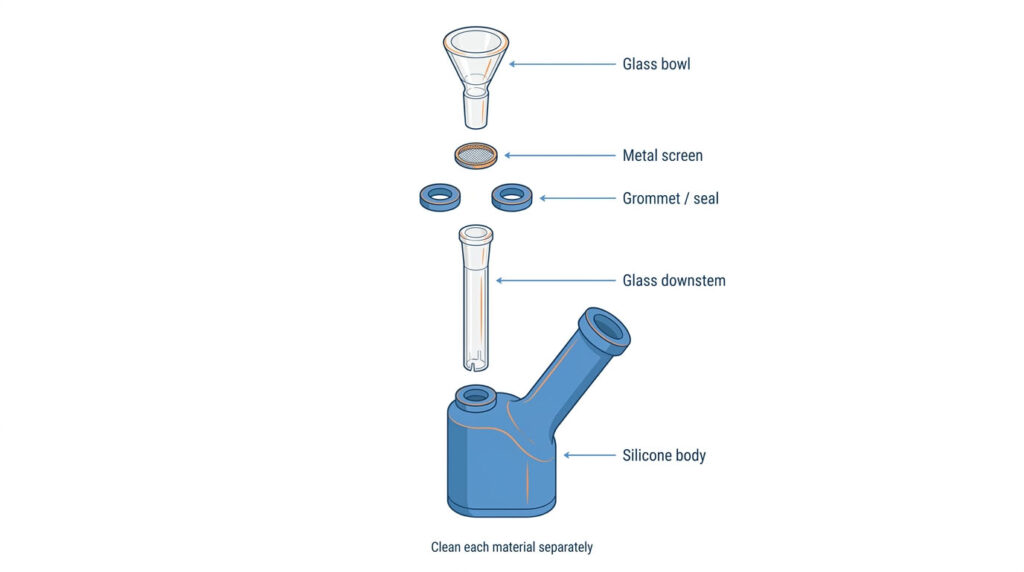
Do not choose a cleaner based only on the flexible outer body. A product described as a “silicone bong” may contain a glass chamber, stainless-steel bowl, quartz attachment, magnetic insert, adhesive, printed decoration, or permanently bonded joint. This silicone pipe versus glass comparison explains the broader material trade-offs. The least resistant component sets the practical cleaning limit.
| Component | Common material | Safest starting method | Main caution |
|---|---|---|---|
| Flexible body or base | Cured silicone rubber | Warm water, mild dish soap, and a soft nonabrasive tool | Do not assume every compound, pigment, or bonded insert tolerates alcohol, heat, or long soaking |
| Bowl and downstem | Often borosilicate glass, stainless steel, or another rigid material | Remove and clean separately using the component maker’s method | Glass can chip or crack; coatings and seals may limit solvents |
| Percolator or inner chamber | Glass, silicone, or a mixed assembly | Confirm whether it is removable and which openings may be brushed | Do not force a bonded or narrow-necked part apart |
| Grommet, plug, seal, or screen | Silicone, rubber, plastic, glass, or metal | Wash separately if designed to be removed | Small parts can tear, deform, corrode, or be lost down a drain |
| Printed, coated, magnetic, or bonded section | Mixed materials | Use the least aggressive approved hand-wash method | The decoration, adhesive, magnet, or insert may fail before the silicone body |
| Unknown or damaged component | Unverified | Stop and obtain the product instructions | Do not improvise with solvent, heat, or force |
Disassembly matters. EYCE’s cleaning guide instructs owners to remove the glass and clean it separately. Ooze likewise tells users to disassemble silicone hybrid pieces and remove glass attachments before cleaning. Apply that principle only to parts designed for user removal.
What You Need to Clean a Silicone Bong
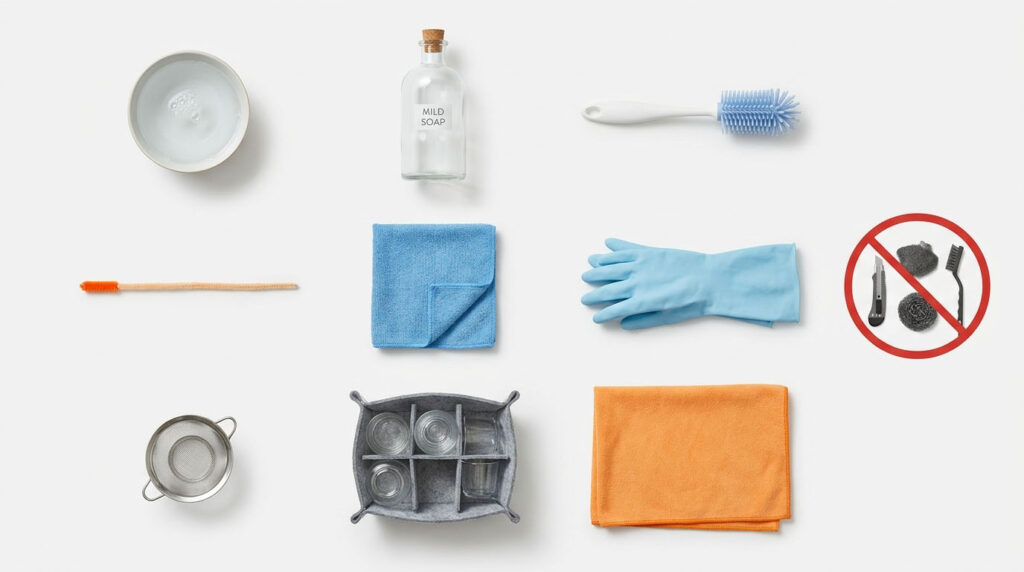
For the default hand-wash method, prepare:
- warm—not boiling—water;
- mild, preferably unscented liquid dish soap;
- clean fingers, a soft bottle brush, a soft nylon pipe cleaner, or a nonabrasive cloth;
- a basin or drain strainer that will catch small parts;
- separate padded containers for fragile components;
- a clean lint-free towel and ventilated drying area;
- household gloves if the cleaner label or residue handling calls for them; and
- the exact product manual or current manufacturer care page.
You normally do not need a knife, metal pick, steel wool, stiff wire brush, melamine foam, scouring powder, or an improvised chemical mixture. Sharp and abrasive tools can cut silicone, scratch rigid components, and damage the sealing surfaces around a bowl or downstem.
How to Clean a Silicone Bong in Six Steps
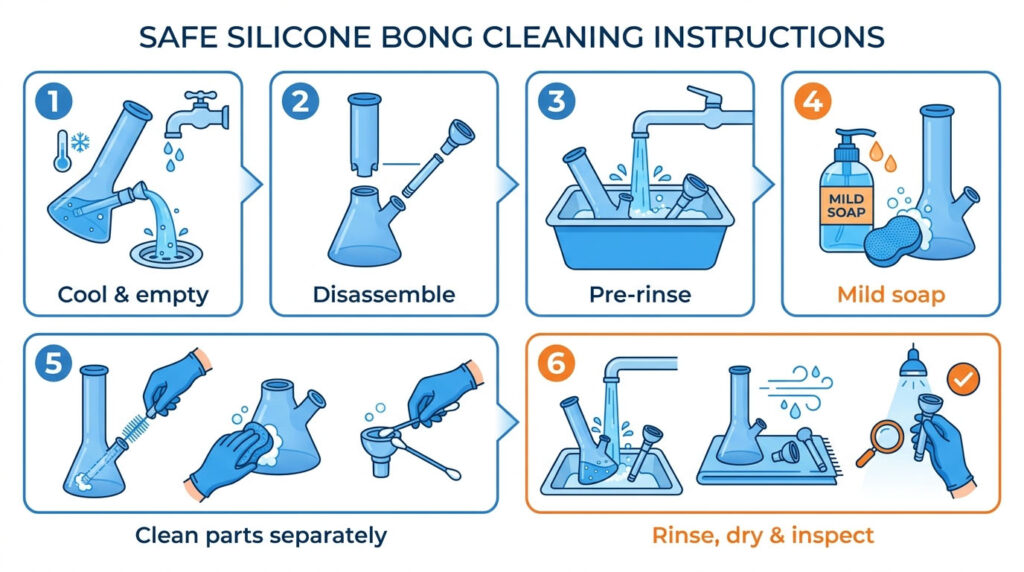
1. Let It Cool and Empty the Water
Wait until the bowl, downstem, body, and any other heated component are at room temperature. Keep the work area away from open flame, sparks, hot burners, and smoking materials.
Empty the used water into an appropriate drain where local rules allow, then rinse the drain. Do not begin cleaning while ash, an ember, or a hot attachment remains in the bong. A sudden temperature change can also damage glass components.
2. Disassemble Only the User-Removable Parts
Remove the bowl, downstem, screen, grommet, plug, cap, and other detachable pieces in the sequence specified by the maker. Photograph the assembly first if the orientation is not obvious.
Support glass close to the joint and pull straight rather than levering it sideways. If a part is stuck, do not pry it out with a blade or screwdriver. Recheck the instructions or ask the manufacturer; forcing a rigid insert through silicone can tear the surrounding wall.
3. Pre-Rinse the Silicone Body
Rinse the approved silicone body with warm water to remove loose ash and softened surface film. Direct water through each open passage. Gently flex an all-silicone section if its maker allows it, but do not sharply crease a bonded joint or stretch a narrow opening around a rigid insert.
Use warm water unless the exact instructions call for hot water. Very hot water can burn hands and can subject unknown glass, bonded, or mixed-material parts to unnecessary thermal stress.
4. Wash With Mild Soap and a Soft Tool
Add a small amount of mild dish soap and warm water to the silicone body. Work the solution across the walls, base, mouthpiece, water chamber, joint openings, and molded channels using clean fingers or a soft nonabrasive brush.
Use enough movement to lift residue, not enough force to scrape or stretch the surface. If a soft brush cannot reach a channel, use a flexible cleaning tool sized for that passage rather than a sharp metal object. Repeat the wash with fresh soapy water if the first solution becomes heavily soiled.
5. Clean Glass, Metal, and Other Parts Separately
Place each fragile part in its own padded container so glass pieces cannot strike one another. Use the component maker’s cleaner, contact time, and rinse procedure. A method authorized for a glass bowl is not automatically authorized for the silicone body, grommet, printed logo, or coated metal.
If the instructions permit isopropyl alcohol for a removable glass or metal component, keep it far from flame and ignition sources, provide ventilation, and follow the product label. Do not heat alcohol or pour it into a warm component.
6. Rinse, Dry, Inspect, and Reassemble
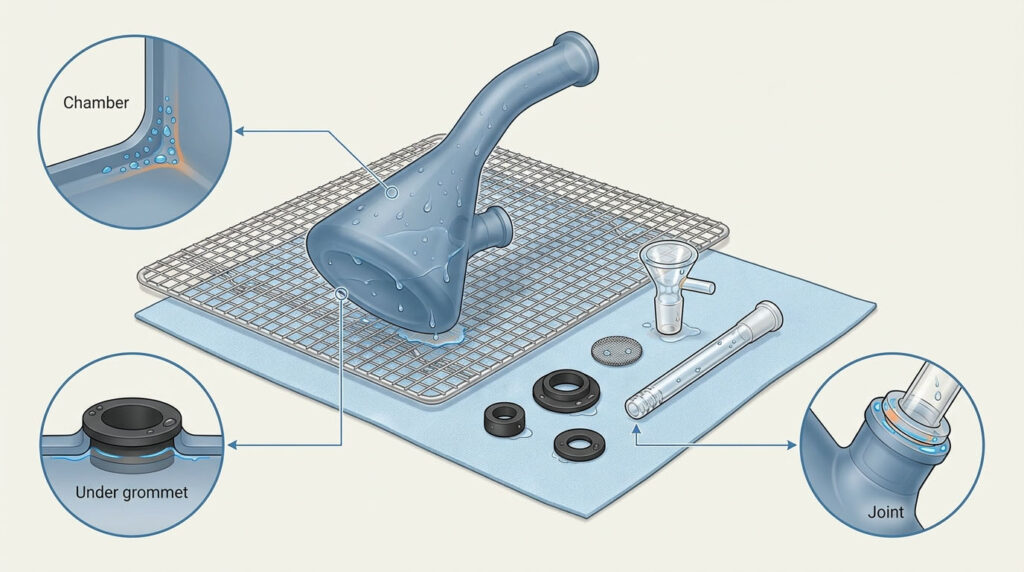
Rinse every washable surface until no soap, specialty cleaner, loose resin, fragrance, grit, or oily film remains. Flush narrow passages from both directions when the design permits.
Shake out loose water gently, blot accessible surfaces, and air-dry all parts separately in a ventilated place. Do not reassemble or store the bong while moisture remains inside a chamber, beneath a grommet, or around a joint. Once dry, inspect every component before putting it back together.
How to Remove Stubborn Resin From a Silicone Bong
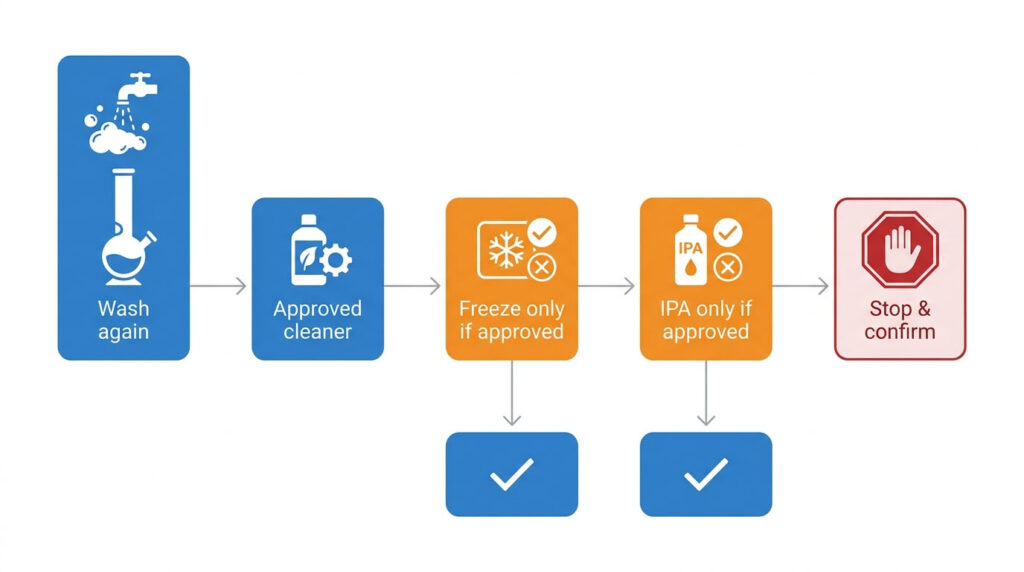
Sticky resin is the main reason people reach for aggressive methods. Start with the least aggressive option and escalate only within the product’s care instructions.
Repeat the Warm Soapy Wash
Fresh warm water and detergent may need more than one pass. Drain the dirty solution, add fresh soap and water, gently flex or brush the approved surfaces, and rinse again. This is slower than a strong solvent but presents fewer compatibility questions for an unknown silicone compound or mixed assembly.
Use Only a Manufacturer-Approved Silicone Bong Cleaner
“Bong cleaner” is a use category, not a compatibility guarantee. Some formulas are sold only for glass, metal, or ceramic. Confirm that the cleaner label names silicone and that the bong maker permits it. Follow the stated amount, dwell time, agitation, rinse, and drying steps; do not extend a short treatment into an overnight soak.
EYCE’s product-specific guide uses its silicone cleaner for a short treatment followed by gentle brushing and thorough rinsing. That supports the use of a named compatible cleaner on the named products—not every cleaner on every silicone bong.
Freeze and Flex Only When the Manufacturer Allows It
Freezing can make some resin brittle so it releases when a flexible body is gently flexed. It is also a product-specific method, not a universal property test. For example, Waxmaid authorizes freeze-and-flex for its Mr. Y model; that model-specific instruction does not establish compatibility for every silicone bong.
Before freezing an approved model:
- empty and rinse the bong;
- remove every user-removable mixed-material part named in the manual; do not freeze a body with fixed glass, metal, quartz, ceramic, or liquid-filled components unless the manufacturer explicitly approves the complete assembly;
- dry the silicone body;
- protect it from food and freezer contamination in a clean closed bag or container;
- use only the time and temperature given by the maker; and
- flex it over a lined waste container, then finish with the normal wash and rinse.
Do not move a frozen hybrid assembly directly into hot water. Do not strike it against a hard surface, and do not use a knife to chip off cold residue.
Use Isopropyl Alcohol Only With Exact Approval
There is no honest universal “yes” or “no” for rubbing alcohol on finished silicone bongs. Public brand guidance conflicts:
- The current EYCE FAQ says it does not recommend rubbing alcohol on its silicone products because it may discolor and wear the material over time.
- However, EYCE’s June 29, 2026 bong-cleaning post recommends 91%–99% IPA for its platinum-cured silicone bongs and says IPA will not damage that material. Because this directly conflicts with EYCE’s live FAQ, an EYCE owner should confirm the method with the company before using alcohol.
- PieceMaker’s FAQ says isopropyl alcohol can help clean its products and also lists other model-specific methods.
- Ooze’s silicone collection page mentions isopropyl for sticky silicone areas, while the current Ooze Res Gel product page says that particular gel is not recommended for silicone.
These differences are why a generic blog should not prescribe one concentration or soak time for every bong. Follow the most product-specific current care label or manual for the exact model and named cleaner. A newer general blog post should not automatically override a live product warning. If official sources conflict, pause and ask the manufacturer.
When alcohol is expressly permitted, remember that it is a fire hazard. NIOSH classifies isopropyl alcohol as a Class IB flammable liquid. Work in a ventilated area away from flame, heat, sparks, and smoking; keep the container closed when not in use; never boil or microwave it; and follow its label for handling and disposal.
Do not automatically pour used alcohol or resin-laden cleaner down the drain. Never mix it with another product, and follow the cleaner label and local household-hazardous-waste rules. The U.S. EPA warns that improper disposal can include pouring hazardous household products into drains, where they may contaminate septic or wastewater systems.
How to Clean a Silicone Bong Without Alcohol
An alcohol-free sequence is straightforward:
- cool, empty, and disassemble the bong;
- pre-rinse the silicone body with warm water;
- wash with mild dish soap and a soft brush;
- repeat with fresh solution for remaining film;
- use a manufacturer-approved alcohol-free silicone cleaner if necessary;
- use freeze-and-flex only when the exact model permits it; and
- rinse and air-dry completely.
Clean removable glass or metal parts according to their separate instructions. “Without alcohol” does not mean that vinegar, bleach, acetone, essential oil, or another household solvent is automatically safer.
How to Remove Odor, Stains, and Sticky Film From a Silicone Bong
Lingering Odor
Emptying the water, cleaning all passages, and drying the disassembled parts are more useful than masking odor with fragrance. Rewash the body with fresh unscented detergent, clean the grommet and storage case, rinse thoroughly, and let each component dry in open air.
An odor that returns from a deep tear, bonded seam, or permanently tacky area may indicate trapped residue or material change. Stop using the component and contact the manufacturer rather than saturating it with perfume or essential oil.
Brown or Dark Staining
Color and cleanliness are not identical. Resin can stain a light-colored silicone body even after transferable residue is gone. Judge the dry surface: it should not feel oily or permanently tacky, release material onto a clean cloth, or smell strongly of cleaner.
Do not abrade a stain merely to restore the original color. Replace the part if discoloration is accompanied by cracking, swelling, burning, delamination, a new chemical odor, or a texture change.
Persistent Sticky Film
Repeat the approved detergent wash and allow the part to dry before judging it. If a clean, dry surface remains uniformly tacky or swollen, stronger solvent is not a reliable repair. The silicone, coating, or another component may have changed and should be assessed by the manufacturer.
Can You Use Alcohol, Salt, Vinegar, a Dishwasher, or Boiling Water?

| Method | Practical boundary | Main precaution |
|---|---|---|
| Warm water and mild dish soap | Default for washable silicone bodies | Use a soft tool, rinse completely, and dry every passage |
| Named silicone cleaner | Use only when compatible with the exact bong and component | Follow the label; “glass cleaner” and “bong cleaner” do not automatically mean silicone-safe |
| Isopropyl or rubbing alcohol | Only when the exact manufacturer permits it | Brand guidance conflicts; alcohol is highly flammable and must not be heated or used near ignition |
| Coarse salt or another abrasive | Not a default for soft silicone | Particles can abrade or lodge in features; use only under a product-specific procedure |
| Freezer cleaning | Only for a body explicitly approved for freezing and flexing | Remove mixed-material parts, empty and dry the body, and avoid impact or rapid heating |
| Dishwasher | Only when the complete product or named component is labeled dishwasher-safe | Remove glass and small parts as directed; resin may contaminate the appliance and heated drying may be excluded |
| Boiling water or steam | Only under an exact manufacturer procedure | Mixed parts, trapped air, thermal shock, distortion, and burn injury make boiling a poor generic recommendation |
| Vinegar or baking soda | Not a default resin-removal method. EYCE’s June 2026 post mentions baking soda only as a warm-water odor rinse after its approved IPA procedure; the reviewed manufacturer guides do not establish vinegar as a universal silicone-bong cleaner | They do not replace detergent or a compatible resin cleaner; baking soda can act as a mild abrasive |
| Bleach or hydrogen peroxide | Not a routine bong-cleaning or degreasing method | Use only with written compatibility and an exact rinse procedure; never mix cleaners |
| Acetone, fuel, paint thinner, drain cleaner, or oven cleaner | Avoid as household bong-cleaning methods | They can damage materials and create hazardous exposure or residue |
Cleaner combinations are not DIY upgrades. Poison Control advises users to follow label directions, ventilate, and never mix household cleaning products. Use one approved method at a time and rinse as directed.
How Often Should You Clean a Silicone Bong?
There is no universal calendar because water volume, residue load, product geometry, and frequency of use differ. Use an event-based routine:
- After use: Empty the water, remove loose material, and rinse the approved parts after they cool. Ooze recommends replacing bong water after each use.
- When film first appears: Perform the full hand-wash method before the residue becomes thick and difficult to reach.
- Before storage or travel: Clean, rinse, and dry every component; never store water in the bong.
- After an unknown cleaner or spill: Stop and ask the manufacturer how to assess compatibility before using the product again.
- Whenever airflow, odor, or assembly changes: Disassemble and inspect instead of forcing a blocked passage or loose joint.
Frequent gentle cleaning is easier on a bong than waiting for heavy buildup and then relying on aggressive solvent, abrasion, or heat.
When Should You Replace a Bong or Component?
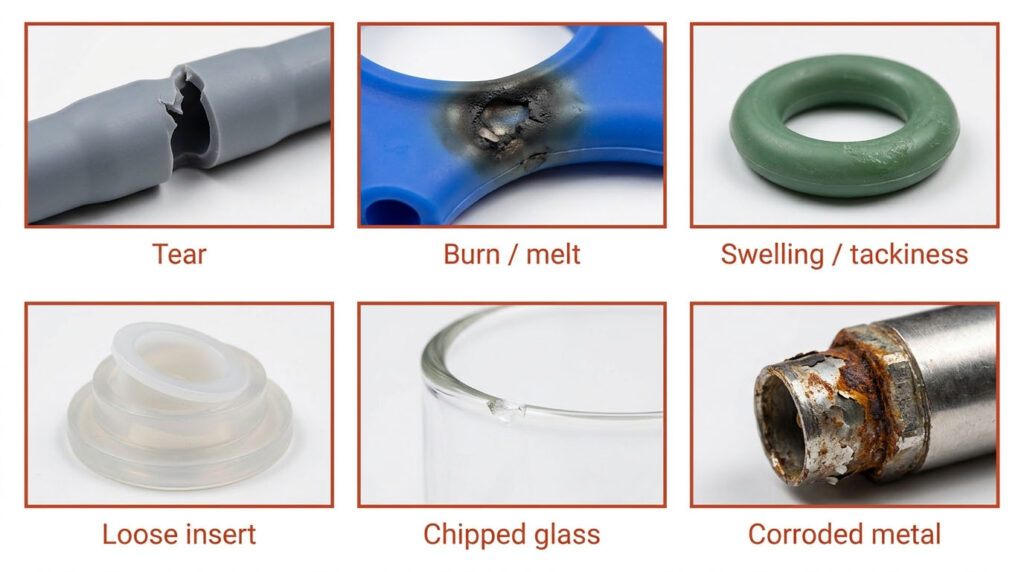
PieceMaker’s terms state that damaged parts should not be used. More generally, retire the affected part or ask the manufacturer to inspect it when you find:
- a tear, puncture, split seam, or crack around the mouthpiece, bowl, downstem, or base;
- a burnt, melted, charred, hardened, or bubbled area;
- permanent tackiness, swelling, softness, or texture change after correct washing and drying;
- a loose or separating glass, metal, magnetic, printed, or bonded insert;
- inaccessible residue or recurring spots inside a damaged seam;
- a persistent chemical or burnt odor;
- a joint that no longer holds a bowl or downstem securely;
- chipped, cracked, or heavily scratched glass; or
- corroded, flaking, or deformed metal.
Do not patch a mouth-contact or heat-adjacent tear with household caulk or glue. A repair material can introduce new compatibility, heat, adhesion, and cleanability problems.
Frequently Asked Questions
What Is the Best Way to Clean a Silicone Bong at Home?
Cool and disassemble it, wash the silicone body with warm water, mild dish soap, and a soft nonabrasive tool, clean rigid parts separately, rinse thoroughly, and air-dry. This is the most conservative starting method for an unknown washable model.
Can You Clean a Silicone Bong With Rubbing Alcohol?
Only when the exact manufacturer permits it. Current brand guidance conflicts, so do not infer compatibility from the word “silicone.” If alcohol is approved, follow the stated concentration and contact time, ventilate, keep it away from ignition sources, rinse as directed, and dry completely.
How Do You Clean a Silicone Bong Without Alcohol?
Use repeated warm-water and mild-soap washes, a soft brush, and a compatible alcohol-free silicone cleaner if needed. A maker-approved freeze-and-flex procedure can help with some models. Vinegar, bleach, and acetone are not automatic substitutes.
Can You Put a Silicone Bong in the Freezer to Clean It?
Only if the manufacturer approves freezing the exact body. Remove all unapproved glass, metal, quartz, ceramic, and liquid-filled parts first. Empty and dry the body, protect it from freezer contamination, and avoid striking it or moving it directly into hot water.
Can You Boil a Silicone Bong?
Do not treat boiling as a generic silicone-bong method. Some manufacturers permit it for specific products, while hybrid assemblies can contain parts with different limits. Use boiling only under the exact time, disassembly, and handling procedure supplied by the maker.
Is a Silicone Bong Dishwasher-Safe?
Only when its care label says so. PieceMaker lists top-rack washing as an option for its products, while Ooze discourages putting a bong in the dishwasher because resin can contaminate the appliance. Remove glass and small parts and disable heated drying only when the exact instructions require it.
Can I Use 420 Cleaner or Another Silicone Bong Cleaner?
Check the exact formula, not just the brand or product category. Product lines often contain separate formulas for glass and for plastic or silicone. Use a cleaner only when its current label names silicone and the bong maker allows it.
How Do I Clean the Glass Bowl and Downstem?
Remove them and clean them separately in padded containers using the component maker’s procedure. Do not let glass parts strike each other, avoid sudden temperature changes, and inspect for chips or cracks before reassembly.
Why Does My Silicone Bong Still Smell After Cleaning?
Residue or moisture may remain in a grommet, narrow channel, storage case, or damaged seam. Rewash all approved removable parts with unscented soap, rinse, and dry them separately. Persistent odor from a tear, tacky surface, or bonded joint is a reason to stop using the component and contact the manufacturer.
Designing Silicone Bong Components for Easier Cleaning
For an OEM silicone body or component, cleanability should be designed before tooling rather than added as a care claim after production.
Important design checks include:
- Disassembly: Make intended user-removable glass, metal, and silicone parts obvious and difficult to install incorrectly.
- Internal geometry: Use accessible radii and smooth flow paths instead of blind recesses that trap water and residue.
- Drainage: Define a stable drying position that empties every chamber and prevents pooling beneath an insert.
- Interfaces: Control the dimensions, tear resistance, and retention force around bowl, downstem, screen, and grommet openings.
- Material system: Validate the complete silicone compound, pigment, print, insert, magnet, and adhesive—not only the base polymer.
- Cleaner compatibility: Test production-representative parts with the exact detergent or specialty cleaner, concentration, contact time, temperature, agitation, rinse, and repeated cleaning cycles named in the care guide.
- Inspection and replacement: Make heat damage, tearing, swelling, or a loose insert visible and provide replaceable components where practical.
- Instructions: State which parts detach and whether alcohol, freezing, a dishwasher, or boiling is permitted for each part.
For brands developing a custom molded silicone assembly, RY Silicone’s silicone manufacturing process covers raw-material preparation, mold making, mixing, molding, printing, inspection, and packaging. Cleanability requirements and any heat, chemical, or intended-use claims should be specified and validated for the complete production assembly; the linked page does not establish smoking-product or inhalation-use certification.
References
- EYCE: Silicone Product Cleaning FAQ
- EYCE: How to Clean Silicone Pipes With Silicone Cleaner
- EYCE: How to Clean a Silicone Bong
- Waxmaid: Mr. Y Care Instructions
- PieceMaker: Product Cleaning FAQ
- PieceMaker: Terms and Conditions
- Ooze: Silicone Bong and Pipe Care FAQ
- Ooze: Cleaning and Maintenance FAQ
- Ooze: Resolution Gel Compatibility Notes
- CDC/NIOSH: Isopropyl Alcohol Chemical Hazards
- Poison Control: Safe Use of Household Cleaning Products
- US EPA: Household Hazardous Waste
- CDC: Cannabis and Lung Health
- WHO: Waterpipe Tobacco Smoking FAQ