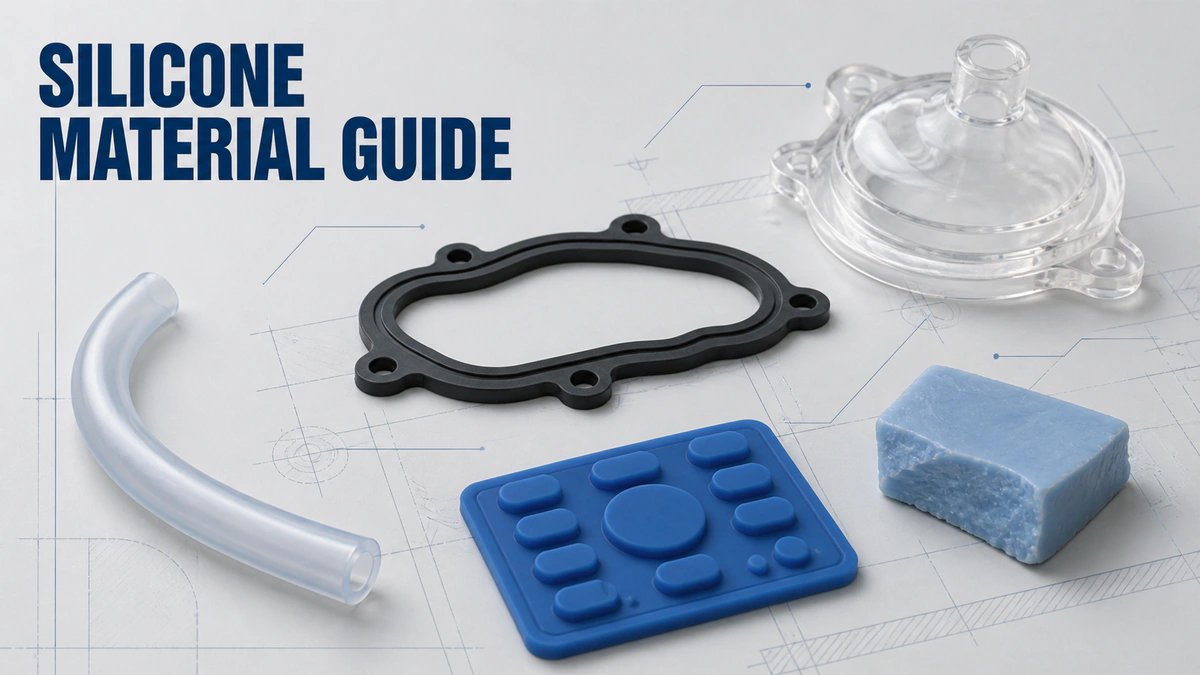
Silicones include fluids, gels, resins and elastomers. This guide focuses on cured silicone elastomers used in molded, extruded and sealed components—not on every class of silicone polymer.
Within that scope, VMQ, PVMQ and FVMQ identify polymer chemistry; LSR, HCR and RTV describe supply form or cure route; food-contact and medical claims depend on evidence tied to a specific compound and finished article. The sections below connect those labels to operating temperature, contact media, geometry, tolerance, production volume and compliance requirements so engineers and buyers can rule out unsuitable options before requesting a quote.
What Is Silicone Material
Silicones are a family of synthetic polymers built on a silicon-oxygen (Si-O) backbone with organic side groups. This guide covers their cross-linked elastomeric forms: pumpable LSR, solid-gum HCR/HTV, and one- or two-part RTV systems that cure into rubber-like materials. General-purpose VMQ compounds are often specified around -55°C to 200°C, but the usable range belongs to the selected compound and service environment.
Silicone rubber is easy to confuse with elemental silicon — see how silicon differs from silicone. Its silicon-oxygen backbone contributes to thermal stability and long-term flexibility, while formulation, filler package and cure route determine much of the finished performance.
Because of these characteristics, silicone is widely used in environments involving high temperatures, outdoor exposure, food contact, medical use, and demanding industrial conditions.
Buyers evaluating material safety can start with what the toxicity and chemical safety data actually shows.
Types of Silicone Materials
Silicone is classified along several independent axes, which should not be treated as competing material types. VMQ, PVMQ and FVMQ describe polymer chemistry; LSR, HCR/HTV and RTV describe supply form or cure route; food-contact, medical, conductive and sponge grades describe intended use or physical form. A food-contact part, for example, may be made from either LSR or HCR. For a side-by-side overview, see how the main silicone grades differ.
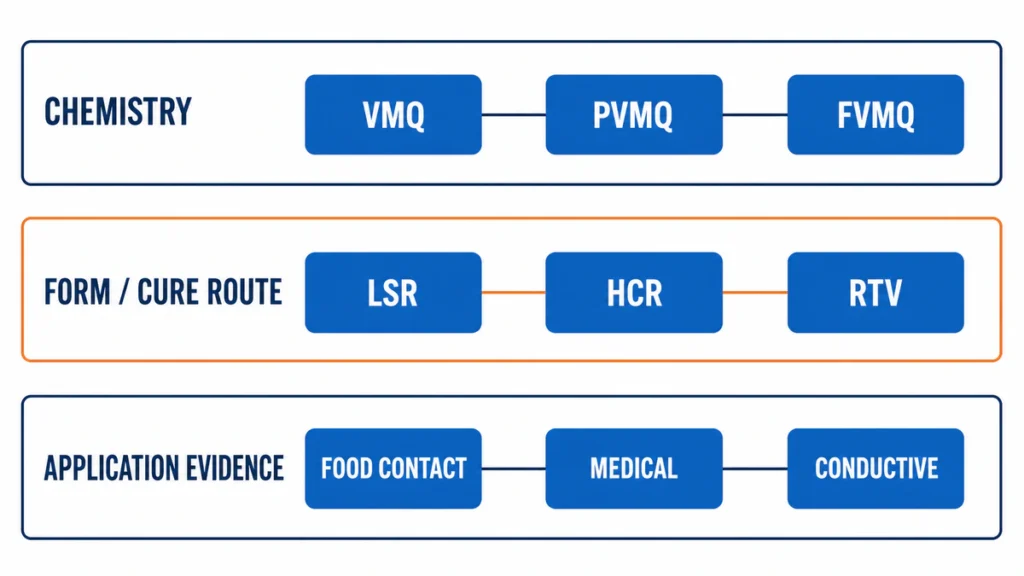
ASTM D1418-22 designations identify the polymer family and provide an initial indication of temperature and fluid resistance. They do not define the final service window on their own; the compound formulation, cure system, environment and supplier TDS still govern the usable range.
| ASTM D1418 | Chemistry | Typical continuous range | Where it is specified |
|---|---|---|---|
| MQ | Dimethyl silicone | -50°C to 200°C | Legacy and general-purpose compounds |
| VMQ | Methyl vinyl silicone | -55°C to 200°C | Most commercial LSR and HCR grades |
| PVMQ | Phenyl methyl vinyl silicone | -100°C to 200°C | Low-temperature seals, aerospace |
| FVMQ | Fluorosilicone | -55°C to 175°C | Fuel, oil and solvent contact |
These temperatures are indicative compound-selection ranges, not limits specified by ASTM D1418. They are informed by commercial silicone-rubber guidance, including the Shin-Etsu characteristic-properties guide; the selected supplier TDS and application testing still govern release.
If a supplier quotes only “food grade silicone” without identifying the compound, cure system, applicable food-contact requirement and test evidence, the quote is not technically comparable to another supplier’s.
Liquid Silicone Rubber (LSR)
Liquid Silicone Rubber is a platinum-cured silicone material mainly used in injection molding processes. It is commonly chosen for products requiring high precision, cleanliness, and consistency.
Typical applications include:
- Medical components
- Baby products
- Wearable devices
- Food-grade parts
LSR is common for thin, high-precision baby-care parts such as nipples and pacifiers, while larger feeding products may still use compression-molded HCR. The process should therefore be selected by geometry, volume and compliance requirement rather than by product category alone.
Learn more about how liquid silicone rubber is processed and what changes between platinum and peroxide cure. The direct HCR comparison appears in the decision table below.
High Consistency Rubber (HCR)
HCR silicone has a solid gum-like consistency and is widely used in compression molding and extrusion.
Common products include:
- Industrial seals
- Gaskets
- Silicone tubing
- Automotive components
HCR is the base compound behind many molded seals, tubing and continuous profiles.
Learn more about how HCR gum is compounded and cured.
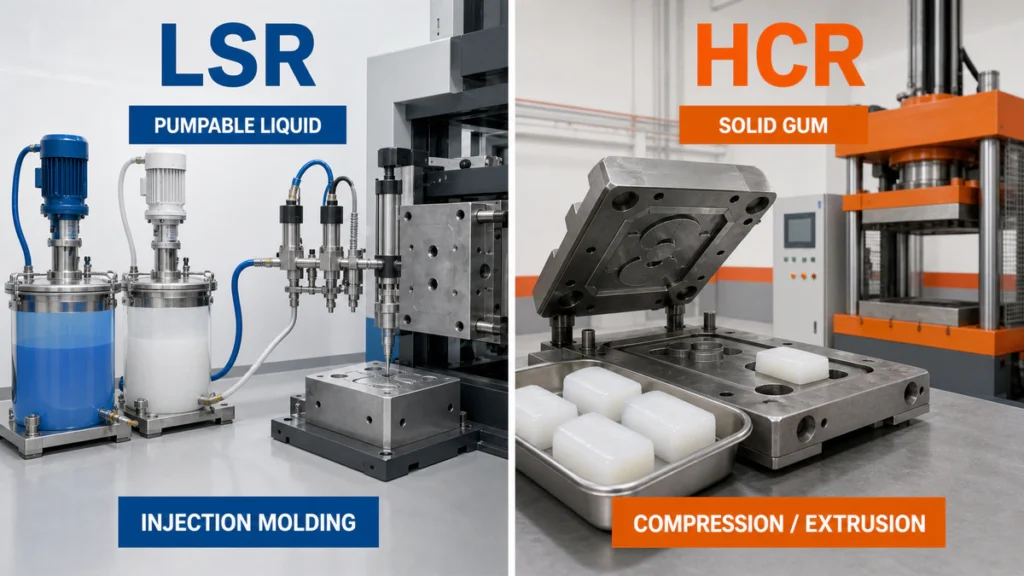
LSR and HCR are the two supply forms most molded-part projects compare. Volume and tolerance often define the economic process window, but geometry, hardness, cleanliness, cure system, overmolding requirements and acceptable flash can override that choice:
| Item | LSR | HCR / HTV |
|---|---|---|
| Supply form | Two-part pumpable liquid, 1:1 A/B | Milled gum or pre-formed sheet |
| Cure system | Platinum addition cure | Peroxide or platinum cure |
| Main process | Injection molding with cold runner | Compression, transfer, extrusion |
| Typical hardness | 10–70 Shore A | 30–80 Shore A |
| Cycle time | Seconds for small parts | Minutes per press cycle |
| Tooling cost | Higher (cold runner, precision cavities) | Lower |
| Flash and trimming | Minimal, can be near flash-free | Deflashing usually required |
| Economic volume | High annual volume, automated runs | Low to medium volume, frequent changeover |
These are common process tendencies, not cost or volume thresholds. Part size, wall thickness, cavitation, automation, flash allowance and secondary finishing can reverse the economic result.
For the full decision walk-through behind this table, see choosing between HCR and LSR for a given part.
RTV Silicone
RTV silicone cures at room temperature and is often used for sealing, bonding, and encapsulation.
It is commonly found in:
- Electronics sealing
- Construction applications
- Adhesives and coatings
Related: how RTV silicone cures without heat
Food Grade Silicone
“Food-grade silicone” is not a separate polymer family or a universal certification. It normally refers to a specific compound and finished article formulated, processed and tested for an applicable food-contact requirement, such as 21 CFR 177.2600 in the United States or the BfR Recommendations on Food Contact Materials within the relevant German and EU framework.
Typical products include:
- Baking molds
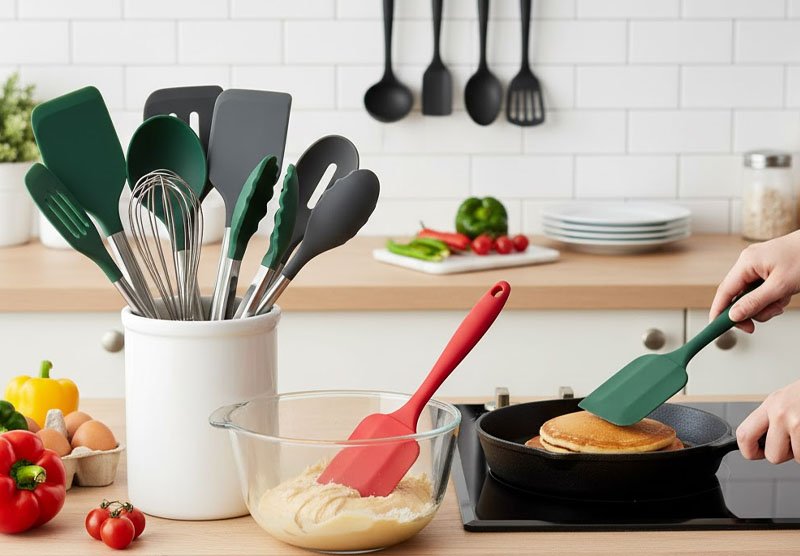
- Kitchen utensils
- Food processing seals
- Beverage components
See our detailed guide on what actually makes a compound food grade.
Medical Grade Silicone
“Medical-grade silicone” is not one globally defined material class. It refers to a controlled compound supported by traceability and biological-evaluation evidence appropriate to the device’s contact type and duration; the finished device still requires its own risk-based evaluation.
Common applications include:
- Respiratory devices
- Medical tubing
- Wearable medical equipment
- Surgical components
See how medical grade compounds are qualified for the biocompatibility evidence and sterilization behavior buyers are expected to document.
Other Specialty Silicone Grades
Beyond the main categories, several specialty grades are selected for specific performance requirements:
- Fluorosilicone for fuel, oil, and solvent exposure
- Closed-cell sponge and foam for cushioning, insulation, and low-closure-force sealing
- Conductive silicone for EMI shielding and contact keypads
Key Silicone Properties
One reason silicone is so widely used is its balance of thermal, mechanical, and chemical properties. For a full technical breakdown, see how silicone properties are measured and specified.
Instead of focusing on just one feature, engineers often choose silicone because it performs consistently under challenging conditions.
The figures below are indicative selection ranges for general-purpose VMQ, not specification limits. They were cross-checked against commercial compound data such as the WACKER solid and liquid silicone-rubber selection guide and the Shin-Etsu molding-compound guide. Filler loading, hardness, cure system, test conditions and post-cure move every row, so the selected compound TDS governs release.
| Property | Typical range (VMQ) | Test method |
|---|---|---|
| Hardness | 10–80 Shore A | ASTM D2240 |
| Tensile strength | 4–11 MPa | ASTM D412 |
| Elongation at break | 200–800% | ASTM D412 |
| Tear strength | 9–35 kN/m | ASTM D624 |
| Compression set | 15–40% (22 h at 175°C) | ASTM D395 Method B |
| Volume resistivity | 10^14–10^15 Ω·cm | ASTM D257 |
| Dielectric strength | 20–25 kV/mm | ASTM D149 |
| Thermal conductivity | 0.2–0.3 W/m·K | — |
Heat Resistance
Silicone maintains stability across a wide temperature range, making it suitable for both high-heat and low-temperature environments.
In many formulations, silicone can handle temperatures from approximately -50°C to 250°C.
Continuous service is the number that matters when sourcing. Many general-purpose VMQ compounds are rated near 200°C in dry air, while 250°C is normally treated as short-term exposure; compression, sealed conditions, fluids and required service life can lower those limits. As standard VMQ stiffens below roughly -55°C, PVMQ or another qualified low-temperature compound may become the starting direction.
Post-curing can reduce residual volatiles, odor and compression set when the selected compound requires it. Four hours at 200°C in a forced-air oven is a common supplier test or production condition, not a universal rule. The actual time and temperature must follow the compound TDS, part thickness and the validated extractables, odor or mechanical target. When post-cure is part of that validated specification, it belongs on the drawing or purchase requirement rather than being left to supplier discretion.
This makes it useful for:
- Automotive engine components
- Industrial insulation
- High-temperature seals
- Kitchen and cooking products
For a deeper explanation, see which grades hold up under sustained heat.
Flexibility and Elasticity
Silicone remains flexible even after long-term exposure to heat, UV, and outdoor environments.
Compared with many plastics, silicone is less likely to become brittle over time.
This property is especially important for:
- Silicone keypads
- Wearable products
- Medical accessories
- Flexible sealing components
Learn more about how silicone behaves under load and repeated deformation. Hardness selection is covered in choosing a Shore A value, which is the single spec most often left undefined at RFQ stage.
Chemical Resistance
Silicone generally performs well against moisture, ozone and oxidation, but chemical resistance varies sharply with the exact fluid, concentration, temperature and exposure time.
Because of this, it is commonly used in:
- Food processing equipment
- Outdoor electrical systems
- Industrial sealing applications
More details can be found in how silicone reacts to solvents and industrial chemicals, including which media cause reversible swelling rather than permanent chemical attack.
UV and Weather Resistance
Unlike many plastics, silicone can maintain performance during long-term outdoor exposure.
It resists:
- UV radiation
- Ozone
- Rain and humidity
- Temperature cycling
This makes silicone suitable for:
- Outdoor electronics
- Automotive exterior parts
- Solar and lighting applications
See how silicone ages under UV and weathering for realistic service-life expectations. Transparent grades deserve extra scrutiny, since visible discoloration appears long before mechanical properties fall off.
Electrical Insulation
Silicone materials are widely used in electrical and electronic systems because of their dielectric properties and temperature stability.
Typical applications include:
- Cable insulation
- Electronic connectors
- Power systems
- Sensor protection
See how silicone performs as a dielectric for insulation data. Carbon- or silver-filled compounds reverse this behavior entirely and are specified as conductive grades instead.
Food Safety and Biocompatibility
Special silicone grades are designed for food contact and medical applications.
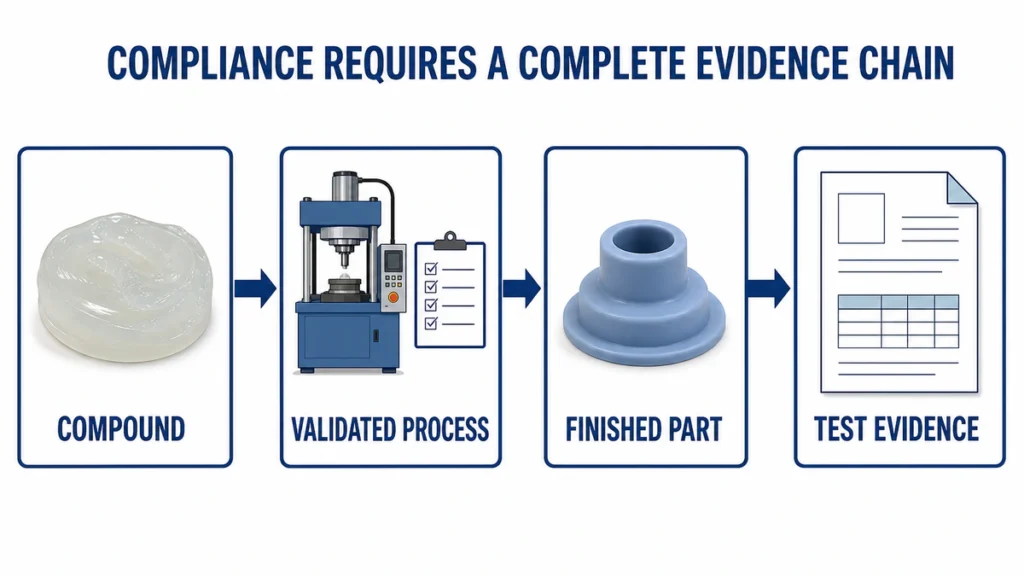
Suitability depends on evidence tied to the actual compound and finished article:
- The formulation must match the intended contact condition
- Migration, extraction or biocompatibility testing must match the applicable requirement
- Cure and post-cure conditions must remain within the validated process
- Traceability must connect the finished part to the tested compound and report
See where food-grade and medical-grade requirements diverge before assuming one certification substitutes for the other.
Where Silicone Is the Wrong Choice
Silicone is a weak choice when sliding abrasion, cut growth, high tensile load or dynamic wear governs the design:
- Abrasion and tear resistance can sit below polyurethane and nitrile, so sliding-wear and sharp-edge applications require direct comparison testing
- General-purpose VMQ has modest tensile strength, and thin high-load sections can initiate tears at gates, parting lines or damaged edges
- Standard VMQ can swell in hydrocarbon fuels, mineral oils and some non-polar solvents; FVMQ often improves compatibility, but the actual fluid, temperature and immersion time still require testing
- Silicone is usually more expensive than commodity rubber, and cured scrap cannot be remelted and returned to the process like a thermoplastic
These limits, rather than the datasheet highlights, are usually what decide the material.
Silicone Manufacturing Processes
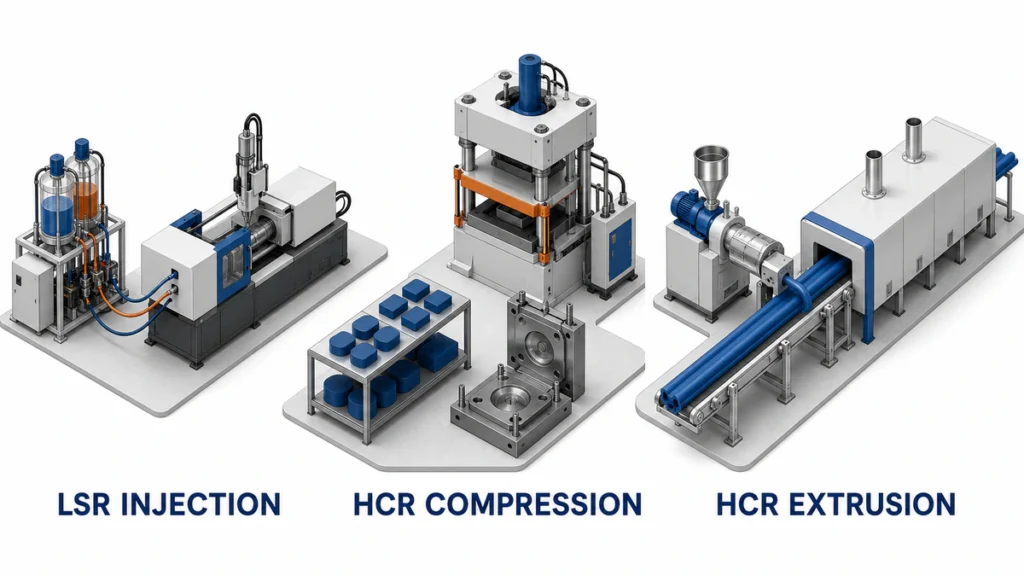
Different manufacturing methods are used depending on the product design, material grade, and production volume. Our walkthrough of the full production workflow covers each stage from compound to finished part, while what is silicone vulcanization explains the crosslinking chemistry shared by all of them.
Compression Molding
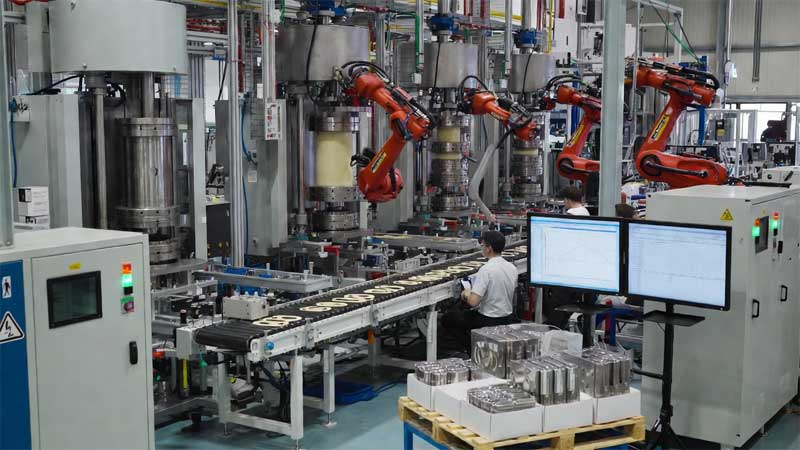
Compression molding is commonly used for medium-volume silicone parts and relatively simple product structures. Cycle time is driven by section thickness at press temperatures around 170–180°C, so the process stays economical when tooling cost matters more than unit labor.
It is often selected for:
- Gaskets
- Industrial seals
- High-hardness silicone parts
Read more about how compression molding runs in practice, including where deflashing labor starts to outweigh the tooling savings.
Liquid Silicone Injection Molding
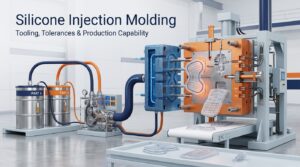
LSR injection molding is suitable for many high-precision silicone products and automated production environments. Cold-runner tooling with well-controlled venting and vacuum can hold tight features and run with very low flash, which is why the process is common—but not automatic—for medical and baby-care parts.
Advantages include:
- Tight tolerances
- High repeatability
- Fast production cycles
- Clean manufacturing process
Common applications include:
- Medical parts
- Consumer electronics
- Baby care products
The trade-off is tooling. Cold-runner systems and vacuum-sealed cavities raise the mold budget, and the payback comes from cycle time and scrap rate rather than from unit price alone. See how silicone injection molding runs end to end for the process detail.
Silicone Extrusion
Continuous silicone extrusion is used to manufacture continuous silicone profiles such as tubing, strips, and insulation materials.
Typical products include:
- Silicone tubing
- Silicone cords
- Wire insulation
Extruded profiles are vulcanized continuously in a hot-air or salt-bath line, so dimensions are held by line speed and oven temperature instead of a closed cavity. Wall and diameter tolerances are therefore looser than molded parts, and a drawing that demands molded-level tolerance on an extruded profile is the most common reason an extrusion quote comes back as a molding quote.
Typical output includes tubing, cord and continuous strips with a defined cross-section. Standard flat silicone sheet is usually calendered rather than extruded. The two processes have different tolerance limits.
Tooling, Post-Processing and Prototyping
Molding is only part of the cost and quality picture:
- Silicone mold design guide — draft angles, wall thickness, venting, shrinkage
- Silicone mold costs — what drives tooling budgets
- Silicone post cure — used when the compound specification or validated compliance process requires it
- From prototyping to mass production — what changes when tooling moves from soft molds to production steel
Silicone vs Other Materials
Material selection depends on the dominant load case, not on which material has the longest list of advantages. Use the table to identify the first trade-off, then open the detailed comparison for the actual service conditions.
| Alternative | Choose silicone when | Choose the alternative when | Decision check |
|---|---|---|---|
| Conventional rubber | Heat, ozone, UV or low-temperature flexibility governs | Abrasion, tear strength or lower material cost governs | Is the seal static or exposed to sliding wear? |
| Rigid plastic | Elastic recovery, sealing or repeated flexing is required | Structural stiffness and high-speed molding dominate | Must the part carry load or recover from deformation? |
| TPU | Heat stability, weathering and long-term elasticity matter | Abrasion resistance and toughness matter more | Is the main failure mode heat aging or surface wear? |
| PVC | High-temperature flexibility and long outdoor exposure justify the cost | A lower-cost tube or profile can meet the temperature and compliance target | What is the real continuous temperature and contact requirement? |
| Nylon | Sealing, insulation or flexible recovery is required | The part must carry structural load or resist wear | Is flexibility functional or is it unwanted deflection? |
| Polyurethane | Heat, ozone and weathering dominate | Abrasion, tear and load-bearing strength dominate | Will the part fail first from environment or mechanical wear? |
Silicone vs Rubber
Silicone is usually favored when heat, ozone, UV exposure or low-temperature flexibility governs; conventional rubbers can be better when abrasion, tear resistance or lower material cost governs. See how silicone and conventional rubber differ under heat.
Silicone vs Plastic
Choose silicone for elastic recovery, sealing and repeated flexing; choose a rigid plastic when structural stiffness, lower unit cost or very high-speed molding governs. See where silicone outperforms rigid plastics.
Silicone vs TPU
Silicone is the stronger starting point for heat, weathering and long-term elastic recovery, while TPU is often better for abrasion resistance and toughness. See the trade-off between silicone and TPU.
Silicone vs PVC
Silicone is often selected for higher-temperature flexibility, long outdoor exposure or a validated plasticizer-free formulation; PVC remains economical when its temperature, flexibility and compliance limits fit the application. Read the full comparison in PVC vs silicone.
Silicone vs Nylon
Silicone suits sealing, insulation and elastic recovery, while nylon suits structural load and wear; moisture-driven dimensional change must also be considered for nylon. See the full nylon vs silicone selection comparison.
Silicone vs Polyurethane
Silicone is usually favored for heat, UV and ozone exposure, while polyurethane is often stronger in abrasion, tear resistance and load-bearing toughness; compliance must be verified for the selected grade in either material. See polyurethane as an alternative elastomer for the full comparison.
Common Silicone Applications
Industry name alone does not justify silicone. The material earns its place only when the service condition—temperature, weathering, electrical behavior, contact compliance or elastic recovery—rules out a cheaper elastomer or rigid plastic.
Industrial Silicone Components
Common industrial products include:
- Seals
- Gaskets
- Insulators
- Dampers
Silicone is a strong fit for static seals exposed to heat, ozone or repeated compression. It is a weaker choice for sliding wear, sharp-edge assembly or dynamic contact unless tear and abrasion performance have been validated. For the design side, start with gasket design in silicone to define compression, groove geometry and allowable movement. For the production side, use industrial silicone parts manufacturing when the drawing is ready for process and tooling review.
Medical Silicone Products
Medical applications use silicone when flexible recovery, transparency, sterilization compatibility or controlled skin contact makes it suitable; the polymer name alone does not establish biocompatibility.
Typical applications include:
- Medical tubing
- Respiratory devices
- Wearable healthcare products
Selection starts with contact type and duration, then the sterilization route. Steam, radiation and chemical sterilants can affect hardness, color and mechanical retention differently, so the evidence must match both the compound and the finished device.
Food Grade Silicone Applications
Food-contact silicone is commonly used for:
- Kitchenware
- Baking molds
- Food processing equipment
- Beverage systems
Selection must match repeated or single-use contact, food type, temperature and contact time. Post-cure is required only when the compound specification or validated process calls for it; migration, extraction or sensory evidence must correspond to the intended article rather than to a generic “food-grade” label.
For projects that have already defined the contact condition and test requirement, silicone kitchenware production provides the relevant manufacturing route.
Baby and Childcare Silicone Products
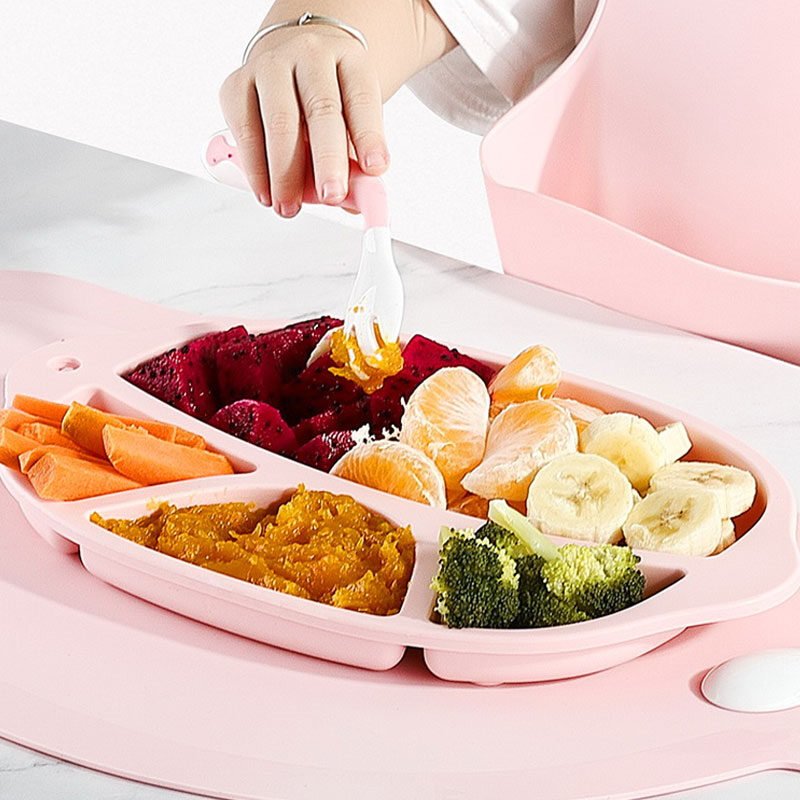
Baby-care applications include feeding sets, bibs, teethers, pacifiers and other products that combine soft-touch geometry with food- or skin-contact requirements. Thin, intricate parts may favor LSR, while larger feeding products can remain economical in compression-molded HCR. Buyers planning a coordinated product line can review the available routes for silicone baby product manufacturing.
Custom Silicone Molds
Reusable baking, ice, confectionery and casting molds need enough flexibility for demolding without losing cavity shape. The decision combines wall thickness, support ribs, surface finish, tear resistance and the intended contact requirement. See custom silicone mold manufacturing when the project is a finished mold product rather than production tooling for another silicone part.
Promotional and Branded Silicone Products
Wristbands, keychains, coasters and other branded accessories are selected less by extreme material performance than by color consistency, logo reproduction, surface finish and order volume. For programs built around multiple branded items, use custom silicone promotional product production as the category entry point.
Automotive Silicone Components
Automotive applications often involve:
- High temperatures
- Oil exposure
- Outdoor environments
Silicone is commonly used in:
- Engine seals
- Cable protection
- Vibration dampers
The failure mode differs by component: a static seal is governed by compression set and fluid swell, a hose by pressure and reinforcement, and an exterior boot by ozone and flex cycling. Under-hood parts are specified against continuous temperature and the actual contact fluid. Fuel or aggressive oil exposure may justify FVMQ because it generally resists hydrocarbons better than VMQ, but coolant and lubricant compatibility must still be checked against fluid composition, temperature, immersion time and allowable volume change.
Coolant and charge-air hoses commonly use HCR compounds with reinforcement selected for pressure, temperature and the actual fluid.
Consumer Electronics Silicone
Electronics use silicone for elastic key response, environmental sealing and electrical insulation—not simply for a soft-touch surface.
Typical products include:
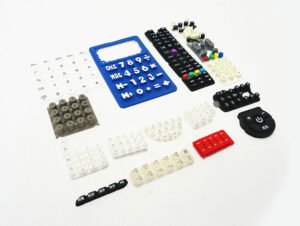
- Silicone buttons
- Protective covers
- Wearable accessories
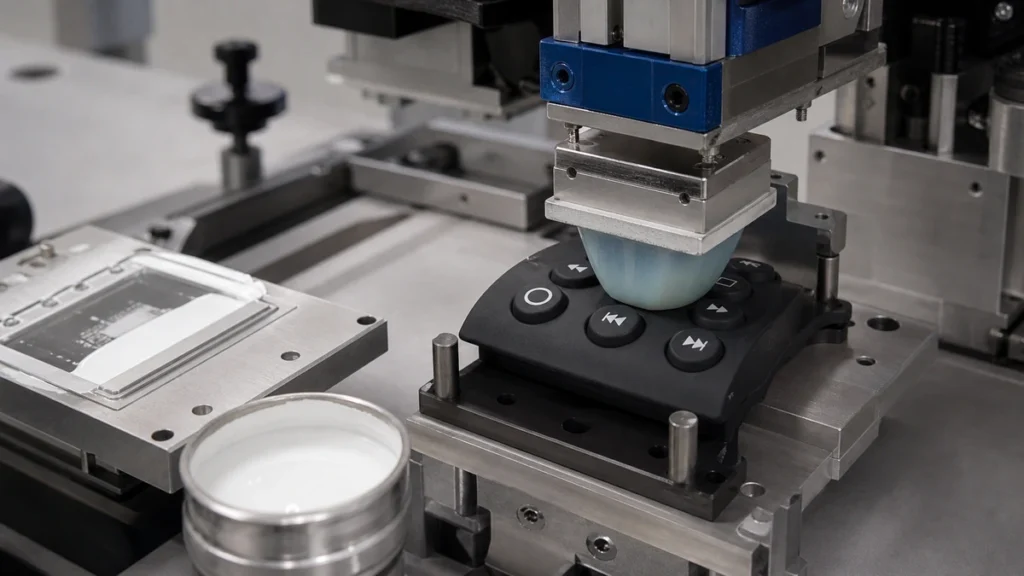
Unfilled silicone is normally insulating. Conductive compounds rely on carbon, nickel or silver-filled systems, and increasing conductivity can change hardness, tear behavior and cost. See what goes into designing a custom keypad for actuation force, key travel, and printing constraints.
How to Choose the Right Silicone Material
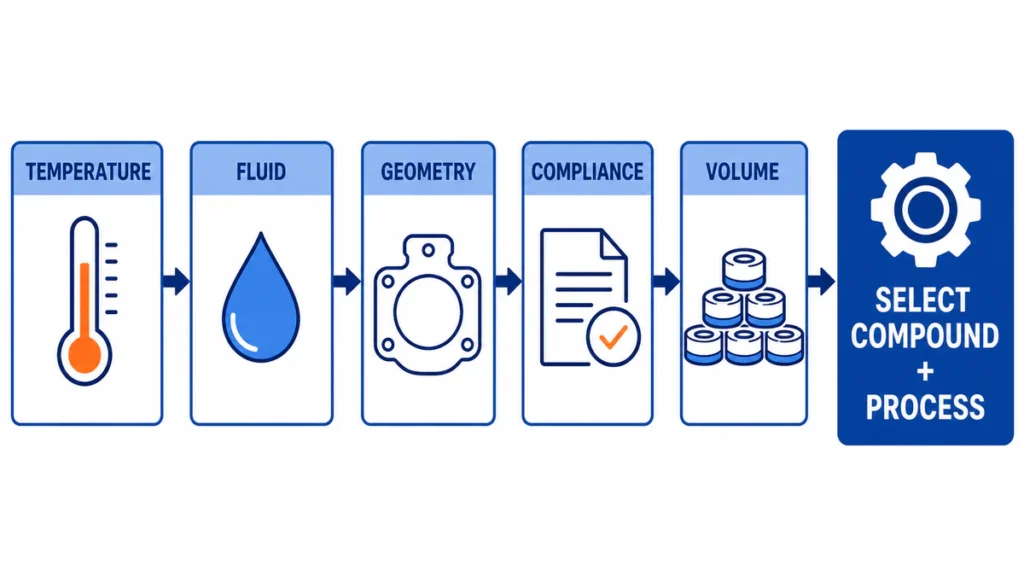
Start with the failure condition and required evidence, then select the polymer family, hardness and process. Choosing “silicone” first and defining the service environment later usually produces a quotation that cannot be validated.
| Service condition | Starting direction | Verify before release | Do not assume |
|---|---|---|---|
| Continuous hot-air service near 180–200°C | Heat-resistant VMQ compound | Property retention, compression set, time at temperature | A short-term peak rating is a continuous rating |
| Hydrocarbon fuel or aggressive oil exposure | Evaluate FVMQ against VMQ and other elastomers | Volume change, hardness change and retained strength in the actual fluid | All oils and coolants require the same polymer |
| Service below about -55°C | Evaluate PVMQ or a qualified low-temperature compound | Low-temperature retraction, sealing force and cycling | Room-temperature softness predicts cold sealing |
| Repeated food contact | Qualified VMQ-based LSR or HCR | Applicable extraction or migration evidence and validated cure conditions | “Food grade” is a universal certificate |
| High-volume, thin or intricate molded part | Evaluate LSR injection molding | Tooling payback, venting, flash limit, automation and annual volume | LSR automatically gives better part performance |
| Low- to medium-volume, thicker molded part | Evaluate HCR compression molding | Cycle time, deflashing labor, parting line and compression set | Lower tooling cost means lower total cost |
| Continuous tube, cord or profile | HCR extrusion | Cross-section tolerance, cure line, cut length and secondary joining | An open-die profile can hold molded-part tolerances |
Temperature Requirements
Specify the maximum continuous temperature, peak temperature and duration separately. Add thermal cycling and the surrounding medium; 200°C in dry air is not the same condition as 200°C under compression or in oil.
Chemical Exposure
Name the actual fluid, concentration, temperature and exposure time. “Oil resistant” or “solvent resistant” is not a test condition, and compatibility data from room-temperature immersion may not predict a hot compressed seal.
Hardness and Flexibility
Shore A hardness is not the same as stiffness in the finished part. Wall thickness, unsupported span and geometry can make a 40 Shore A part feel stiffer than a thinner 60 Shore A part. For seals, pair hardness with compression, contact pressure and compression-set requirements.
See how to communicate shore hardness and thickness requirements to suppliers to avoid spec misunderstandings.
Compliance Requirements
Food-contact and medical applications may call for evidence such as:
- 21 CFR 177.2600 extraction testing for repeated-use rubber articles
- BfR Recommendation XV evidence within the applicable German and EU legal framework
- USP <88> Class VI testing where contractually required
- A risk-based ISO 10993 biological evaluation for the finished medical device
These requirements cover different hazards and articles, and they are not interchangeable:
| Standard | What it covers | Usual evidence |
|---|---|---|
| FDA 21 CFR 177.2600 | Rubber articles for repeated food contact | Extraction testing in water and n-hexane |
| BfR Recommendation XV | German recommendation for silicones used in food-contact materials; applied within the relevant legal framework | Evidence matched to the current recommendation, intended article and contact conditions |
| USP Class VI | Biological reactivity of medical elastomers | Systemic, intracutaneous and implantation tests |
| ISO 10993-5 / ISO 10993-10 / ISO 10993-23 | In-vitro cytotoxicity / skin sensitisation / irritation | Risk-based test plan matched to device contact type and duration |
| RoHS / REACH SVHC | Restricted substances and reportable substances of very high concern | Material declaration or SVHC statement, supported by risk-based analytical testing where needed |
| UL 94 | Small-scale flammability classification such as V-0 | Tested material, specimen thickness and color; not a blanket finished-part claim |
Compliance depends on the applicable rule, the compound, the finished article and how it was processed—not on the word silicone. FDA 21 CFR 177.2600 is a regulation for rubber articles intended for repeated food contact, not an FDA-issued material certificate. Likewise, USP Class VI results do not replace a medical device’s risk-based ISO 10993 evaluation. Ask for the report, test conditions, laboratory and exact article or compound tested; a generic statement of conformity is not enough.
For broader chemistry screening, see whether silicone contains PFAS. For article-level evidence, review how silicone mold safety and regulatory evidence should be checked before accepting a generic compliance statement.
Manufacturing Method
Geometry, tolerance and annual volume connect material selection to process selection:
- LSR injection molding favors thin or intricate parts, automation and high repeat volume, but requires higher tooling investment
- HCR compression molding tolerates frequent changeover and lower volume, but adds press time, flash and manual handling
- Extrusion suits continuous profiles, but an open die cannot reproduce every tolerance or feature shown on a molded-part drawing
Do not select the process from annual volume alone. Undercuts, inserts, wall transitions, gate restrictions, acceptable parting lines and required cleanliness can eliminate an otherwise economical option.
What to Fix Before Sending an RFQ
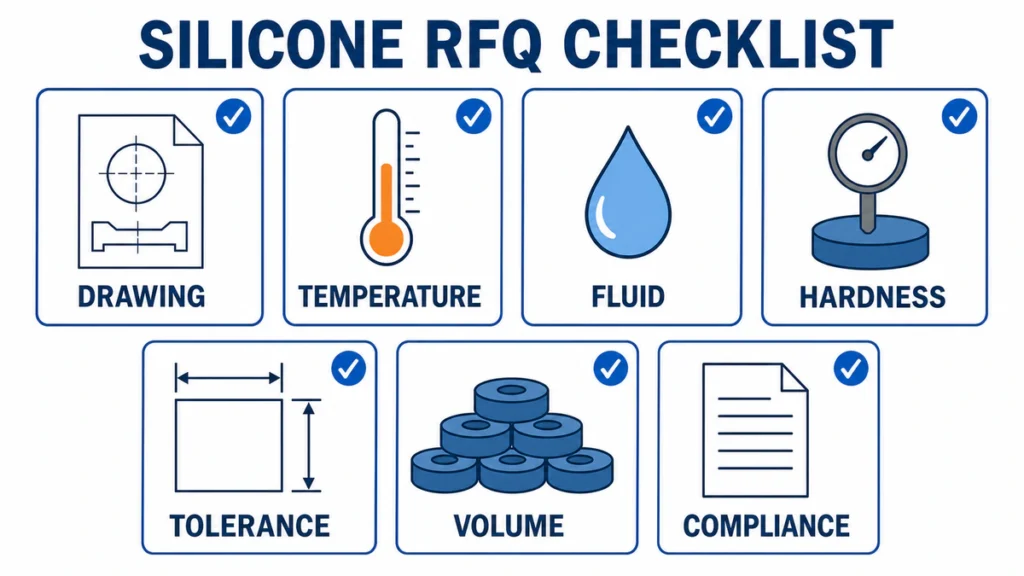
Six items decide whether quotes from different suppliers are comparable at all:
- Hardness with a tolerance, for example 50 ±5 Shore A; soft or medium cannot be quoted
- Dimensional tolerance class per ISO 3302-1, M1 through M4 for molded parts; tighter classes affect tooling, inspection and process-control cost
- Colour reference as a Pantone number or an approved physical sample, plus whether matching is judged under one light source or two
- Post-cure requirement, driven by the compliance target rather than by preference
- Acceptable parting line and gate position marked on the drawing
- Annual volume and order pattern, which decide cavitation and whether LSR tooling pays back
A quote built without these is a placeholder, and the gap normally reappears as a price revision after the first sample round.
Frequently Asked Questions
What is silicone material used for?
Silicone is used in industrial, medical, automotive, food-grade, and consumer applications due to its flexibility, durability, and heat resistance. See the versatility of silicone parts.
Is silicone better than rubber?
It depends on the application. Silicone generally performs better under heat and outdoor exposure, while rubber may provide better abrasion resistance in some environments.
Is silicone food safe?
A silicone article is suitable for food contact only when its formulation, manufacturing conditions and test evidence match the intended food, temperature and contact time. See how to tell if your supplier uses real food grade materials.
What temperature can silicone withstand?
Many silicone formulations can withstand temperatures ranging from approximately -50°C to 250°C, with 200°C as the usual continuous limit for general-purpose VMQ.
Is silicone environmentally friendly?
Long service life can reduce replacement frequency, but it does not make silicone automatically sustainable. Cured silicone is a thermoset and cannot be remelted like a thermoplastic, so environmental claims need a defined life-cycle boundary. See can silicone be recycled.
Request Custom Silicone Solutions
Use the selection tables above to define the service temperature, contact medium, geometry, hardness, tolerance class, annual volume and compliance evidence before approaching a manufacturer.
If you are still screening factories, use the questions to ask before placing a silicone OEM order. When the project is ready for technical review, request custom silicone solutions with the latest drawing revision and those seven inputs. A useful quotation should state its material, process, tooling and testing assumptions rather than hide them behind one unit price.