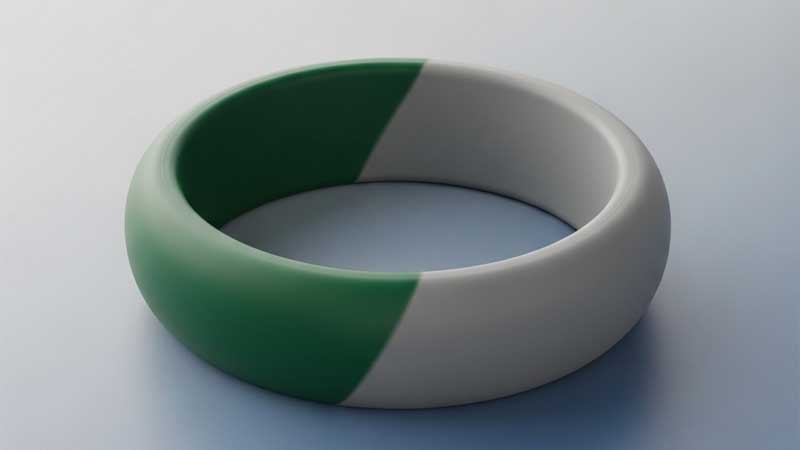
Silicone rings have become a popular everyday choice for many people. Their soft, flexible feel, metal-free design, and suitability for active lifestyles make them ideal for a wide range of users. But how exactly is a high-quality silicone ring made?
This article takes you behind the scenes, walking through every key stage, from raw material selection to product design, molding processes, and quality control. Each part of the journey plays a direct role in shaping the ring’s comfort, durability, and overall performance.

How to Choose the Right Material for a Silicone Ring?
A high-quality silicone ring starts with strict control over raw materials. The type, safety, and performance of the silicone directly affect the ring’s comfort, durability, and appearance.
LSR and HCR
Two main types of silicone are commonly used:
LSR (Liquid Silicone Rubber)
- Key traits: Excellent flowability, fast curing, ideal for precision molding
- Benefits: Smooth surface, minimal flash, perfect for automated mass production
HCR (High Consistency Rubber)
- Key traits: Higher viscosity, requires mechanical mixing
- Benefits: Stable process, more cost-effective
For rings that need a refined look and a comfortable feel, LSR is the top choice.
Safety and Certification
Since silicone rings touch the skin directly and are often worn for long hours, material safety is critical. Look for silicone that meets the following global standards.
| Certification | Meaning and Benefits |
| FDA | Complies with food-contact safety, non-toxic and safe |
| USP Class VI | Medical-grade biocompatibility, gentle for sensitive skin |
| BPA-Free | No bisphenol A, no risk of harmful leaching |
| RoHS / LFGB | Meets EU environmental and food safety standards |
Key Performance Traits
A good ring should not only be safe but also perform well in everyday use.
| Property | Ideal Standard | What It Means |
| Hardness (Shore A 30–60) | Soft and flexible | Comfortable to wear, won’t dig into skin |
| Tensile Strength > 6 MPa | Strong under tension | Won’t snap easily, even during workouts |
| Tear Strength > 15 kN/m | Resistant to edge tearing | Keeps its shape, lasts longer |
| Elongation > 300% | High stretchability | Returns to form after pulling or bending |
| Temp Range: -60°C to 200°C | Withstands heat and cold | Safe in various indoor and outdoor conditions |
| Color Stability | UV and oxidation resistant | Won’t fade or yellow with sunlight or time |

How to Design a High-Quality Silicone Ring?
Once the right silicone material is selected, the next step is product design. This plays a key role in how the ring looks, feels, and performs in real life.
A well-designed silicone ring is more than just a soft circle. It should fit the finger comfortably, look good, and work well in different settings. From sizing and structure to surface texture and breathability, every small detail affects the user experience and product quality.
Let’s take a closer look at the design principles behind a great silicone ring, covering ergonomics, sizing, aesthetics, prototyping, and mold optimization.
Ergonomic Design: Comfort Comes First
- Inner and Outer Curves: A soft curved transition on both edges helps the ring sit smoothly on the finger. This reduces friction and prevents pressure marks during long wear.
- Balanced Thickness and Width: Most rings use a thickness of 1.5–2.5 mm. Widths vary depending on the style—from slim minimalist bands to wider sport-style designs. The right balance offers both visual appeal and comfort.
- Breathability Channels: Small grooves on the inner band help improve airflow and reduce sweat buildup. This feature is especially useful for active use like workouts or outdoor activities.
- Anti-Slip Surface: Textured patterns improve grip. Even in wet conditions or during movement, the ring stays securely in place.

Accurate Sizing: The Foundation of a Good Ring
- Standard Size System: Designs follow the US ring size system, from size 4 to 13, to fit most male and female hands.
- Shrinkage Compensation: During curing, silicone shrinks by about 1.5%–3%. The design must account for this to ensure the final size is accurate.
- Custom Size Options: Custom sizing is available for brands or bulk orders, including special shapes or asymmetrical designs to meet market needs.
Aesthetic Details: Style Meets Identity
- Surface Finishes: Options include glossy, matte, frosted, gradient, or metallic-like coatings. This adds variety and meets different personal preferences.
- Engraving and Patterns: Custom logos, symbols, fingerprints, or meaningful text can be added using mold engraving or laser marking.
- Flexible Color Matching: Single-color, two-tone, pastel (macaron), glow-in-the-dark, and other special finishes are all possible.
Prototyping: Turning Ideas into Real Products
| Step | Description |
| 3D CAD Modeling | Design is built in software like SolidWorks or Rhino to ensure proper shape and balance |
| Sample Testing | 3D printing or soft molds are used to create initial samples for review |
| Wear Testing | Target users try the rings in real-life settings. Feedback helps fine-tune details |
| Mold Confirmation | Once finalized, high-precision multi-cavity molds are created for stable mass production |
Mold Optimization: Every Detail Matters
- High-Precision Molding: Ensures clean ring outlines and a smooth, round inner surface.
- Rounded Corners and Chamfers: Soft edges avoid sharp contact, improving comfort and safety.
- Smart Venting and Draft Angles: Helps remove trapped air, reduces flash, and makes de-molding easier and more efficient.

How Are Silicone Rings Made?
The molding process is a key step in turning raw silicone into a finished ring. This stage determines the ring’s shape, accuracy, and surface finish. Different molding methods lead to very different results, especially when aiming for premium quality.
Two Common Molding Methods
Compression Molding
This method uses High Consistency Rubber (HCR). The silicone is first mixed and then placed into a mold, where it’s pressed under heat to form the shape.
Pros: Lower equipment cost, good for mass production, low unit price.
Limits: Not ideal for fine details, may produce flash that needs trimming.
Liquid Silicone Rubber (LSR) Injection Molding
This process mixes two components (A/B) in a sealed system and injects them into a mold. The ring forms through fast curing.
Pros:
- High precision and clear detail
- Fully automated, clean, and consistent
- Little to no flash, so post-processing is minimal
- Ideal for rings with complex shapes, smooth surfaces, and high comfort
Limits:
- Higher costs for equipment and molds
- Requires stricter production control
Key Control Points
Mixing and Coloring
- Silicone must be mixed evenly with pigments and curing agents. This ensures a uniform structure and accurate color.
- In LSR molding, mixing happens in a sealed system to avoid bubbles and contamination.
- Strict color-matching with swatches helps avoid color inconsistency between batches.
Vacuum Defoaming
Before molding, vacuum defoaming helps remove trapped air. This step reduces bubbles and layers inside the product, improving both the appearance and strength.
Curing Control
- Temperature, pressure, and curing time must be set with precision.
- For higher-end rings, a post-curing step is often added. This helps improve elasticity and long-term durability.

How Are Silicone Rings Finished on the Surface?
After molding, silicone rings go through several surface finishing steps. These may seem simple, but they directly affect comfort, durability, and overall quality.
Removing Flash
During molding, flash or extra edges can form. These are removed by:
- Cold Trimming: Freezing the rings and quickly peeling off the flash. This method suits large-scale production.
- Automated Trimming Machines: Efficient and consistent, ideal for mass manufacturing.
Surface Treatments
Different treatments fit different product styles:
| Treatment Type | Purpose |
| Matte or Glossy Finish | Enhances look, fits various styles |
| Coating with Soft-Touch Oils | Makes rings smoother and skin-friendly, reduces dust sticking |
| Anti-Dust and Anti-Static Treatment | Keeps the surface clean for daily wear |
| UV-Resistant Coating | Slows aging, keeps colors lasting longer |
Printing and Engraving
Patterns, text, or logos can be added for recognition:
| Method | Features |
| Screen Printing | Cost-effective, works well on flat surfaces |
| Pad Printing | Good for curved surfaces, more detailed patterns |
| Laser Engraving | Permanent marks, resistant to wear, great for custom messages |
Post-Curing
High-end rings often undergo post-curing:
- Purpose: Remove leftover substances and improve tensile strength and stability
- Use Case: Essential for food-grade and medical-grade silicone rings
Cleaning and Packaging
- Ultrasonic Cleaning: Removes tiny particles and residues
- Clean Packaging: Used for premium or medical-grade products
- Desiccant Sealing: Prevents moisture, suitable for shipping and storage

How Is Quality Controlled in Silicone Ring Manufacturing?
To make a truly reliable silicone ring, strict quality control is essential. From raw material inspection to final product checks, every step must be handled with care. This ensures each ring is safe, durable, well-fitting, and free from defects.
Incoming Material Inspection (IQC)
Quality control starts at the source. All silicone materials are checked before entering production. Key checks include verifying purity and viscosity, and making sure there are no impurities or foreign particles. Certification documents must also be reviewed, such as FDA, LFGB, REACH, RoHS, or ISO 10993. These confirm the material meets safety and environmental standards. Only approved materials move on to the next stage.
In-Process Quality Control (IPQC)
During molding and processing, quality checks are carried out regularly. Staff inspect size, hardness, and appearance. Molds are checked often to avoid defects caused by wear. Measuring tools like calipers or optical scanners ensure rings match design specs. Hardness is also tested (usually Shore A 40–60) to guarantee comfort. Visual checks look for bubbles, discoloration, or debris to make sure the surface is clean and colors stay consistent.
Final Product Testing (FQC)
Before packaging, each ring goes through a final inspection. This includes testing size accuracy, tensile strength, rebound, surface finish, and odor. Some products also undergo temperature cycling, UV aging, and abrasion tests. These simulate real-life use to make sure the ring stays in shape and keeps its color over time. For medical or food-grade rings, extra tests ensure they are non-toxic, odor-free, and skin-safe according to ISO 10993.
Traceable Batch Management
In addition to physical checks, a clear traceability system adds another layer of quality assurance. Each batch of raw materials and finished products is logged with details like source, production parameters, test results, and shipping time. If any problem comes up, this system helps trace the cause quickly and respond fast. It also builds trust by showing a brand’s commitment to transparency and quality.

Conclusion
From start to finish, every decision—from the silicone type to the production method—matters. The right design, precise forming, and strict inspection all come together to create a ring that’s safe, stylish, and built to last.
Looking to bring your own silicone product to life? Whether you need custom silicone rings or other silicone goods, we’re here to help you develop high-quality solutions tailored to your brand. Get in touch to explore custom manufacturing options that meet your exact needs.