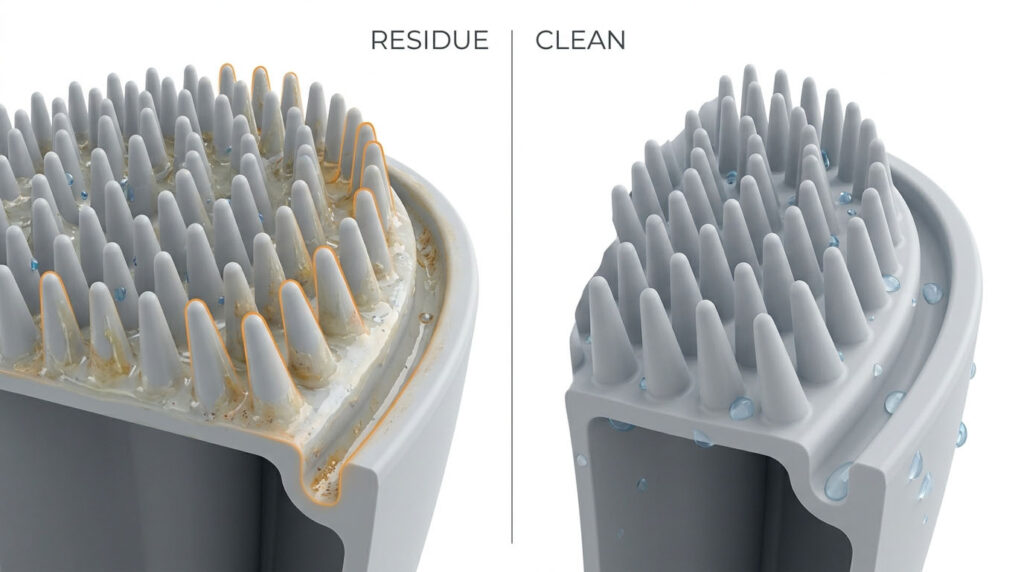
A silicone face brush touches facial cleanser, skin oil, sunscreen, makeup, and water every time you use it. Residue can remain between fine silicone touchpoints, around seams, beneath a removable head, or beside a charging port even when the surface looks clean.
The safest routine is simple: clean the face-contact surface after every use, remove all cleanser, and let the brush dry completely. The important exception is an electric facial cleansing brush. A silicone exterior does not prove that the motor, battery compartment, or charging interface may be rinsed or immersed.
What Is the Safest Way to Clean a Silicone Face Brush?
Quick answer: Turn off and unplug a powered brush. Check whether the whole device, only a removable head, or neither part may be held under running water. Rinse the approved face-contact surface with lukewarm water. If the care instructions allow soap, gently work a small amount of mild liquid soap between the silicone tips with clean fingers. Rinse away all foam, blot with a lint-free towel, and air-dry in a ventilated place. Do not use alcohol, bleach, acetone, boiling water, a dishwasher, or a sterilizer unless the manual for that exact model expressly permits the method.
This guide covers one-piece manual silicone face scrubbers, silicone cleansing pads, waterproof powered brushes, and devices with a washable silicone surface or head. It does not cover makeup-brush cleaning mats, face-mask applicators, nylon brush heads, body scrubbers, or the liquid product sometimes called a “facial cleanser.” For material-wide care principles, see How to Clean Silicone. For product benefits and suitability, see Are Silicone Face Brushes Good?.
Before Cleaning, Identify the Brush Type and Water Rating
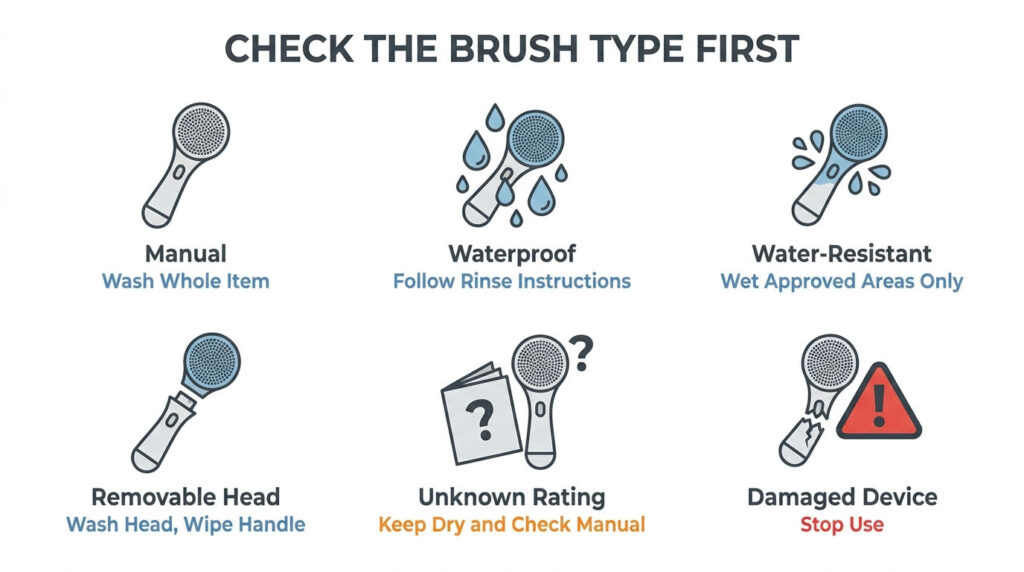
“Silicone facial cleansing brush” describes several constructions. The visible tips may be silicone, but the complete product can also contain plastic, adhesive, metal, a motor, battery, seals, buttons, or a removable attachment. Its cleaning limit is set by the full assembly—not by silicone alone.
| Brush type | Typical construction | Safest starting method | Main caution |
|---|---|---|---|
| Manual one-piece scrubber or pad | Molded silicone with no electronics | Wash the whole item with lukewarm water and approved mild soap | Printing, a suction cup, coating, or insert may set additional limits |
| Powered waterproof brush | Silicone exterior over a sealed motor and battery | Follow the model’s rinse and drying instructions | Waterproof does not authorize boiling, chemicals, or charging while wet |
| Water-resistant or splash-resistant device | Silicone cleaning area on a partly sealed body | Wet only the areas approved in the manual | Do not infer that the device is submersible |
| Device with removable head | Washable attachment plus electronic handle | Remove and wash the approved head; wipe the body separately | Keep moisture out of the drive, port, and battery compartment |
| Unknown water rating | Unverified materials, seals, or rinse limits | Use a dry lint-free cloth; find the instructions before wet cleaning | Do not immerse it based on appearance alone |
| Damaged powered device | Cracked body, loose seal, damaged port, or other fault | Stop using it and contact the manufacturer | Do not rinse, charge, or attempt a household repair |
Brand instructions show why this check matters. PMD describes its PMD Clean as waterproof and tells users to rinse it after use. A Conair silicone facial-brush manual, however, describes that model as water-resistant, rinseable but not submersible. Both have silicone cleaning surfaces, but their water limits differ.
What You Need
For most models, prepare:
- lukewarm fresh water;
- a small amount of mild liquid soap only if the maker allows it;
- clean fingers or a soft, lint-free cloth;
- a clean, dry, lint-free towel;
- an open, ventilated drying area; and
- the exact product manual or official care page.
You normally do not need an abrasive scrubber or strong disinfectant. A harsher cleaner can damage silicone tips, pigments, coatings, adhesives, seals, or electronics—and residue left behind may contact the face during the next use.
How to Clean a Silicone Facial Cleansing Brush in Five Steps
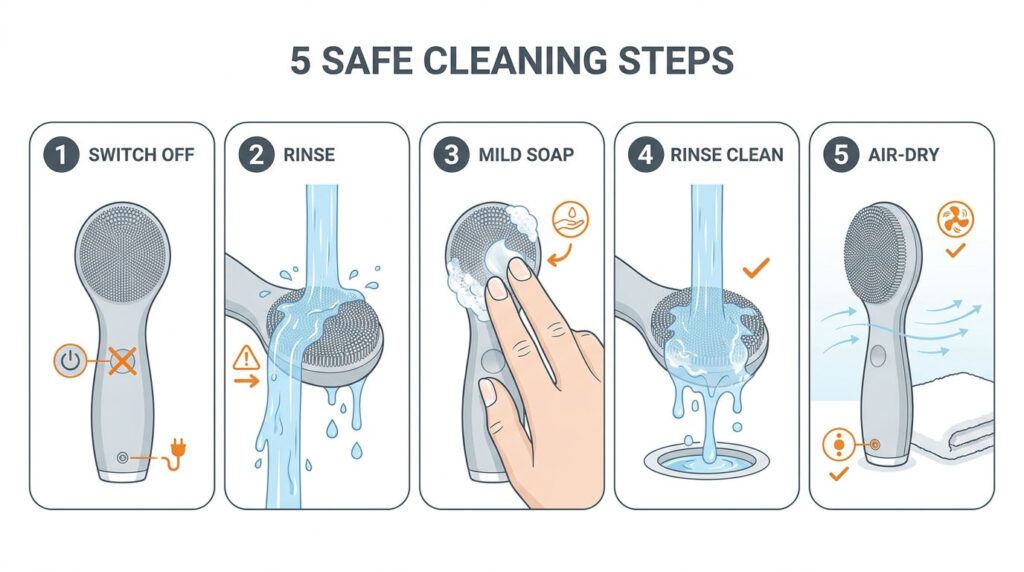
1. Switch Off, Unplug, and Define the Washable Area
For a manual silicone face scrubber, proceed to rinsing. For an electric brush:
- switch it off;
- disconnect the charging cable or supply unit;
- close any battery cover as directed;
- remove the cleansing head only if it is designed to detach; and
- confirm which parts may be rinsed, wiped, or immersed.
If the manual is unavailable, do not put a powered brush under the tap simply because the outside feels like silicone. Keep it dry, use only a dry lint-free cloth, and contact the brand until the water rating and approved cleaning method are confirmed.
2. Remove Fresh Cleanser and Makeup Residue
Rinse the approved silicone surface promptly with lukewarm water. On a non-submersible model, follow the manual’s head-rinsing or damp-wiping method and keep the handle and openings away from the stream.
Use clean fingertips to move gently between the silicone tips. Pay attention to their roots, the edge of the cleansing surface, grooves on the reverse side, the underside of a manual pad, hanging holes, and the joint around a removable head.
Do not scrape between touchpoints with a pin, nail tool, blade, or metal pick. Thin silicone tips can tear, and a sharp object can damage a seal or enclosure.
3. Wash With Mild Soap When the Manual Allows It
Apply a small amount of permitted mild liquid soap to the wet face-contact surface. Massage it gently across and between the silicone touchpoints using your fingertips. The goal is to lift oil and product film, not to scour the material.
FOREO’s current LUNA 4 instructions tell users to wash the brush surface with water and soap after use, rinse with warm water, and pat it dry with a lint-free cloth. The same manual warns that clay-based, silicone-based, and grainy cleansers can damage that model’s soft touchpoints. Those are LUNA 4 instructions—not a universal permission for every cleanser or powered brush.
Avoid rough sponges, stiff toothbrushes, scouring powder, and melamine foam. They can roughen the touchpoints or cosmetic finish without improving cleanliness.
4. Rinse or Wipe Until No Film Remains
Rinse every approved washable surface until there is no foam, slippery cleanser, oily makeup remover, grit, or heavy fragrance. Flex a manual pad gently or move fingertips through the rows so water reaches the roots of the touchpoints.
If residue remains, repeat the approved mild wash instead of escalating immediately to alcohol or bleach.
For a body that cannot be rinsed, use the exact cloth or wipe method in its manual. Keep water away from charging sockets, switches, speaker openings, battery compartments, and imperfect seals unless the manufacturer specifically identifies those areas as washable.
5. Blot and Air-Dry Completely
Shake off loose water without striking the brush against the sink. Blot the approved surfaces with a clean lint-free towel, then leave the brush exposed to circulating air. Dry detachable heads, stands, caps, and handles separately when the design allows it.
Do not reinstall a head, replace a cap, close a travel case, store the brush, or connect a charger until every contact surface and opening is dry. Do not accelerate drying with a hair dryer, radiator, oven, direct flame, or prolonged direct sunlight.
How Often Should You Clean a Silicone Face Brush?
Clean the face-contact surface after every use. FOREO instructs users to clean the LUNA 4 after use, while PMD tells users to rinse PMD Clean after each use and let it air-dry. Promotional terms such as “antibacterial” or “odor-resistant” do not mean a device is self-cleaning.
A more thorough clean should mean better access and inspection, not automatically a harsher chemical. Perform it when you notice film, odor, staining, or buildup:
- separate user-removable components as directed;
- inspect touchpoint roots, attachment sockets, stands, caps, and battery-cover edges;
- wash only the approved components with the approved cleaner;
- wipe the electronic body according to its manual;
- rinse all washable parts carefully; and
- dry each piece before reassembly.
Some brands specify an additional interval. Conair, for example, tells users of one water-resistant silicone model to rinse its brush head after each use and clean the complete unit weekly with warm soapy water. Treat that as model-specific—not a universal weekly schedule.
How to Remove Cleanser, Makeup, Oil, Stains, and Odor
Cleanser or Soap Film
A cloudy, slippery, or perfumed layer usually means product remains between the touchpoints. Rewash with lukewarm water and approved mild soap, work from the base of the tips toward their ends, and rinse longer than you wash.
If film returns quickly, use less cleanser on the device and confirm that the formula is compatible. FOREO excludes clay-based, silicone-based, and grainy cleansers for the LUNA 4. Another brand may have different limits.
Makeup, Sunscreen, and Skin Oil
Clean these residues promptly. Start with the routine method and repeat once if needed. Do not reach first for makeup remover, cleansing oil, rubbing alcohol, or solvent. A formula that is suitable for skin is not automatically compatible with pigments, silicone overmolds, adhesives, or seals.
If makeup repeatedly reaches the device, remove heavy makeup using a skin-appropriate method before using the brush, when that matches the brush maker’s instructions.
White or Stained Silicone
First determine whether the color is transferable surface residue. Wash normally, repeat once with fresh approved soap, and inspect the dry brush.
Some pigment may remain after the surface is clean. Conair notes that makeup can discolor its cited silicone brush without affecting that model’s performance. Do not generalize that assurance to every brush, but do distinguish cosmetic color transfer from an oily film, permanent tackiness, cracking, or material that transfers to a cloth.
Do not promise that bleach, peroxide, baking soda, toothpaste, or hard scrubbing will restore a white brush. Aggressive treatment can change the texture or color while leaving absorbed pigment in place.
Odor or Visible Spots
Odor can result from trapped cleanser or moisture in a groove, cap, stand, socket, or seam. Rewash, rinse, and dry all approved parts separately. Clean the storage stand and cover too. A hot, sharp chemical, electrical, or battery-like smell may indicate device failure; switch the device off, do not charge or continue cleaning it, and contact the manufacturer.
Do not mask odor with perfume or essential oil. If a smell or discolored spot returns from an inaccessible seam, cracked surface, or enclosure after correct cleaning and complete drying, stop using the brush on the face. Contact the manufacturer or replace the affected head or device instead of applying an unapproved disinfectant.
How to Clean an Electric or Sonic Silicone Facial Brush
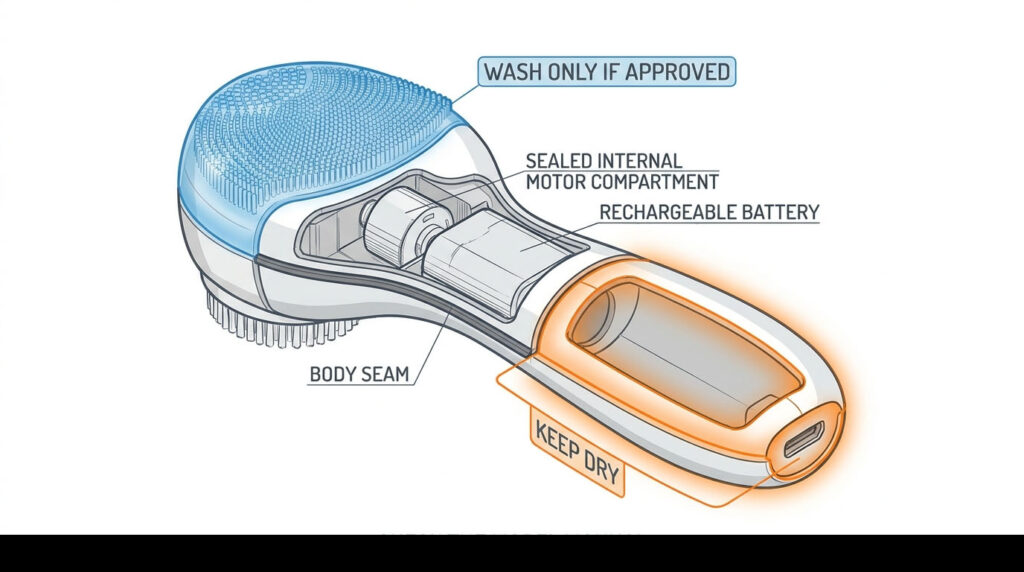
The five-step method still applies, but electrical boundaries come first.
Waterproof Is a Model-Specific Claim
A waterproof rating does not authorize indefinite soaking, high-pressure water, boiling, chemical immersion, dishwasher use, or cleaning while charging. Follow the stated conditions for running water, shower use, immersion, battery-cover position, and removable attachments.
Keep Charging and Battery Areas Dry
Switch off and unplug before cleaning. After rinsing an approved waterproof model, remove surface water and wait until the charging area is completely dry before reconnecting power. Do not push a metal object into a port or fill it with cleaner.
If the device uses a battery cap, inspect and wipe the accessible area only as the manufacturer directs. Do not pry open a sealed enclosure.
Treat a Removable Head and Handle Separately
When only the attachment is washable:
- detach it according to the manual;
- wash and dry the attachment;
- wipe the handle with its approved low-moisture method;
- keep liquid out of the attachment drive and openings; and
- reattach only after both pieces are dry.
Do not try to restore a damaged waterproof seal with household glue or caulk.
Can You Use Alcohol, Bleach, Baking Soda, or Heat?
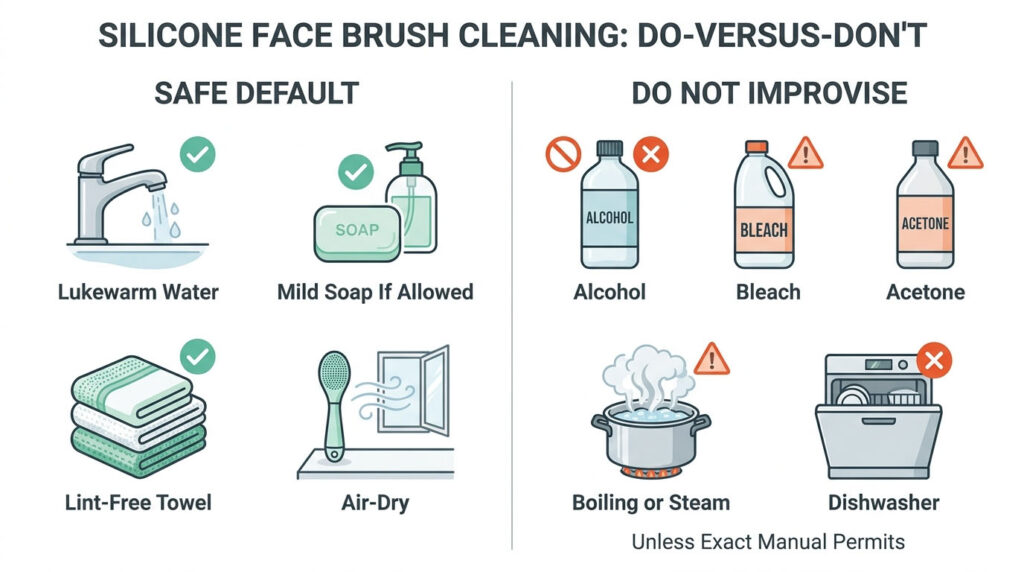
There is no universal sanitizer or “deep-clean” recipe for every silicone facial cleansing device.
| Method | Practical boundary | Main concern |
|---|---|---|
| Lukewarm water | Default rinse for parts identified as water-safe | Keep unapproved handles, ports, and battery areas dry |
| Mild liquid soap | Useful for oil and cleanser film when permitted | Rinse completely so residue does not return to the skin |
| Manufacturer device cleaner | Use only on the named compatible products and as directed | A spray approved by one brand is not automatically cross-compatible |
| Rubbing alcohol or hand sanitizer | Not a general face-brush cleaner | FOREO says alcohol-containing cleaners may irritate skin and damage LUNA 4 silicone; other material and seal compatibility is model-specific |
| Vinegar, baking soda, toothpaste, or melamine foam | Not a default method; use only if the exact manufacturer permits it | Vinegar is acidic; baking soda is alkaline and particulate; toothpaste and melamine foam may be abrasive |
| Bleach or hydrogen peroxide | Use only if the exact manual supplies a compatible procedure | There is no universal product-safe concentration or rinse procedure |
| Acetone, petrol, or another solvent | Avoid | FOREO specifically prohibits acetone and petrol on the cited device |
| Boiling water or steam | Never use on a powered brush; use on a manual item only if expressly approved | Heat can damage pigments, inserts, adhesive, seals, and electronics |
| Dishwasher, ultrasonic, or UV device | Use only under an explicit product procedure | Conair prohibits dishwashers for its cited model; electronics need separate validation |
The manufacturer instructions cited here emphasize after-use cleaning and complete drying—not household sterilization. Keep a face-contact brush personal. If a specific contamination event requires disinfection, use only the procedure validated for that exact model.
Drying and Storage Matter as Much as Washing
Store the clean brush in a ventilated place away from standing sink water, direct sun, and high heat. Orient it so water drains away from dense touchpoints and seams. A stand should promote airflow rather than form a cup around the wet base.
Before travel, clean and dry the brush and case completely. Engage the travel lock when provided and pack the charging cable separately from damp bathroom items. Never seal wet touchpoints under a cap.
Protecting Skin Comfort
A clean brush can still irritate skin through pressure, frequency, or friction. The American Academy of Dermatology’s face-washing guidance recommends a gentle nonabrasive cleanser, lukewarm water, and avoiding scrubbing; its conservative baseline uses fingertips because tools can irritate some skin.
If you choose to use a silicone facial cleaning brush:
- use light pressure and the maker’s lowest comfortable setting;
- do not treat more friction as a deeper clean;
- avoid cuts, wounds, sunburn, or actively irritated skin;
- ask a dermatologist before mechanical exfoliation if you use retinoids or benzoyl peroxide, have rosacea, eczema, a recent procedure, or another skin concern;
- do not share the brush or head; and
- stop use if it causes burning, persistent redness, itching, swelling, pain, or a rash.
If symptoms are severe, worsening, or do not resolve, contact a healthcare professional.
AAD guidance on mechanical exfoliation notes that a brush or pad can be too irritating for some dry, sensitive, or acne-prone skin. Its rosacea guidance recommends fingertip cleansing instead of sponges or scrubbing. Tool cleaning improves hygiene; it does not make every brush appropriate for every skin condition.
When Should You Replace the Brush?
Replacement is model-specific. PMD says the integrated PMD Clean silicone head needs no routine replacement. Conair labels the cited FCB9 model disposable and states that it provides up to 120 one-minute uses. Follow the stated interval for any replaceable head and replace it earlier if damaged.
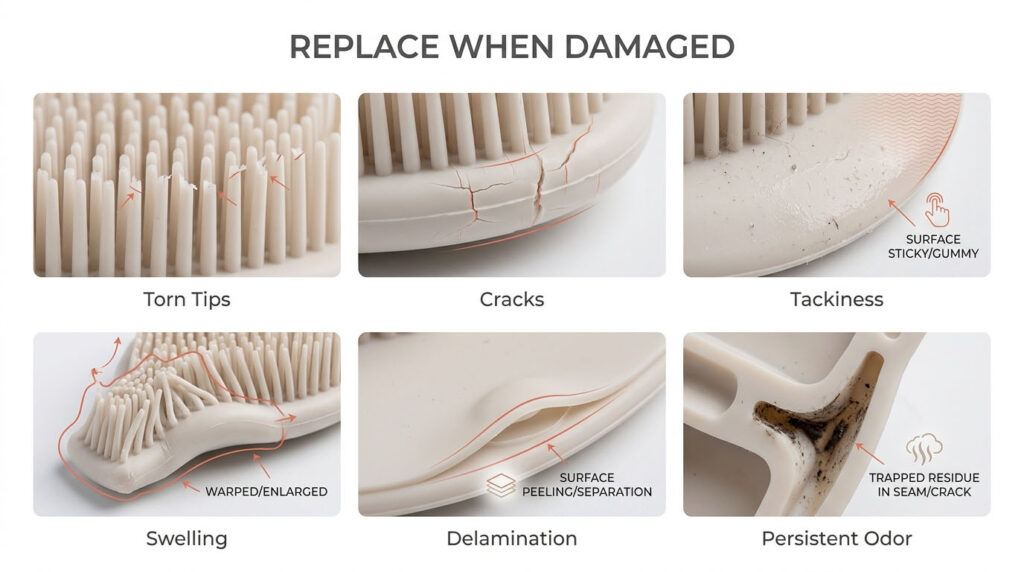
Replace a manual brush or removable head when you find:
- torn, split, deformed, or missing touchpoints;
- a rough edge that contacts the skin;
- permanent tackiness or swelling after correct washing and drying;
- trapped residue or recurring spots in a crack;
- persistent odor from an inaccessible area;
- delamination between silicone and another material; or
- an attachment that no longer locks securely.
Stop using a powered device and contact the manufacturer if the enclosure, seal, battery cover, charging interface, cord, or attachment drive is damaged; if water appears behind a sealed surface; or if the device develops abnormal heat, odor, noise, or vibration.
Frequently Asked Questions
Should I Clean a Silicone Face Brush After Every Use?
Yes. Remove cleanser and visible residue after each use, then let the approved surfaces dry completely. FOREO, PMD, and Conair all provide after-use cleaning instructions for the cited devices. A periodic detailed inspection does not replace routine cleaning.
How Do You Clean a Manual Silicone Face Scrubber or Cleansing Pad?
Rinse it with lukewarm water, use a small amount of mild liquid soap if its instructions permit, massage between the tips with clean fingers, rinse thoroughly, blot, and air-dry. Hand-washing is the conservative default when no boiling or dishwasher instruction is provided.
Can I Wash a Silicone Face Brush With Facial Cleanser?
Rinse away the cleanser used during treatment, but do not assume every formula is compatible with the device. FOREO warns against clay-based, silicone-based, and grainy formulas on LUNA 4. Check the manual and remove all product afterward.
Can I Clean a Silicone Face Brush With Rubbing Alcohol?
Not as a universal method. FOREO prohibits alcohol-containing cleaners on LUNA 4. Use alcohol only when the instructions for your exact brush authorize the product, concentration, contact time, and rinse or drying method.
Can I Boil a Silicone Facial Cleansing Brush?
Never boil an electric brush. Boil a manual item only when its maker expressly approves the complete product for that process. Pigments, logos, inserts, suction parts, and mixed materials may have lower limits than silicone itself.
Can a Silicone Face Brush Go in the Dishwasher?
Only when its label explicitly says so. Never put a powered cleansing device in a dishwasher without a written product procedure. For an unlabelled manual scrubber, hand-washing is safer.
Why Does My Silicone Face Brush Smell or Feel Sticky?
Cleanser, makeup remover, skin oil, or trapped moisture may remain near the touchpoints, cap, stand, or seam. Rewash, rinse, and dry all approved parts separately. Permanent tackiness, recurring odor from a sealed joint, cracks, or swelling are replacement signals.
Do I Need to Disinfect the Brush?
Routine home care begins with the cleaning and drying method in the manual. Do not improvise a disinfectant or share the face-contact head. If disinfection is required after a specific contamination event, ask the manufacturer for a validated procedure.
Designing a Custom Silicone Face Brush for Easier Cleaning
For an OEM manual scrubber or a silicone component on a powered cleansing device, cleanability should be defined before tooling.
Important design checks include:
- Touchpoint geometry: Use rounded tips, accessible roots, and spacing that allows cleanser to rinse away.
- Drainage: Avoid blind recesses and specify a natural storage position that releases water.
- Material and hardness: Select a skin-contact formulation and hardness appropriate to the intended mechanical action; “food-grade” alone is not a facial-device specification.
- Surface and decoration: Validate color, printing, texture, and laser marks against the intended cleansers and repeated washing.
- Interfaces: Minimize inaccessible seams and design removable heads that can be cleaned without prying.
- Powered enclosure: Align overmolding, seals, adhesives, battery or charging design, and water-ingress testing with the care instructions.
- Stand and travel cover: Promote airflow and prevent pooled water around touchpoints or the base.
- Validation: Test production-representative parts with intended cleanser formulas, water temperature, rinse time, drying orientation, and repeated use-and-cleaning cycles.

RuiYang supports custom brush development, molding, color, branding, inspection, and packaging. Brands can review Custom Silicone Brush Manufacturing when defining touchpoint geometry and production requirements. Skin-contact, electrical, waterproofing, and market-compliance claims should be verified for the complete finished product rather than inferred from the silicone material.