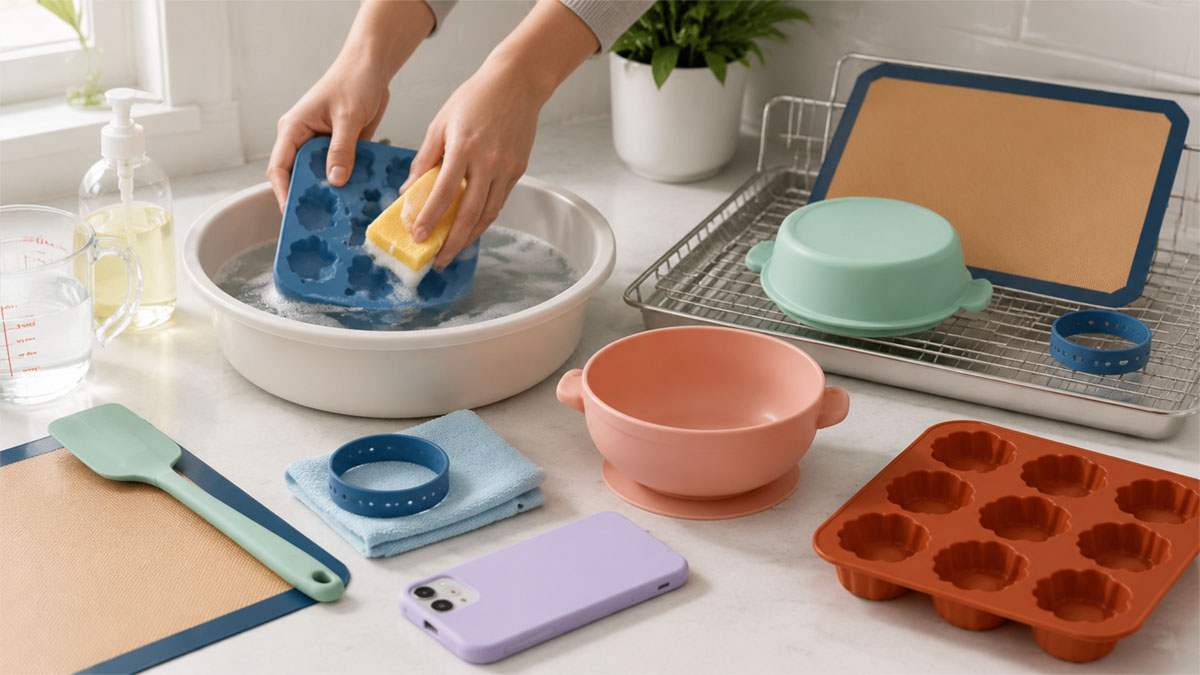
Silicone is easy to rinse, but grease, soap film, pigments, skin oils, and residue can remain after a quick wash. The safest response is usually a more thorough cleaning with detergent—not automatically more heat or a stronger chemical.
What Is the Best Way to Clean Silicone?
Quick Answer: To clean most washable, cured silicone products, use warm water, mild grease-cutting dish detergent, and a soft sponge or cloth. Clean both sides and any grooves, rinse away all detergent, and dry the item completely. Before using alcohol, vinegar, bleach, a dishwasher, boiling water, or steam, check the care instructions for the complete product—not only the silicone material.
This guide covers cured silicone rubber products that are intended to be washed. It does not cover uncured silicone caulk, construction residue on glass or tile, mold growing inside bathroom sealant, or validated reprocessing of medical devices. Those jobs involve different materials, risks, and cleaning methods.
Before You Start: Identify the Product and the Problem
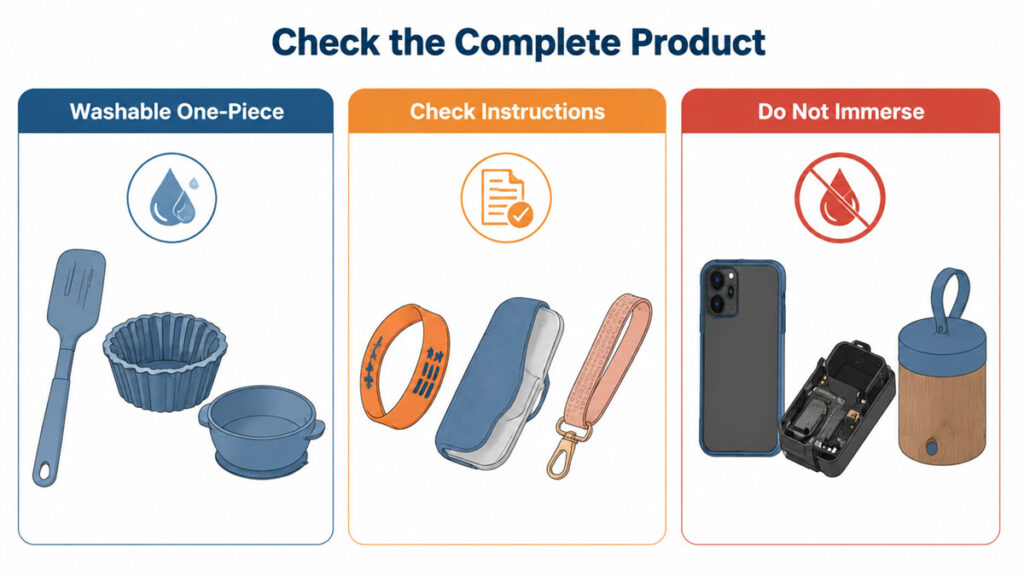
“Silicone” describes a family of materials, not one universal finished product. Two items that feel similar can have different pigments, coatings, inks, adhesives, inserts, and temperature limits. Some clear or soft accessories are also made from TPU, TPE, or another elastomer rather than silicone rubber. If the material is unknown, follow the product label instead of assuming a silicone cleaning method applies.
Check three things before washing:
- Is it cured, washable silicone? This guide is for finished products, not wet sealant or installation residue.
- Is it a one-piece product? Wood, electronics, metal joints, foam, fabric reinforcement, adhesive, and printed decoration may set the real cleaning limit.
- What are you removing? Dirt, oil, detergent film, odor, discoloration, and microorganisms are different problems. A product can be clean but still discolored, or look clean but require sanitizing for a specific use.
Choose a Cleaning Method by Product Type
| Product type | Common concern | Safest starting method | Special limit |
|---|---|---|---|
| One-piece kitchenware and food-contact items | Grease, food pigment, odor | Warm water, dish detergent, soft sponge | Use a dishwasher or sanitizer only when the finished item permits it |
| Silicone molds, silicone baking mats, and flexible bakeware | Oil film, residue in corners, burned food | Wash both sides and flex gently to reach molded details | Avoid knives, metal scrapers, and aggressive abrasion |
| Removable silicone phone cases, silicone watch bands, covers, and wearable accessories | Skin oil, dust, dye transfer, printed decoration | Remove from the device, hand-wash gently, rinse, and dry fully | Do not soak electronics, adhesive assemblies, or coated parts unless allowed |
| Baby and personal-care products, including silicone face brushes | Routine soil and hygiene | Clean according to the product instructions after use | Boiling, steam, or chemical sanitizing must be approved for that product |
| Printed, bonded, or reinforced products | Residue around seams and inserts | Use a short, gentle hand wash | The print, coating, adhesive, or insert may be less resistant than the silicone |
| Multi-material smoking accessories, including silicone bongs | Resin, stale water film, ash, and odor | Cool, empty, disassemble, and clean each material separately | Alcohol, freezing, boiling, and dishwashers require approval for the exact component |
| Medical or regulated-use products | Validated hygiene or reprocessing | Follow the device instructions for use | A household cleaning guide cannot replace a validated procedure |
How to Clean Silicone in Five Steps
For a fully cured, washable item whose care instructions permit soap-and-water cleaning, use the least aggressive method that removes the residue. This protects the surface texture, printed markings, bonded parts, and reinforced structure as well as the silicone itself. Do not immerse an assembly that contains electronics or another non-water-resistant component.
- Let the item cool and disassemble it if permitted. Do not move hot bakeware directly into cold water. Remove detachable parts only as the instructions allow.
- Remove loose residue. Wipe away crumbs, dust, hair, or soft food before applying detergent. Do not pry residue out with a knife.
- Wash with warm water and detergent. Apply mild dish detergent with a soft sponge, cloth, or soft-bristled brush. Work across both sides, edges, holes, seams, and molded details.
- Rinse thoroughly. Detergent or rinse-aid residue can leave a slippery film, fragrance, or unwanted taste on food-contact products.
- Dry completely before use or storage. Air-dry on a clean rack or use a clean, lint-free towel when appropriate. Open collapsible products and separate nested parts so trapped water can escape.
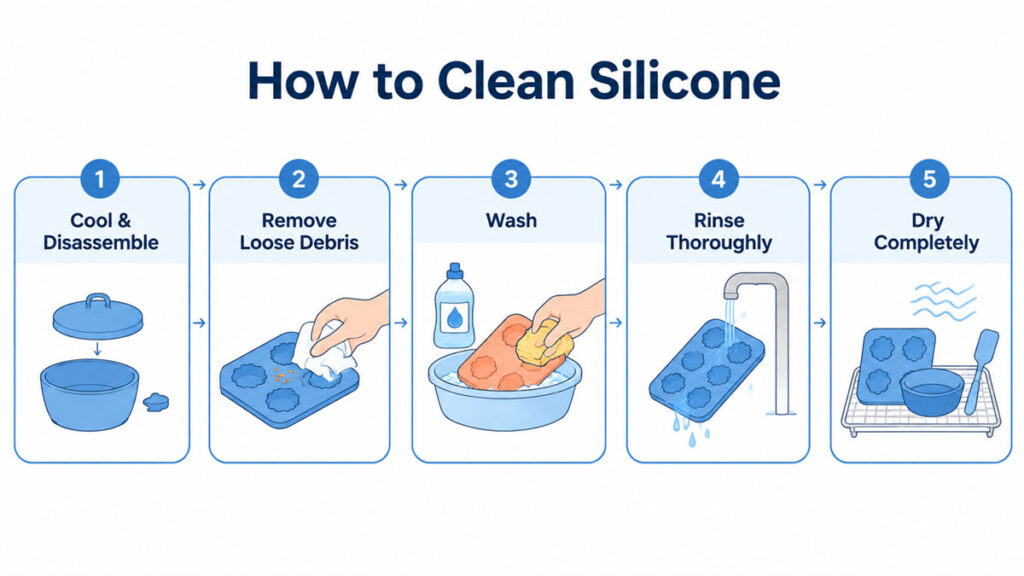
This basic method works for many household items, including spatulas, lids, cups, trays, silicone baking mats, silicone molds, removable silicone phone cases, and silicone wristbands. It is a starting point, not permission to soak or heat every product.
How to Remove Common Problems From Silicone
Grease and Oily Film
Silicone repels water, so plain rinsing does little to lift cooking oil or body oil. Detergent is the working part of the process.
- Rewash with fresh warm water and a grease-cutting dish detergent.
- Clean both sides, not only the visible or food-contact surface.
- Flex mats and molds gently so the sponge reaches ribs and corners.
- Rinse until the surface no longer feels slick from detergent.
- Let the item dry before judging the result; a wet surface can be misleading.
If the film returns quickly, review how the item is used. Aerosol cooking spray, overheated oil, fragranced rinse aid, excess detergent, and storage before full drying can all contribute to recurring residue.
Lingering Odors
Remove the source before trying to mask the smell. Wash with an unscented detergent, rinse thoroughly, and air-dry in a ventilated place. Repeat the wash if an oily film remains. For persistent food odors, a mild paste of baking soda and water may be used as a short spot treatment on a compatible surface, followed by another complete wash and rinse.
For a deeper troubleshooting sequence, see How to Remove Smells from Silicone Kitchenware.
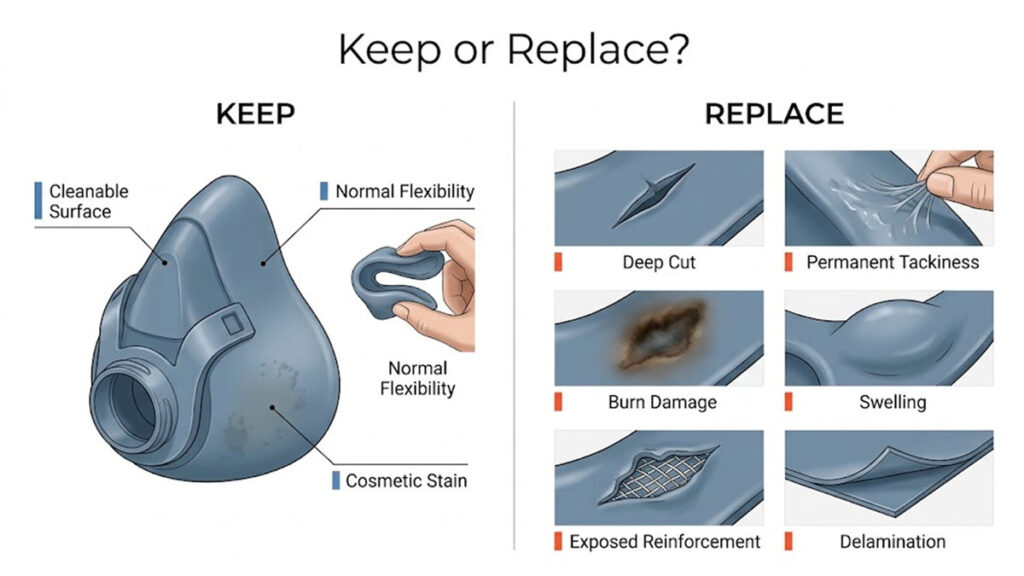
An odor is more concerning when it follows unknown solvent exposure or appears together with swelling, cracking, delamination, permanent tackiness, or exposed reinforcement. In those cases, replacement is safer than repeated experimentation.
Surface Stains and Discoloration
Color and cleanliness are not the same. Tomato, turmeric, coffee, makeup, fabric dye, and other pigments can discolor a light product after removable residue is gone.
Start with detergent washing. If the care instructions allow it, try a mild baking-soda paste with a soft cloth, then rinse well. Avoid repeated hard scrubbing: it can dull a surface without removing pigment that has migrated into the material.
A clean stain that does not transfer and is not accompanied by damage is usually an appearance issue. Yellowing or color change caused by aging, ultraviolet exposure, oxidation of another polymer, or pigment migration may not be reversible. Do not assume a transparent accessory is pure silicone or promise that household cleaners can make it clear again.
Sticky Silicone
First determine whether the stickiness is on the surface or comes from the product itself.
- Rewash with fresh detergent to remove oil, soap, and adhesive residue.
- Rinse thoroughly and allow the item to dry completely.
- Check whether the tackiness is localized near a label, bonded joint, coating, or printed area.
If a clean, dry item remains uniformly tacky, the material, coating, or additive system may have changed. Stronger solvents are not a reliable repair. Replace products that remain permanently sticky, especially when they contact food, skin, or the mouth.
Mold or Mildew
For a removable, washable product with surface growth, first clean away visible soil, then use only a sanitizing method approved for that product. Replace the item if growth remains in deep cuts, porous adjoining materials, inaccessible joints, or damaged food-contact surfaces.
Mold growing in bathroom or window sealant is a different problem. The growth may be behind or inside the joint, and cleaning cannot repair failed caulk. Do not use a product-care procedure as a substitute for sealant inspection or replacement.

Can You Use Alcohol, Vinegar, Bleach, Baking Soda, or Heat?
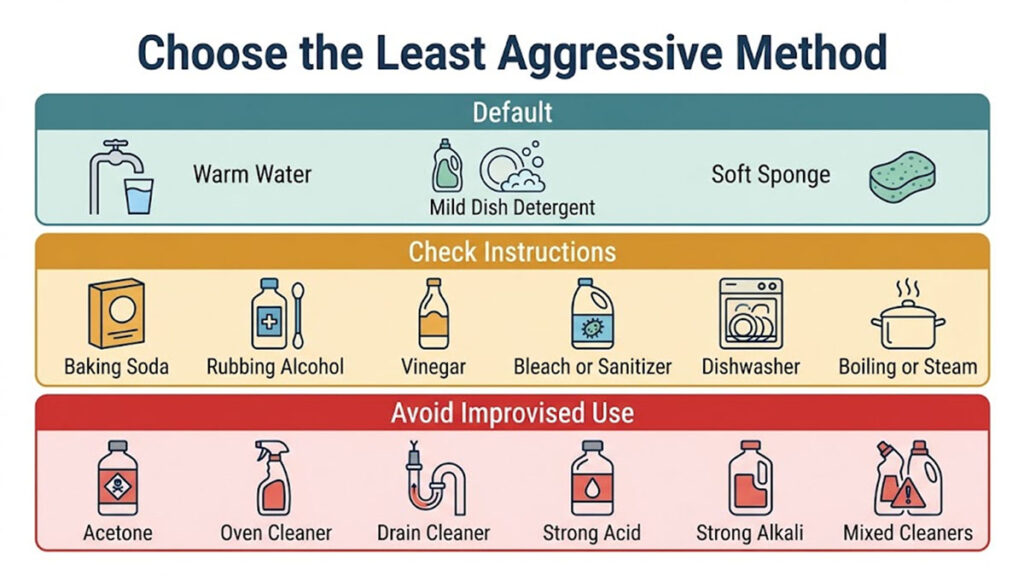
There is no universal chemical-compatibility answer for every finished silicone product. Base polymer, fillers, pigment, ink, coating, adhesive, contact time, concentration, and temperature all affect the result.
| Method | Practical boundary | Key precaution |
|---|---|---|
| Mild dish detergent | Default for routine cleaning of most washable household products | Rinse fully; fragrance and excess detergent can leave residue |
| Baking-soda paste | Optional spot treatment after normal washing | Use light pressure and test printed, coated, or polished surfaces first |
| Rubbing alcohol | Sometimes permitted as a short wipe on compatible, uncoated products | Do not assume it is safe for inks, coatings, adhesives, electronics, or bonded parts |
| Vinegar solution | May help with mineral film when the product instructions allow it | Rinse well; avoid unverified long soaks and never mix with bleach |
| Chlorine bleach or sanitizer | Use only when both the product and cleaner label permit the intended application | Clean first; follow dilution, contact time, rinse, ventilation, and drying directions |
| Boiling water or steam | Suitable only for products specifically designed and labeled for the process | Material heat resistance does not guarantee that the complete product can be boiled |
| Dishwasher | Use only for complete items marked dishwasher-safe | Secure flexible parts and follow the stated rack, cycle, and detergent instructions |
| Acetone, oven cleaner, drain cleaner, strong acid, strong alkali, or other solvent | Not a general household silicone-cleaning method | Use only with written compatibility and process guidance from the product or material supplier |
Can You Clean Silicone With Rubbing Alcohol?
Only when the finished product instructions allow it. Some cured silicone compounds may tolerate brief alcohol contact, but a finished item can also contain ink, a soft-touch coating, adhesive, plastic, foam, or electronic parts. Test an inconspicuous area when the manufacturer recommends spot testing, use the shortest necessary contact, and do not make alcohol soaking a default method.
Can You Clean Silicone With Vinegar?
Vinegar may be useful for mineral film on a compatible product, but it is not the first choice for grease and should not be treated as universally safe. Use the dilution and contact time specified by the product maker, rinse thoroughly, and never combine vinegar or another acid with chlorine bleach.
Can You Use Bleach on Silicone?
Do not improvise a bleach recipe for a silicone product. If sanitizing is required, confirm that the product can tolerate the method and use a cleaner labeled for the intended surface. Follow its concentration, contact time, rinse or air-dry direction, and ventilation requirements. Never mix bleach with another cleaner.
Can You Boil Silicone to Clean It?
Only boil a product when its instructions explicitly permit boiling. A heat-resistant silicone compound does not make a complete assembly boil-safe. Printed graphics, adhesive, rigid inserts, valves, electronic components, and trapped air can introduce different limits. Boiling is also not a substitute for washing away visible soil first.
Can Silicone Go in the Dishwasher?
Only if the complete item is marked dishwasher-safe. Open folded containers, separate nested parts, secure light pieces against water jets, and keep thin items away from exposed heating elements. If a cycle leaves a slippery or perfumed film, hand-wash with unscented detergent and rinse thoroughly. See Can Silicone Go in the Dishwasher for loading, cycle, and product-specific guidance.
Cleaning, Sanitizing, and Disinfecting Are Not the Same
Cleaning removes dirt, impurities, and many germs with soap, water, and physical action. Sanitizing reduces remaining microorganisms to a level defined as acceptable for the intended use. Disinfecting uses a registered product or defined process to inactivate specified microorganisms under its labeled conditions. Sterilizing is a separate, validated process intended to eliminate all viable microorganisms; boiling or household disinfection should not be described as sterilization.
Cleaning comes first. Dirt and grease can interfere with a sanitizer or disinfectant, and ordinary household items do not need routine disinfection in every situation. When sanitizing is required for a food-contact, infant-feeding, or other specialized product, use a method approved for that item.
The cleaner label controls correct use. The EPA directions for use identify the approved surface, dilution, application method, contact time, and other precautions. Never mix bleach with ammonia, vinegar, acids, or another cleaner; the CDC warns that mixing bleach or disinfectants with other cleaners can release dangerous vapors.
Medical devices, infant-feeding products, and regulated-use items may require validated cleaning, sanitizing, disinfection, or sterilization instructions. Follow the product-specific procedure, including its detergent or disinfectant, concentration, temperature, contact time, rinsing, drying, and inspection requirements, rather than converting a general household method into a hygiene claim.
What Should You Avoid When Cleaning Silicone?
- Steel wool, coarse scouring pads, and stiff abrasive brushes
- Knives, razor blades, metal picks, and sharp scrapers
- Unverified solvent soaking or aggressive chemical mixtures
- Combining bleach with vinegar, ammonia, acids, or another cleaner
- Moving a hot product directly into cold water
- Boiling, steaming, oven heating, or using a sanitize cycle without product approval
- Long soaking of printed, coated, bonded, reinforced, or electronic assemblies
- Storing an item while folded, nested, or still damp
- Continuing to use a damaged food-, skin-, or mouth-contact surface because it “looks clean”
When Should You Replace a Silicone Product?
Cleaning cannot reverse mechanical, chemical, or thermal damage. Replace the item when you find:
- deep cuts, tears, missing material, or shedding;
- permanent tackiness after detergent washing and complete drying;
- brittle, chalky, burned, swollen, or deformed areas;
- exposed fabric, wire, or another reinforcement;
- separation between silicone and a rigid insert;
- damaged printing or coating that affects the intended use;
- persistent chemical odor after unknown cleaner or solvent exposure;
- contamination trapped in a joint or surface that can no longer be cleaned.
Normal discoloration alone is not the same as structural failure. The useful question is whether the product still has a continuous, stable, cleanable surface and remains within its intended service conditions.
Frequently Asked Questions
What Is the Safest Way to Clean Silicone?
For most washable, cured silicone products, start with warm water, mild dish detergent, and a soft sponge or cloth. Rinse thoroughly and dry completely. Product instructions take priority whenever an item contains printing, coatings, adhesive, inserts, or electronics.
What Cleans Silicone Best?
Detergent is usually more important than heat. It lifts oil so water can carry it away. Strong chemicals are not automatically more effective and may introduce compatibility problems.
Why Does Silicone Feel Sticky After Washing?
The usual removable causes are oil, excess detergent, adhesive residue, or residue trapped in texture. Rewash, rinse, and let the item dry. Permanent tackiness on a clean, dry surface may indicate a changed material or coating and is a reason to replace the product.
How Do You Remove Grease From Silicone?
Rewash both sides with fresh warm water and a grease-cutting dish detergent. Use a soft sponge, work detergent into molded details, rinse completely, and assess the surface only after it dries.
Can Stained or Yellowed Silicone Become Clear Again?
Surface soil may be removable, but pigment migration, ultraviolet aging, oxidation, or a change in another polymer may be permanent. Clean the item normally, but do not use increasingly aggressive chemicals in an attempt to reverse material aging.
How Often Should Silicone Products Be Cleaned?
Clean food-contact and personal-use products according to their instructions after use. Clean other household products when visibly dirty or at the interval set by the manufacturer. Dry items fully before storage.
Should New Silicone Products Be Washed Before First Use?
Yes for products whose instructions call for first-use washing. In the United States, 21 CFR 177.2600 states that finished rubber articles intended for repeated food contact must be thoroughly cleaned before their first food-contact use. This does not establish the cleaning limits of every silicone-looking product.
Cleaning Guidance for Custom Silicone Products
For a custom product, the cleaning instruction should be designed and verified with the product—not copied from a generic material description. “Food-grade silicone” or a heat-resistance value alone does not define how the finished assembly should be cleaned.
A usable cleaning specification should identify:
- the expected soil, oil, pigment, or microbial challenge;
- the detergent or sanitizer chemistry and permitted concentration;
- contact time, water quality, temperature, and mechanical action;
- rinse and drying requirements;
- dishwasher, boiling, steam, or commercial cleaning limits;
- pigments, inks, coatings, molded textures, adhesive, and bonded inserts;
- the number of cleaning cycles the product should withstand;
- inspection criteria and the conditions that require replacement.
These decisions should be tested on production-representative parts, including all colors, decorations, and inserts. If you are developing custom silicone products, define the intended cleaning process during material selection and product design so the care instructions match the finished construction.
Silicone Cleaning Checklist
- Confirm the product is cured, washable silicone and check its care instructions.
- Start with warm water, mild detergent, and a soft cleaning tool.
- Clean seams, edges, molded details, and both sides.
- Rinse away detergent completely.
- Dry before stacking, folding, sealing, or reinstalling.
- Use alcohol, vinegar, bleach, boiling, steam, or a dishwasher only when permitted.
- Never mix cleaners.
- Replace products with permanent tackiness, cracking, delamination, exposed reinforcement, or burn damage.