Most “silicone allergy” complaints we see do not start with a doctor. They start with a customer email: a rash under a wristband, redness around a baby bib, irritation from a wearable pad. The buyer assumes the silicone is the problem and asks us to “fix the material.”
Usually, the material is not the problem.
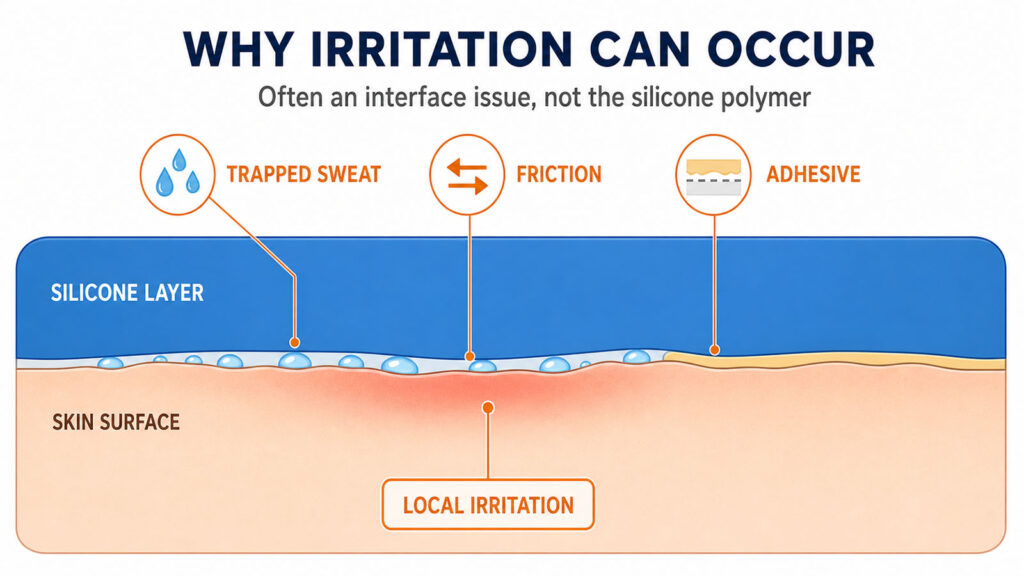
True silicone allergy is rare. Most skin reactions linked to silicone products come from irritation, trapped sweat, adhesives, pigments, processing residues, or another material in the product — not from the silicone itself.
For consumers, this is a health question. For procurement and product teams, it is a material-grade, supplier-control, and testing-scope question. This article covers it from the manufacturing side. It does not replace a doctor.
What Silicone Allergy Actually Means
People use “allergy” to describe almost any skin reaction. From a materials standpoint, three different things get mixed together, and they have different causes and different fixes.
| Reaction Type | Common Cause | What It Means for a Product Team |
|---|---|---|
| True allergic reaction | Rare immune response to a substance | Needs medical confirmation, not a material swap |
| Irritant contact dermatitis | Sweat, friction, heat, trapped moisture | Design and use-condition issue |
| Reaction to non-silicone components | Adhesives, pigments, additives, surface residue | Material specification and process issue |

The practical point: a red, itchy patch under a silicone product is far more often contact dermatitis or a reaction to something added to the silicone than a real immune response to the polymer. Symptoms alone do not prove silicone allergy. Confirming a true allergy requires a dermatologist or allergist, often using patch testing.
Why Silicone Is Usually Considered Hypoallergenic
Silicone Is Chemically Stable
Cured silicone has a stable siloxane backbone and is largely inert against skin. Unlike natural rubber latex, it does not contain the natural proteins that drive most latex allergies. That stability is the reason silicone is the default material for pacifiers, menstrual cups, feeding products, and many medical contact parts.

“Hypoallergenic” is a low-risk statement, not a zero-risk guarantee. The risk that does exist usually comes from what sits alongside the silicone, or from how it was processed.
Where Reaction Complaints Usually Come From
| Risk Source | Typical Product Scenario | Factory-Side Control |
|---|---|---|
| Residual odor or volatiles | Low-cost molded parts, under-cured material | Correct curing system and post-curing |
| Pigments and additives | Colored baby or kitchen products | Food-grade / medical-grade pigment selection |
| Adhesives | Wearable pads, patches, stick-on covers | Adhesive compatibility, not just silicone grade |
| Surface contamination | Poor handling, packing, or storage | Clean packing and incoming/outgoing QC |
| Sweat and friction | Seals, masks, wristbands, long-contact parts | Product design and real use-condition testing |
In most complaint cases, the answer is in this table — not in the polymer.
Symptoms Users May Report
Reported symptoms are skin-level and overlap heavily with ordinary irritation:
- Redness and rash at the contact point
- Itching or burning
- Swelling or small bumps
- Dryness and peeling after prolonged contact
These look almost identical to eczema, sweat dermatitis, or a reaction to an adhesive. That overlap is exactly why “it must be a silicone allergy” is usually a premature conclusion. Persistent or severe reactions should be reviewed by a dermatologist or allergist, who can confirm the actual trigger.
Which Silicone Products Need More Care
Exposure condition decides risk, not the word “silicone.” A gasket and a menstrual cup are both silicone and do not need the same material proof.
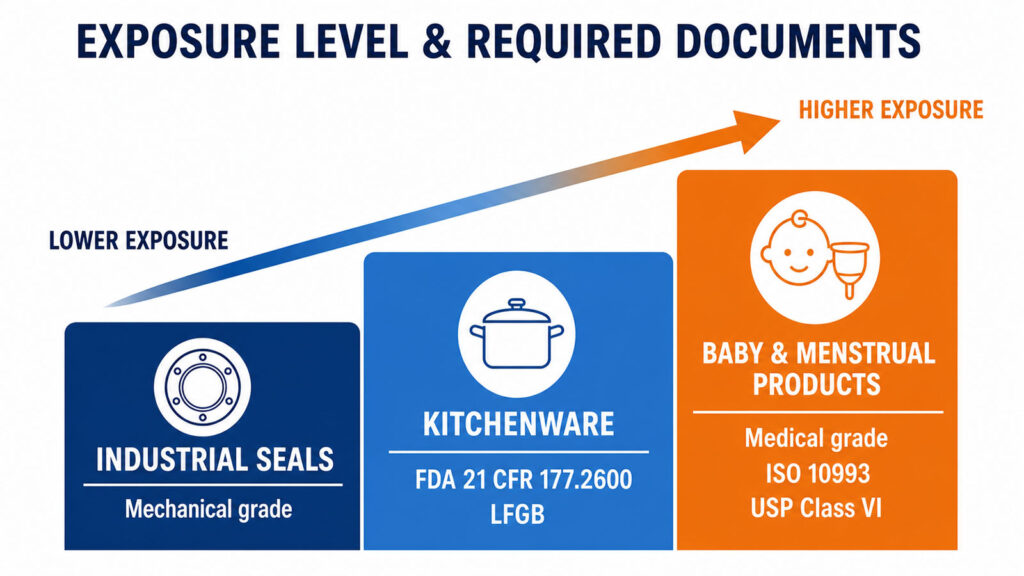
| Product Type | Exposure Condition | Risk Focus |
|---|---|---|
| Pacifiers, teethers, feeding sets | Oral contact, repeated use | Food-grade material, platinum-cured |
| Kitchenware | Food contact, heat exposure | FDA 21 CFR 177.2600 / LFGB |
| Menstrual cups | Prolonged mucosal contact | Medical-grade material, biocompatibility |
| Medical tubing, masks | Long skin or body contact | ISO 10993 / USP Class VI where applicable |
| Wristbands, wearable pads | Sweat, friction, long skin contact | Design, ventilation, adhesive compatibility |
| Seals, gaskets, industrial strip | Usually no skin contact | Mechanical and chemical resistance first |
The higher up this table a product sits, the less “food-grade silicone” alone is enough to answer the safety question.
Silicone Allergy vs Latex Allergy
Buyers often assume that if a user reacts to latex, they will react to silicone. That is the wrong comparison.

| Material | Allergy Risk | Main Reason |
|---|---|---|
| Natural rubber latex | Higher | Natural proteins can trigger immune allergy |
| Silicone | Lower | Synthetic, stable, generally inert |
| TPE / TPU | Depends on formulation | Additives and plasticizers may matter |
This is why silicone is so often specified as the latex alternative for skin-contact and medical products. The substitution still needs the right grade and the right test report — swapping the polymer does not remove the obligation to validate the finished product.
Which Certifications Matter for Skin or Food Contact
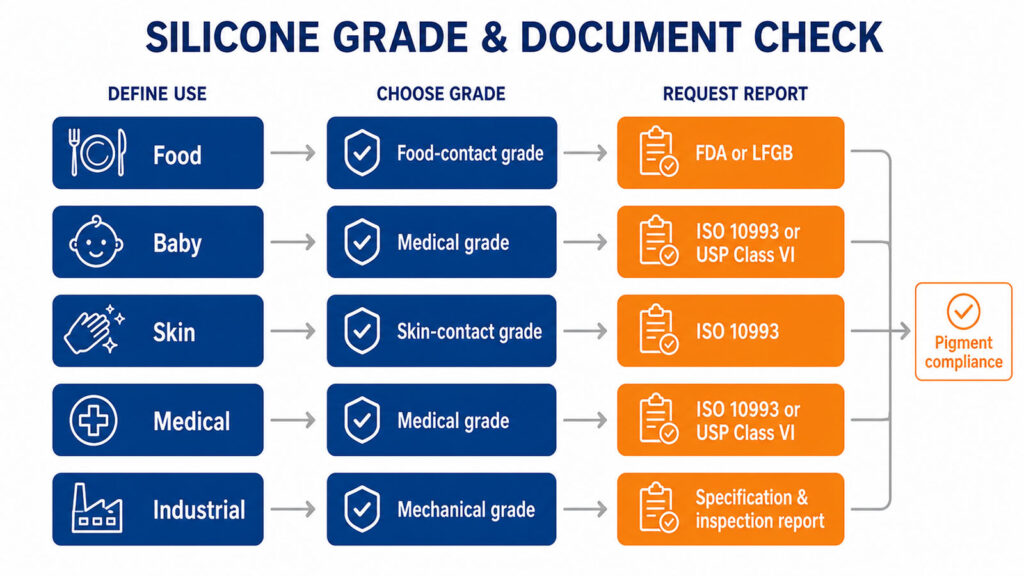
This is where most reaction risk is actually controlled — at the specification stage.
FDA and LFGB for Food Contact
FDA 21 CFR 177.2600 is the common reference for silicone in food-contact use in the US market. LFGB is the German/EU food-contact standard and is generally stricter, including overall migration testing. Passing LFGB usually means higher-grade raw material and longer post-curing, which raises cost. “It has FDA” is not the same as “safe for every use case.”
ISO 10993 and USP Class VI for Medical or Prolonged Contact
If a product goes into the body, contacts mucosa, or stays on the skin long-term, food-grade is not the right proof. ISO 10993 covers biocompatibility evaluation, and USP Class VI is a common medical-grade material reference. Neither one replaces testing on the finished product in its real use condition. For the complete device-level pathway, see how silicone biocompatibility is evaluated under ISO 10993.
Supplier Documents Buyers Should Ask For
- Material grade statement (food-grade vs medical-grade)
- FDA 21 CFR 177.2600 or LFGB report for food contact
- ISO 10993 / USP Class VI support for medical or prolonged body contact
- Pigment and additive compliance
- Curing system: platinum-cured or peroxide-cured
- Post-curing process for odor-sensitive or skin-contact products
- Batch traceability
If a supplier cannot produce the documents that match the actual exposure, the safety claim is unverified.
Manufacturing Factors That Affect Skin Comfort
Two process decisions explain most odor and irritation complaints.
| Curing System | Typical Use | Reaction / Comfort Relevance |
|---|---|---|
| Platinum-cured silicone | Baby, food, medical, high-clarity parts | No cure byproducts, low odor, cleaner system |
| Peroxide-cured silicone | Industrial and general parts | Can leave trace odor; needs proper post-curing |
Post-curing is not a marketing word. Insufficient post-curing on peroxide-cured parts can leave residual odor and volatiles that a sensitive user perceives as a “reaction.” For oral, food, and skin-contact products, platinum-cured material plus adequate post-curing removes a large share of these complaints before they happen. The exact post-curing time and temperature depend on the part and the grade, so they should be confirmed against the production spec rather than assumed.
How to Reduce Reaction Complaints
This is a product-team checklist, not medical advice.

Before mass production:
- Define the real application: food, baby, skin-contact, medical, or industrial
- Choose the material grade from the actual exposure, not the cheapest option
- Confirm pigment and additive compliance
- Decide platinum-cured vs peroxide-cured
- Request the test reports that match the use case
- Evaluate samples under real use conditions, including sweat and friction
After a customer complaint:
- Get the batch number and contact duration
- Check whether an adhesive, fabric, coating, or packaging touched the skin
- Do not default to “silicone allergy” before ruling out irritation and additives
- Direct serious or persistent reactions to a dermatologist or allergist
FAQ
Can silicone cause an allergic reaction?
It can, but true silicone allergy is rare. Most reactions linked to silicone products are caused by irritation, sweat, adhesives, pigments, or residues rather than the silicone itself.
Is silicone safer than latex for allergy-sensitive users?
Usually yes. Silicone does not contain the natural latex proteins that trigger most rubber allergies, which is why it is often specified as a latex alternative.
Is food-grade silicone the same as medical-grade silicone?
No. Food-grade silicone is qualified for food contact. Medical-grade silicone may require additional biocompatibility evaluation, depending on how and where the product contacts the body.
Material Safety Depends on the Use Case, Not the Word “Silicone”
Silicone is a low-risk material for skin and food-contact products, but the word “silicone” is not enough for procurement. The real variable is exposure: a baby teether, a menstrual cup, a wearable pad, and an industrial gasket do not need the same proof.
Before production, define contact duration, body-contact area, target-market regulation, pigment requirements, and testing scope. Without that information, no supplier can honestly promise “allergy-free” — and any supplier that does is selling a claim it cannot test.
References
- 21 CFR 177.2600 — Rubber Articles Intended for Repeated Use. U.S. Office of the Federal Register / FDA, current edition. https://www.ecfr.gov/current/title-21/chapter-I/subchapter-B/part-177/subpart-C/section-177.2600
- Lebensmittel- und Futtermittelgesetzbuch (LFGB). German Federal Ministry of Justice / Federal Office of Justice (Gesetze im Internet), consolidated current version. https://www.gesetze-im-internet.de/lfgb/
- Use of International Standard ISO 10993-1, “Biological Evaluation of Medical Devices — Part 1.” U.S. Food and Drug Administration, Guidance for Industry, September 2023. https://www.fda.gov/regulatory-information/search-fda-guidance-documents/use-international-standard-iso-10993-1-biological-evaluation-medical-devices-part-1-evaluation-and
- 〈88〉 Biological Reactivity Tests, In Vivo (USP Class VI). United States Pharmacopeia–National Formulary (USP-NF). https://doi.usp.org/USPNF/USPNF_M98834_01_01.html
- Latex Allergy. American Academy of Allergy, Asthma & Immunology (AAAAI), Conditions Library. https://www.aaaai.org/tools-for-the-public/conditions-library/allergies/latex-allergy
- Irritant Contact Dermatitis. DermNet (Occupational Dermatology Research and Education Centre), updated July 2021. https://dermnetnz.org/topics/irritant-contact-dermatitis