Cutting silicone rubber might seem easy, but it often surprises even experienced users. The right approach depends on more than just a sharp blade. Thickness, hardness, shape, and final use all make a difference. Using the wrong method can lead to rough edges, tearing, or parts that do not fit. In this article, we will walk through eight proven ways to cut silicone cleanly and efficiently, helping you save time, reduce waste, and get the results you need.
What Makes Silicone Rubber Harder to Cut Than It Looks?
Silicone is flexible, elastic, and forgiving in use. That is exactly why it can be tricky during cutting.
When a blade touches silicone, the material does not always stay still. It can shift slightly, compress under pressure, or spring back after the cut. On thin sheets, that often leads to wandering lines or uneven edges. On thicker parts, the blade may drag more than expected and leave a rougher finish.
The material type also changes the result. Soft silicone behaves differently from firmer grades. A smooth sheet is easier to cut than a textured one. Some formulations resist clean separation more than others. Even the same material can behave differently depending on temperature, shape, and how it is held on the work surface.
This is why good cutting is not only about force. It is about control. A light, stable pass often works better than trying to push through too quickly.
How to Choose the Right Cutting Method for Silicone Rubber?
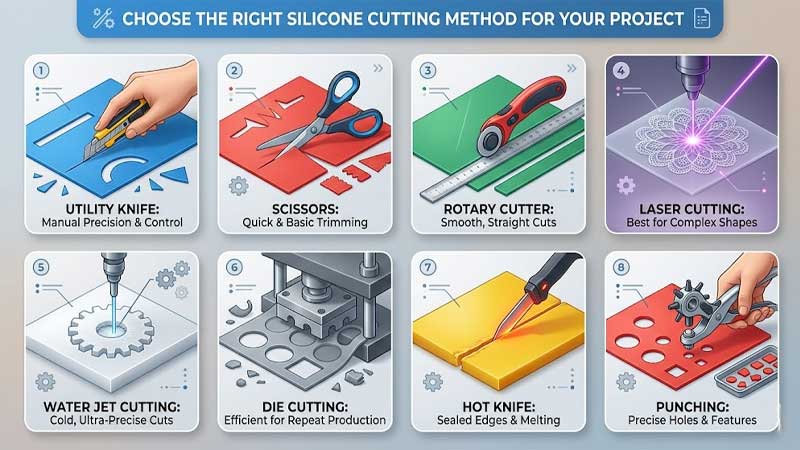
The best cutting method depends on four main things: thickness, shape, volume, and edge requirement.
A simple way to think about it is this:
| Project need | Best-fit method |
| Thin sheet, small sample work | Utility knife, scissors, rotary cutter |
| Long straight cuts | Rotary cutter, straightedge |
| Complex shapes or fine detail | Laser cutting |
| Thick material with clean edges | Water jet cutting |
| Repeated parts in volume | Die cutting |
| Holes and repeat punch shapes | Punching |
| Edge sealing during cutting | Hot knife |
This is only a starting point, of course. In real production, the choice often comes down to balancing three things at once: accuracy, speed, and cost.
A method can look attractive on paper, but not make sense in production. Laser cutting, for example, may be excellent for detail, but if the order is large and the shape is stable, die cutting may be the smarter choice. Manual trimming may be cheap, but if the job needs repeatable dimensions, it can quickly become expensive in labor and rework.
That is the part many people miss. The best method is not the one that looks most advanced. It is the one that fits the actual job.
Tools and Equipment You May Need
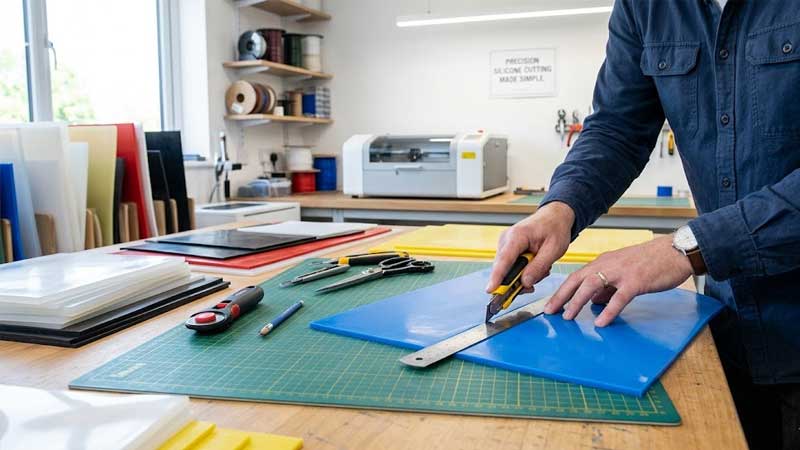
For small jobs, the tool list is simple. A sharp utility knife, cutting mat, ruler, and a stable work surface can cover a lot of ground. Scissors and rotary cutters also help when the material is thin and the cut does not need industrial-level precision.
For larger or more demanding jobs, the setup changes.
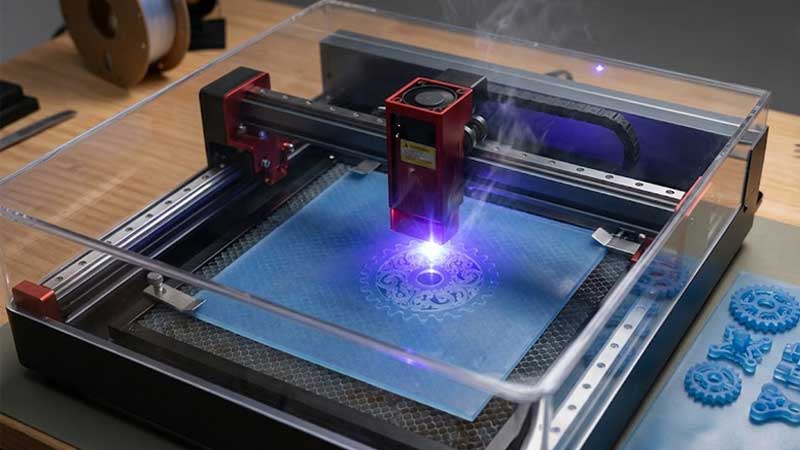
Laser cutters are useful when the shape is complex and repeatability matters. Water jet cutting works well when heat is a concern or the material is thicker. Die cutting is often the preferred option for repeated shapes at scale. Hot knives can help when a cleaner sealed edge is needed. Punch tools are useful when the task is to create holes or simple cutouts quickly and consistently.
Safety tools matter too. Gloves help protect hands from sharp blades. Eye protection is smart in workshop settings. Ventilation becomes important when heat-based cutting is involved. A neat work area also matters more than people often think, because silicone sheets can slip or shift easily if the surface is not properly prepared.
How to Prepare Silicone Rubber Before Cutting?
Good cutting starts before the blade moves.
First, inspect the material. Check whether the sheet is clean, flat, and free from dust, oil, or other residue. If the material has been stored for a while, make sure it has not picked up deformation or surface contamination. A tiny issue at this stage can become a bigger one after cutting.
Next, mark the cutting line carefully. For straight jobs, a ruler and fine marker are usually enough. For more complex parts, templates help reduce error. If the part will be assembled with other components, remember to leave the right allowance. Cutting exactly on the line is not always the same as cutting to the right size.
Then secure the material properly. Silicone is flexible, so if it is not held down well, it can move during the cut. That movement is often what causes the edge to drift or the final part to lose accuracy. A flat, steady setup is worth more than many people realize.
It also helps to think about the end use before cutting begins. A decorative piece can tolerate a little more variation. A sealing part usually cannot. A simple sample may only need to look good. A production part has to fit, work, and repeat.
8 Essential Methods for Cutting Silicone Rubber
Method 1: Utility Knife or Scalpel
This is one of the most common ways to cut silicone rubber, especially for small jobs and thin sheets.
A sharp utility knife gives good control. It is practical, inexpensive, and easy to use. For light trimming, sample preparation, or small custom work, it is often enough. A scalpel can be even better for fine detail, especially when the cut must stay tight and clean.
The key here is not to rush. Silicone usually cuts better with steady pressure than with a hard push. A single clean pass is ideal when the material is thin. For thicker pieces, multiple light passes can be safer and more accurate than trying to force the blade through in one movement.
This method has limits. It is not the best choice for high volume work. It also becomes less attractive when the shape is large, repetitive, or highly complex. But for prototyping and quick adjustments, it remains one of the most useful methods in the shop.
Method 2: Scissors
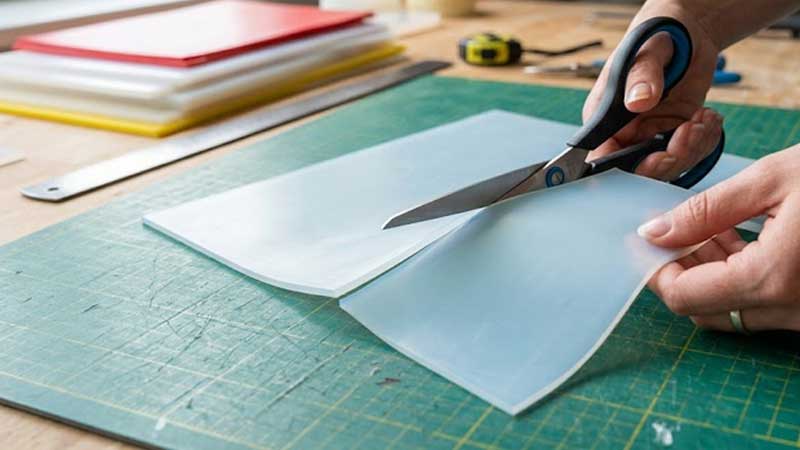
Scissors are easy to overlook, but for thin silicone sheets they can be surprisingly useful.
They work best for rough trimming, quick adjustments, and low precision tasks. If the material is soft and thin, a sharp pair of scissors can give a fast result with very little setup. That makes them practical for simple work.
The weakness is consistency. It is hard to get perfectly uniform edges with scissors, especially on longer cuts or curved shapes. The material can squeeze slightly between the blades, which may leave the edge uneven. For that reason, scissors are better for basic trimming than for finished parts that need exact sizing.
A lot depends on the blade quality. Dull scissors tend to drag the material more than cut it. If the cut starts to feel forced, the edge usually shows it.
Method 3: Rotary Cutter
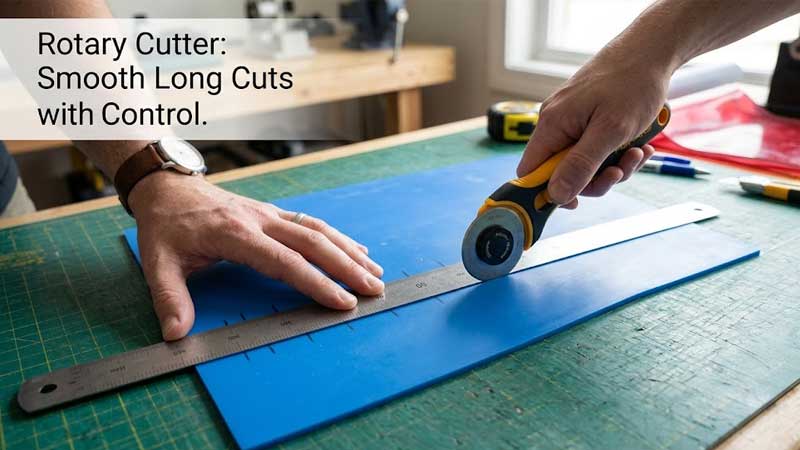
A rotary cutter is a strong choice when the job involves long straight lines or large sheet material.
It moves more smoothly than scissors and can be easier to guide along a ruler. For repeated straight cuts, it can save time and give a cleaner line. It is especially useful when the material is thin to medium thickness and the shape is simple.
The main strength of a rotary cutter is control over long cuts. The main weakness is curves. Tight bends and detailed shapes are not its best use case. It also depends on a stable surface and a steady hand. If the sheet moves even a little, the line can wander.
For workshop use, this tool sits in a very practical middle ground. It is faster than a knife for some jobs, cleaner than scissors for others, and still simple enough to use without a complicated setup.
Method 4: Laser Cutting
Laser cutting is often the best answer when the shape is complex and precision matters.
It is especially useful for detailed outlines, repeated patterns, and parts that need very consistent dimensions. Once the file is set correctly, the laser can produce accurate shapes with good repeatability. That is one of the biggest reasons it is popular in production environments.
There is, however, a tradeoff. Laser cutting brings heat into the process, and silicone does not always react the same way as a harder plastic or metal sheet would. Depending on the material and settings, heat can affect the edge, the surface, or the surrounding area. Ventilation is also important because cutting fumes should be managed properly.
This method is strong, but not always the first choice for every job. If the part is simple and the volume is high, another method may be more economical. If the shape is complex, the tolerance is tight, and the finish matters, laser cutting often earns its place.
Method 5: Water Jet Cutting
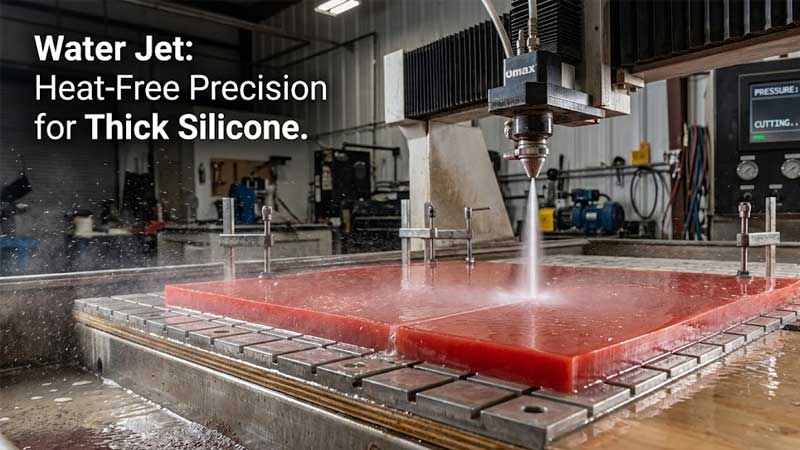
Water jet cutting is a solid option when the silicone is thick or when heat needs to be avoided.
Because it does not rely on thermal cutting, it is often valued for cleaner mechanical separation and less heat distortion. That makes it useful for thicker parts and some technical applications where edge quality matters.
The process is more industrial, though. It requires the right equipment and proper setup, so it is not usually the easiest choice for small workshop work. But for production settings, it can be a very good fit when the part is thick, the edge needs to stay clean, and heat-related distortion is a concern.
This is one of those methods that makes more sense as the material gets harder to handle by hand. The thicker the silicone, the more a stable cutting system starts to matter.
Method 6: Die Cutting
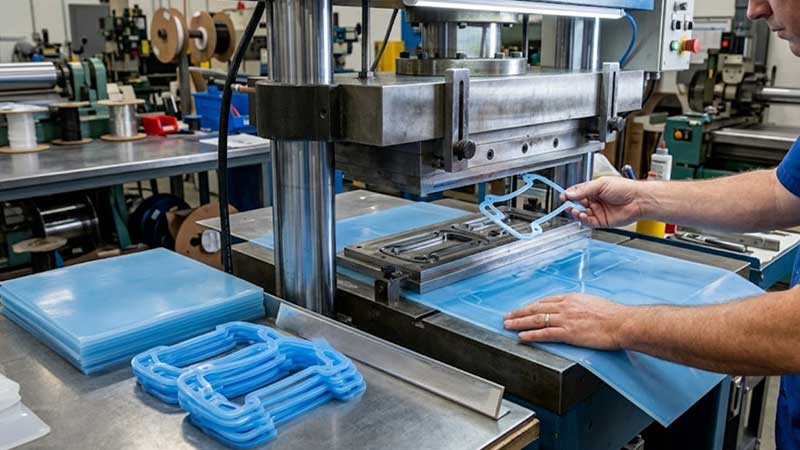
Die cutting is one of the most efficient ways to produce repeated silicone parts.
It is a strong choice for stable shapes, consistent dimensions, and larger production runs. Once the die is made, the process becomes fast and repeatable. That is why die cutting is so common for gaskets, pads, seals, and other parts that need the same shape again and again.
The biggest advantage is consistency. The biggest drawback is tooling. A die requires upfront development, so it makes less sense for one-off work or very small batches. But once volume grows, that initial investment can pay off quickly.
There is also a design limitation. Die cutting works best when the part shape is suitable for the tooling method. If the design changes often, the process becomes less efficient. So before choosing die cutting, it is smart to ask a simple question: will this shape stay the same long enough to justify the tooling?
For repeat orders, the answer is often yes.
Method 7: Hot Knife Cutting
Hot knife cutting can be useful when the edge needs to be sealed at the same time it is cut.
This method is often considered for thicker silicone or parts that benefit from a smoother, more finished edge. The heat helps reduce fraying and can improve the appearance of the cut line in certain applications.
The downside is control. Too much heat can cause discoloration or unwanted surface change. The operator needs a steady hand and a clear sense of the right temperature. In this case, more heat is not better. Just enough heat is.
Hot knife cutting works best when the material and part design are already matched to the process. It is not a universal solution, but in the right setup, it can save time and improve edge quality.
Method 8: Punching
Punching is the right choice when the task is to make holes or repeated simple cutouts.
It works well in production when the hole size stays constant and the shape does not change often. For parts like silicone gaskets, pads, or small technical components, punching can deliver good speed and repeatability.
The main thing to watch is alignment. If the part needs to match another component later, the hole position must be accurate. Tool wear also matters. A worn punch can leave rough edges or inconsistent sizes, especially over longer runs.
Punching is one of the cleanest ways to handle a very specific job. It is not the answer for everything, but for the right geometry, it is efficient and dependable.
Cost, Speed, and Accuracy: What Usually Matters Most
People often ask which method is best, but in practice the better question is which method is best for this job.
If cost is the biggest concern and the volume is low, manual cutting may be enough. If the part is simple and only needs a few samples, the fastest setup is usually the smartest one.
If accuracy matters more, a controlled method is better. Laser cutting, water jet cutting, and die cutting all bring more repeatability than hand methods. If volume is the main issue, die cutting often wins because it reduces labor after the tooling is in place.
So the real balance is not just about price. It is about total cost. A cheaper process can become expensive if it causes waste, rework, or unstable dimensions. A more advanced process can look expensive at first, but save money once the order gets bigger.
That is why production teams usually think in stages: sample, pilot run, and then full production. The right cutting method can change at each stage.
Troubleshooting Common Silicone Cutting Problems
Even experienced operators encounter issues when cutting silicone rubber. Most problems are manageable once you understand the cause. The key usually lies in proper setup, tool condition, and choosing the right cutting method. The table below summarizes common issues, likely causes, and practical solutions.
| Problem | Possible Cause | Solution |
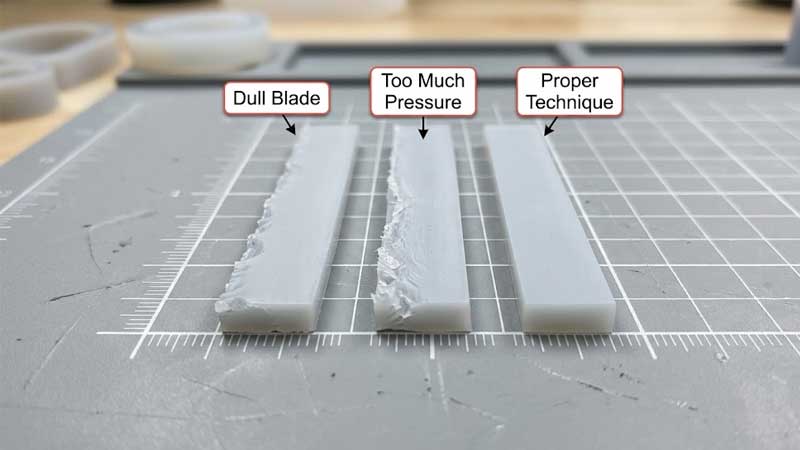
| Rough edge | Dull blade or cutting too fast | Replace or sharpen blade, slow down cutting speed |
| Silicone tears | Material moves or excessive pressure | Secure material, apply lighter, steady pressure |
| Cut line drifts | Sheet not fixed or too much force on flexible area | Clamp sheet properly, use gentle, controlled cutting |
| Discolored edge | Heat from laser or hot knife | Adjust temperature, allow proper ventilation, avoid prolonged contact |
| Inconsistent repeated parts | Process not controlled or unsuitable method | Switch to a more repeatable method, check tooling and alignment |
FAQ
Can silicone rubber be cut with scissors?
Yes, especially when the sheet is thin and the cut is simple. It works best for rough trimming or small manual jobs.
What is the cleanest way to cut silicone rubber?
It depends on the part. For complex shapes, laser cutting is often very clean. For thick material, water jet cutting can be a strong option. For repeated parts, die cutting is usually the most consistent.
Is laser cutting safe for silicone rubber?
It can be, as long as the equipment is used correctly and ventilation is handled properly. Heat and fumes need to be controlled.
What is the best method for mass production?
Die cutting is often the best choice when the shape is stable and the volume is high.
How do you prevent silicone from tearing during cutting?
Use a sharp blade, secure the material properly, and avoid forcing the cut too quickly.
Final Thoughts
There is no single best way to cut silicone rubber. There is only the method that matches the material, the shape, the quantity, and the finish requirement.