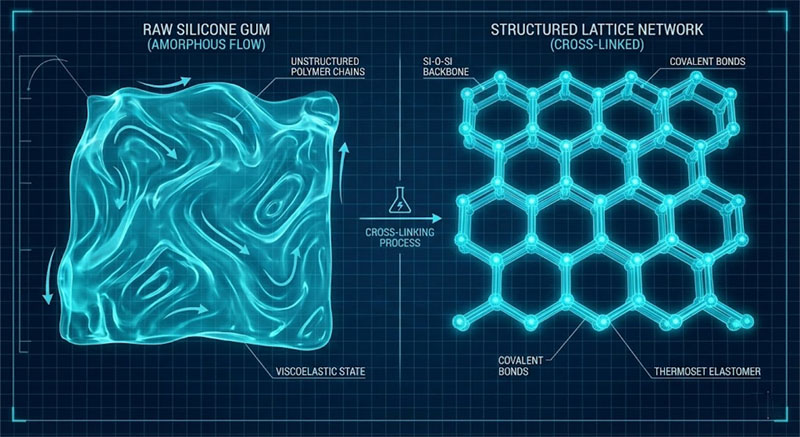
Silicone vulcanization is the curing process that crosslinks silicone polymers into an elastic, stable network.
In engineering practice, vulcanization is not a single moment but a time-dependent process influenced by temperature distribution, formulation sensitivity, post-cure conditions, and part geometry.
Most engineers don’t misunderstand silicone vulcanization because they lack theory.
They misunderstand it because they treat it like a material property instead of a process behavior.
On paper, vulcanization looks contained: temperature, time, catalyst, crosslink density.
In production, it stretches, drifts, and leaves fingerprints that don’t show up in lab samples.
That gap is where problems live.
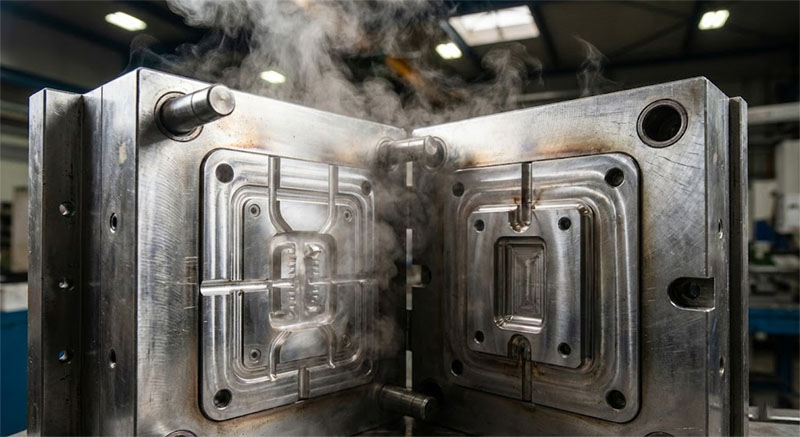
Mistake 1: Treating Vulcanization as “Done” at Demold
Demolding is not the end of vulcanization.
It’s just the point where the part is solid enough to handle.
In compression and injection molding, we cure to shape stability, not chemical completion. The network keeps evolving after the mold opens—especially in peroxide-cured systems and thick sections.
What this looks like in production:
- Shore hardness creeps upward over days
- Compression set improves or worsens depending on post-cure
- Dimensional memory tightens after shipment, not before inspection
Engineers often validate parts too early.
They measure at 24 hours, lock the spec, and move on.
Six months later, the field behavior doesn’t match the data—and no one can explain why.
This is underestimated because the mold cycle feels definitive.
In reality, it’s only the first boundary.
Mistake 2: Assuming Temperature Is Uniform Because the Press Is Stable
A press can be stable and still produce uneven vulcanization.
Tool steel mass, cavity depth, part geometry, and even runner balance change how heat actually moves through silicone. Silicone doesn’t conduct heat well. It lags, traps, and gradients form quietly.
In multi-cavity tools, this shows up as:
- Cavity-to-cavity hardness variation
- Inconsistent tear strength with identical material
- One cavity passing compression set while another fails
Engineers often trust the platen temperature because it’s controlled and logged.
What they don’t see is the thermal delay inside the silicone itself.
This is missed because early sampling usually favors edge cavities.
Center cavities expose the problem later—when volumes increase.
Mistake 3: Believing Cure Time Scales Linearly
Doubling cure time does not double cure quality.
At some point, additional heat stops improving crosslink density and starts introducing side effects:
- Volatile byproducts trapped in thick sections
- Surface oxidation
- Brittleness masked by initial hardness readings
We see this when engineers extend cure “just to be safe.”
The parts pass short-term tests and fail aging or fatigue.
The non-linearity is uncomfortable.
It means there is a window, not a ramp.
Most teams underestimate this because spreadsheets prefer linearity.
Silicone chemistry does not.
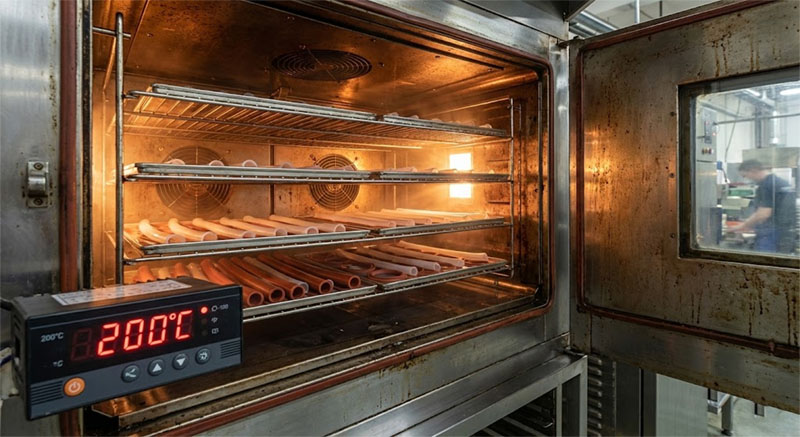
Mistake 4: Ignoring Post-Cure as a Process, Not a Checkbox
Post-cure is often treated like cleanup.
In reality, it’s where final material behavior gets decided.
Air flow, part spacing, load density, and ramp rate all matter. A crowded oven cures differently than a sparse one—even at the same setpoint.
Over time, we see:
- Batch-to-batch odor differences
- Inconsistent extractables
- Regulatory test failures that appear “random”
Engineers underestimate post-cure because it happens after molding, often outside their direct control.
But post-cure is where silicone becomes compliant—or doesn’t.
If post-cure isn’t controlled, vulcanization isn’t finished. It’s just postponed.
Mistake 5: Assuming One Formulation = One Vulcanization Behavior
Two materials with the same datasheet hardness do not vulcanize the same way.
Filler type, polymer chain length, inhibitor content, and catalyst sensitivity all change how forgiving—or fragile—the cure window is.
In production, this shows up when:
- A “drop-in replacement” needs longer cure
- Scrap increases without visible defects
- Flash behavior changes even with identical tooling
Engineers trust the spec sheet because it looks comparable.
Manufacturing sees the difference because the process stops behaving the same way.
This is underestimated because qualification focuses on outputs, not process sensitivity.
Silicone Vulcanization: Common Engineering Questions
Is silicone vulcanization completed when the part is demolded?
No. Demolding only indicates shape stability. Chemical crosslinking can continue for days or weeks, especially in peroxide-cured systems and thick sections.
Why does silicone hardness change after production?
Because vulcanization continues after molding. Ongoing crosslinking, post-cure conditions, and thermal history can cause Shore hardness and compression set to drift over time.
Why do identical silicone parts behave differently across cavities?
Silicone has low thermal conductivity. Differences in cavity location, tool mass, and heat transfer create uneven cure states even when press temperatures are stable.
Does longer cure time always improve silicone performance?
No. Vulcanization is non-linear. Excessive cure time can trap volatiles, increase brittleness, or reduce long-term fatigue performance.
Where Vulcanization Actually Lives
Vulcanization isn’t a moment.
It’s a trajectory—from press loading through post-cure, aging, and real use.
Engineers usually engage with it at one point.
Manufacturing deals with it across time.
That difference explains most disagreements.
If vulcanization is treated as a fixed step, problems feel mysterious.
If it’s treated as a moving process, the patterns start to repeat—and become manageable.
That’s the boundary most teams don’t see until something fails quietly, months later.
Engineering Takeaway
Silicone vulcanization should be treated as a process behavior, not a material constant.
When cure progression, thermal lag, and post-cure variability are ignored, long-term failures appear without obvious root causes.
Click to learn more about what is silicone vulcanization.