A vibrant color can make silicone kitchenware stand out on the shelf, but behind every beautiful hue lies a challenge — ensuring it’s safe for food contact and consistent across batches.
Balancing color formulation, migration safety, and color consistency is critical in developing compliant, high-quality silicone kitchen products.
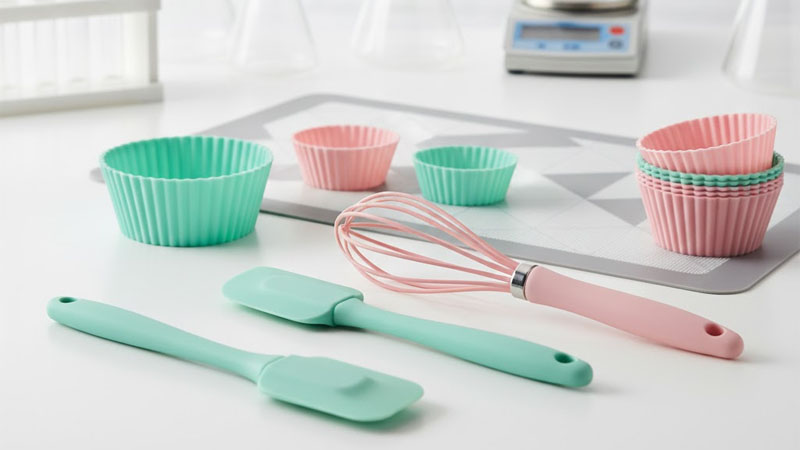
When I worked with a client developing a pastel-colored bakeware line, the first prototypes looked great — until migration tests failed due to pigment choice. It was a valuable lesson in how pigment chemistry and formulation balance affect both aesthetics and safety.
Colorant Selection and Compliance?
Color selection begins with compliance. Even the most appealing pigment is useless if it cannot meet food-contact safety regulations.
All colorants used in food-contact silicone must comply with FDA, LFGB, and EU 10/2011 regulations, ensuring no harmful migration or chemical residue.

Colorants fall into two broad categories: organic pigments and inorganic pigments. Organic pigments offer vibrant hues but can have higher migration risk. Inorganic pigments provide stability and heat resistance but are limited in color range.
Colorant Selection Guidelines
| Pigment Type | Advantages | Risks | Recommended Use |
|---|---|---|---|
| Inorganic (e.g., TiO₂, Fe₂O₃) | High heat stability, low migration | Limited brightness | Preferred for kitchenware |
| Organic (e.g., azo, phthalocyanine) | Vibrant color, wide palette | Possible migration, fading | Use only with certified grades |
| Custom masterbatch | Controlled dispersion | Needs compliance proof | For consistent production |

Every pigment must come with a Declaration of Compliance (DoC) and be tested for extractables under specific temperature and solvent conditions. FDA 21 CFR 177.2600 and LFGB standards are the primary benchmarks.
Migration Levels and Restricted Substance Control?
Even compliant pigments can migrate if used in excessive concentration or poor dispersion. Proper formulation balance ensures safety under real-use conditions.
Migration control depends on pigment stability, crosslink density, and process cleanliness.

In one test, a bright red silicone mat passed initial LFGB testing but failed after 200°C aging due to unreacted low-molecular residues. We reduced the pigment load by 20% and extended post-curing time — it then passed comfortably.
Migration Control Factors
| Factor | Effect | Recommended Practice |
|---|---|---|
| Pigment loading | Higher loading increases migration | Stay below 2–3% for strong colors |
| Crosslink density | Tighter network reduces leaching | Optimize curing system |
| Post-curing | Removes volatiles | ≥4 hrs @ 200°C |
| Filler interaction | Impacts pigment stability | Use silica with proper surface treatment |

ΔE vs. Migration Comparison (Example)
| Color ΔE Change After 200°C Aging | Migration Level (mg/dm²) | Risk |
|---|---|---|
| ΔE < 1 | < 5 | Safe |
| ΔE 1–2 | 5–10 | Monitor |
| ΔE > 2 | >10 | Review formulation |
By linking visual color change with migration data, we can detect early signs of instability before formal certification testing.
Batch Consistency and Color Difference?
Consistency builds brand trust. Even a slight color shift between batches can lead to customer complaints or rejections.
Batch-to-batch color consistency requires strict pigment dispersion control, curing process repeatability, and colorimetric verification.
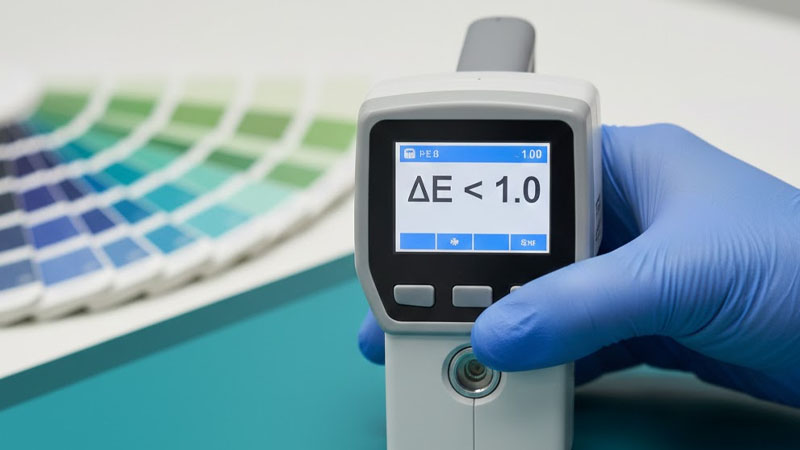
In one production run, we noticed the same “mint green” color appearing bluish in one batch and yellowish in another. The root cause was a subtle pigment dispersion variation due to a different mixing temperature.
Color Consistency Management
| Parameter | Control Method | Target |
|---|---|---|
| Pigment ratio | Precision dosing | ±0.1% |
| Mixing temperature | Temperature-controlled kneader | 70–90°C |
| Curing conditions | Time and temperature record | ±2% variation |
| ΔE tolerance | Spectrophotometer check | ΔE ≤ 1.0 vs. master sample |
Using a master color chip or standard reference sample ensures all future batches match both in color tone and migration behavior. Continuous color monitoring should be part of final inspection, not just development.
Impact of Formulation on Mechanical Properties?
Pigments and additives can change more than color — they influence hardness, elasticity, and tear strength.
Color formulation can alter mechanical properties of silicone, so balancing visual goals with performance is essential.
For example, adding 2% titanium dioxide typically increases hardness by 3–5 Shore A, while high organic pigment loading can reduce elongation. We often validate mechanical properties alongside color and migration tests to ensure holistic product quality.
Example Data
| Pigment Type | Hardness Change (Shore A) | Elongation Change (%) | Observation |
|---|---|---|---|
| TiO₂ (2%) | +4 | -5 | Slight stiffening |
| Fe₂O₃ (1.5%) | +2 | -3 | Stable performance |
| Organic red (3%) | +6 | -12 | Reduced elasticity |

To balance strength and flexibility, additive systems like silicone-compatible plasticizers or silica fillers can be adjusted. Mechanical testing ensures no degradation after repeated heating cycles.
Verification and Retention Samples?
Proper documentation and reference samples protect both supplier and buyer in case of future variation or compliance disputes.
Retention samples and verification testing establish a traceable color and safety baseline for ongoing production.
Each approved color should have:
- A master color chip kept in both laboratory and customer records.
- A certificate of analysis (CoA) confirming pigment lot number and compliance.
- A migration test report linked to the specific formulation.
- Periodic aging and revalidation to verify long-term stability.
This structured system allows traceability if a customer later reports odor, fading, or compliance issues. Color samples should be retained for at least two years beyond the last production batch.
Conclusion
Color formulation for silicone kitchenware is both an art and a science. A beautiful color must also be safe, compliant, and consistent — from the first batch to the millionth.
Looking to develop compliant and consistent colors for your silicone kitchenware?
Submit your color cards and target regulations, and our technical team will create a custom formulation recommendation that meets both performance and safety standards at RuiYang Silicone.