Silicone vs polyurethane is not a contest with one universal winner. The choice depends on the load, temperature, environment, service life, and manufacturing route. Choose silicone for temperature extremes, UV exposure, and long-term sealing. Choose polyurethane for abrasion, load-bearing, impact, and broad hardness options.
That simple rule prevents many early mistakes. It is not enough for a final material specification. A wheel, static gasket, medical valve, potting compound, and construction sealant may all use one of these polymers, but they do not ask the material to do the same job.
Executive Summary
- Silicone is usually the safer choice when heat, cold, UV, ozone, or long-term compression recovery controls service life.
- Polyurethane is usually stronger under abrasion, impact, repeated contact, and high mechanical loads.
- Do not approve either material family from a generic comparison chart. Compare actual grades using the same test method, temperature, specimen geometry, and conditioning.
Silicone vs Polyurethane at a Glance
| Decision factor | Silicone elastomer | Polyurethane elastomer |
|---|---|---|
| Polymer structure | Inorganic silicon–oxygen backbone with organic side groups | Organic polymer formed from polyols and isocyanates |
| Typical strength | Temperature stability, weathering, electrical insulation, compression recovery | Abrasion resistance, tear strength, tensile strength, impact absorption |
| Typical weakness | Lower abrasion resistance and higher raw-material cost | More sensitive to heat, UV, hydrolysis, and formulation chemistry |
| Hardness range | Common molded grades are available from very soft to firm rubber | Very broad range, from flexible foam and soft elastomer to rigid systems |
| Outdoor exposure | Usually strong against UV and ozone | Depends heavily on aromatic or aliphatic chemistry and stabilizer package |
| Wet service | Low water absorption, but bond design still matters | Polyether grades usually resist hydrolysis better than polyester grades |
| Processing | HCR compression/transfer molding, LSR injection molding, extrusion, coating | Cast elastomer, RIM, foam, coating, adhesive, TPU injection molding or extrusion |
| Cost direction | Usually higher material cost | Often lower, but tooling, scrap, secondary operations, and service life can reverse the comparison |
These are material-family tendencies. They are not guaranteed values. A filled high-consistency silicone rubber and a cast polyester polyurethane should not be compared as if each represents its entire polymer family.
When Should You Choose Silicone?
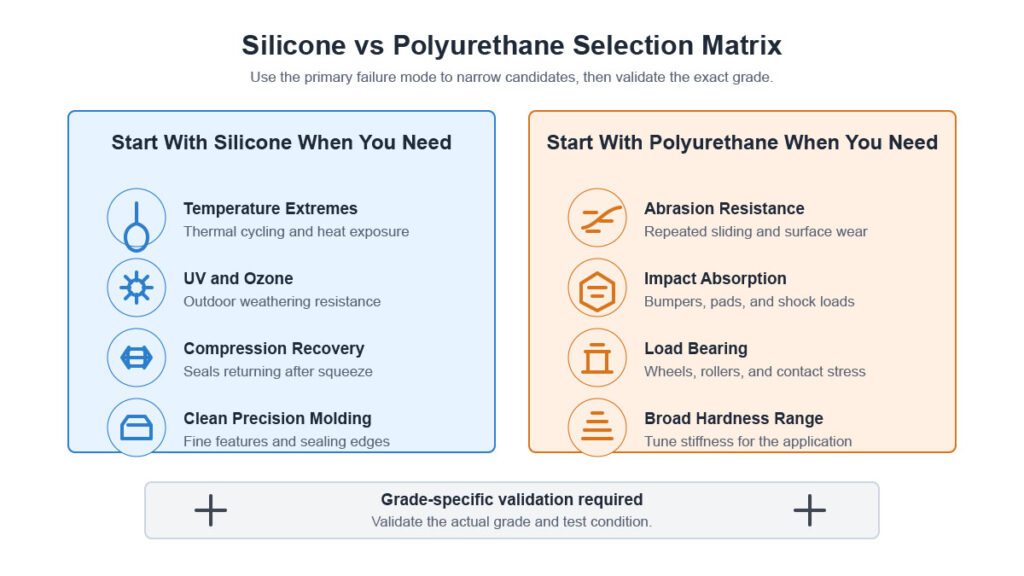
Choose silicone when the application is controlled by thermal cycling, outdoor weathering, low-temperature flexibility, or long-term sealing force.
Temperature extremes and heat cycling
Many general-purpose silicone elastomers are specified for long service around -45°C to 200°C, while individual grades may have narrower or wider limits. Dow lists -45°C to 200°C as a useful long-term range for one SYLGARD silicone elastomer and warns that part-level validation is still required near the limits. Rogers lists -55°C to 200°C for its BISCO cellular silicone range.
The important issue is not the highest temperature printed on a brochure. It is what happens after hundreds of heat cycles while the part remains compressed, stretched, or exposed to fluid. Hardness, elongation, compression set, adhesion, and electrical properties may not age at the same rate.
Polyurethane can tolerate heat, but its usable range varies sharply by chemistry. The American Chemistry Council notes that non-flaming thermal degradation of some polyurethane products may begin around 150–180°C. That is a degradation warning, not a recommended operating range. Continuous-use limits for a specific polyurethane grade are normally much lower and must come from its technical data sheet.
UV, ozone, and outdoor weathering
Silicone is normally the lower-risk option for exposed seals, lighting components, outdoor enclosures, and glazing joints. Its silicon–oxygen backbone gives it strong resistance to UV and ozone. Dow describes structural silicone sealant as resistant to UV radiation, heat, humidity, ozone, and temperature extremes.
Polyurethane needs a more specific question: is the system aromatic or aliphatic, and what stabilizers or coating protect it? Aromatic polyurethane can discolor under UV. Discoloration does not always mean immediate mechanical failure, but it matters for visible components and can indicate surface aging. Aliphatic systems improve color stability, usually at a higher formulation cost.
Teams often underestimate weathering because initial tensile data looks acceptable. The real difference appears after months of sunlight, moisture, and thermal movement. A black industrial roller and a white exterior seal do not have the same acceptance criteria.
Long-term sealing and compression recovery
For static gaskets exposed to heat, silicone often retains sealing force better than general-purpose polyurethane. Low compression set matters because a gasket can look intact and still lose contact pressure.
Compression-set numbers are easy to misuse. ASTM D395 for solid rubber and ASTM D3574 for cellular materials use different specimens and procedures. Temperature, compression percentage, recovery time, and sample thickness all change the result. Compare values only when the test conditions match.
For a cabinet gasket or battery enclosure, we check more than the initial compression force. We also check gap tolerance, target compression, force relaxation, closure load, and recovery after aging. Over-compressing a soft gasket can shorten service life even when the material itself is suitable.
Cleanliness, biocompatibility, and food-contact applications
Silicone is widely used for baby products, kitchenware, medical components, tubing, and valves because suitable grades can combine heat resistance, flexibility, and clean molding. That does not make every silicone grade food-safe or medical-grade.
Compliance belongs to the exact compound and finished-part test scope. FDA 21 CFR 177.2600, LFGB recommendations, USP Class VI, and ISO 10993 answer different questions. Pigments, post-cure conditions, mold-release agents, adhesives, and printing can change the finished part. Request the compound declaration and relevant test report before approving the material.
When Should You Choose Polyurethane?
Choose polyurethane when the component sees sliding wear, rolling contact, impact, high load, or a hardness level that silicone cannot provide efficiently.
Abrasion, cut, and tear resistance
Polyurethane is usually the stronger candidate for wheels, rollers, scrapers, drive components, protective pads, mining parts, and material-handling components. The American Chemistry Council lists abrasion, impact, cuts, tears, oils, and solvents among properties available from polyurethane elastomers. BASF also positions polyurethane for industrial wheels where load-bearing capacity and abrasion resistance control performance.
This advantage is not theoretical. In repeated contact, a silicone surface may polish, nick, or tear at an edge while the polyurethane part continues to carry load. The failure often begins at a gate mark, sharp corner, bonded interface, or local stress concentration rather than in the middle of a standard tensile specimen.
Specify abrasion with a test method such as DIN 53516 or ASTM D5963. A statement such as “excellent wear resistance” is not enough for supplier comparison.
Load-bearing and impact behavior
Polyurethane can be formulated with high tensile strength, tear strength, and load-bearing capacity while retaining elasticity. This makes it useful for bumpers, shock absorbers, wheels, couplings, and protective components.
Hardness alone does not describe this behavior. Two materials at Shore A 80 can have different modulus, rebound, hysteresis, tear strength, and heat build-up. For a dynamic wheel, we need load, speed, duty cycle, hub design, operating temperature, and acceptable flat-spot behavior. A harder compound can increase load capacity but transmit more vibration and generate different internal heat.
Broad hardness and processing options
Polyurethane covers cast elastomers, flexible and rigid foams, coatings, adhesives, sealants, and thermoplastic polyurethane. That range allows engineers to tune hardness, density, rebound, damping, and processing route more widely than with a standard silicone-rubber program.
The trade-off is formulation sensitivity. “Polyurethane” is not one material. Polyester, polyether, and polycarbonate soft segments behave differently. Isocyanate chemistry also affects UV stability, mechanical behavior, and processing. A supplier substitution that keeps only Shore hardness constant can still change service life.
Paintability and bonding
For construction joints and assemblies that require painting, polyurethane sealant is often easier to integrate. Many silicone surfaces are difficult to paint and difficult to bond without plasma treatment, primer, or a silicone-specific adhesive.
Do not generalize this into “polyurethane bonds better.” Adhesion depends on the substrate, surface energy, contamination, primer, joint movement, cure condition, and adhesive chemistry. Glass, anodized aluminum, painted metal, ABS, nylon, and untreated polypropylene require different validation.
How Do Heat, Water, and Chemicals Change the Decision?
The correct answer depends on exposure time, concentration, temperature, and mechanical stress. A short wipe test at room temperature does not predict continuous immersion at 80°C.
Water and hydrolysis
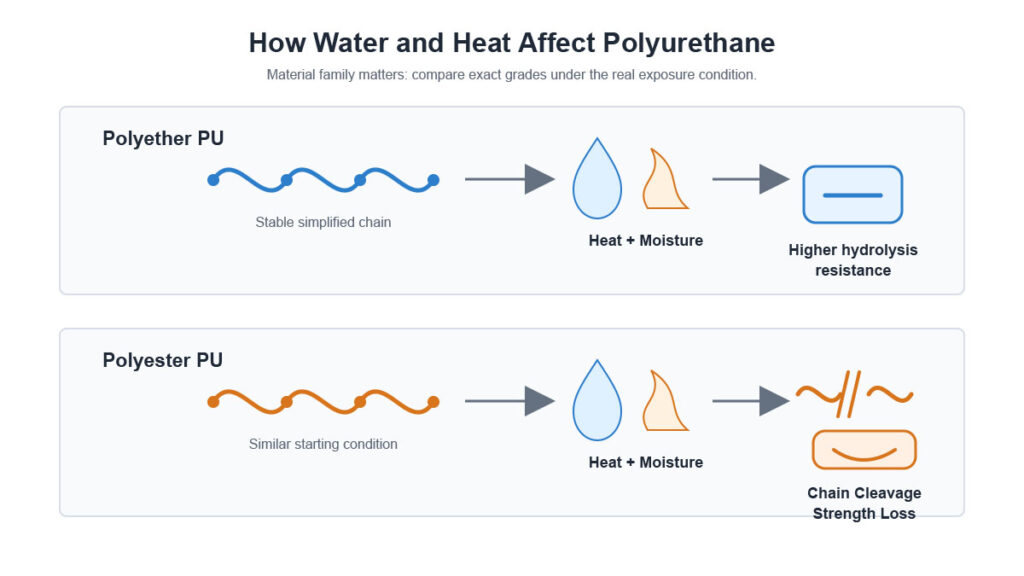
Silicone has low water absorption and usually performs well in humid or wet service. Polyurethane performance depends strongly on the soft-segment chemistry. Polyether polyurethane generally has better hydrolysis resistance than polyester polyurethane. Polyester grades may provide strong mechanical and oil-resistance properties but can lose strength under prolonged hot-water or high-humidity exposure.
This is frequently missed because both grades may pass a short room-temperature soak. Hydrolysis accelerates with heat. For wet-service polyurethane parts, ask for tensile retention, elongation retention, hardness change, and dimensional change after an agreed aging condition.
Oils, fuels, solvents, acids, and alkalis
Neither polymer family wins every chemical exposure. Silicone can swell in some fuels, oils, and non-polar solvents. Polyurethane may resist oils and abrasion well, but concentrated acids or alkaline solutions can attack certain grades. BASF notes that polyurethane chemical resistance changes with exposure time, temperature, concentration, and chemical type, and that degradation can follow swelling and molecular-chain cleavage.
Use an immersion test based on ASTM D471 or a relevant application standard. Record volume change, mass change, hardness, tensile strength, and visual condition. Test the actual colored compound, not only the base polymer.
Which Material Is Better for Molded Parts?
The part geometry and volume can decide the manufacturing route before the property chart does.
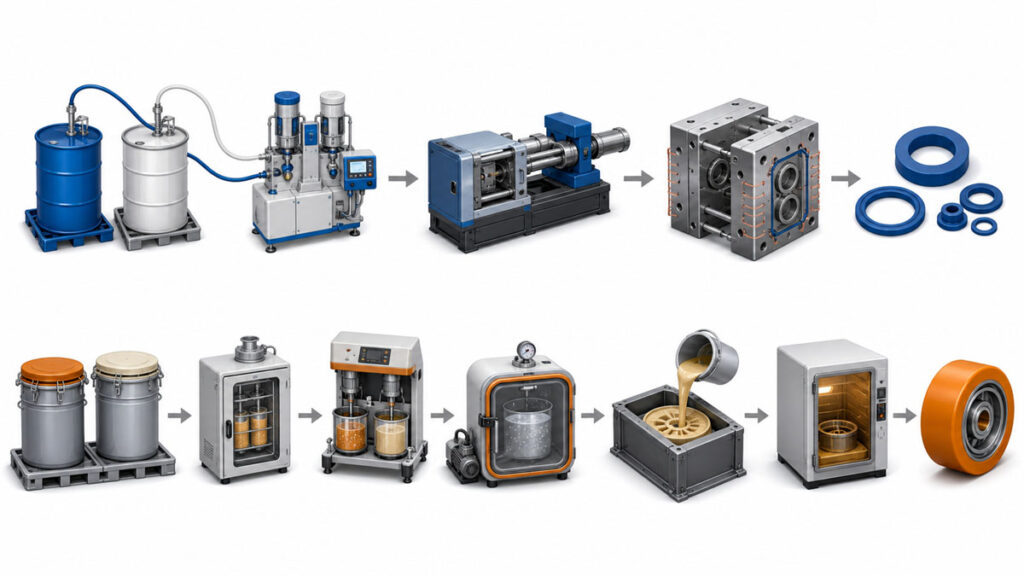
Silicone molding routes
High-consistency silicone rubber can be compression molded, transfer molded, extruded, or injection molded depending on the compound and geometry. Liquid silicone rubber uses a two-component metering system, a cold runner, and a heated mold. LSR works well for high-volume parts, thin sections, automated demolding, and overmolding when the tool and substrate are designed for it.
Silicone tooling must control flash at the parting line and vents. Low-viscosity LSR can enter very small gaps. Tool fit, vacuum, injection pressure, and clamp stability therefore affect flash more than a generic material comparison suggests.
Polyurethane molding routes
Cast polyurethane is useful for low-to-medium volumes, thick sections, rollers, wheels, and large elastomeric parts. Reaction injection molding supports larger parts and complex shapes. TPU can be injection molded or extruded with thermoplastic equipment.
Moisture control is critical for many polyurethane systems. Polyols, prepolymers, fillers, molds, and ambient air can introduce water. Water reacts with isocyanate and can create carbon dioxide, bubbles, voids, or inconsistent properties. Drying, mix ratio, degassing, mold temperature, and post-cure therefore belong in the process specification.
Is Silicone More Expensive Than Polyurethane?
Silicone usually has the higher material price, but piece price cannot be predicted from polymer family alone.
| Cost driver | Silicone impact | Polyurethane impact |
|---|---|---|
| Raw material | Usually higher | Often lower, with large variation by chemistry |
| Tooling | Precision tooling may be required to control LSR flash | Cast tooling can be economical at lower volume; TPU injection tooling may be comparable to plastics |
| Cycle and cure | LSR can support fast automated cycles; HCR may require secondary post-cure | Cast systems may require controlled cure and post-cure; TPU can run thermoplastic cycles |
| Scrap and rework | Thermoset silicone cannot be remelted | Thermoset PU cannot be remelted; TPU sprues may be recyclable subject to quality limits |
| Secondary operations | Plasma, primer, or special adhesive may be needed | Surface treatment or primer may still be required; paintability can reduce secondary complexity |
| Service life | Can offset price in hot, outdoor, or long-term sealing applications | Can offset price in abrasive, impact, or high-load applications |
The correct comparison is total part cost at the required service life. A cheaper gasket that loses sealing force early is not cheaper. A premium silicone roller that wears rapidly in abrasive contact is also not a good purchase.
A Practical Silicone vs Polyurethane Selection Method
Use the application limit that would cause the first unacceptable failure.
- Define continuous and peak temperature, including cycle count and dwell time.
- Record static load, dynamic load, compression, sliding speed, and impact frequency.
- List fluids with concentration, temperature, and exposure duration.
- Define outdoor exposure, UV, ozone, humidity, and required appearance.
- Set measurable acceptance limits for compression set, abrasion loss, tensile retention, hardness change, swelling, and color shift.
- Choose the material family and grade only after matching the test method to the failure mode.
- Validate molded parts from the intended process. Plaques and supplier data sheets do not capture gates, weld areas, knit lines, bonded inserts, or production variation.

What Information Is Needed Before Quotation?
For a useful material recommendation, send the drawing, annual volume, hardness target, temperature range, load condition, chemical exposure, required life, color, compliance scope, and current failure mode. If an existing part is being replaced, include its material grade and test reports.
Silicone is the stronger default for heat, weathering, and long-term sealing. Polyurethane is the stronger default for wear, impact, and load. The final decision belongs to the grade, geometry, process, and validation condition—not the polymer name.