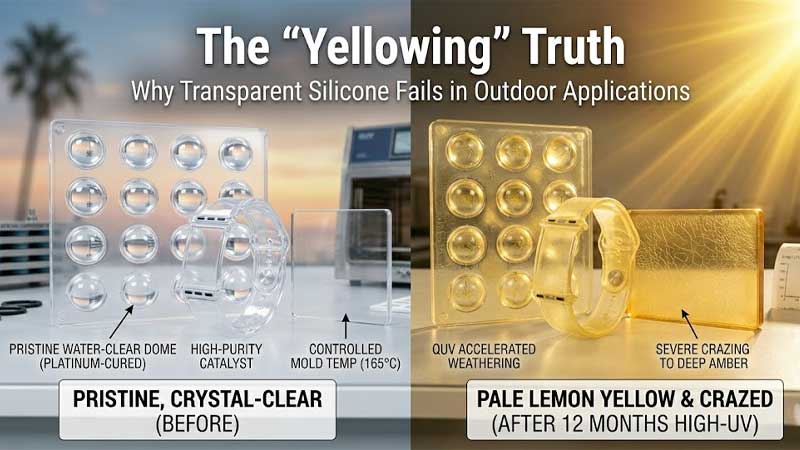
In this no-fluff, production-floor guide, we reveal exactly why non-yellowing transparent silicone turns pale lemon in 6–12 months under real California sun and how CMF engineers, product designers, and brands can finally specify optical-grade LSR that actually survives high-UV, coastal, and urban environments for years.
The Costly Myth That Still Dominates CMF Reviews
For years, suppliers have pushed non-yellowing silicone as the holy grail for designers who need crystal-clear parts that stay crystal-clear. Walk through any CMF review in San Francisco, Boston, or Seattle and you’ll hear the same pitch: “Platinum-cured, optical-grade LSR—guaranteed forever clear.”
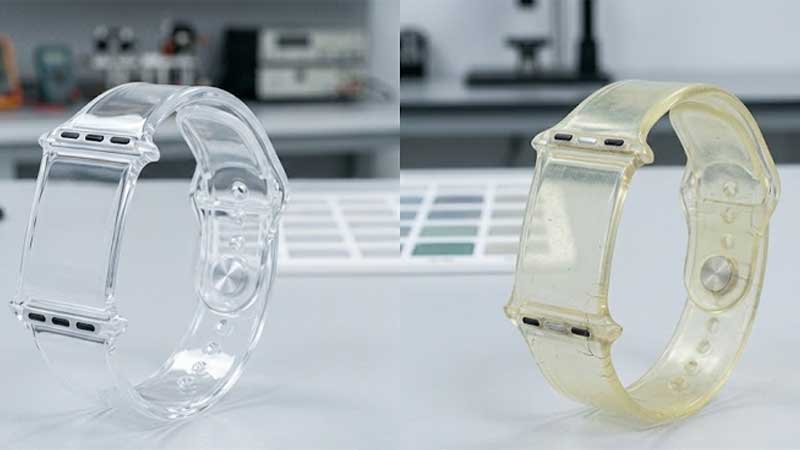
Yet in California’s high-UV reality—especially the relentless 300+ days of intense sunlight from Los Angeles to the Bay Area—transparent smartwatch bands, landscape lighting diffusers, and outdoor earphone housings routinely shift from water-clear to pale lemon within 6–12 months. The yellowing of clear silicone isn’t just a cosmetic headache; it signals deeper degradation: embrittlement, loss of elasticity, and a measurable drop in light transmission that kills product performance.
After 15+ years running high-volume LSR production for North American brands, we’ve seen the same failure modes repeat across factories in China, Vietnam, and the U.S. This isn’t theory. It’s the production-floor truth that marketing brochures never mention.
Chemistry Deep Dive: Addition-Cure vs. Condensation-Cure
Why Addition-Cure (Platinum) Wins for Optical Applications?
The backbone of silicone—the Si-O-Si chain—is indeed one of the most UV-stable bonds in polymer chemistry. That’s why the myth persists. The problem lives in the side chains and everything else that gets added during manufacturing.
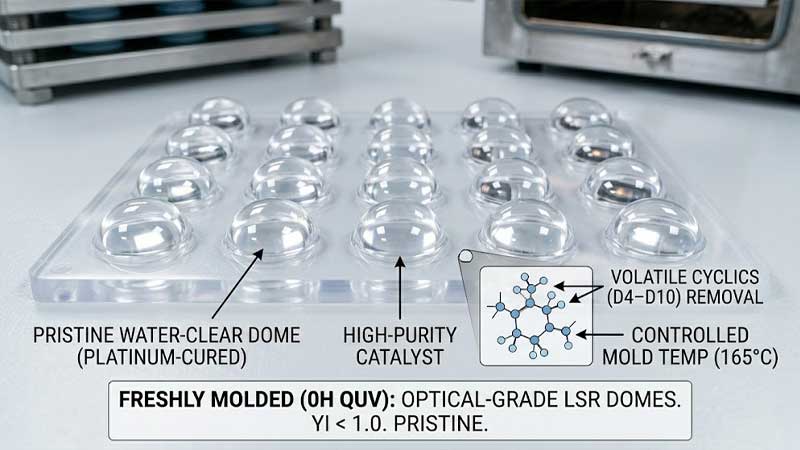
Addition-cure (platinum-catalyzed hydrosilylation) is the undisputed choice for optical-grade LSR. No acidic by-products, minimal volatiles, and the cleanest initial color when everything is perfect. But perfect is rare.
Platinum catalyst purity is everything. We’ve tested catalysts from 99.9 % to 99.99 % Pt. The difference shows up as a faint straw tint right out of the mold—visible only under D65 daylight but enough to start the yellowing clock. Even trace inhibitors or excess methylhydrosiloxane (the Si-H crosslinker) will, under UV, form chromophores via radical side reactions. In one 2024 production run for a premium wearable brand, a 2 % overdose of crosslinker in a 50:1 A/B mix turned parts noticeably yellow after only 800 hours of QUV—well inside the 12-month outdoor warranty window.
Condensation-Cure’s Fatal Flaws Exposed
Condensation-cure (peroxide or tin-catalyzed) is still widely used for cost-driven outdoor parts. Here’s the reality:
| Feature | Addition-Cure (Platinum) | Condensation-Cure (Peroxide/Tin) |
| By-products | None | Acidic (acetic acid, alcohols) |
| Initial color | Water-clear | Often faint yellow |
| UV stability | Excellent (with proper post-cure) | Poor – accelerates oxidation |
| Outdoor recommendation | Preferred for transparent | Avoid for high-UV transparent |
| Typical failure time | 3000+ hours QUV possible | <1000 hours in California sun |
We stopped offering peroxide-cured transparent grades for any outdoor spec after a 2022 landscape-lighting project in Arizona where parts yellowed and cracked in under four months.
Production Tip That Changed Everything
Even with top-tier platinum systems, post-curing is non-negotiable. 4 hours at 200 °C under vacuum removes D4–D10 cyclic siloxanes that otherwise migrate to the surface and oxidize into yellow quinone-like structures.
The Migration Problem: It’s Not Always the Silicone Itself
Pigment Migration vs. True Silicone Yellowing
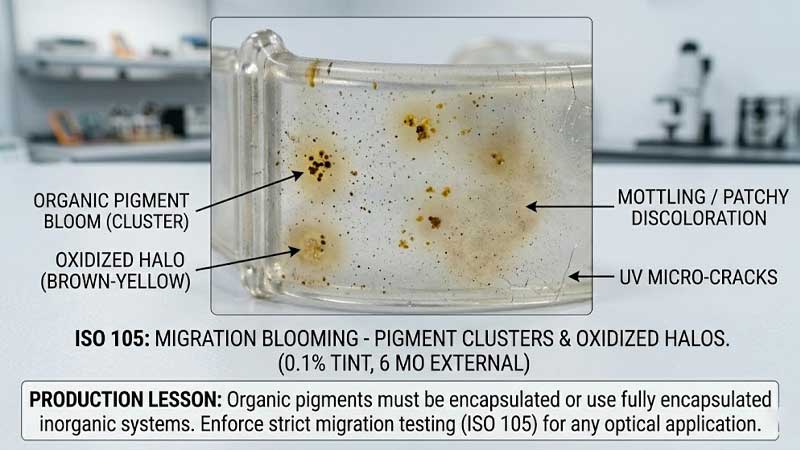
Sometimes the silicone is innocent. Pigment migration is brutally common when brands try to add the slightest tint for premium warmth.
| Cause | Typical Loading | Failure Mode | Our Rule |
| Organic pigments | 0.1–0.5% | Blooming & oxidation | Refuse >0.05% |
| Certain iron oxides | 0.2% | Brown-yellow halos | Full ISO 105 migration test |
| Designer “warm tint” | Trace | YI jump 1.2 → 9.8 in 6 months | Zero tolerance for optical |
Environmental Absorption & Skin Contact
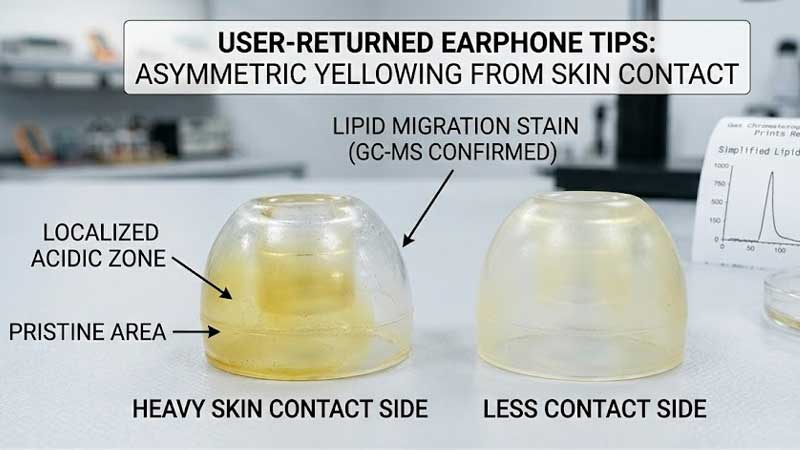
Silicone’s gas permeability is legendary (up to 100× higher than most rubbers). In downtown LA or Seattle’s port areas, ozone, NOx, and PAHs diffuse straight in. Real-world case: a major audio brand’s transparent over-ear cushions yellowed fastest on the right earpiece—GC-MS proved sebum lipids and sweat salts created localized acidic micro-environments.
The UV Stabilizer Trap: Clarity vs. Durability
Every CMF engineer faces the same spreadsheet dilemma: “How much stabilizer can I add before I ruin the feel and strength?”
| Stabilizer Loading | 3000h QUV ΔE | Tear Strength Loss | Surface Feel | Recommendation |
| 0.5–0.8% | <2.0 | <5% | Excellent | Safe sweet spot |
| 1.0–1.2% | <1.5 | 8–12% | Good | Most outdoor projects |
| >1.5% | <1.0 | 12–20% | Tacky, dust magnet | Only if strength allows |
One client wanted “optical clarity better than glass” plus “five years zero yellowing.” We delivered 0.7 % custom HALS blend that passed 4000-hour QUV at ΔE < 1.5—but elongation dropped 9 %. Rule of thumb: never exceed 1.2 % total stabilizer loading unless you re-validate the entire mechanical spec.
Manufacturing Logic: Process Controls That Actually Matter
Mold Temperature – The Silent Killer
Running at 180–190 °C to shave cycle time adds +0.8 YI units from thermal oxidation of platinum catalyst.
Release Agents & Tooling Discipline
We now mandate solvent-free, platinum-compatible release systems and full mold cleaning every 500 shots.
Post-Curing Standard
Our non-negotiable protocol: 4 hours at 200 °C + 2 hours at 150 °C under nitrogen purge. Parts that skip this routinely fail 1000-hour QUV.
Real-World Testing Protocol (Beyond ASTM G154)
We run every outdoor transparent spec through this combined-stress protocol:
| Cycle Phase | Duration | Conditions | Purpose |
| UV Exposure | 8 hours | 60 °C, 1.0 W/m² @ 340 nm (UVA-340) | Simulate peak California sun |
| Condensation | 4 hours | 50 °C, 100% RH | Dew & humidity attack |
| Dry Heat + RH Cycling | 12 hours | 70 °C / 85% RH cycling | Diurnal desert/coastal swings |
Results are reported with Konica Minolta CM-700d spectrophotometer under D65/10° — full spectral curves and ΔYI vs. hours.
How to Specify the Right Silicone for Your Next Project
Use this exact checklist when talking to suppliers:
- Demand Optical Grade LSR only — medical or food-contact certified as purity proxy.
- Require UV stabilizer package % in writing + full mechanical impact report (tensile, tear, elongation).
- Verify post-curing capability with furnace logs and D4–D10 < 50 ppm.
- Request 1000-hour QUV data on your exact durometer and color — never generic brochures.
- Confirm supplier experience with your target environment (high-UV coastal, desert, urban pollution).