Silicone baking mats can look clean while still holding a thin film of cooking oil, detergent, baked sugar, or strong food odor. The safest response is usually a more complete hand wash—not a knife, aggressive scrubber, strong solvent, or high-temperature “cleaning hack.”
What Is the Best Way to Clean a Silicone Baking Mat?
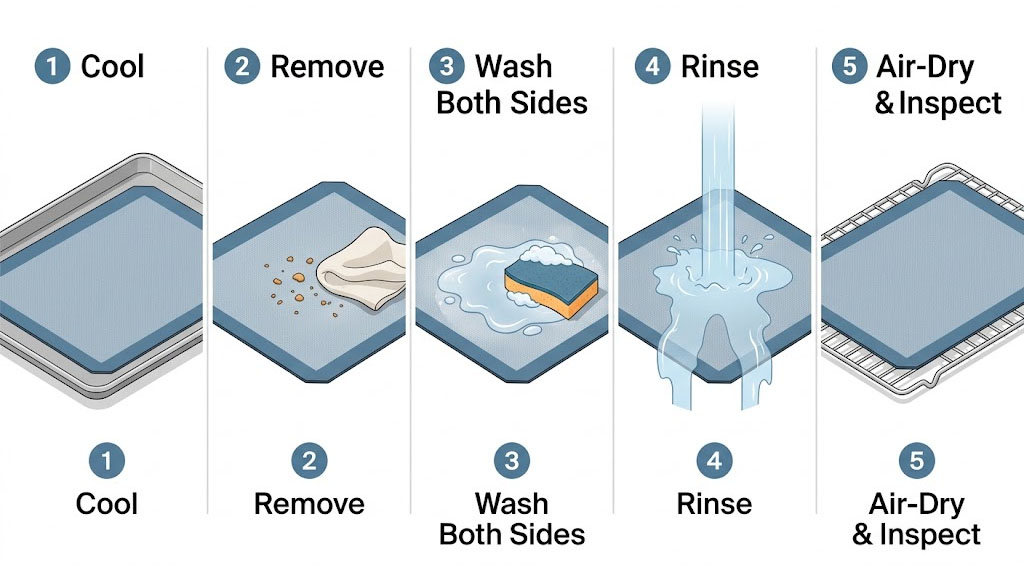
Quick answer: Let the mat cool, remove loose food, then wash both sides with warm water, mild dish detergent, and a soft nonabrasive sponge. Rinse until no detergent remains, shake off excess water, and air-dry completely before storing the mat flat or loosely rolled. Repeat the wash with fresh detergent for stubborn grease. Use a dishwasher or stronger treatment only when the care instructions for that specific mat allow it.
This guide covers reusable, flat baking and pastry mats intended for food contact. It does not cover metal baking sheets, sink or dish-drying mats, grill mats, industrial work mats, or three-dimensional baking molds. For shaped cavities, see How to Clean Silicone Molds. For other products, use the broader guide to cleaning silicone.
Before You Start: Check the Mat’s Construction and Care Label
Many reusable baking mats are composites: a silicone cooking surface reinforced with fiberglass mesh. Others may be solid silicone or include printed measurements, textured zones, perforations, reinforced edges, or another backing. These differences affect whether the mat can be soaked, placed in a dishwasher, rolled, or exposed to a particular cleaner.
The care label controls the method. OXO, for example, identifies one of its fiberglass-and-silicone baking mats as dishwasher-safe, while other products recommend hand-washing or provide narrower cleaning instructions. General heat resistance of silicone does not establish the cleaning limits of every finished mat.
Before cleaning, check:
- whether the product is a baking mat or a countertop-only pastry mat;
- whether it is dishwasher-safe;
- whether soaking, boiling, or chemical sanitizing is permitted;
- whether printed markings need special care;
- whether the mat may be stored flat, rolled, or both;
- whether there are cuts, exposed fibers, lifting edges, bubbles, or other damage.
Do not cut a reinforced mat to fit a pan unless its manufacturer explicitly identifies it as trimmable. A standard fiberglass-reinforced baking mat should not be used as a cutting surface.
Diagnose the Cleaning Problem First
| What you notice | Likely issue | Safest starting response |
|---|---|---|
| Crumbs, flour, or dry sugar | Loose food residue | Brush or wipe away gently before washing |
| Slick film or grease transfer | Oil, cooking spray, meat fat, or detergent residue | Rewash both sides with fresh warm water and mild grease-cutting detergent |
| Hard caramel, cheese, or baked sauce | Baked-on food | Use short warm-soapy-water contact if allowed, then a soft sponge |
| Perfumed or soapy smell | Detergent or rinse-aid residue | Rinse again and air-dry in a ventilated place |
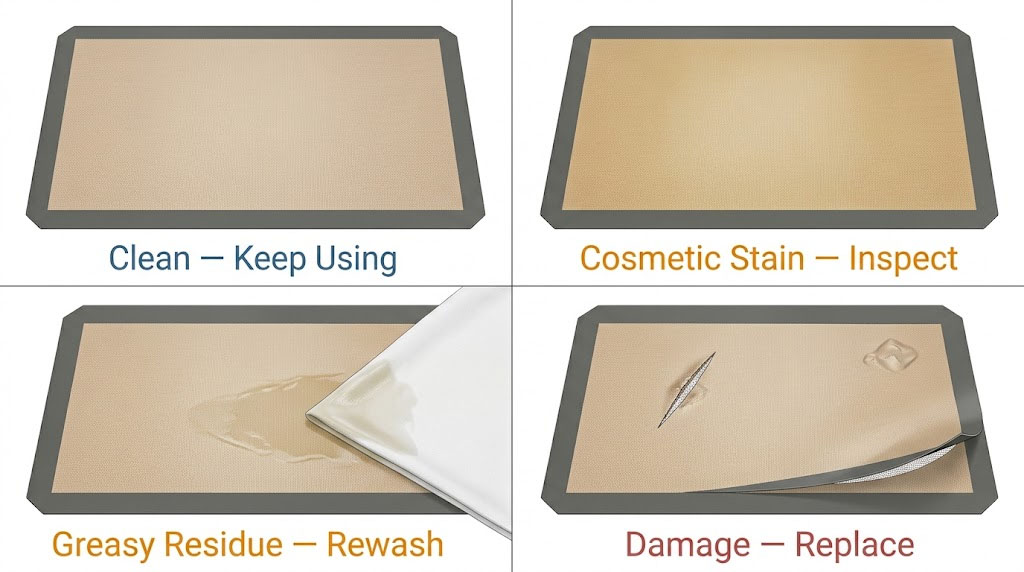
| Brown or yellow color with an intact surface | Food pigment or normal use discoloration | Clean normally; do not escalate solely to restore color |
| Permanent tackiness, exposed mesh, bubbles, or peeling | Material or structural damage | Stop using the mat and replace or ask the manufacturer to assess it |
How to Clean a Silicone Baking Mat in Five Steps
1. Let the Mat Cool Completely
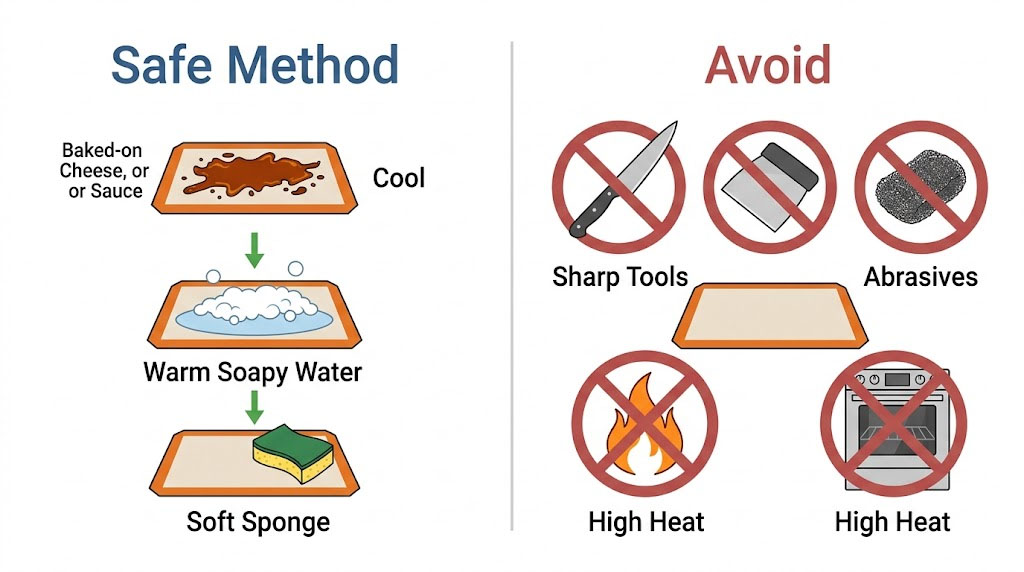
Allow both the baking sheet and mat to cool before handling. Do not lift a flexible mat while it is supporting hot fat, melted sugar, or liquid food. Cooling also lets many residues firm up so they can be removed without being smeared across the surface.
2. Remove Loose Food Without Scraping
Lift off crumbs and cooled food with your fingers, a soft cloth, or a soft brush when the care instructions permit one. Gently flexing a cool mat can release brittle crumbs, but do not sharply crease it.
Do not use a knife, razor, metal spatula, stiff brush, or steel wool. Aggressive tools can cut the silicone coating or expose reinforcement.
3. Wash Both Sides With Mild Detergent
Lay the mat as flat as practical in the sink. Apply a small amount of mild dish detergent with a wet, soft sponge and use light pressure across the full cooking surface. Turn the mat over and clean the back, edges, corners, printed areas, and texture as well. Oil can travel under a mat or collect near the rim of a sheet pan.
Warm water supports detergent action, but “hotter” is not automatically better. Do not use boiling water unless the product instructions specifically permit it.
4. Rinse Thoroughly
Rinse both sides until no foam, fragrance, or obvious detergent film remains. A slippery or perfumed feel may come from excess detergent or rinse aid rather than cooking oil. Use an additional clean-water rinse before moving to a stronger method.
5. Air-Dry and Inspect
Shake off excess water and place the mat where air reaches both sides. A clean rack is preferable to leaving the wet mat sealed against a counter or sheet pan. Inspect it only after it is dry.
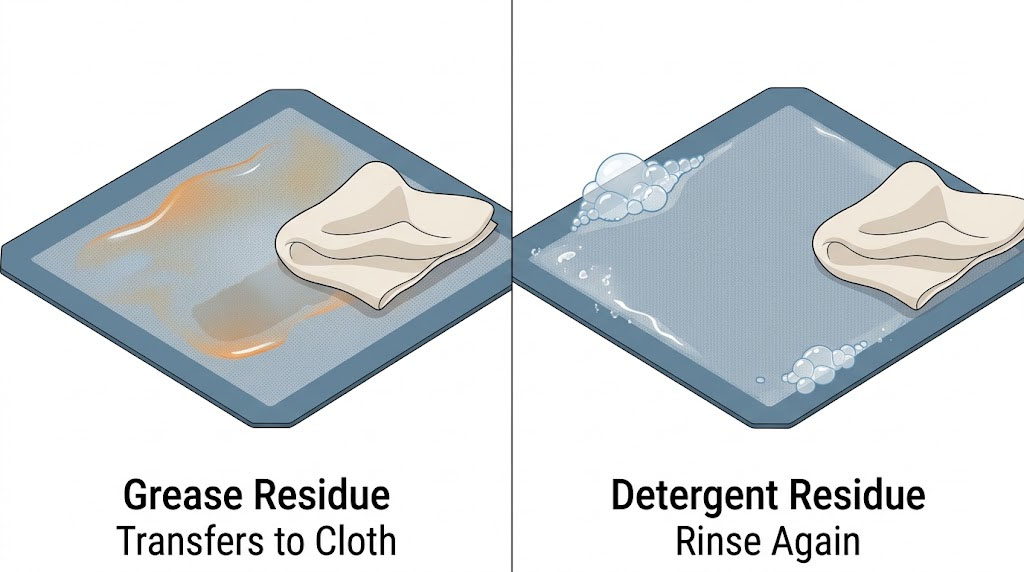
Check for remaining food, residue that transfers to a clean cloth, permanent tackiness, cuts, frayed edges, bubbles, peeling, exposed reinforcement, or a persistent burnt or chemical odor.
How to Deep-Clean a Greasy or Sticky Silicone Baking Mat
Grease is the most common reason silicone baking mat cleaning feels incomplete. Butter, cooking oil, cheese, meat fat, and aerosol cooking spray can build up through repeated heating. Detergent or rinse aid can also leave a film that feels similar.
Start with another complete wash:
- Use fresh warm water rather than greasy dishwater.
- Apply a small amount of mild grease-cutting dish detergent to a clean sponge.
- Wash both sides, edges, and any printed or textured zones.
- Rinse longer than usual and let the mat dry fully.
- Test whether visible residue or oil transfers to a clean white cloth or paper towel.
Clean the mat after each food use instead of reheating yesterday’s oil during the next bake. Avoid greasing the mat when the product and recipe do not require it. Some manufacturers specifically state that their nonstick mats need no butter, oil, or spray.
Do not assume every trace of surface feel is contamination. A Silpat care sheet notes that some oily feel and discoloration can remain after correct washing on that product. That statement should not be generalized to every brand. If the dry mat transfers material, has become newly tacky or dull, no longer releases food, or smells burnt or chemical, stop escalating the cleaning and assess it for damage.
How to Remove Baked-On Sugar, Cheese, or Burnt Food
Let caramel, cheese, sauce, or dough cool first. Gently lift loose pieces without digging into the surface.
If the care instructions permit wet contact or soaking, expose the affected area to warm soapy water for a short period, then wipe with a soft sponge. Repeat instead of increasing pressure. Do not invent a universal soak time: printed, laminated, perforated, and reinforced mats may have different limits.
Do not use oven cleaner, a metal scraper, a self-cleaning oven cycle, broiler, stovetop, grill, torch, or open flame. Also skip the popular high-temperature oven-cleaning hack unless the mat manufacturer gives an exact cleaning temperature and time for that model. A temperature that is safe for one mat may exceed the limit of another, and heated oil can smoke.
If a blackened patch is embedded in a surface that has bubbled, melted, hardened, cracked, or separated, it is damage rather than removable food residue. Replace the mat.
How to Remove Odors and Stains
Wash with mild, preferably unscented dish detergent, rinse thoroughly, and dry in moving air. Confirm that no greasy film remains because food fat can continue to carry odor.
Strongly flavored foods may leave a trace scent even after the mat is clean. Consider keeping separate mats for delicate cookies and pastries versus garlic, fish, meat, or heavily seasoned roasting. For persistent kitchenware odors, use the product-specific decision process in How to Remove Smells From Silicone Kitchenware.
Tomato, spices, caramelized sugar, and browned fat can change the mat’s color. A uniform stain does not necessarily mean removable food remains. Do not escalate automatically to bleach, peroxide, abrasives, solvents, or oven heat merely to make an intact mat look new.
Can Silicone Baking Mats Go in the Dishwasher?
Some can; others should be hand-washed. “Silicone” is not a dishwasher instruction.
For example, OXO identifies its silicone-and-fiberglass baking mat as dishwasher-safe. The Sasa Demarle group also describes Silpat mats as washable with a soft sponge and soapy water and dishwasher-safe, while individual product instructions may recommend hand-washing to extend service life or specify a particular rack.
If the label confirms dishwasher use:
- position the mat without a sharp fold;
- keep it secure and away from an exposed heating element;
- make sure it cannot block the spray arm;
- use the detergent and cycle permitted by the manufacturer;
- rinse by hand afterward if fragrance or rinse-aid film remains;
- dry completely before storage.
If the label is missing or unclear, hand-washing is the conservative default. See Can Silicone Go in the Dishwasher? for a broader product and loading guide.
Are Baking Soda, Vinegar, Alcohol, Bleach, or Heat Safe?
| Method | Role | Important boundary |
|---|---|---|
| Mild dish detergent | Default for food soil and grease | Use a modest amount, then rinse fully |
| Baking-soda paste | Optional spot treatment for some products | Use only when the mat maker permits it; avoid dry or aggressive scrubbing on silicone and printing |
| Vinegar or lemon | Product-specific treatment, not the first choice for grease | Use only when allowed, rinse thoroughly, and never mix an acid with bleach |
| Rubbing alcohol or solvent | Not a routine food-contact mat cleaner | Use only under written instructions for the complete mat, then wash and rinse as directed |
| Bleach or sanitizer | Only for a defined hygiene need | Clean first; both the mat and sanitizer label must permit the food-contact use; never mix cleaners |
| Boiling, steam, or oven heat | Not a universal cleaning method | Use only if the manufacturer supplies a cleaning procedure for that model |
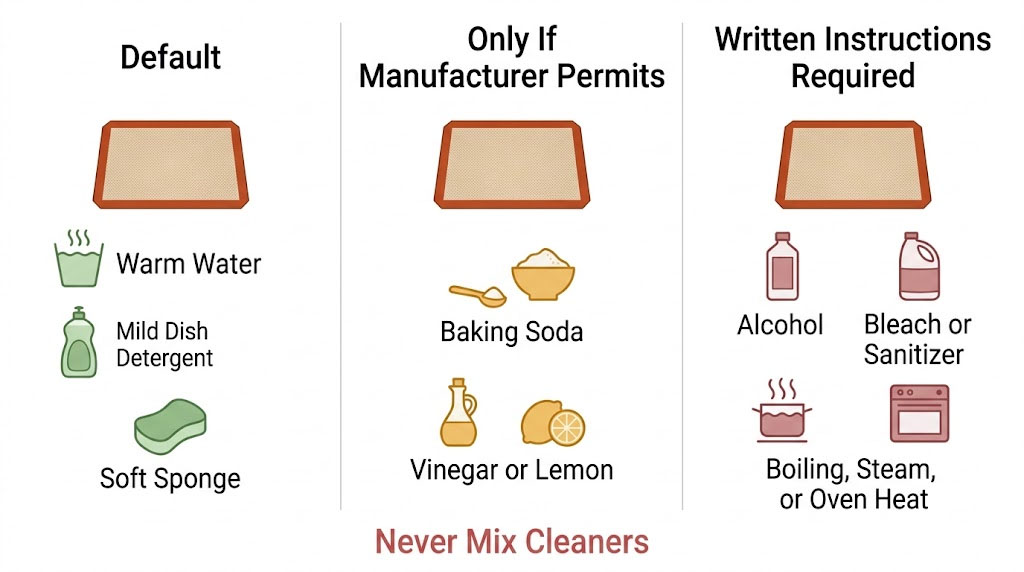
Fat Daddio’s publishes baking-soda, vinegar, and lemon methods for its own mats, while other brands provide different care instructions. Treat them as optional, model-specific methods—not a homemade universal recipe. Do not mix bleach with vinegar, lemon juice, ammonia, alcohol, or another cleaner.
Health Canada recommends using and maintaining silicone bakeware according to the manufacturer’s intended use and instructions. The finished mat’s label therefore matters more than a general statement about silicone rubber.
How Should You Clean a New Baking Mat Before First Use?
Inspect the mat for debris, cuts, edge separation, or an unusual odor. Follow its first-use instructions; in the absence of a more specific method, wash with warm water and mild dish detergent, rinse thoroughly, and air-dry before adding food.
Do not put a new mat in an empty oven to “burn off” an odor. Contact the seller or manufacturer if a strong chemical smell remains after the approved first-use cleaning.
For U.S. repeated food-contact use, 21 CFR 177.2600 states that finished rubber articles must be thoroughly cleaned before their first food-contact use. It does not establish the cleaning method or suitability of every unidentified mat.
How to Dry and Store a Silicone Baking Mat
Store the mat clean and completely dry. Follow the manufacturer, which commonly recommends flat storage or a loose roll. Do not make a sharp fold or crease in a reinforced mat, and do not press knives, metal tools, clips, or heavy cookware into the surface.
Keep it in a cool, dry location away from direct sunlight, household chemicals, and strong odors. If you roll it, use a wide, loose roll rather than a tight elastic that leaves an indentation.
For baking use, care, and comparison with parchment beyond the cleaning topic, see The Ultimate Guide to Silicone Baking Mats.
When Should You Replace the Mat?
Stop using and replace or ask the manufacturer to assess a mat with:
- a cut, tear, puncture, or exposed fiberglass reinforcement;
- frayed or separating edges;
- bubbles, peeling, delamination, or permanent warping;
- a melted, brittle, cracked, or carbonized area;
- permanent tackiness or material that transfers after correct washing and drying;
- residue that cannot be removed without damaging the surface;
- a persistent chemical or burnt odor;
- loss of food-release performance together with a visible surface change.
Color change alone is not always a reason to discard an otherwise stable mat. Structural damage, material transfer, and unexplained surface change matter more than appearance alone.
Frequently Asked Questions
Why Does My Silicone Baking Mat Still Feel Greasy After Washing?
Cooking oil may remain, or excess detergent or rinse aid may create a slippery film. Rewash both sides with fresh warm water, mild grease-cutting detergent, and a clean sponge; rinse thoroughly and assess the dry mat. Check the brand instructions before trying a stronger treatment because some products retain a slight characteristic surface feel.
Can I Use Baking Soda on a Silicone Baking Mat?
Only when the mat manufacturer permits it. Use detergent first. If a gentle baking-soda paste is approved, keep the treatment localized, do not scrub printing or the surface aggressively, and rinse it away completely.
Can I Use Vinegar on a Silicone Baking Mat?
Vinegar is not the first choice for cooking grease. Use it only for a problem and contact time covered by the mat instructions, rinse completely, and never combine it with chlorine bleach.
Can I Soak a Silicone Baking Mat Overnight?
Do not assume long soaking is safe or necessary. Use normal hand-washing or a short warm-soapy-water treatment when permitted. Printed, reinforced, laminated, and perforated mats may have different limits.
How Do I Remove Baked-On Sugar or Cheese?
Let it cool, lift loose pieces gently, then use short warm-soapy-water contact and a soft sponge if allowed. Repeat instead of using a knife, metal scraper, abrasive powder, or high oven heat.
Why Has My Silicone Baking Mat Turned Brown or Yellow?
Food pigments, heated oils, sugar, and normal use can cause cosmetic discoloration. Continue using it only when the surface remains intact, cleanable, free of transferable residue, and within the manufacturer’s care criteria.
How Often Should I Clean a Silicone Baking Mat?
Clean it after each food use and before long-term storage. More frequent cleaning may be needed after oil spray, seeds, sugar, egg wash, or strongly flavored foods.
Can I Cut a Silicone Baking Mat to Fit a Pan?
Not unless that product is specifically sold as trimmable. Many baking mats contain fiberglass mesh; cutting them damages the finished edge or exposes reinforcement.
Cleaning Instructions for Commercial and Custom Baking Mats
For a commercial or custom mat, care instructions should be validated on the complete product rather than copied from a generic silicone data sheet. Construction, edge encapsulation, fiberglass or other reinforcement, silicone formulation, printing, texture, detergent, water chemistry, cleaning temperature, dishwasher cycle, food residue, and drying method all influence service life.
Define and test:
- approved detergents, concentrations, pH range, and contact times;
- hand-wash, dishwasher, or commercial warewashing conditions;
- compatible sanitizers and required post-treatment rinsing;
- drying and storage methods;
- expected appearance changes and acceptable surface feel;
- inspection and replacement criteria for cuts, exposed mesh, delamination, and release performance;
- the number of baking and cleaning cycles the product must withstand.
Testing should use production-representative custom silicone baking mats with the intended reinforcement, colors, printing, edge design, food, and cleaning process.
References
- Sasa Demarle Group: Silpat Construction and Care
- Silpat Care Instructions
- Maison Demarle: Silpat Professional Technical Sheet
- OXO: Silicone Baking Mat Product Details
- Fat Daddio’s: Silicone Bakeware Care
- Fat Daddio’s FAQ: Silicone Baking Mats
- Health Canada: The Safe Use of Cookware and Bakeware
- 21 CFR 177.2600: Rubber Articles Intended for Repeated Use