Most teams deciding how to choose a silicone manufacturer start by lining up unit prices. That is the wrong first filter. A cheap quote only becomes meaningful after you know which process the part needs, who controls the tool, and whether the evidence applies to the production article.
The usual failure is not a bad first sample. It is a locked tool, a locked compound, and a locked supplier — then flash, odor, color drift, or a certificate that does not match the part you are actually shipping.
Match the factory to the process your part needs, then require evidence that reasonably covers the production formulation, cure path, and intended use. Do not award tooling until the quote identifies the molding route, test scope, and tool-location and transfer terms.
Executive Summary
- A silicone manufacturer is a factory with process ownership. A trader with a catalog photo is a different decision.
- HCR, LSR, and extrusion are different production systems. If the shop cannot run the route your geometry needs, the rest of the quote is noise.
- Compliance starts with the destination market, intended use, and evidence scope. A certificate is useful only when it connects the applicable requirement, production formulation, process, article, and shipped lot.
What Does “Silicone Manufacturer” Actually Mean?
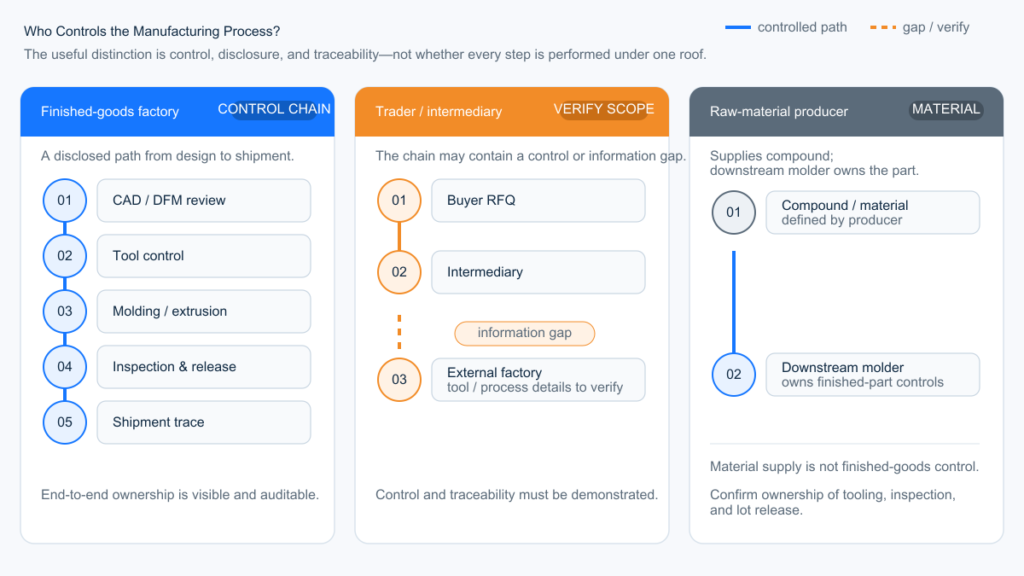
For a custom OEM project, it means a supplier that controls the relevant production process, discloses where the tool and production cell are located, and can trace the compound lot to the shipped batch. Some qualified manufacturers use approved toolmakers or subcontracted secondary operations; the issue is disclosure and control, not whether every step sits under one roof.
Three different businesses hide under the same search term:
| Entity | What they actually sell | When they fit | Walk-away signal |
|---|---|---|---|
| Finished-goods factory | Molded, extruded, or overmolded parts; owns or runs the tool | Custom OEM / ODM work | Cannot name press type, process, or mold location |
| Trader / catalog reseller | Sourcing and logistics; production sits somewhere else | Standard SKUs, small trial buys | Production site differs from the approved sample source and no controlled transfer or requalification plan is provided |
| Raw-material producer | Gum, LSR, fluids, additives | You already have a molder | They cannot quote a finished consumer or industrial part |
The ambiguity stays hidden because the word “manufacturer” is easy to put in a title. It becomes visible when you need a cavity change, a hardness adjustment, or a second color and the contact cannot reach the tool room. By then, the approved first article may not represent the production cell.
Ask which process and press family will run the part, where the mold will be stored, who owns and maintains it, and what happens if production is transferred. If tooling or secondary work is outsourced, require the supplier to disclose the site and remain accountable for validation, change control, and traceability. Factory-audit questions belong on how to inspect silicone product factories.
How to Choose a Silicone Manufacturer by Process Fit
Choose the factory by the process your part can actually run — not by the material name on the quote.
When we review an RFQ, we start with the 3D geometry, critical tolerances, insert or bonding details, annual volume, and validation requirements. We do not select HCR or LSR from the product category alone, and we do not treat the more automated route as the default.
The main silicone manufacturing processes are not interchangeable. HCR and LSR are not two grades of the same shop capability. They lock different equipment, different tool construction, and different labor content. Extrusion is a third system. A compression shop quoting an LSR thin-wall seal is not “close enough.”
| Part condition | Starting process | Factory must have | Wrong-shop failure |
|---|---|---|---|
| Simple molded kitchen, baby, or promotional parts; uncertain volume | HCR compression | Compression presses, charge control, trimming discipline | Paying LSR tooling for a part that will never use the automation |
| Thin walls, fine seals, small features, stable volume | LSR injection / LIM | A/B metering, precision tools, flash control | Compression flash on every shot; operators trimming what the tool should have stopped |
| Plastic or metal overmold | LSR injection, after bond method is defined | Insert loading, mold-temp control, bond or interlock method | A hand sample that looks bonded and later peels after heat or flex |
| Tubing, strip, cord, profile, sheet | HCR extrusion or calendering | Die, continuous cure, cutting / joining | A molder quoting a molded workaround for a continuous profile |
| Large, simple industrial gasket or pad | HCR compression | Charge placement control, acceptable parting-line plan | An LSR quote whose tool cost never pays back |
LSR is often treated as a quality upgrade when it is actually a production system. Its cost is justified by thin sections, cavity-to-cavity dosing, and volume—not by making a spatula safer or a gasket more “medical.” If the drawing is still moving, a lower-cost HCR compression tool can be useful for checking overall geometry, assembly fit, handling, and basic functional assumptions before production LSR steel is locked. Record the material and process differences: an HCR prototype does not validate LSR filling, gate location, cold-runner or cavity balance, flash behavior, automated demolding, cycle time, or final LSR shrinkage. Those conditions must be confirmed on the production-intent LSR tool and process. If the geometry needs liquid silicone rubber flow and the annual volume is stable, do not force it into compression to save the mold invoice.
Ask the factory to name the route on the quotation: compression, transfer, HCR injection, LIM, extrusion. If that line is blank, the price is not a process quote. It is a guess.

What Evidence Should You Require Before Tooling?
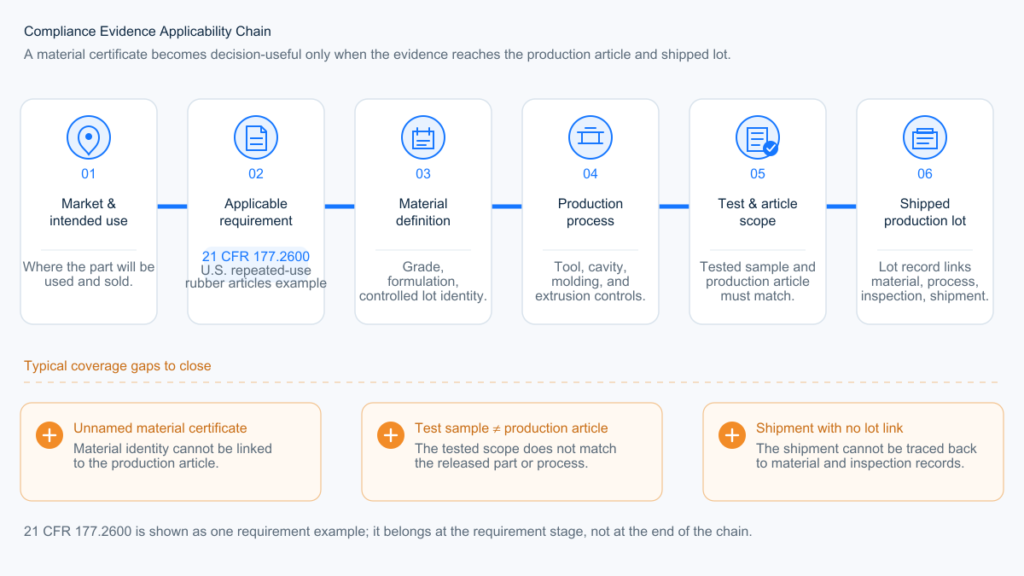
Start with the destination market, product use, and failure risk. Then build an evidence chain that connects the applicable requirement to the production article and shipped lot. Do not begin with a supplier’s certificate and work backward to invent coverage.
In our LSR programs, we keep the material declaration, supplier batch traceability, and applicable third-party report scope as separate records. A material COA can support the chain, but we do not use it as finished-product approval.
The same framework applies to food-contact, children’s, medical, electrical, automotive, and general industrial parts. The regulation or customer specification changes; the evidence logic does not.
| Evidence layer | What to verify | Usable evidence | Coverage gap |
|---|---|---|---|
| 1. Applicable requirement | Destination market, product category, intended contact or exposure, and customer specification | Named regulation, standard, drawing note, or contractual requirement with its applicable scope | “FDA,” “medical grade,” “RoHS,” or “food safe” used with no identified requirement or use condition |
| 2. Material definition | Supplier, grade, cure system, hardness, pigment, additives, and any primer, ink, insert, or coating that remains in the product | Controlled material specification, supplier declaration, TDS / SDS where relevant, and formulation or color reference | A report for an unnamed base compound reused across different colors, additives, or bonded assemblies with no assessment |
| 3. Process scope | Molding or extrusion route, cure and post-cure, washing, printing, bonding, overmolding, and outsourced operations | Released process route and records showing which operations the evidence covers | The tested material and the production article follow materially different processing paths |
| 4. Test and article scope | Specimen or finished article, test method, conditions, laboratory, report date, and acceptance criteria | Report or documented rationale showing why the tested configuration applies to the production article | A certificate title is relevant, but the sample, method, exposure, or configuration does not match the claim |
| 5. Traceability and change control | Connection from material lot through the work order, tool, process, inspection, packaging, and shipment | Lot records plus a defined review path when material, color, process, site, tool, or sub-supplier changes | The supplier cannot connect the report and material declaration to the shipped production lot |
No single document proves every layer. ISO 9001 describes a quality-management system. BSCI addresses social compliance. A material COA describes a supplied lot. A product test report covers the sample and conditions named in that report. Treating any one of them as universal product approval creates a scope gap.
US Food-Contact Example
For a repeated-use silicone rubber article sold for food contact in the United States, 21 CFR 177.2600 is one applicable starting point. It addresses permitted constituents and extractives conditions for rubber articles. It is not an FDA endorsement of a factory, and it does not make every product described as food-grade silicone compliant by name.
Apply the five-layer framework: identify the intended food contact and use conditions; define the compound, pigment, and cure system; record cure and post-cure; confirm what article and conditions the report covers; then connect that evidence to the production lot. Finished-article or supplemental testing is needed when the regulation, customer requirement, existing report scope, or risk assessment calls for it.
A separate full test for every color is not a universal FDA rule. Review pigment chemistry, concentration, existing report coverage, and the size of the change. The result may be document review, a supplier declaration, targeted supplemental testing, or a new finished-article test. Use how to verify whether a silicone supplier uses real food-grade material for the detailed supplier-verification path. Treat cure-system selection as a separate material and process decision.
How Should You Score a Silicone Manufacturer?
Use a weighted scorecard only after the project requirements are fixed. It helps compare qualified candidates; it cannot turn a process mismatch or missing legal requirement into an acceptable supplier.
Rate each criterion from 0 to 5 using the same evidence standard for every supplier:
- 5 — Demonstrated: Project-specific capability is fully supported by applicable records, reports, drawings, or a released control plan; no material closure action remains
- 4 — Substantially demonstrated: The project-specific evidence is mostly complete; only a minor, low-risk item remains, with an owner and due date
- 3 — Conditionally acceptable: Capability appears suitable, but one meaningful documentation, validation, or control-ownership gap must be closed before award
- 2 — Partially supported: The proposed route may work, but multiple material gaps or unverified assumptions prevent qualification
- 1 — Claimed only: The supplier gives a generic capability statement with little project-specific evidence
- 0 — Unacceptable: Capability mismatch, refusal to disclose a required control, unmet hard gate, or no usable evidence
Calculate weighted points as (rating ÷ 5) × weight. Use integer ratings and record the evidence or open action behind every score. This is a suggested procurement framework, not an industry certification standard; adjust the weights and thresholds before scoring if the project risk requires it.
| Qualification criterion | Weight | Evidence to request | 0-point condition |
|---|---|---|---|
| Process fit and DFM | 25 | Named molding route; press family; DFM notes covering parting line, gate, venting, flash, shrinkage, post-cure, and critical tolerances | The proposed process cannot hold the geometry, tolerance, volume, or overmolding requirement |
| Quality and measurement control | 20 | First-article format; measurement method; control plan; defect limits; nonconformance and corrective-action workflow | No defined way to inspect the drawing’s critical dimensions or functional features |
| Compliance and traceability | 15 | Applicable report scope; compound and pigment declarations; cure conditions; lot traceability; documented change assessment | An applicable legal or customer requirement is unmet, or the production lot cannot be linked to the material lot |
| Tool control and change management | 15 | Tool ownership; storage site; cavity identification; maintenance records; engineering-change approval; transfer and requalification terms | The supplier will not disclose where the tool or production cell is located or who controls a transfer |
| Commercial completeness | 10 | Separate tooling, material, molding, trimming, post-cure, inspection, packaging, and freight assumptions; MOQ rationale | One-line price with material, process, inspection, and secondary operations undefined |
| Capacity and supply continuity | 10 | Planned press and cavities; realistic utilization; bottleneck operation; backup equipment or recovery plan; lead-time assumptions | The supplier cannot explain how the forecast volume will fit the nominated production cell |
| Project communication and revision control | 5 | Named project owner; drawing revision control; response and escalation path; written approval records | Quotations, drawings, and samples are issued with no controlled revision reference |
| Total score | Decision | Required next step |
|---|---|---|
| 80–100 | Qualified shortlist | Proceed to audit, sample, or pilot-lot validation |
| 65–79 | Conditional shortlist | Close named documentation or control gaps before tooling |
| Below 65 | Do not award tooling | Replace the supplier or restart technical qualification |

A high total does not override a hard gate. Reject or pause the award if the process route is unsuitable, an applicable compliance requirement is unmet, material traceability is absent, or production and tool-control terms are withheld. Do not allow communication, low price, or a polished factory presentation to compensate for those gaps.
What Must Be Approved Before Mass Production?
An approved sample is not the same as an approved production process. Before release, connect the drawing revision, first-article results, measurement method, material lots, production cell, and packaging record into one controlled approval package.
These are contractual production controls, not universal legal requirements. Their depth should match the part’s function, market, and failure risk.
Separate T1, FAI, and Pilot-Lot Approval
These are three different gates. Do not use one label for all three.
| Stage | What it proves | Required output | What it does not prove |
|---|---|---|---|
| T1 tool trial | Whether the identified tool can fill, vent, cure, demold, and produce usable parts; it exposes flash, shrinkage, cavity-balance, and tooling issues | Trial samples, tool and process record, preliminary dimensional results by cavity, and a correction list | Routine production approval. T1 parts may still come from adjusted settings or a tool that requires correction |
| First Article Inspection (FAI) | Whether parts from the identified tool, material, process, and cavity meet the released drawing and agreed functional and cosmetic requirements | Ballooned drawing, dimensional and functional results, cavity identity, material and process references, measurement method, and written disposition of deviations | Stable output at production quantity, validated capacity, or packaging performance |
| Pilot-lot approval | Whether the nominated production cell can repeat the approved result using production-intent material, operators, cycle conditions, post-cure, inspection, and packaging | Lot record, yield and defect data, rework, cavity balance, inspection results, traceability, and packaging output | Permission to ignore open deviations or make uncontrolled changes after release |
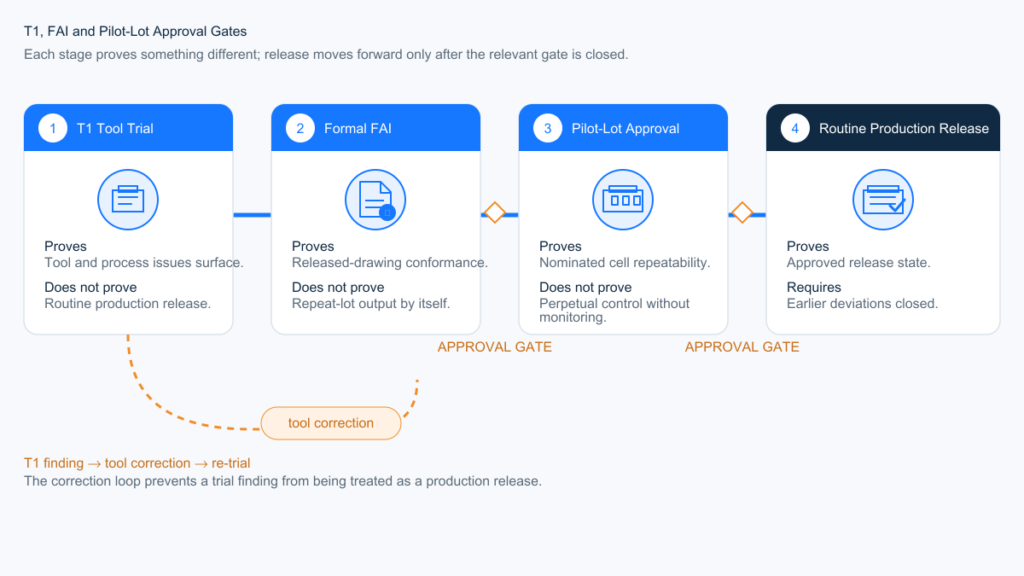
T1 samples may be used for FAI only when the production-intent tool, released drawing, material, process, cavity identification, conditioning, sampling plan, and measurement method already meet the FAI requirements. Otherwise, complete the tool corrections first and run the formal FAI afterward.
| Control | Minimum record | Approval condition | What triggers reapproval |
|---|---|---|---|
| Change control | Released drawing, specification, BOM, material grade, color reference, process route, production site, tool and cavity list, plus a written supplier-change request workflow | No defined change is implemented until its effect on function, dimensions, compliance, cost, and lead time is reviewed and dispositioned in writing | Material source or grade, pigment system, cure chemistry, tool or cavity, press or process route, production site, subcontractor, post-cure, cleaning, inspection, or packaging change when relevant |
| First Article Inspection (FAI) | Report tied to the released drawing revision; agreed samples from every production cavity; ballooned characteristics; functional and cosmetic results; material and process records | Results meet the drawing and approved defect limits, or every deviation has a written concession before production release | New or modified tool, added cavity, major repair, production transfer, material or process change, or a corrective action that can affect fit, form, or function |
| Measurement system | Datum scheme, fixture, contact force where relevant, conditioning time, measurement temperature, instrument, calibration status, and measurement-system analysis for critical characteristics when justified | Buyer and supplier agree how each critical feature will be measured before sample approval; results are taken after the specified cure, post-cure, and conditioning stage | Gauge, fixture, software, datum, operator method, inspection site, or conditioning method changes |
| Lot traceability | Raw compound and pigment lots, mixing or metering batch, work order, press and tool, cavity where required, cure and post-cure record, inspection result, packaging lot, and shipment reference | A shipped carton can be traced backward to its production and material records, and an affected material or process lot can be traced forward to the shipped cartons | Material, labeling, batching, production-site, subcontractor, ERP, or packaging-record changes |
| Mass-production approval | Released drawing and specifications, approved FAI, applicable compliance file, signed sample or visual standard, control plan, defect criteria, packaging approval, and pilot-lot record from the nominated production cell | The pilot lot uses production-intent material, tool, process, post-cure, inspection, and packaging; all open deviations have an owner and written disposition | Any approved change that can affect fit, form, function, compliance, appearance, traceability, or validated capacity |
FAI Must Represent the Production Process
The FAI should not come from a hand-adjusted sample route that will disappear after approval. For a multi-cavity tool, results must retain cavity identity. For a post-cured part, dimensions and functional tests must be taken at the agreed stage after post-cure and conditioning. Silicone can deform under probe force, so the inspection report is incomplete if it lists numbers but not the fixture, datum, and measurement method.
For our LSR tools, we agree the T1 sampling level and critical characteristics before tool release, then issue the dimensional report by cavity against the released drawing revision. This is where an unspecified measurement method becomes visible: two acceptable parts can produce different numbers under different fixtures or probe forces.
A golden sample remains useful for color, texture, flash, gate vestige, and other visual limits. It does not replace dimensional FAI, functional testing, or a controlled defect standard. For a separate release checklist, use how to evaluate sample quality before mass production.
Define Which Changes Require Notification
Do not use “no process changes” as a vague purchase-order sentence. Name the controlled inputs. At minimum, review changes to the compound, pigment, cure system, molding route, tool or cavity, nominated press, production site, post-cure, inspection method, and any outsourced operation.
Not every change requires a full repeat of every test. The change assessment should decide whether the response is document-only review, partial reinspection, new FAI, supplemental compliance testing, pilot-lot approval, or full requalification.
Release a Pilot Lot Before Routine Production
The pilot lot is the bridge between a successful sample and routine output. It should run on the nominated production cell with production-intent material, operators, cycle conditions, post-cure, inspection, and packaging. Record actual yield, defects, rework, cavity balance, inspection results, and packaging output rather than extrapolating from the first sample.
Do not release routine mass production while the drawing revision, FAI deviations, measurement method, compliance scope, or packaging standard remains unresolved. A signed sample cannot close those gaps by itself.
Cost, MOQ, and Lead Time Thresholds
Do not choose a factory by the lowest unit price on a one-line quotation. Choose by which costs become irreversible once the tool is cut.
When we quote an LSR project, tooling, cavitation, and cycle-time assumptions come from the 3D file and annual volume. If the volume or design stability does not justify injection tooling, we compare compression rather than forcing the project into the higher-tooling route.
| Decision | What it locks | Threshold |
|---|---|---|
| Process route | Press, labor, flash, automation | Name the route before comparing price |
| Tool architecture | Cavity count, cold runner, insert hardware | Split tooling from piece price on the quote |
| Annual volume | Whether LSR automation or HCR flexibility wins | Quote at a realistic annual volume, not one trial PO |
| Color count | Changeover, purge, extra evidence | Each new color needs press-change planning and a documented review of whether existing compliance evidence still applies |
| Post-cure / wash / 100% trim | Days and labor that never appear in “cycle time” | If those lines are missing, the lead time is incomplete |
| MOQ | How the factory recovers setup and color change | MOQ must match your real replenishment, not a catalog default |
A factory can quote a low piece price by hiding steel, inserts, trimming, post-cure, or first-article inspection. That is not a cheaper manufacturer. It is an incomplete manufacturer quote. The gap shows up after sample approval, when the first production lot needs more labor than the sample cell used.
Do not invent a “standard MOQ.” Compression and LIM recover setup differently. A one-cavity HCR tool and an eight-cavity LSR tool do not share the same economic floor. If the factory cannot explain what the MOQ is recovering — material, color change, press time, or packaging — the number is a sales default.
Lead time is a sequence, not a slogan. DFM and design-file quality decide when tool design can start, and production-intent tool fabrication comes before T1. T1 then identifies tool and process changes. Formal FAI should be completed against the released drawing after the required cure, post-cure, and conditioning; a pilot lot from the nominated production cell follows once open deviations are closed. Routine production is released only after that approval. If a prototype or soft tool is used first, the quotation and validation plan should identify it separately because its samples do not replace FAI from production-intent tooling. Exact timing moves with cavity count, steel type, and how complete the design files are. A factory that quotes “15 days” with no drawing review is selling a calendar, not a plan.
When Should You Walk Away From a Quote?
Walk away when the factory cannot make the process, the evidence, or the tool ownership explicit.
Treat these as hard stops unless they are resolved in writing before tooling:
- The quote does not name compression, LIM, extrusion, or another specific route.
- The supplier cannot show why an applicable compliance or customer-specification file covers the production formulation, process, article, and intended use.
- The supplier will not disclose the mold location, ownership, maintenance responsibility, or transfer rights.
- The production site differs from the approved sample source and there is no controlled transfer, validation, or requalification plan.
- Critical tolerances look like rigid-plastic numbers with no measurement method.
- The price is far below the other process-named quotes and the factory cannot explain which cost was removed.
An acceptable sample often delays the decision to walk away, even though it proves only that one defined sample condition worked. It does not show that the same controls will hold across unattended production, tool wear, pigment-lot changes, and repeated setups. Flash, odor, color, and dimensional drift need records and approval criteria; appearance alone cannot control them.
If you are already past first article and quality is sliding, reopen the supplier qualification record and require evidence against the released process and approval criteria. Do not turn this page into a detective story.
Should You Choose a US Factory or an Overseas Factory?
Choose by program risk, not by a country slogan.
A US plant can reduce timezone friction, inbound freight time, and the cost of frequent on-site iteration. If a US-based shortlist is required, use this directory of silicone manufacturers and suppliers to identify candidates, then apply the same process, evidence, and tool-control gates described above. An overseas custom plant can also be the rational economic choice for custom industrial silicone parts and other defined OEM programs. Neither location has an automatic cost or quality advantage. Compare landed cost, tooling, tariffs, validation effort, engineering-change speed, capacity, and supply-continuity risk.
Country labels are often used as a shortcut for quality, but origin does not replace process fit. A US trader is still a trader. An overseas factory that controls the process, discloses the production and tool locations, and supports the applicable evidence can still be the right manufacturer. Origin trust, import mechanics, and US launch paperwork are separate decisions from factory qualification.
If the program is a short, high-change engineering build with heavy on-site iteration, local manufacturing can be worth the premium. If the program is a stable consumer or industrial OEM part with a defined drawing, the better question is still: who runs the process and what file covers the article?
What Information Is Needed Before a Quote?
A factory cannot choose a process, a tool, or a real price from a product photo. Send this before you ask anyone to bid:
- STEP model plus a 2D drawing with critical dimensions, cosmetic zones, and parting-line preference
- Annual volume, first PO quantity, and expected program life
- Hardness, color count, transparency, and any insert or overmold material
- Use conditions: temperature, food / skin / fluid contact, compression, expected cycles
- Destination-market and customer requirements; for example, 21 CFR 177.2600 for an applicable US repeated-use food-contact article
- Whether dimensions are inspected before or after post-cure
- Packaging, labeling, and lot-traceability requirements
If those inputs are missing, every manufacturer will invent a different part and you will compare invented quotes. Use the checklist above to structure the RFQ. The drawing standard lives on design files for custom silicone parts.
The decision boundary is narrow. Use this page to screen the factory. Use process pages to pick HCR or LSR. Use compliance pages to define the evidence plan. Do not award tooling until the route, evidence scope, production site, and tool-location and transfer terms are recorded in the quotation or supply agreement.
Have a defined project? Send the STEP file, 2D drawing, annual volume, material requirements, and destination market through our RFQ form. We will identify the proposed process route, open technical questions, and the assumptions behind tooling and unit pricing before you commit.