Silicone is often described as lightweight, waterproof, and hydrophobic. Those terms are easy to mix up. Typical solid silicone density is about 1.05–1.60 g/cm³, so most unfoamed silicone parts sink in water. Hydrophobicity helps water bead on the surface, but it does not make every silicone design leakproof or impermeable.
For product design, three separate questions matter: the compound density, the complete part’s average density, and the way water interacts with the surface and seal geometry.
What Is the Typical Silicone Density?
The density of a cured silicone rubber compound is its mass divided by its volume. It is normally reported in g/cm³, kg/m³, or as specific gravity.
For many solid HCR compounds and LSR compounds, a practical starting range is 1.05–1.60 g/cm³. WACKER reports this range for silicone rubber and notes that additional inactive fillers such as quartz can raise density to about 1.75 g/cm³. Individual specialty compounds can fall outside this range, so the approved material data sheet remains the controlling value.
| Silicone material or construction | Practical density range | Buoyancy tendency in fresh water | Main reason for variation |
|---|---|---|---|
| General-purpose solid silicone rubber | 1.05–1.30 g/cm³ | Usually sinks | Polymer, reinforcing silica, pigment and additives |
| Highly filled silicone compound | 1.30–1.75+ g/cm³ | Sinks | Quartz, metal oxide or other high-density filler |
| Fluorosilicone or specialty compound | Grade-specific | Usually sinks | Different polymer and filler package |
| Silicone foam or sponge | Often below 1.0 g/cm³ | May float | Closed or open cellular structure |
| Hollow molded silicone part | Depends on total mass and displaced volume | May float | Trapped air lowers the part’s average density |
These are design ranges, not incoming-inspection limits. For purchasing and quality control, specify the density shown on the approved TDS and define the test method.
Are Density and Specific Gravity the Same?
They are closely related but not identical.
Density is mass per unit volume. Specific gravity is the ratio of a material’s density to the density of water at a defined temperature. Because water is close to 1.00 g/cm³, the numerical values are often similar when density is expressed in g/cm³.
A silicone compound with a density of 1.20 g/cm³ therefore has a specific gravity close to 1.20 under ordinary test conditions.
For solid silicone parts, common measurement methods include:
- ASTM D792 for density and specific gravity by displacement
- ISO 1183-1 Method A for immersion measurement
- ASTM D297 methods used for rubber products and compounds
The method, specimen condition, temperature, and presence of trapped bubbles affect the result. Comparing supplier data without checking the method can create a false difference.
Does Silicone Float in Water?
Most solid, unfoamed silicone rubber sinks because its density is higher than the density of fresh water.
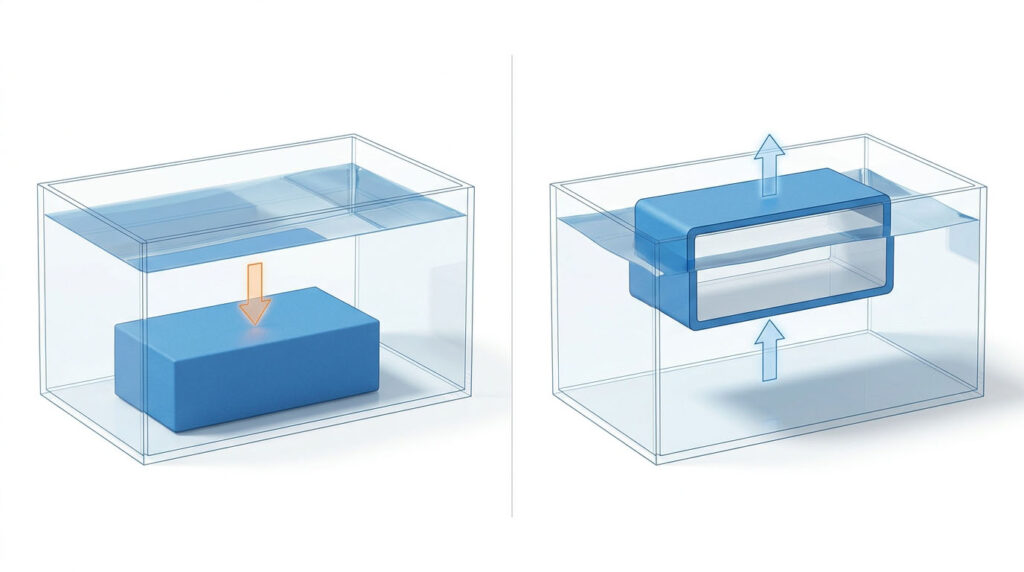
The basic condition is:
- If average part density is below 1.00 g/cm³, the part can float in fresh water.
- If average part density is above 1.00 g/cm³, the part sinks unless its geometry traps enough air.
- In salt water, the liquid density is higher, so the same part receives slightly more buoyant force.
SIMTEC reports a typical LSR density of 1.10–1.50 g/cm³ and notes that solid LSR therefore sinks. The important word is solid. A hollow bath toy, sealed float, or overmolded assembly may float even when its silicone skin is denser than water.
Solid silicone example
A solid silicone component has:
- Volume: 100 cm³
- Compound density: 1.20 g/cm³
- Mass: 100 × 1.20 = 120 g
When fully submerged, it displaces about 100 g of fresh water. The part weighs more than the displaced water, so it sinks.
Hollow silicone example
Assume a sealed part weighs 70 g and displaces 150 cm³ of water based on its external volume.
Average part density = 70 ÷ 150 = 0.47 g/cm³
The sealed air cavity lowers the density of the complete assembly below that of water, so the part can float. If the cavity leaks and fills with water, that advantage disappears.
How Much Does a Silicone Part Weigh?
Use the finished compound density, not a generic silicone value.
Mass = volume × density
For dimensions in millimeters:
Mass (g) = volume (mm³) ÷ 1,000 × density (g/cm³)
A rectangular silicone pad measuring 100 × 50 × 5 mm has a volume of 25,000 mm³, or 25 cm³. At 1.20 g/cm³, the estimated mass is:
25 × 1.20 = 30 g
| Input | Example value | Procurement risk if assumed |
|---|---|---|
| Net molded volume | 25 cm³ | CAD volume may exclude ribs, gates or inserts |
| Compound density | 1.20 g/cm³ | A substituted formulation changes piece weight |
| Estimated part mass | 30 g | Packaging and freight estimates can drift across large orders |
| Order quantity | 100,000 pieces | A 2 g error becomes 200 kg across the shipment |
This calculation is useful for quotation and packaging estimates. Final piece-weight limits should come from validated samples because flash, insert weight, pigment, filler loading, and molding variation remain in the finished part.
What Changes Silicone Density?
Silicone density is formulation-dependent. It is not controlled by polymer name alone.
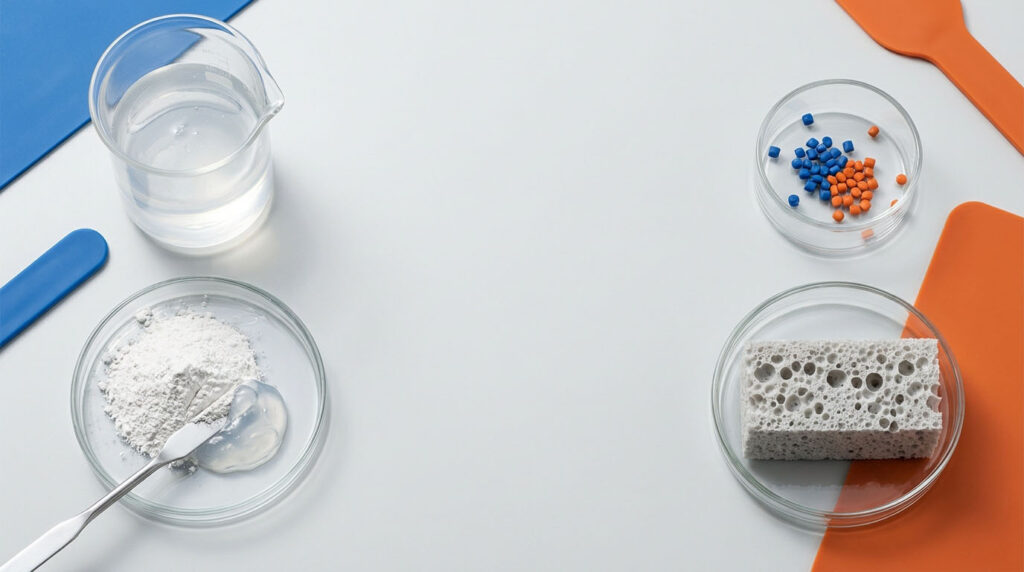
Reinforcing and inactive fillers
Fumed or precipitated silica reinforces the polymer. Quartz and other mineral fillers can raise density further. A compounder may use fillers to adjust hardness, tear strength, rheology, electrical behavior, swelling resistance, or cost. The same Shore A hardness can therefore be reached with different formulation packages and different densities.
Pigments and functional additives
Color masterbatch usually causes a smaller change than heavy filler loading, but the effect is measurable when part-weight tolerances are narrow. Flame-retardant, thermally conductive, electrically conductive, or radiopaque additives can change density substantially.
Air, voids, and cellular structure
Foamed silicone contains gas cells and may have a bulk density below 1.00 g/cm³. Unintended voids can also reduce the measured density of a specimen, but that is a defect signal rather than a valid route to lightweighting.
Cure and process control
Cure condition normally has less influence on density than formulation, but mixing errors, incorrect A:B ratio for LSR, contamination, or trapped air can shift measured values. Density is therefore useful as a fast screening check, not as proof that every mechanical or compliance property is correct.
Is Silicone Hydrophobic?
Untreated PDMS-based silicone is inherently hydrophobic because methyl groups orient at its low-energy surface. Water tends to bead instead of spreading on a silicone sheet.

A commonly reported water contact angle for untreated PDMS is around 100–120°. Published measurements vary with formulation, surface roughness, cleanliness, droplet method, and conditioning. A contact angle above 90° generally indicates hydrophobic wetting behavior.
Hydrophobicity describes the surface interaction with a water droplet. It does not describe the complete behavior of a molded product.
| Property | What it measures | What it does not prove |
|---|---|---|
| Water contact angle | Surface wettability | Leak resistance of an assembly |
| Water absorption | Mass gained after defined exposure | Surface beading behavior |
| Water-vapor permeability | Moisture transport through material | Resistance to liquid-water leakage at a joint |
| IP rating | Enclosure protection under a defined test | Universal performance at every pressure and duration |
Surface treatment also changes the result. Oxygen plasma or corona treatment can temporarily make PDMS more hydrophilic to improve bonding, coating, or microfluidic wetting. Silicone surfaces can then undergo hydrophobic recovery over time. Bonding trials should therefore define the allowed time between treatment and adhesive application.
Is Silicone Waterproof?
A continuous silicone component is generally resistant to liquid water, but “waterproof” is a system claim rather than a raw-material property.
A molded gasket can still leak when:
- compression is too low or uneven;
- the parting line crosses the sealing surface;
- flash, knit lines, dust, or surface damage create a leakage path;
- compression set reduces sealing force over repeated heat cycles;
- the housing deflects under pressure;
- the joint design relies on adhesive that does not wet untreated silicone;
- the enclosure is tested at a pressure or duration outside its design boundary.
Teams often overestimate hydrophobicity because visible water beading looks like proof of sealing performance. In production, the leak path is usually at the interface, not through the center of a sound silicone section.
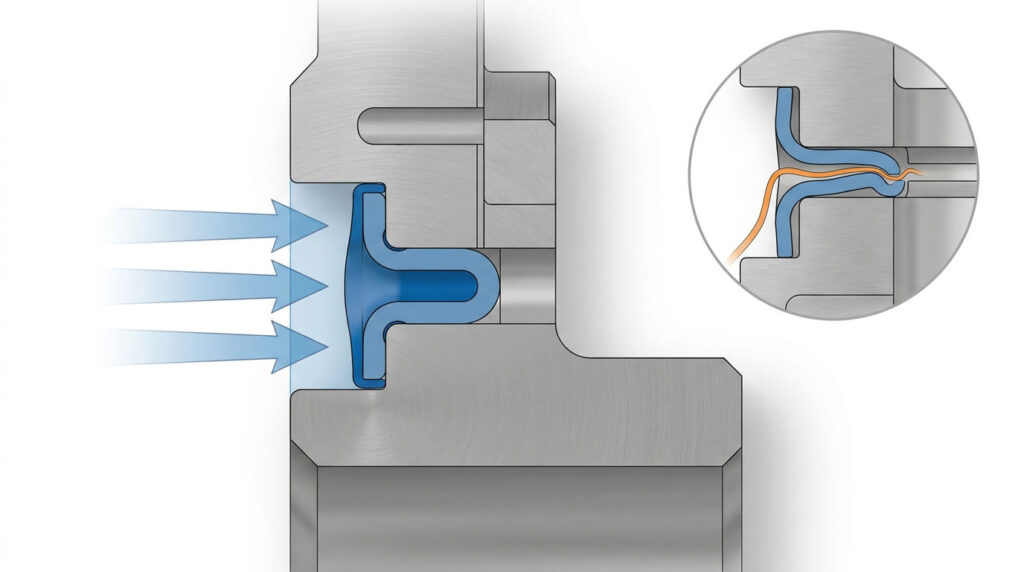
For an enclosure, define the actual requirement: splash exposure, continuous immersion, hydrostatic pressure, steam, salt water, cleaning chemicals, or an IP test. These conditions are not interchangeable.
How Much Water Does Silicone Absorb?
Silicone rubber generally has low water uptake, but a universal value such as “below 0.5%” should not be applied to every compound.
Published databases contain a wide spread because they combine dense rubber, foam, specialty formulations, different specimen thicknesses, and different exposure conditions. Water absorption must therefore be tied to a grade and a method such as ASTM D570 or ISO 62, with the duration and temperature stated.
For a real specification, request:
- the tested grade and cure condition;
- specimen thickness;
- immersion time and water temperature;
- percentage mass change;
- dimensional change, if tight tolerances matter;
- electrical or mechanical property retention after conditioning.
Low water absorption also does not mean zero water-vapor transmission. Silicone has relatively high gas and vapor permeability compared with many dense organic elastomers. This is useful for breathable membranes but can be a limitation in moisture-barrier packaging or sensor enclosures.
How Should Buyers Specify Silicone Density?
Use density as one controlled property inside a complete material specification.
| Specification item | Practical requirement |
|---|---|
| Material grade | Supplier and exact compound code |
| Cure system | Platinum, peroxide, or grade-specific system |
| Density or specific gravity | Nominal value and tolerance from approved TDS |
| Test method | ASTM D792, ASTM D297, or ISO 1183-1 |
| Test condition | Temperature, specimen condition and cure state |
| Part-weight tolerance | Defined separately from material density |
| Water requirement | Absorption, immersion, pressure, vapor transmission, or IP test |
| Change control | No formulation or filler substitution without approval |
Do not use density alone to accept a silicone compound. Two materials can have the same density while differing in tensile strength, tear resistance, compression set, post-cure requirement, extractables, and regulatory status.
Frequently Asked Questions
Does food-grade silicone float?
Food-contact status does not determine buoyancy. Most solid food-contact silicone parts sink because their density is above 1.00 g/cm³. A hollow or foamed design may float.
Is silicone heavier than water?
Most solid silicone rubber is heavier per unit volume than fresh water. Typical compound density is approximately 1.05–1.60 g/cm³, while fresh water is close to 1.00 g/cm³.
Does a higher Shore hardness mean higher density?
Not necessarily. Hardness and density both depend on formulation, but there is no universal conversion between them. Use the compound TDS for each value.
The Design Boundary
For weight calculations, provide the finished CAD volume, insert weight, approved compound density, and piece-weight tolerance. For flotation, provide the complete assembly mass, external displaced volume, cavity sealing method, and service liquid. For water resistance, define pressure, time, temperature, joint geometry, and the applicable test.
Without those inputs, “silicone floats” and “silicone is waterproof” are material generalizations, not production specifications.