Buyers spec “silicone” and assume the cure system is a detail we sort out in the back. With peroxide cure, that assumption is where the trouble starts — not on day one, but three weeks later when parts come back smelling wrong or failing a migration test.
Peroxide vulcanization (typically DCBP-type initiators) is the low-cost route to vulcanized solid silicone. For the right parts it works well. But it behaves differently in production than platinum cure, and those differences surface as odor, color, and post-processing time — costs that are easy to miss at the quote stage.
Executive Summary
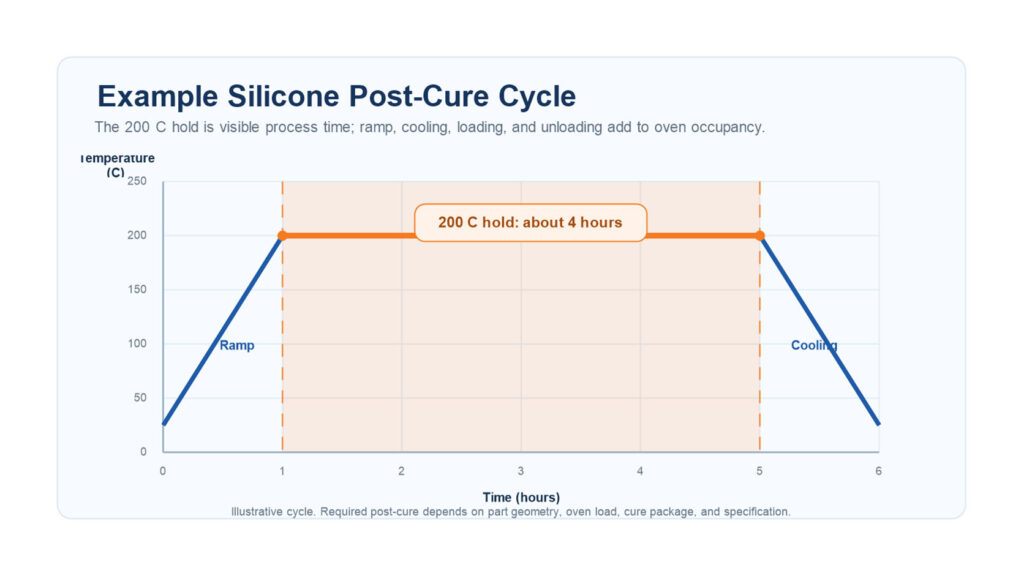
- Peroxide cure leaves reaction by-products that carry odor; without proper post-curing (typically 200°C for ~4 hours), that odor stays in the part.
- It is a cost-driven choice for industrial and general-purpose parts, not food-contact or high-clarity work.
- The real cost of peroxide cure is not the catalyst — it’s the oven time and scrap you add downstream to make the part acceptable.
How Peroxide Vulcanization Behaves in Production
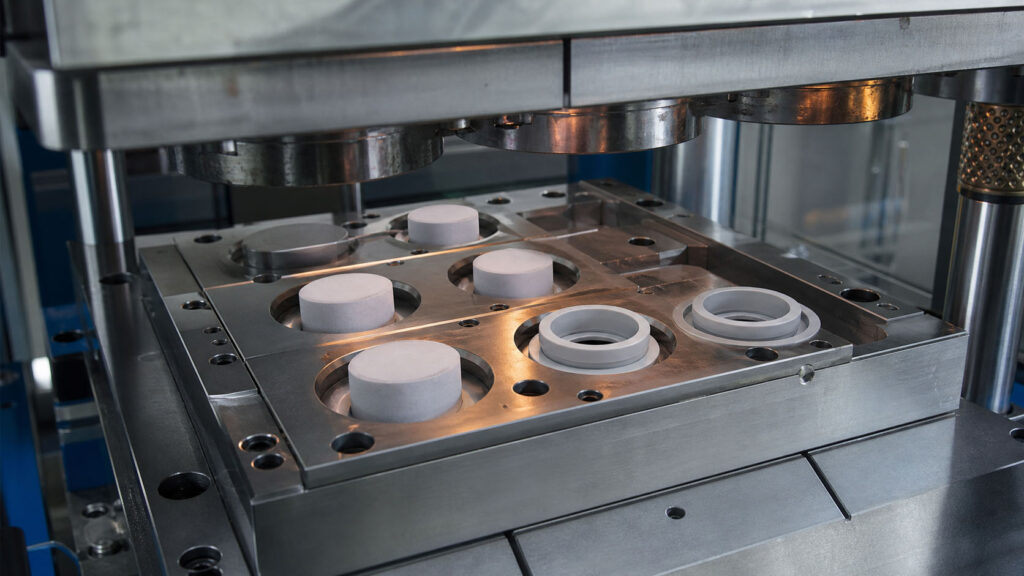
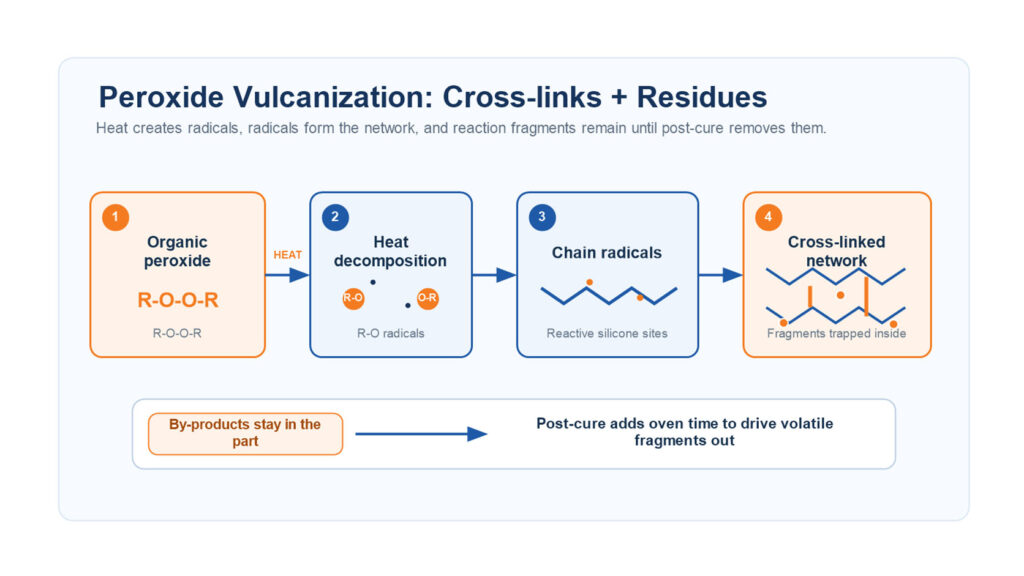
Peroxide vulcanization cross-links solid silicone (HTV) by decomposing the peroxide under heat, usually during compression or extrusion molding. The reaction is straightforward, but it does not finish clean:
- By-products stay in the part. Decomposition leaves acidic residues and volatile fragments in the rubber. They don’t vanish when the mold opens.
- Odor is the visible symptom. The “silicone smell” buyers complain about is usually peroxide residue, not the polymer itself.
- Color runs less stable. Peroxide-cured stock trends toward lower clarity and yellows more readily than platinum-cured material.
Detection point: the smell test at demold is not enough. Residuals off-gas slowly, so a part that seems fine on the bench can still fail after it’s sealed in retail packaging.
Why Post-Curing Is Not Optional Here
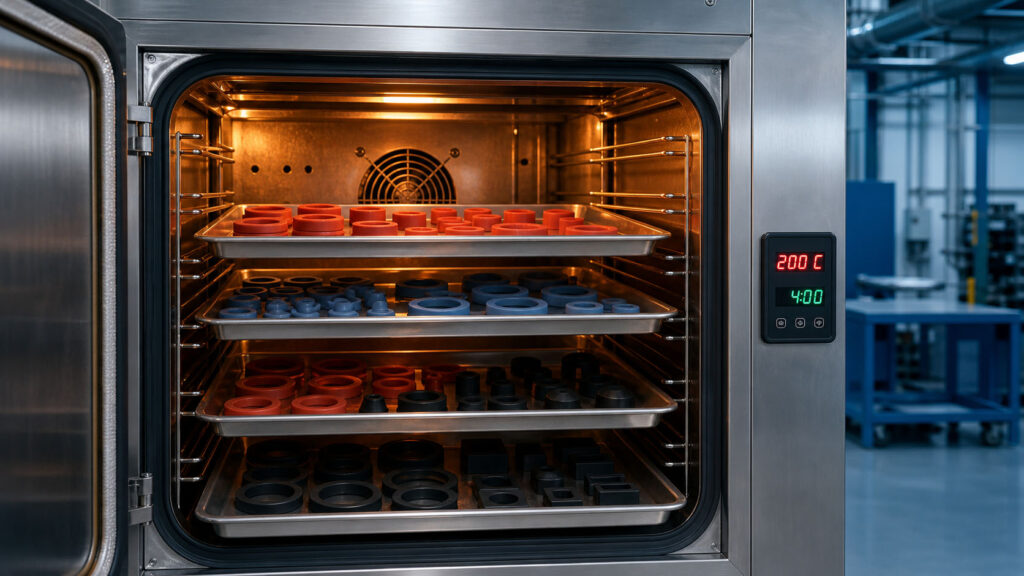
This is where teams underestimate peroxide cure. They treat molding as the finish line, but for peroxide-cured parts molding is only the first cure.
Post-curing (second-stage bake, commonly ~200°C for ~4 hours, longer for thick sections) drives off residuals and stabilizes properties. Shortcut it and you get:
- Persistent odor complaints after shipment
- Higher extractables — a problem the moment the part goes near a mouth, food, or skin
- Property drift as residuals slowly leave the part in the field
The oven time is real cost and real lead time. It’s the part of peroxide cure that never shows up in the raw-material price and gets forgotten in the quote. See Silicone Products Post Cure for the process detail.
Where Peroxide Cure Is the Right Call
Peroxide is not a downgrade — it’s the correct, cost-efficient choice for a defined set of parts:
| Fits peroxide cure | Why |
|---|---|
| Industrial O-rings and seals | Odor and clarity don’t matter; cost does |
| General gaskets and sheet | High volume, low spec sensitivity |
| Everyday non-contact parts | Post-cure removes enough residual for the use case |
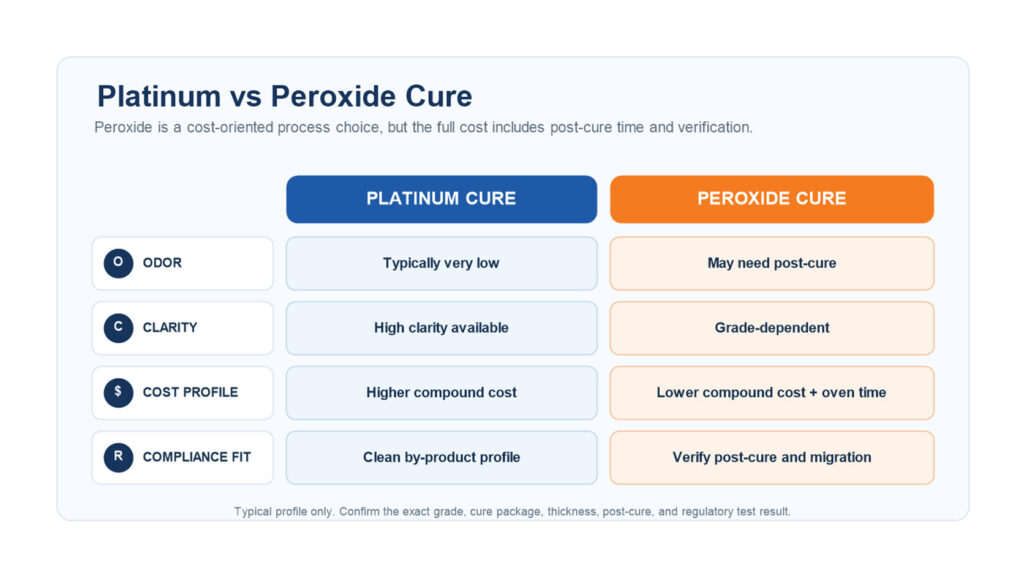
What it is not for: food-contact, medical, baby products, or anything needing clarity and no odor. Those move to Platinum Vulcanization, and that’s a different decision — covered in our platinum-vs-peroxide selection guide.
What to Confirm Before You Commit
Peroxide cure fits when the part tolerates trace residual, some odor risk, and average clarity — and when you’ve budgeted the post-cure oven time, not just the material. If the part touches food, skin, or the body, or needs high transparency, stop here: that’s a platinum-cure conversation, and the cost math changes.
For the definition and full method overview, see What Is Silicone Vulcanization.
References
- 2,4-Dichlorobenzoyl peroxide (DCBP), CID 61078 — PubChem, U.S. National Institutes of Health.
- Plastic materials and articles in contact with food — Regulation (EU) 10/2011 — EUR-Lex, European Union.
- Cross-linkage — Encyclopaedia Britannica.
- Premarket Submissions for Food Contact Substances (Chemistry / migration testing) — U.S. FDA guidance.