Most “properties of silicone” articles read like an encyclopedia entry — Si-O backbone, a paragraph on flexibility, a paragraph on heat resistance, done. That doesn’t help when you have to sign off on a tooling quote or write a finished-part spec sheet.
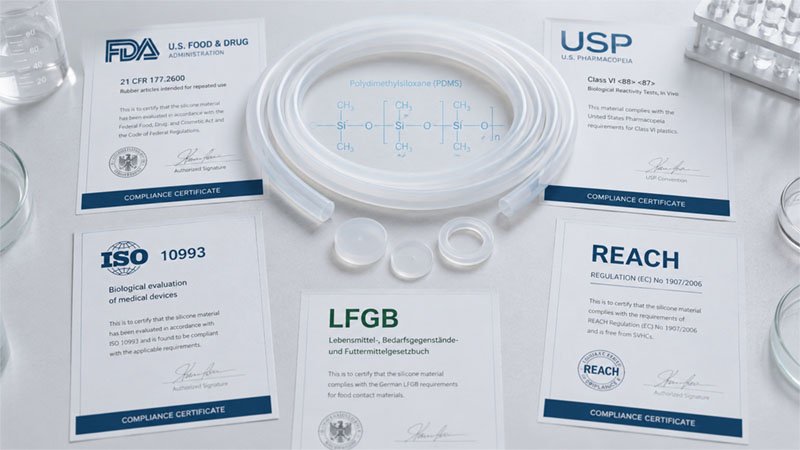
Silicone rubber is a synthetic elastomer with a Si-O-Si backbone, operating continuously from −60 °C to +230 °C, available in Shore A 10–80, electrically insulating up to ~25 kV/mm, and chemically inert to most polar media. Real-world performance is bounded by formulation grade (HTV vs LSR), cure system (peroxide vs platinum), and compliance certification (FDA 21 CFR 177.2600, LFGB §30/§31, USP Class VI, ISO 10993).
This is the property reference I hand to engineers and procurement leads before we discuss tooling. It clarifies what is catalog-spec, what is grade-dependent, and what shifts in production.
1. Physical Properties
1.1 Density and Weight
Silicone density sits at 1.10–1.25 g/cm³, mostly driven by filler loading (fumed or precipitated silica). Higher filler load improves tensile strength but reduces transparency and elongation. Silicone does not float.
| Material | Density (g/cm³) |
|---|---|
| EPDM | 0.86–0.90 |
| Natural rubber | 0.91–0.93 |
| Silicone rubber | 1.10–1.25 |
| PVC | 1.20–1.55 |
| Fluorosilicone (FVMQ) | 1.40–1.60 |
That matters for shipping cost on bulky parts (mats, sheets, oven liners) and for buoyancy-sensitive uses. For material-by-material context see Silicone VS Plastic, PVC vs Silicone, and Silicone VS Rubber.
1.2 Color and Transparency
Base silicone gum is translucent. Platinum-cured grades stay water-clear; peroxide-cured grades tend toward yellow-white because of trace catalyst residues. Pigment is mixed in at the mill or compounding stage, not added later.
Color stability under UV and heat depends on pigment selection, not on silicone itself. Iron-oxide-pigmented parts shift tone after 1,000+ hours of outdoor exposure; cadmium-based pigments fail RoHS and REACH outright.
1.3 Hardness (Shore A)
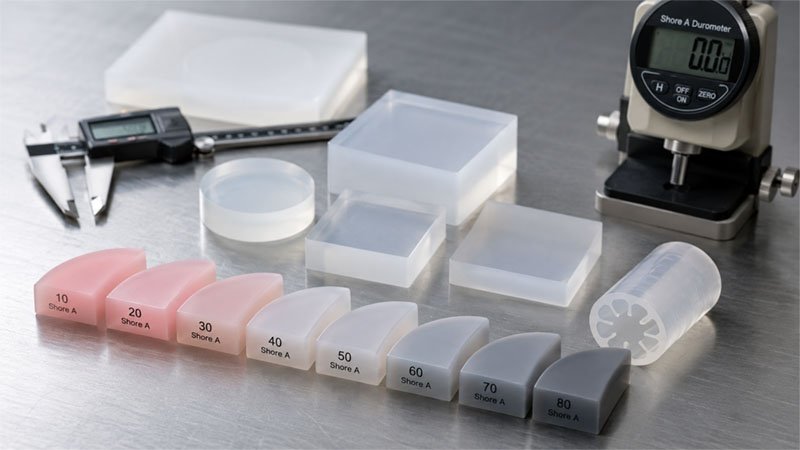
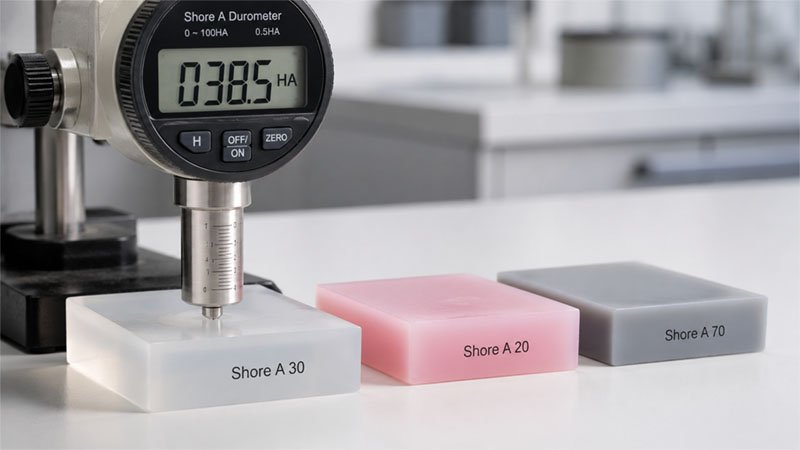
Shore A is the single most-misordered property in silicone sourcing.
| Shore A | Feel | Typical use |
|---|---|---|
| 10–20 | Gel-like | Skin-contact wearables, prosthetic liners |
| 20–30 | Soft, baby-safe | Pacifiers, teethers, menstrual cups |
| 30–50 | Standard “soft” | Seals, gaskets, swim caps |
| 50–70 | Firm | Spatula handles, keypads, baking molds |
| 70–80 | Rigid | Industrial seals, structural parts |
Hardness is measured per ASTM D2240 with a 1-second indenter dwell. ISO 48-4 dwell rules give different numbers. Call out the test method on the PO, or you will receive parts 5–8 Shore points off target and have no recourse.
For how hardness drives sealing performance, tactile feel, and abrasion life, see Silicone Shore A Hardness: Effects on Feel, Sealing, and Durability and Why is Silicone Shore Hardness Important.
and for detailed Silicone Physical Properties Spec Sheet
2. Mechanical Properties
2.1 Tensile Strength and Elongation
General-purpose silicone runs 4.5–10 MPa tensile and 200–800% elongation at break under ASTM D412 / ISO 37. High-tear grades push tensile to 10–12 MPa.
Compared to EPDM (15–20 MPa) or natural rubber (20–30 MPa), silicone is mechanically weak. Silicone is not chosen for tensile load. It is chosen for temperature window, biocompatibility, and recovery.
When a buyer asks “how much weight can silicone hold,” the answer is always: it depends on geometry, not on silicone itself. See How Much Weight Can Silicone Hold for the geometry math.
2.2 Tear Resistance
Tear strength: 9–55 kN/m under ASTM D624 Die B. Liquid Silicone Rubber (LSR) tears more cleanly than HTV because platinum cure produces a denser crosslink network. This is why medical balloons, baby pacifier nipples, and menstrual cups are almost always LSR.
2.3 Compression Set
Compression set under ASTM D395 (22 hr at 175 °C) lands at 5–30%. Lower is better — it tells you how much a gasket fails to bounce back after long compression.
Platinum-cured silicone hits 8–15%. Peroxide-cured grades sit at 20–30% before secondary post-curing, dropping to ~15% after a 4-hour post-cure at 200 °C. You pay for that in cycle time and energy cost.
3. Thermal Properties
3.1 Operating Temperature Range
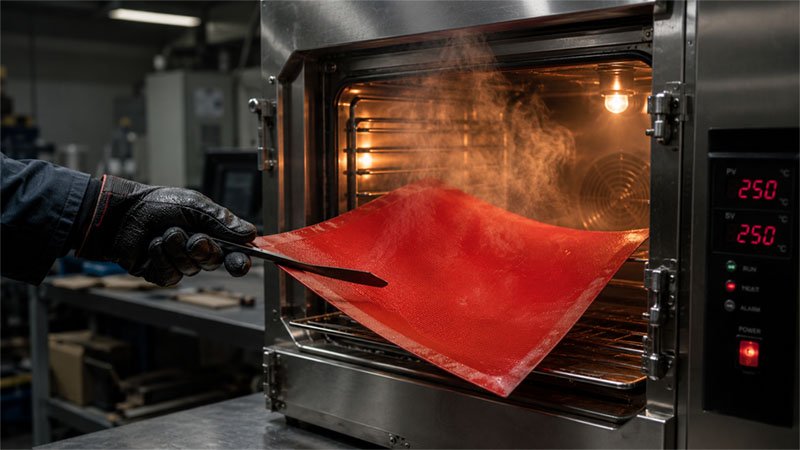
The catalog answer: −60 °C to +230 °C continuous. Iron-oxide-stabilized grades extend short-term resistance to 300 °C.
The factory-floor answer: silicone doesn’t fail catastrophically at the upper limit — it hardens, loses elongation, and develops surface crazing. Run a baking mat continuously at 230 °C and compression set climbs after 6–8 weeks. Customer complaints surface at the 3-month mark, not on day one.
For decomposition behavior see Silicone’s Melting Temperature Marvel — silicone does not melt; it decomposes back to inorganic silica at roughly 350–400 °C.
3.2 Thermal Conductivity
0.18–0.30 W/m·K for unfilled silicone. Thermally-conductive grades (loaded with boron nitride, alumina, or zinc oxide) reach 1.5–3.0 W/m·K — used in LED gap pads and EV battery thermal interface materials.
Standard silicone is a thermal insulator, comparable to wood. That is why a silicone oven mitt works — and why you cannot use unfilled silicone as a heatsink. Details in Silicone’s Thermal Conductivity.
3.3 Flammability
Standard silicone carries a UL94 V-1 rating. Flame-retardant compounds with platinum or hydrate fillers reach V-0. When silicone does burn, it leaves a non-conductive silica ash, which is why silicone cable jackets are specified for high-rise building emergency circuits and marine wiring. See Is Silicone Flammable.
4. Electrical Properties
Silicone is one of the few elastomers that holds dielectric performance across the full operating temperature range.
| Property | Typical range | Test method |
|---|---|---|
| Volume resistivity | 10¹⁴–10¹⁶ Ω·cm | ASTM D257 |
| Dielectric strength | 17–25 kV/mm | ASTM D149 |
| Dielectric constant (1 MHz) | 2.8–3.5 | ASTM D150 |
| Arc resistance | >120 sec | ASTM D495 |
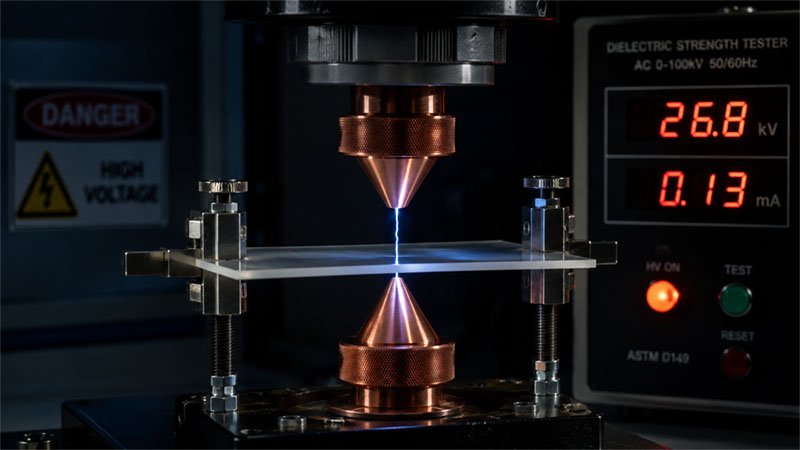
The practical point: PVC insulation softens past 90 °C, while silicone holds dielectric strength to 200 °C+. For thickness-to-voltage selection see Silicone Sheets Dielectric Strength and Ratings and Silicone Sheets Electrical Insulation Layer Thickness Options.
Carbon- or silver-loaded conductive silicone inverts this range entirely — surface resistivity drops to 10⁰–10² Ω/sq. That is a different materialits with its own spec envelope; see conductive silicone properties and Conductive vs Non-Conductive Silicone Keypads.
5. Chemical Properties
5.1 Inertness and Resistance
Silicone is chemically stable against:
- Dilute acids and alkalis
- Polar solvents (water, alcohols, glycerin)
- Oxygen and ozone — unusual for elastomers
- Most foodstuffs and biological fluids
Silicone swells or degrades in:
- Non-polar solvents (gasoline, toluene, mineral oils) — 20–60% volume swell
- Concentrated acids (HCl, H₂SO₄)
- Saturated steam above 150 °C for extended dwell (Si-O backbone hydrolysis)
Swell from short solvent exposure is reversible. Long-term oil contact kills silicone seals in automotive engine bays — specify fluorosilicone (FVMQ) there. Reference: Silicone Strips Chemical Resistance Properties.
5.2 Hydrophobicity
Surface water contact angle: 100–110°. Silicone repels water without coating, which is why silicone is the default release agent on concrete forms and why silicone gaskets seal without added sealant.
5.3 Weathering — UV, Ozone, Oxidation
Silicone retains 80–90% of mechanical properties after 5 years outdoor exposure under accelerated ASTM G155 xenon-arc testing. Natural rubber cracks visibly in 6–12 months outdoor.
This is not full immunity. Carbon-black-filled black silicone holds up better than colored grades; clear silicone yellows visibly after 18–24 months in direct sun. See Is Silicone UV Resistant and Silicone Strips UV and Weather Resistance.
Long-term landfill decomposition is in the 50–500 year range. See How Long Does Silicone Take to Decompose.
6. Biological and Compliance Properties
This is where most specs go wrong. “Food grade” and “medical grade” are not interchangeable, and “silicone-safe” is not a regulatory term.
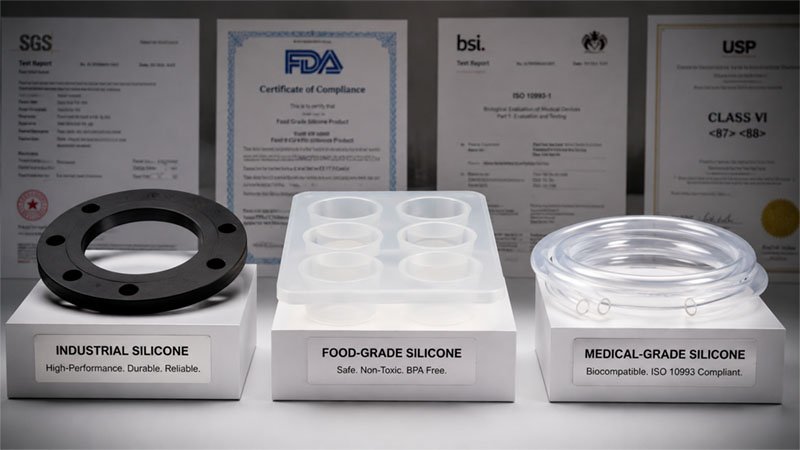
| Compliance tier | Standard | Typical use | Cost premium |
|---|---|---|---|
| Industrial | None required | Seals, gaskets, mats | baseline |
| Food contact (US) | FDA 21 CFR 177.2600 | Bakeware, food storage | +5–10% |
| Food contact (EU) | LFGB §30 / §31 | EU import bakeware, baby bottles | +20–30% |
| Skin contact | ISO 10993-5, -10 | Wearables, prosthetics | +25–40% |
| Medical implant | USP Class VI, full ISO 10993 panel | Catheters, implants | +50–200% |
A grade labeled “medical” is not automatically food-safe — different migration solvents, different leaching tests. See Food-Grade vs Medical-Grade Silicone and Food Grade Silicone.
For skin-contact or biofluid-contact products, biocompatibility must be re-validated on the finished part, not just on the raw material. Pigments, mold release, and post-cure handling all break compliance. Reference: silicone biocompatibility and ISO 10993 testing.
Silicone is also non-sensitizing for most users — see Is Silicone Hypoallergenic.
7. How Properties Shift by Cure System and Grade
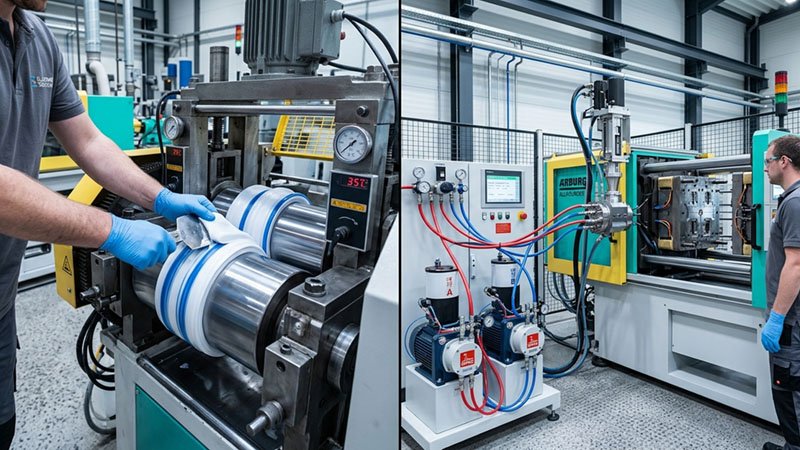
Two formulation decisions lock in roughly 80% of the property envelope before tooling cuts steel:
| Variable | HTV (Solid silicone) | LSR (Liquid silicone) |
|---|---|---|
| Default cure system | Peroxide (platinum optional) | Platinum only |
| Hardness range | 20–80 Shore A | 5–70 Shore A |
| Tear strength | Lower | Higher |
| Compression set | 15–25% (after post-cure) | 8–15% |
| Achievable tolerance | ±0.05–0.10 mm | ±0.02–0.05 mm |
| Tooling cost | Low | High (cold runner) |
| Cycle time | 3–8 min | 30–90 sec |
| Best fit | Low/mid volume, simple geometry | High volume, medical, baby, micro parts |
If the cure system is not specified on the PO, the default is peroxide HTV — cheaper, but with residual cure byproducts that affect taste, smell, and color stability. For anything skin-contact, baby, or medical, demand platinum cure in writing. See LSR vs HTV Silicone Rubber, Curing vs Vulcanization in Silicone, and Silicone Vulcanization: What Engineers Get Wrong.
8. Quick Lookup — All Properties at a Glance
| Property | Typical range | Test standard |
|---|---|---|
| Density | 1.10–1.25 g/cm³ | ASTM D792 |
| Shore A hardness | 10–80 | ASTM D2240 |
| Tensile strength | 4.5–12 MPa | ASTM D412 |
| Elongation at break | 200–800% | ASTM D412 |
| Tear strength | 9–55 kN/m | ASTM D624 Die B |
| Compression set | 8–30% | ASTM D395 |
| Operating temperature | −60 to +230 °C | — |
| Thermal conductivity | 0.18–0.30 W/m·K | ASTM C177 |
| Dielectric strength | 17–25 kV/mm | ASTM D149 |
| Volume resistivity | 10¹⁴–10¹⁶ Ω·cm | ASTM D257 |
| Flame rating | UL94 V-1 (V-0 with FR additive) | UL94 |
| Water contact angle | 100–110° | — |
Silicone property radar chart comparing silicone, EPDM, natural rubber, PVC, and fluorosilicone across hardness, temperature range, dielectric, chemical resistance, and cost
FAQ
Is silicone toxic?
No. Cured silicone is chemically inert and certified for food and medical contact under FDA 21 CFR 177.2600, LFGB §30/§31, and ISO 10993 when properly compounded and post-cured. Uncured silicone and peroxide cure byproducts should not be inhaled in the workshop.
Does silicone melt?
No. Silicone has no melting point. Above ~350 °C it decomposes into silica (SiO₂), a fine white ash. That is why silicone is usable in fire-rated wiring and high-temperature gaskets.
What is the difference between silicon and silicone?
Silicon is the element (Si). Silicone is a polymer with a Si-O-Si backbone and methyl or vinyl side groups. See Silicon vs Silicone.
How long does silicone last?
20+ years indoor, 5–10 years outdoor under direct UV depending on grade. Landfill decomposition is 50–500 years.
What This Pillar Does Not Cover
This is the property reference, not the sourcing playbook. Three boundaries to read before treating any number above as fixed:
- Property numbers are formulation-dependent. Every spec range shifts by ±20% depending on grade, filler load, and cure system. Always request the supplier’s actual TDS for the specific grade quoted.
- Test method matters more than the number. A Shore A 50 part measured at 1-second dwell is not the same as one measured at 15-second dwell. ASTM D2240 vs ISO 48-4 will produce different values on the same part. Lock the method on the spec sheet.
- Compliance documentation expires. FDA, LFGB, and USP test certificates are valid for a specific batch of raw material, not for the finished part indefinitely. Re-test on grade change, supplier change, or pigment change.
Before sending an inquiry to any silicone factory, decide on five inputs:
- Continuous operating temperature (not peak)
- Shore A target with declared test method
- Compliance scope — which standard, which contact mode
- Cure system — platinum or peroxide
- Tolerance class — consumer, industrial, or medical
Without those five, any quote you receive is a guess, and any TDS line item is unverifiable.
This pillar lives next to a broader reference. If you want the full picture — what silicone actually is at the chemistry level, how it’s manufactured, and where it sits in the elastomer family — read the Complete Silicone Material Guide. Use that as the upstream context; use this page as the property lookup.