People outside manufacturing use “silicon” and “silicone” interchangeably all the time—this silicon vs silicone mix-up is one of the most common sourcing mistakes we see.
Inside sourcing and production, that mistake creates real problems.
We still see RFQs asking for “silicon rubber gaskets.” Sometimes the drawing says silicon. The material spec says silicone. Then the purchasing team sends the request to an electronics supplier instead of a rubber molder.
The names are similar. The materials are not.
If you are sourcing molded parts, sealants, medical tubing, electronics components, or thermal materials, you need to separate these two materials immediately.
This article explains the practical difference between silicon and silicone, where each material is actually used, and how to avoid specification mistakes during procurement.
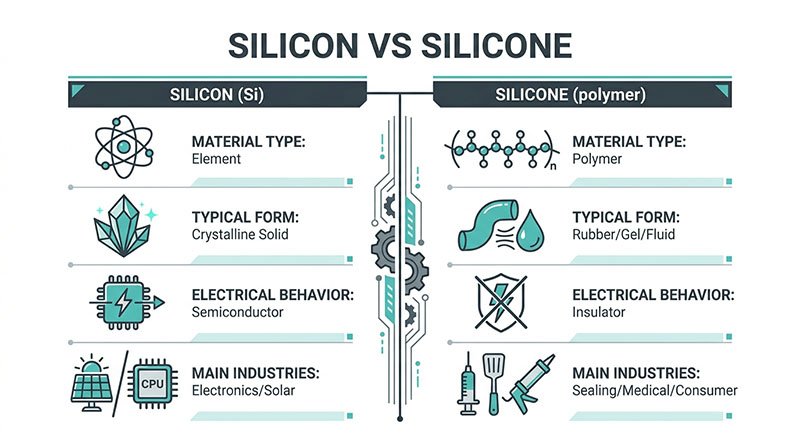
Quick Difference Between Silicon and Silicone
| Material | Silicon | Silicone |
|---|---|---|
| Material type | Chemical element | Synthetic polymer |
| Structure | Pure element (Si) | Siloxane polymer (Si–O–Si backbone) |
| Typical form | Hard crystalline solid | Rubber, gel, fluid, foam, resin |
| Electrical behavior | Semiconductor | Electrical insulator |
| Common industries | Electronics, solar, metallurgy | Sealing, medical, consumer, industrial rubber |
| Flexibility | Brittle | Flexible and elastic |
In most industrial purchasing situations:
- If the application involves chips, wafers, sensors, or photovoltaics, the correct term is usually silicon.
- If the application involves gaskets, tubing, molded rubber parts, sealants, or soft-touch components, the correct term is usually silicone.
That sounds simple, but confusion still happens because many consumer products are labeled incorrectly online.
What Is Silicon?
Silicon is a chemical element with the symbol Si.
It is one of the foundational materials used in modern electronics because its electrical conductivity can be controlled through doping and semiconductor processing.
In manufacturing environments, silicon is normally associated with:
- Semiconductor wafers
- Integrated circuits
- Solar cells
- Electronic sensors
- Metallurgical additives
Silicon itself is not flexible.
It is typically hard, brittle, and crystalline.
That matters because some buyers assume “silicon” refers to a soft industrial material due to the popularity of silicone bakeware, sealants, and rubber products.
It does not.
Common Silicon Applications
Semiconductor Manufacturing
This is the most recognized use.
Computer chips, memory devices, power electronics, and many industrial control systems rely on processed silicon wafers.
Solar Panels
Photovoltaic cells commonly use silicon because of its semiconductor behavior and relatively mature production infrastructure.
Metallurgy
Silicon is also added to aluminum and steel systems to modify material behavior.
This is usually far removed from silicone rubber manufacturing, but the terminology overlap still creates confusion in sourcing documentation.
What Is Silicone?
Silicone is a synthetic polymer.
Its backbone structure is built from alternating silicon and oxygen atoms.
Depending on formulation and processing method, silicone can be produced as:
- Solid rubber
- Liquid silicone rubber (LSR)
- Foam
- Gel
- Fluid
- Resin
In industrial manufacturing, silicone is primarily selected because it stays stable across a wide temperature range while remaining flexible.
That combination is difficult to maintain with many conventional elastomers.
Common Silicone Applications
Seals and Gaskets
Silicone is widely used for:
- O-rings
- Gaskets
- Membranes
- Valve components
- Environmental seals
Especially where UV exposure, outdoor aging, or elevated temperature are involved.
Medical Components
Medical-grade silicone is commonly used for:
- Tubing
- Wearable device interfaces
- Respiratory components
- Fluid handling systems
But medical suitability is not automatic.
A silicone compound only becomes appropriate for medical use after the correct formulation, processing controls, and compliance requirements are established.
Teams sometimes assume all silicone is inherently biocompatible. That assumption causes qualification delays later.
Consumer and Food Contact Products
Silicone is also common in:
- Kitchenware
- Baby products
- Appliance seals
- Flexible consumer components
Again, food-contact compliance depends on the actual compound and certification path, not the word “silicone” itself.
Why the Confusion Happens
The confusion is mostly linguistic.
“Silicon” and “silicone” differ by only two letters.
But the problem gets amplified because many online marketplaces, consumer listings, and low-detail product catalogs use the wrong term repeatedly.
After enough repetition, the incorrect naming starts appearing in:
- RFQs
- CAD notes
- Distributor listings
- Procurement documents
- Supplier emails
Once the wrong term enters the sourcing process, it tends to spread through purchasing and documentation faster than engineering teams expect.
The issue usually does not stop production immediately.
Instead, it creates smaller delays:
- Wrong supplier category
- Incorrect material assumptions
- Invalid compliance expectations
- Quotation mismatches
- Re-specification work later in approval
Those delays compound over time, especially in multi-supplier programs.
Silicon vs Silicone in Electronics
This is where many non-technical buyers become uncertain.
Both materials appear in electronics manufacturing, but they serve completely different functions.
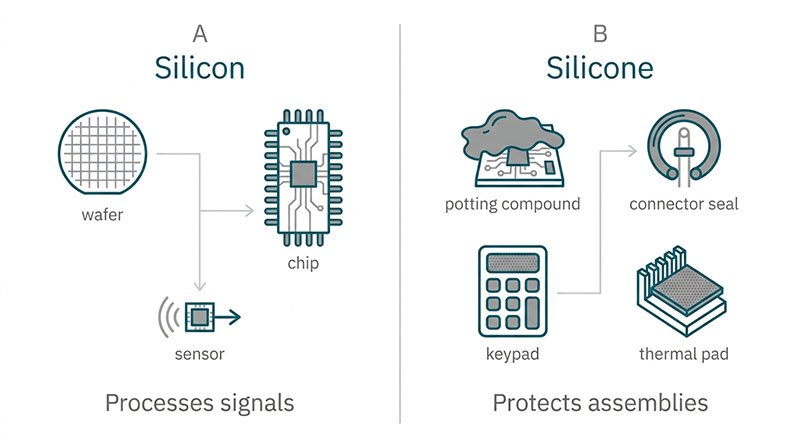
Silicon in Electronics
Silicon handles the electronic function itself.
Examples:
- Chips
- Processors
- Semiconductors
- Power devices
- Sensors
Silicone in Electronics
Silicone usually supports protection, insulation, sealing, or thermal management.
Examples:
- Silicone potting materials
- Silicone Keypads
- Connector seals
- Thermal pads
- Insulating components
- EMI gasketing systems
In other words:
- Silicon processes signals.
- Silicone protects assemblies.
That distinction helps reduce sourcing confusion quickly.
Temperature Resistance: Another Common Misunderstanding
Some buyers assume silicon and silicone are both “high-temperature materials” and therefore interchangeable in heat-related applications.
They are not.
Silicon has an extremely high melting point.
Silicone rubber, meanwhile, is valued because it remains flexible across a relatively wide service temperature range.
Those are different behaviors.
In actual production environments, silicone performance is influenced by:
- Exposure duration
- Compression state
- Chemical contact
- Cycling frequency
- Ventilation conditions
- Pigment and filler systems
A silicone part that performs well at intermittent high temperatures may age much faster under continuous compression and thermal cycling.
This is one reason lifetime expectations often become inaccurate during early material selection.
Teams frequently evaluate temperature resistance as a single number.
In production, aging behavior is usually more important than the headline temperature rating.
How Silicone Is Processed
Most silicone industrial parts are not made from raw polymer alone.
The material normally goes through compounding and conversion processes before final production.
Common silicone manufacturing methods include:
The process route affects:
- Flash control
- Tolerance stability
- Surface finish
- Production speed
- Tooling cost
- Long-term consistency
This becomes important during supplier comparison.
Two suppliers may both quote “silicone,” but the actual manufacturing stability can differ significantly depending on:
- Cure system
- Tooling quality
- Post-curing control
- Material traceability
- Process repeatability
That difference usually becomes visible only after scaling production volume.
When You Should Specify Silicone Instead of Another Rubber
Silicone is not automatically the best elastomer.
It is usually selected when the application needs some combination of:
- Wide temperature stability
- UV resistance
- Outdoor aging resistance
- Electrical insulation
- Soft-touch flexibility
- Regulatory pathways for food or medical use
But silicone also has limitations.
Compared with some other industrial rubbers, silicone may have:
- Lower tear strength
- Higher material cost
- Different fuel or oil resistance behavior
- Greater sensitivity to mechanical damage in some geometries
This is where material selection mistakes happen.
Teams often choose silicone too early because of its temperature reputation without fully evaluating the mechanical environment.
The issue usually appears later at corners, thin walls, repetitive flex points, or aggressive assembly conditions.
Practical Selection Guide
Choose Silicon When the Application Requires:
- Semiconductor functionality
- Electronic conductivity control
- Photovoltaic performance
- Wafer-based electronic systems
- Electronic sensor architecture
Choose Silicone When the Application Requires:
- Flexible sealing
- Environmental protection
- Rubber elasticity
- UV and ozone resistance
- High/low temperature elastomer performance
- Medical or food-contact elastomer pathways
- Electrical insulation
If the application involves molded rubber parts, the correct material is almost always silicone rather than silicon.
FAQs
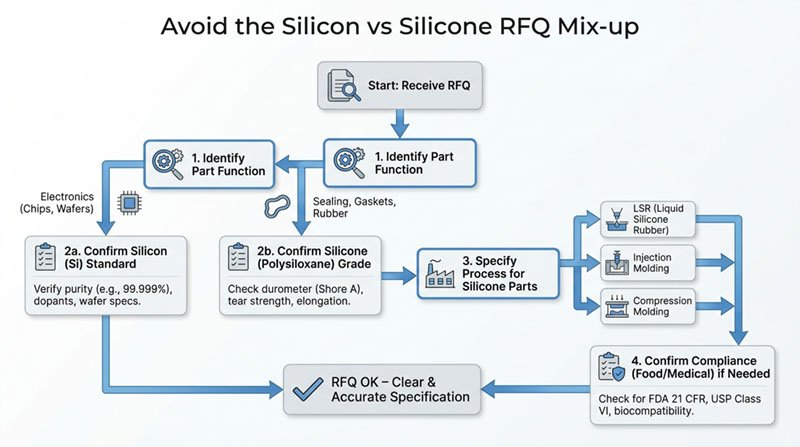
What is the fastest way to tell silicon vs silicone in an RFQ?
Look at the function:
If it’s chips, wafers, sensors, solar cells → it’s almost certainly silicon (Si).
If it’s gaskets, tubing, sealants, keypads, potting, thermal pads → it’s almost certainly silicone (polymer).
When in doubt, ask for material standard/grade (e.g., ASTM/ISO), not just the name.
Can “silicon rubber” ever be correct?
In most cases, no—buyers usually mean silicone rubber. “Silicon rubber” can appear as a wording mistake in emails or listings. To avoid misquotes, confirm whether the part is an elastomer (durometer, compression set, cure system) or an electronic/semiconductor material.
Is silicone made from silicon?
Yes. Silicone contains silicon, but it’s a different material class. Silicone is a polymer built on a Si–O–Si backbone, which is why it can be made into rubber, gels, and fluids rather than a brittle solid.
Why can both materials show up in electronics manufacturing?
Because they play different roles:
Silicon is the semiconductor that processes signals (chips, power devices, sensors).
Silicone usually protects/insulates/seals (potting, connector seals, keypads, thermal pads).
Are silica and silicone the same thing?
No. Silica (SiO₂) is a mineral (often used as a reinforcing filler). Silicone is a polymer. Many silicone rubbers contain silica filler, which is one reason the names get mixed up.
What should I specify to avoid supplier mismatch?
Beyond “silicon” or “silicone,” include:
For silicone parts: process (compression/injection/LSR), durometer, color, post-cure needs, operating temperature, media exposure, and required compliance (food/medical).
For silicon (electronics): purity/grade, wafer specs, resistivity/doping requirements, and packaging/handling constraints.
When is silicone NOT a good elastomer choice?
Silicone is great for temperature stability, UV/ozone resistance, and insulation, but it may be a weaker choice when you need:
higher tear/abrasion resistance
strong oil/fuel/solvent compatibility
lowest possible piece price
In those cases, the right rubber family (e.g., NBR/FKM/EPDM) may fit better.
Final Note
The naming confusion between silicon and silicone looks minor from the outside.
In manufacturing workflows, it is not.
Once incorrect terminology enters drawings, RFQs, or sourcing discussions, it tends to create downstream specification problems that are difficult to unwind cleanly.
The earlier the material definition becomes precise, the easier it is to control supplier alignment, compliance expectations, and production stability later.
For silicone projects, the important discussion usually starts after the word “silicone.”
The actual compound, curing system, regulatory scope, processing method, and operating environment matter far more than the base material category alone.
For broader material selection beyond this silicon vs silicone topic, visit Silicone vs Other Materials.