Most buyers spec “flame retardant silicone” the way they tick a box on a catalog sheet. They assume it is one material with one fixed behavior.
It is not. Flame retardancy is a test result tied to a specific standard, a specific sample thickness, and a specific orientation. A grade that passes a horizontal burn can fail a vertical one. A part that self-extinguishes on the bench can still exceed a rail smoke or toxicity limit and get rejected at certification.
That gap rarely shows up at sampling. It shows up months later, at homologation or during a fire audit, when the test report does not match the standard the end application actually requires. The risk here is misreading the standard, not poor compounding. This page sets out what silicone does in a fire, and where the testing boundaries sit. Fire behavior is just one slice of silicone’s broader material properties, and like the rest it shifts with grade and filler system.
Executive Summary
- Standard silicone rubber is not “non-flammable.” It is comparatively fire-safe: it tends to self-extinguish, burns to a non-conductive silica (SiO₂) ash, and releases no halogens — but base grades usually only reach UL94 HB, not V-0.
- A UL94 V-0 rating, a low smoke-density result, and EN 45545 / NFPA 130 compliance are three separate tests. Passing one does not imply the others. Rail and transit parts fail most often on smoke and toxicity, not on ignition.
- Specify the standard and the hazard level, not the word “flame retardant.” Grade, filler system, and whether you need ceramifying (circuit-integrity) silicone all follow from which certification the part must hold.
How silicone behaves in a fire
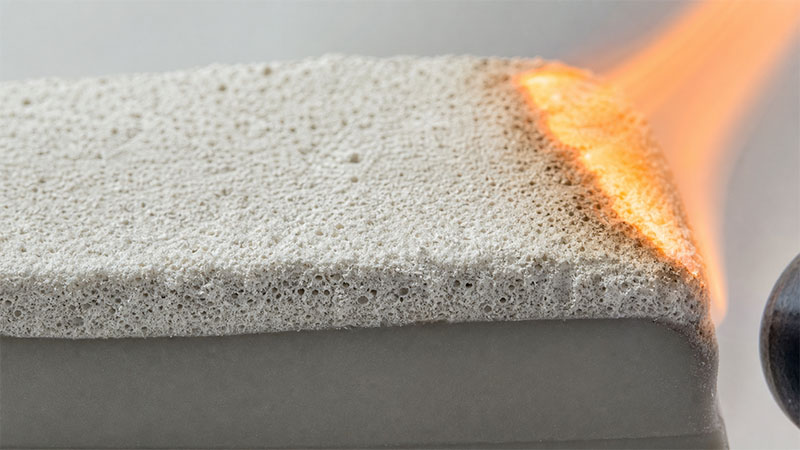
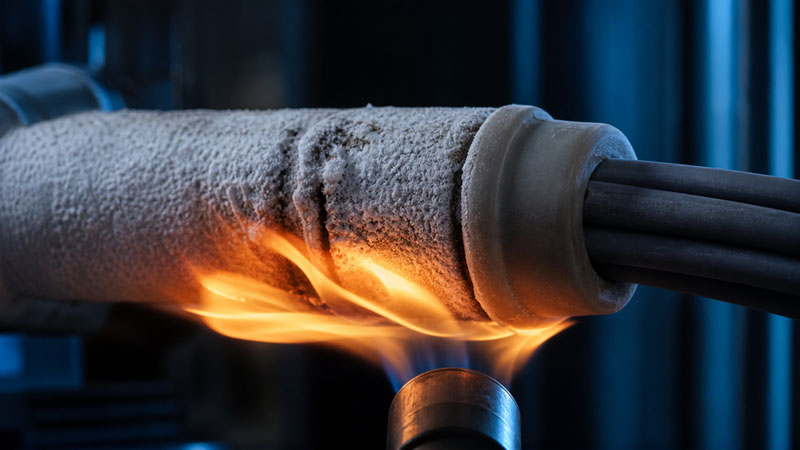
The silicone backbone is silicon-oxygen (Si-O), a high-energy bond that stays stable through the standard continuous service range of −40°C to 230°C. Under direct flame, the organic side groups (mostly methyl) oxidize first, and the backbone converts toward amorphous silica.
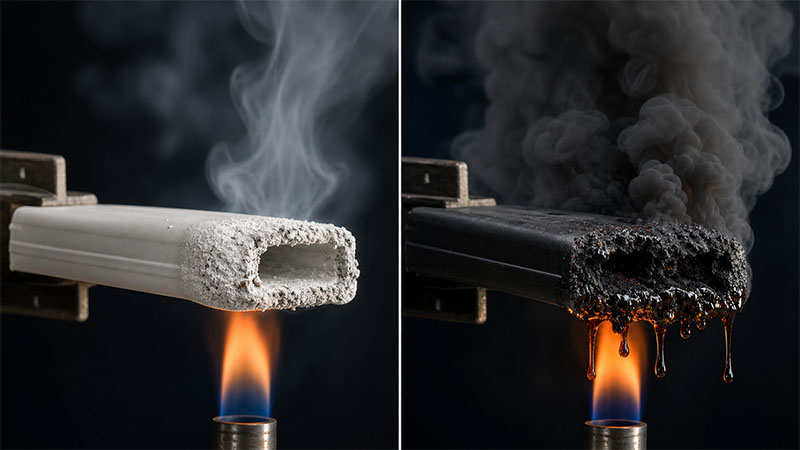
That conversion is why silicone behaves differently from thermoplastics in a fire. It does not melt and drip. It builds an insulating silica ash layer that shields the material underneath and slows further combustion. Many general-purpose grades self-extinguish once the flame source is removed.
The limiting oxygen index (LOI) reflects this. Silicone rubber typically sits in the 26–39% range depending on filler loading and FR additives, against 21% oxygen in ambient air.
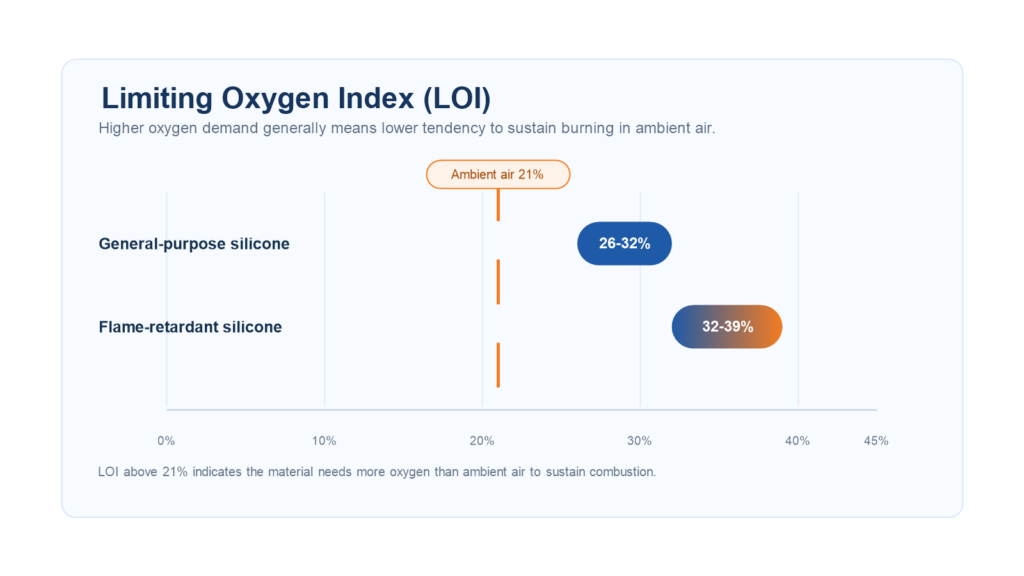
A value above 21% means the material will not readily sustain its own flame in normal air. General-purpose grades sit lower in that band; FR grades sit higher.
The judgment gap: “self-extinguishing” is not the same as “flame retardant rated.” Self-extinguishing describes observed behavior. A rating is a pass against a defined test at a defined thickness. Teams that treat the two as interchangeable get caught when a certifier asks for the report.
UL94 flame retardant ratings (HB to V-0)
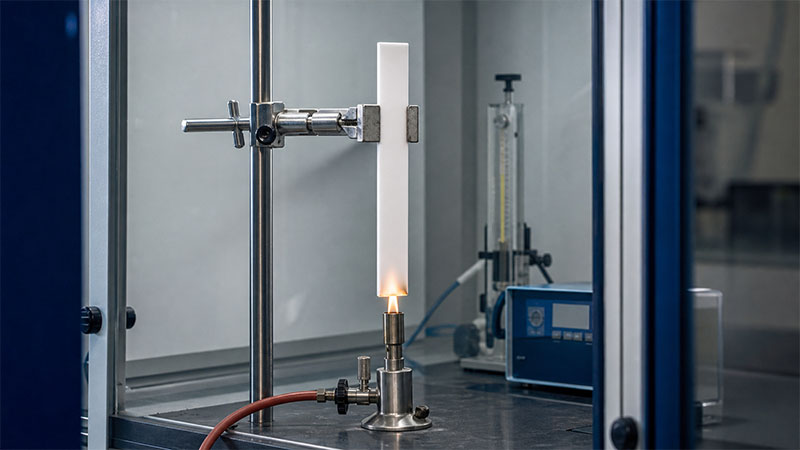
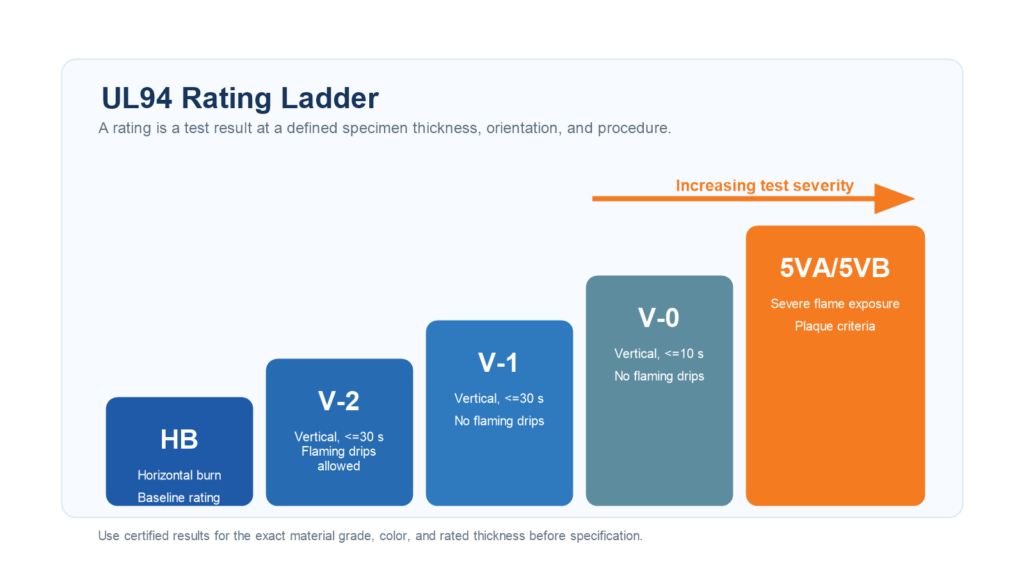
When a spec says “V-0,” it is referencing UL94, which classifies a sample by how it burns in a fixed orientation at a stated thickness.
| UL94 rating | Orientation | Pass behavior (simplified) |
|---|---|---|
| HB | Horizontal | Slow, limited burn rate. Lowest classification. |
| V-2 | Vertical | Self-extinguishes within 30s; flaming drips allowed. |
| V-1 | Vertical | Self-extinguishes within 30s; no flaming drips. |
| V-0 | Vertical | Self-extinguishes within 10s; no flaming drips. |
| 5VA / 5VB | Vertical, larger flame | Highest level; typical for enclosures. |
Base silicone often lands at HB. Reaching V-0 usually requires a dedicated FR grade — platinum cure with a tuned filler and synergist system. The rating is thickness-specific: a compound certified V-0 at 3.0mm is not automatically V-0 at 1.0mm. A spec that says “V-0” with no thickness is incomplete, and that is the single most common error we see on incoming drawings.
Two adjacent tests usually travel with UL94:
Limiting oxygen index (LOI)
ASTM D2863 / ISO 4589 measure the minimum oxygen concentration needed to keep the material burning. It is the cleanest single number for comparing FR grades, because it does not depend on part geometry the way a burn rating does.
Glow-wire testing (IEC 60695)
For electrical and electronic enclosures, IEC 60695-2-12/13 (GWFI / GWIT) matters more than UL94. It tests ignitability from a hot wire — the realistic failure mode for a keypad, connector seal, or housing near a fault current, not an open flame.
Smoke density and toxicity requirements
Ignition resistance is the part everyone tests first. It is also the part that rarely causes a rejection. In enclosed environments — tunnels, rolling stock, aircraft cabins — the controlling risk is what the material releases while it burns, not whether it ignites.
This is silicone’s structural advantage, and it is rooted in the combustion chemistry.
| Aspect | Standard silicone rubber | PVC |
|---|---|---|
| Main residue | Amorphous silica (SiO₂), insulating ash | Carbon char + molten residue |
| Acid gas | None — halogen-free | Hydrogen chloride (HCl), corrosive |
| Smoke | Low optical density | Dense black smoke |
| Behavior under flame | Non-dripping; holds shape as ash | Softens and drips |
The relevant standards here are separate from UL94:
- Smoke density: ASTM E662 (NBS smoke chamber) and ISO 5659-2 measure optical smoke (Ds).
- Halogen-free / acid gas: IEC 60754 confirms the absence of corrosive halogen gases.
- Toxicity: EN 45545-2 uses a Conventional Index of Toxicity (CIT) derived from gas analysis.
The judgment gap on this one is expensive. A grade can clear a vertical burn test cleanly and still exceed a smoke or CIT limit for an enclosed application. Halogen-free combustion is exactly why silicone displaces PVC in cabling and seals where people are confined during a fire. Buyers who optimize only for the burn rating discover the smoke and toxicity requirement late, after the FR grade is already locked.
Rail and transit certification: EN 45545 and NFPA 130
This is where “flame retardant silicone” stops being a material claim and becomes a component classification.
EN 45545-2 (European rail)
EN 45545-2 does not certify a material in isolation. It classifies a finished component by hazard level — HL1, HL2, HL3 — where HL3 is the most demanding and applies to environments like underground and tunnel operation. Requirements are grouped into requirement sets (R-numbers) keyed to the product type and where it sits in the vehicle, with limits on oxygen index, smoke density, and toxicity.
The consequence: the same silicone compound can satisfy one R-set and fail another. A material does not “have” EN 45545; the part is assessed for a stated hazard level and product category. Asking for “EN 45545 silicone” without the HL and R-set is the rail-industry equivalent of asking for V-0 without a thickness.
NFPA 130 (North American transit)
NFPA 130 governs fixed guideway transit and passenger rail. It references component-level tests — ASTM E162 for flame spread and ASTM E662 for smoke density — rather than a single material rating. A part qualified for a European HL3 line still needs its own NFPA 130 evidence for a North American project; the reports are not interchangeable.
Ceramifiable silicone and circuit integrity
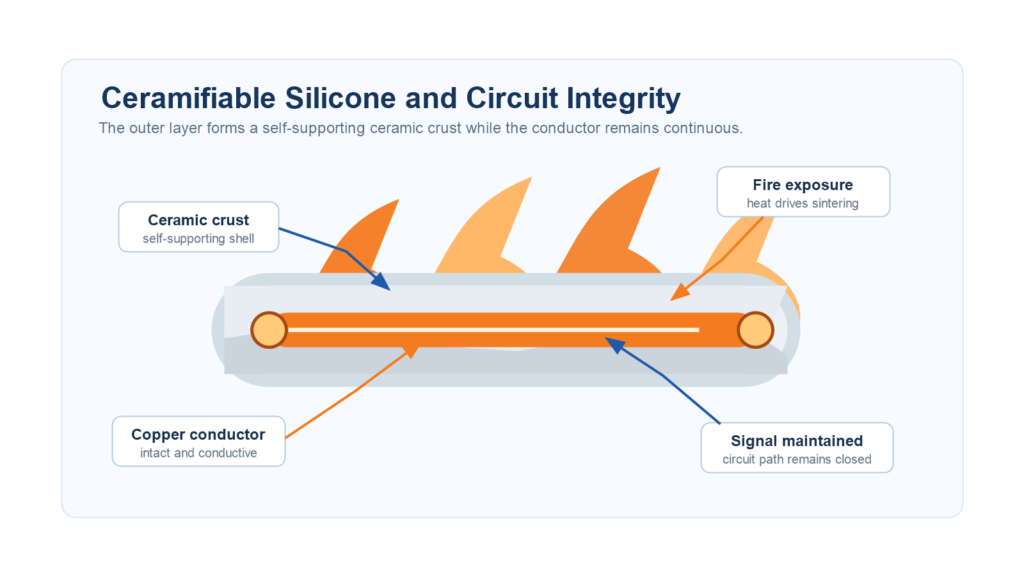
There is a specialized class worth flagging because it is frequently confused with ordinary FR silicone: ceramifying (ceramifiable) silicone used in fire-resistant cabling.
Under fire, this grade does more than char. Its filler system sinters into a coherent, self-supporting ceramic crust that keeps insulating after the polymer has burned away. That maintains circuit integrity — the cable keeps carrying signal or power during the fire. This is the requirement behind emergency lighting, alarm, and signaling circuits.
The standards are again specific and separate:
| Concern | Standard | What it measures |
|---|---|---|
| Ignition / burn rating | UL94 (IEC 60695-11-10/20) | Self-extinguishing class (HB to V-0) |
| Oxygen index | ASTM D2863 / ISO 4589 | Minimum O₂ % to sustain burning (LOI) |
| Glow wire | IEC 60695-2-12/13 | Ignitability from a hot wire (electronics) |
| Smoke density | ASTM E662 / ISO 5659-2 | Optical smoke (Ds) |
| Halogen / acid gas | IEC 60754 | Halogen-free verification |
| Rail (Europe) | EN 45545-2 | Hazard level classification (HL1–HL3) |
| Transit (N. America) | NFPA 130 | Flame spread + smoke for guideway transit |
| Circuit integrity | IEC 60331 / BS 6387 | Cable keeps functioning during fire |
What to specify when ordering flame retardant silicone
Do not order “flame retardant silicone.” The phrase does not constrain anything we can build against, and it is where most of the late-stage rejections originate.

To quote a grade that will actually clear certification, we need:
- The target standard and, for rail, the hazard level and R-set (for example, EN 45545-2 HL2, R22) or the NFPA 130 reference.
- The sample thickness the rating must hold at, since UL94 and LOI results move with thickness.
- Whether circuit integrity is required — that decides ordinary FR versus ceramifying silicone, and they are different material families with different cost.
- Any smoke-density and toxicity limits for the enclosed environment.
- The certifying body or lab, because the report, not the compound name, is what your customer audits.
Two boundary conditions to plan around. FR and ceramifying grades carry higher material cost and longer testing lead time than general-purpose silicone, and the heavier filler loading that raises the LOI also raises hardness and cuts elongation — so the FR requirement can quietly change the mechanical behavior of a seal or keypad. If the part is both a flammability-rated component and a precision sealing element, send us the mechanical spec alongside the fire standard so we can confirm both are reachable in one compound before tooling.
What we need from you next: the controlling standard, the rated thickness, and whether the application is enclosed. With those three, we can tell you which grade family applies and where the cost and lead-time break.
Frequently asked questions
Can you burn silicone?
Yes, silicone will burn under a sustained, direct flame — but it does not behave like a typical plastic. Instead of melting and dripping, the organic side groups oxidize and the silicon-oxygen backbone converts to an insulating amorphous silica (SiO₂) ash. That ash layer shields the material underneath and slows further combustion, which is why many grades self-extinguish once the flame source is removed.
Is silicone flammable?
Silicone is comparatively fire-safe rather than truly “non-flammable.” Its limiting oxygen index (LOI) typically sits in the 26–39% range, versus 21% oxygen in ambient air, so it will not readily sustain its own flame in normal conditions. However, base grades usually only reach UL94 HB — reaching a self-extinguishing V-0 rating requires a dedicated flame-retardant grade.
What is the difference between self-extinguishing and flame retardant rated?
“Self-extinguishing” describes observed behavior: the material stops burning once the flame is removed. A “rating” is a documented pass against a defined test (such as UL94 V-0) at a specific thickness and orientation. The two are not interchangeable — a certifier will ask for the test report, not the observed behavior.
Does burning silicone release toxic or corrosive fumes?
Standard silicone is halogen-free, so it does not release corrosive acid gases like the hydrogen chloride (HCl) produced by PVC. It also burns with low optical smoke density and leaves a non-conductive silica ash. That said, enclosed applications (rail, transit, aircraft) still test smoke density (ASTM E662 / ISO 5659-2) and toxicity (EN 45545-2 CIT) separately — a grade can pass a burn test and still exceed a smoke or toxicity limit.
What does a UL94 V-0 rating actually mean for silicone?
UL94 V-0 means the sample self-extinguishes within 10 seconds in a vertical orientation with no flaming drips, at a stated thickness. The rating is thickness-specific: a compound certified V-0 at 3.0mm is not automatically V-0 at 1.0mm. A spec that says “V-0” with no thickness is incomplete.
Is flame retardant silicone enough for rail or transit parts?
Not on its own. EN 45545-2 (European rail) classifies a finished component by hazard level (HL1–HL3) and requirement set, while NFPA 130 (North American transit) references component-level tests like ASTM E162 and ASTM E662. A material doesn’t “have” EN 45545 — the part is assessed for a stated hazard level and product category, and European and North American reports are not interchangeable.
What is ceramifying (ceramifiable) silicone?
It is a specialized grade used in fire-resistant cabling. Under fire its filler system sinters into a coherent, self-supporting ceramic crust that keeps insulating after the polymer has burned away, maintaining circuit integrity (per IEC 60331 / BS 6387). This is the requirement behind emergency lighting, alarm, and signaling circuits, and it is a different — and more costly — material family than ordinary FR silicone.
References & Standards
- UL 94 — Flammability of Plastic Materials for Parts in Devices and Appliances (Underwriters Laboratories; harmonized with IEC 60695-11-10). Reference
- Limiting Oxygen Index (LOI) — minimum oxygen concentration to sustain combustion, measured per ASTM D2863 / ISO 4589. Reference
- IEC 60695-2-12:2021 — Glow-Wire Flammability Index (GWFI) test method for materials (IEC). Reference
- ISO 5659-2:2017 — Smoke generation: determination of optical density by a single-chamber test (ISO). Reference
- EN 45545-2:2020 — Railway applications: fire behaviour requirements for materials and components (CEN). Reference
- NFPA 130 — Standard for Fixed Guideway Transit and Passenger Rail Systems (NFPA). Reference
- IEC 60331-1:2018 — Test for circuit integrity of cables under fire and mechanical shock (IEC). Reference