Most adhesion failures on printed silicone are blamed on the ink. In our experience the ink is rarely the variable that changed. Silicone surface pretreatment is, and it is usually the least documented step in the whole process: no parameter on the drawing, no record on the traveller, no measurement on the line.
The part passes first article, ships, and comes back three months later with legends lifting at the edges. The purchase order specified an ink system and a cure cycle. It said nothing about what condition the surface was in when the ink touched it.
This page compares the three treatments actually used in production — atmospheric plasma, chemical primer, and corona discharge — on the four things that decide which one belongs on your line: how much surface energy they add, how long that effect lasts, what they cost per part, and how repeatable they are across a shift.
Executive Summary
- Cleaning is not optional and not a treatment. Mould release and silicone oil bloom defeat all three methods; if the surface is contaminated, plasma and corona simply activate the contaminant.
- Plasma is the most capable on 3D parts, and the most perishable. Treated silicone begins losing surface energy within the hour, so the print station has to sit next to the treater.
- Primer buys time, corona buys throughput. Primer tolerates batch workflows and storage; corona is cheap and fast but effectively limited to flat or near-flat geometry.
Why Nothing Sticks to Untreated Silicone
Silicone’s backbone is a siloxane chain with methyl groups pointing outward. Those methyl groups are chemically inert and non-polar, which is exactly why silicone survives heat, UV and chemicals — and exactly why ink beads on it. Surface energy sits around 20–24 mN/m, well below the surface tension of most inks and adhesives.
The wetting rule is simple: if the substrate’s surface energy does not clearly exceed the surface tension of the fluid applied to it, the fluid will not spread and the bond will be mechanical at best.
There is a second problem that pretreatment gets blamed for but cannot solve. Moulded silicone carries mould release on the surface, and incompletely post-cured silicone continues to bring low-molecular-weight siloxane to the surface for days. Treating a contaminated part activates the contaminant layer, not the substrate. Adhesion looks acceptable at first article and fails when that layer migrates.
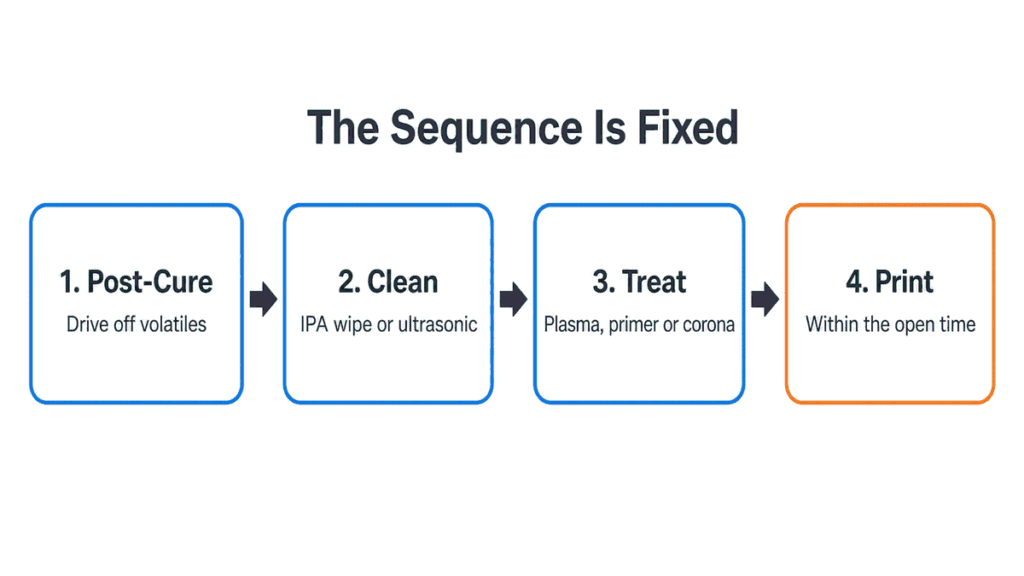
So the sequence is fixed, and the order matters more than the method:
- Post-cure the part properly to drive off volatiles — see Silicone Products Post Cure for the reasoning and typical cycles.
- Clean — IPA wipe or ultrasonic, with a defined maximum hold time before the next step.
- Treat — plasma, primer, or corona.
- Print within the treatment’s open time.
Skip step 1 or 2 and steps 3 and 4 are wasted money.
How Do You Actually Measure Whether the Surface Is Treated?
You measure it, or you do not know. Two methods are used on production floors.
Dyne test pens and inks are the fast method. A test fluid of known surface tension is drawn across the surface; if the film holds for roughly two to three seconds without breaking into droplets, the surface energy is at or above that value. The method is defined in ASTM D2578 and its equivalent ISO 8296. Precision is about ±2 dyne/cm with standard 2 dyne/cm increments, and roughly ±1 dyne/cm with disciplined repeat use.
Two cautions that matter more on silicone than on film:
- Pen nibs contaminate. Marker-style pens pick up machine oil and siloxane and then read low or high with no warning. For anything going into a record, use bottled test fluids with a fresh cotton swab.
- Dyne testing on small, textured or deeply recessed areas is unreliable. On a domed keypad you are often testing the flattest part of a part that is not flat.
Contact angle measurement is the reference method. It is slower, needs an instrument, and is worth having for process qualification and for arguments with customers — but it is not a per-lot production check.
The practical setup is a contact angle baseline at qualification, then dyne fluids at defined intervals on the line, with the reading recorded against the lot.
Atmospheric Plasma: The Most Capable, the Most Perishable
Plasma treatment cleans at a microscopic scale and chemically activates the surface in one dry, non-contact pass. Atmospheric-pressure systems mount over a conveyor or on a robot arm and treat three-dimensional geometry, recesses and multiple faces — the reason it is the default choice when the part is not flat.
What matters operationally is not the surface energy peak. It is the decay.
On silicone specifically, published work on atmospheric plasma hydrophilic modification found the effect stable for about one hour, after which hydrophobic recovery began, with the surface returning to its original values after roughly 24 hours of aging. Equipment manufacturers describe the same behaviour more loosely: dyne level decay varies with material and environment, and treatment life may run from hours to months depending on the substrate. Silicone sits at the fast end of that range, because its short, mobile chains reorient quickly and bring the methyl groups back to the surface.
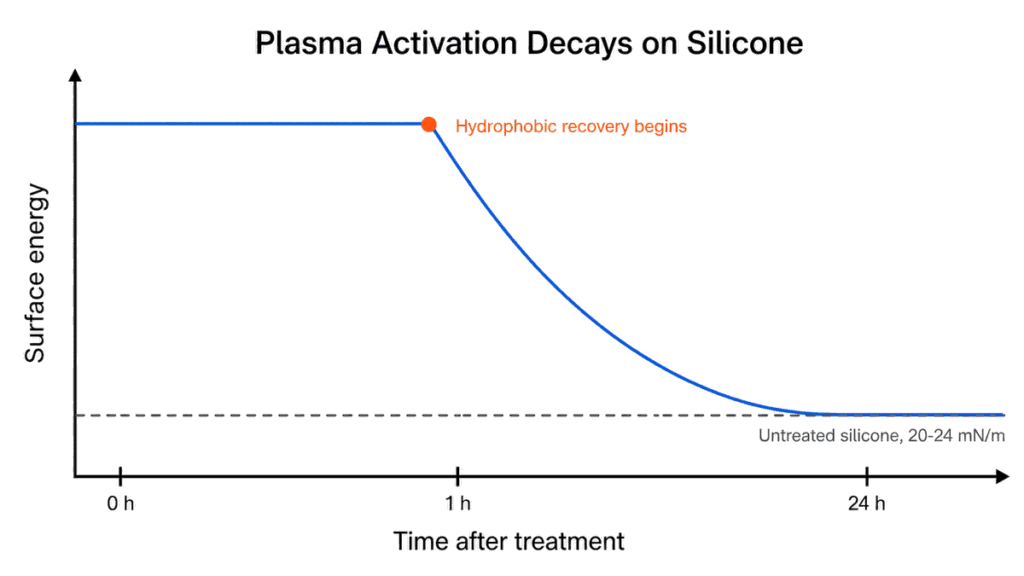
The consequences for a print line:
- The treater must be inline with the printer, not in a separate room. Treat-then-store is not a plasma workflow for silicone.
- Buffer stock between treatment and printing is scrap risk. If the line stops for an hour, the parts in the buffer need retreating.
- Retreatment works. Parts that have aged past their open time can generally be run through again to recover activation, which is cheaper than scrapping them but has to be a written rule, not an operator decision.
- Overtreatment is real. Excessive plasma oxidation can weaken the near-surface layer and affect downstream steps; more power is not more adhesion.
What it costs to run. Atmospheric plasma consumes no chemistry — published system requirements are electricity and clean compressed air only, which is the whole economic argument against primer. Vendor specifications give the throughput envelope: a single nozzle treats a band of roughly 8-12 mm; rotating heads reach 40-150 mm at a published capacity of about 10 m/min; profile systems run 360° treatment at line speeds up to 40 m/min; wide-format DBD nozzles cover up to 100 mm. Typical published draw for a rotating-head system is a 1,000 W generator with about 66 l/min of compressed air at 5-6 bar. At 10 m/min a 60 mm long keypad sits under the head for roughly 0.4 s, so on a normal decorating line plasma is not the bottleneck — the print station is.
On the cost side, energy is close to irrelevant. A combined draw of about 1.5 kW spread across thousands of parts an hour works out below USD 0.001 per part. What actually shows up in your quote is capital amortisation: a single-nozzle inline system written off over three years on a programme running 30,000 parts a month lands at roughly USD 0.02 to 0.03 per part. Against a primer line, which carries consumable cost, flash time, oven time and solvent handling on every batch, plasma is usually the cheaper answer well before you reach high volume.
Humidity and storage temperature change the decay rate. Warm, humid storage accelerates recovery; dry storage slows it. If your shop has no climate control, assume the short end of the window.
Chemical Primer: Slower, Dirtier, and the Only One That Survives Storage
Primers for silicone are solvent-based mixtures of reactive silanes and siloxanes. They work chemically rather than physically: the silane end bonds to the substrate, the other end presents a group the ink or elastomer can react with. This is the same class of chemistry used for silicone overmolding adhesion, applied to a decoration problem instead of a bonding one.
What you gain:
- A real open time. A primed and flashed surface is chemically modified, not just physically activated, so it tolerates a batch workflow, a queue, and an overnight hold in a way plasma does not.
- Geometry independence. Dipping, brushing, spraying and tampon application all reach shapes that a plasma nozzle would need multiple passes for.
- Low equipment cost. No generator, no gas supply, no conveyor integration.
What you pay for it:
- Film thickness discipline. On non-absorbent surfaces the primer film should be barely visible. Too much primer builds a weak boundary layer, and the print then peels with the primer still attached to it. This is the single most common primer defect we see.
- Flash time is a real parameter. The primer must be allowed to dry or hydrolyse per its datasheet before the next step — commonly on the order of 20 to 45 minutes at room temperature, depending on the system. Printing wet is worse than not priming.
- VOC, ventilation and storage. Solvent handling, waste disposal, and a shelf life that is measured against a date rather than an operator’s judgement.
- A post-bake may be required. Some primer systems reach full performance only after an elevated-temperature bake; typical published conditions for silicone parts are 150–200 °C for 2–4 hours.
That last point is worth pricing before choosing primer. If the primer needs a four-hour bake, the process is no longer cheap — it just moves the cost from capital equipment to oven occupancy and WIP.
Corona Discharge: Cheap and Fast, but Bounded by Geometry
Corona treats by exposing the surface to a high-frequency, high-voltage discharge across an air gap. It is the standard choice for roll-to-roll film and web because it is inexpensive, fast, and easy to integrate into a continuous line. On silicone sheet, silicone film, and adhesive-backed gasket stock it does exactly what it is asked to do.
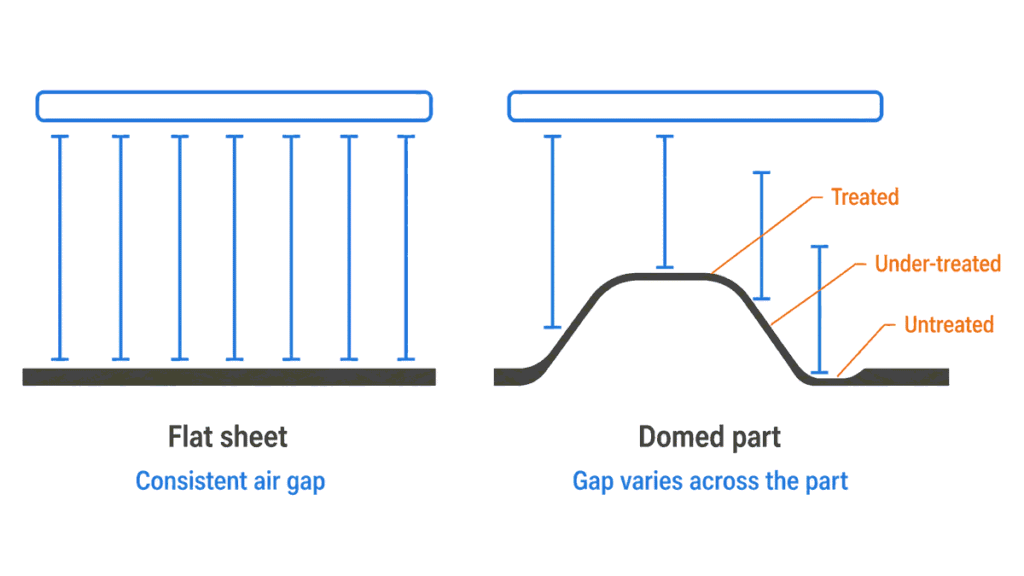
The limit is geometry. Corona depends on a controlled air gap between electrode and surface. A domed keypad, a wristband, or a grommet does not present a consistent gap, so treatment intensity varies across the part — the top of a dome is treated, the flank is under-treated, and the recess is untreated. Vendors have extended corona toward 3D parts with dedicated heads and larger fields, but the working envelope is still measured in inches of part height, not in arbitrary geometry.
Two more constraints that decide it in or out:
- Conductive fixtures and belts can arc under classical corona discharge, which matters for automated handling of parts on metal carriers.
- Ozone is generated and needs extraction, which is a facility question, not a process question.
Corona’s decay behaviour is the same class of problem as plasma’s: activation is physical, so it fades. Because corona puts less energy into the surface than a plasma nozzle does, it also fades faster. Plan on roughly 30 minutes of stable activation on silicone, with most of the benefit gone within about 8 hours. For scale, a corona-treated polyolefin film can drop from 48 dyne/cm to 38 dyne/cm in under 30 days; silicone’s chain mobility makes it move far quicker than that. Treat close to the print station and do not plan around film-industry numbers.
Which Pretreatment Should You Specify?
| Criterion | Atmospheric plasma | Chemical primer | Corona |
|---|---|---|---|
| Mechanism | Physical activation + micro-cleaning | Chemical coupling layer | Physical activation |
| Surface energy gain | On silicone rubber, water contact angle measured from 117° down to under 5° after oxygen plasma at 100 W for 30 s | Not applicable by design — a primer adds a coupling layer, it does not raise substrate surface energy | Roughly 20-24 mN/m up to about 34-38 mN/m |
| 3D and recessed geometry | Yes, the strongest option | Yes, by dip / brush / spray | Limited; needs a consistent air gap |
| Open time before printing | About 1 h stable on silicone; back to untreated values by roughly 24 h | Flash 20-45 min at room temperature, then holds; the ceiling is set by the primer datasheet | About 30 min stable; effectively gone within 8 h |
| Consumables | Gas and power only | Solvent-based primer, VOC handling | Power only |
| Equipment cost | High | Low | Low to moderate |
| Added cycle time | Seconds, inline | Application plus flash, sometimes a bake | Seconds, inline |
| Main failure mode | Parts printed after the open time expired | Primer film too thick, or flashed too short | Uneven treatment on curved surfaces |
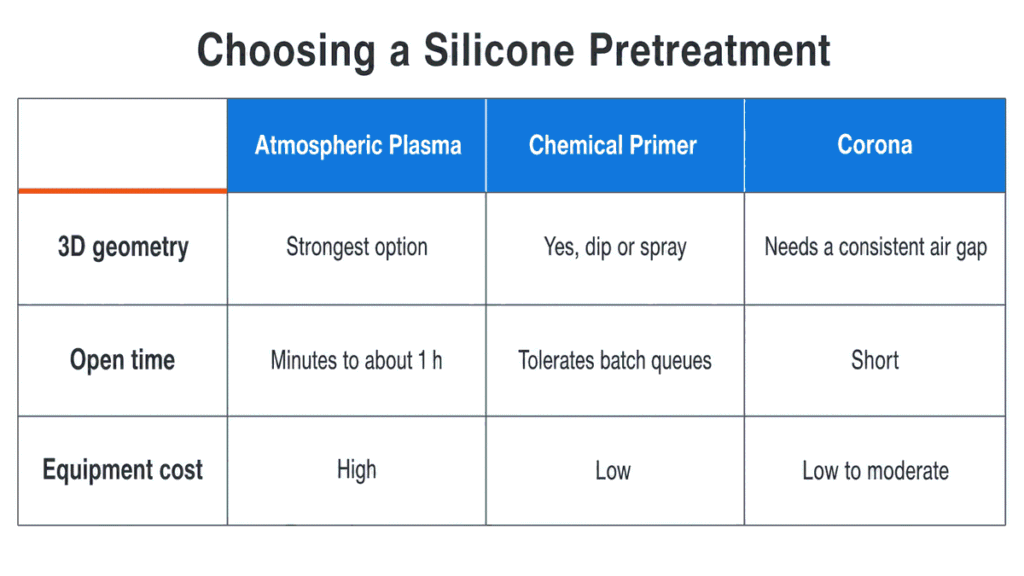
By decoration process, the defaults we work to:
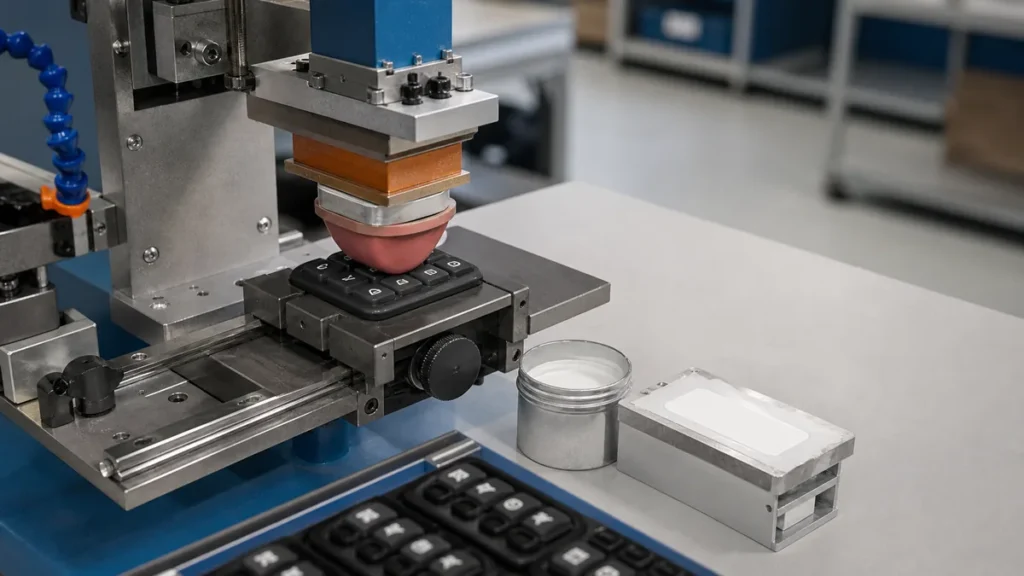
- Pad printing on curved or irregular parts — inline atmospheric plasma when volume justifies the capital, primer when the workflow is batch or the geometry is deeply recessed. This is the highest-risk combination, because a curved part is also the hardest to dyne-test.
- **Screen printing on flat sheet and mats** — corona is usually sufficient and the cheapest per part; plasma if the compound is heavily filled.
- **Transfer printing and wrapped graphics** — primer, because the workflow has holds in it and the treatment has to survive them.
One caveat that overrides all three rows: pretreatment choice interacts with ink chemistry. A properly matched two-part silicone ink on a clean, well post-cured part sometimes needs no pretreatment at all. Read Silicone Printing Ink Formulations and Innovations before assuming a treatment step is mandatory, and see the pillar guide How to Print On Silicone for where pretreatment sits in the wider process.
What Should Be Monitored on the Line?
Pretreatment fails silently. These are the control points worth writing into the traveller:
| Control point | What to record | Why it drifts |
|---|---|---|
| Cleaning | Method, solvent, and time between cleaning and treatment | Handling recontaminates a clean surface within minutes |
| Treatment parameters | Power, speed or dwell, nozzle-to-part distance | Fixture wear and nozzle fouling change effective dose |
| Surface energy check | Dyne value per ASTM D2578, sampled per lot | Electrode wear, contaminated pens, ambient humidity |
| Open time | Elapsed minutes from treatment to print | Line stoppages create aged buffer stock |
| Adhesion result | Cross-hatch classification, not pass / fail | A recorded class shows drift; a “pass” hides it |
The adhesion check closes the loop. Cross-hatch tape testing to ASTM D3359 or ISO 2409, plus a solvent rub, tells you whether the treatment actually did anything — surface energy is a leading indicator, adhesion class is the result. Record the classification against the dyne reading and the drift becomes visible weeks before parts fail in the field.
Where Pretreatment Stops Being the Answer
Pretreatment raises surface energy. It does not fix a compound that is wrong for printing, a part that was never post-cured, or an ink that was never designed for silicone. If adhesion fails after a correct clean, a verified dyne reading and a full cure cycle, the problem is upstream of decoration — usually the compound, the release system, or the moulding cycle. See Platinum vs Peroxide Cured Silicone for how the cure system itself changes surface behaviour.
Before specifying a treatment, four things need to be settled: the part geometry and whether any print face is recessed or curved, the compound and its filler loading, whether the workflow is inline or batch, and the durability standard the print has to survive. Without the last one there is no way to judge whether the cheapest treatment is also the sufficient one.
And if the decoration has to survive abrasion for years rather than pass a tape test at first article, the honest answer is that no pretreatment closes that gap on its own — the question becomes whether the legend should be printed and coated, or moulded and engraved instead. See Silicone Keypad Surface Finishes & Coatings for what goes on top of the ink.
References
- Surface energy data for polydimethylsiloxane — Harvard SEAS, compiled surface energy values for PDMS
- ASTM D2578-23, Wetting Tension of Polyethylene and Polypropylene Films — ASTM International, updated Mar 2023
- ISO 8296:2003, Plastics — Film and sheeting — Determination of wetting tension — ISO, current edition
- Using ACCU DYNE Test marker pens to measure substrate surface energy — Accudyne, method and ±2 dyne/cm precision
- Atmospheric Pressure Plasma Hydrophilic Modification of a Silicone Surface — peer-reviewed study, hydrophobic recovery of treated silicone
- Surface Modification of Polymers by Plasma Treatment — NIH PMC, 2024 review of activation and aging
- Primer for Silicone Rubber — Wacker Chemie AG, reactive silane and siloxane primer chemistry
- LORD IMB Liquid Silicone Rubber Primers, Application Guide — Parker Hannifin, post-bake conditions
- Plasma Surface Pretreatment — The Sabreen Group, geometry limits, arcing and overtreatment
- Corona, Plasma and Flame Pretreatment for Surface Treating Plastics — Enercon Industries, technical article
- ASTM D3359-23, Rating Adhesion by Tape Test — ASTM International, updated Mar 2023
- ISO 2409:2020, Paints and varnishes — Cross-cut test — ISO, current edition
- Plasma-mediated approaches for surface modification of silicone rubber — Queen’s University Belfast, contact angle 117° to under 5° after oxygen plasma
- What is the treatment life of plasma and corona treatment? — Tantec, shelf life by polymer family
- Why corona treatment decays over time — dyne decay rates on film
- SpinTEC atmospheric plasma treater, technical specifications — Tantec, treatment width, line speed, power and air consumption
- Activation with plasma — Plasma.com, published nozzle treatment widths
- Atmospheric pressure plasma — Fraunhofer IFAM, electricity and compressed air as the only inputs