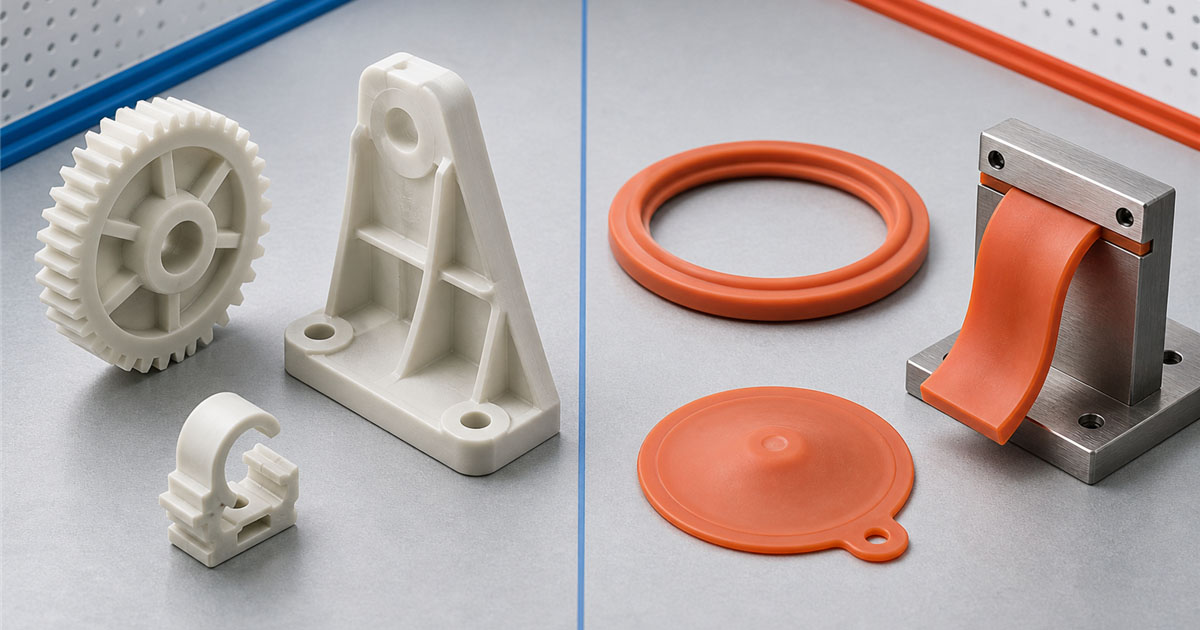
Choosing between nylon vs silicone is not a choice between a “strong” material and a “safe” one. That shortcut causes bad specifications. Nylon is a rigid thermoplastic built for load, wear, and dimensional structure. Silicone is a crosslinked elastomer built for flexibility, sealing, temperature cycling, and weather exposure.
Choose nylon for rigid, load-bearing, wear-resistant parts. Choose silicone for flexible parts exposed to heat, cold, sealing pressure, UV, or repeated deformation. The final grade still has to match the actual temperature, chemical, compliance, and service-life requirements.
Executive Summary
- Nylon is normally the better choice for gears, brackets, housings, bearings, clips, and other parts that must carry load or resist abrasion.
- Silicone is normally the better choice for seals, gaskets, flexible covers, baking products, baby products, and parts that must remain elastic across temperature cycles.
- Do not approve either material by family name alone. PA6, PA66, PA12, glass-filled nylon, HCR silicone, and LSR silicone behave differently. Grade-level data controls the decision.
Nylon vs Silicone at a Glance
| Decision factor | Nylon | Silicone | Practical verdict |
|---|---|---|---|
| Material behavior | Rigid or semi-rigid thermoplastic | Flexible crosslinked elastomer | Start with the required part function |
| Load and stiffness | Higher; can be increased with glass fiber | Low; designed to deform and recover | Nylon for structural parts |
| Abrasion | Generally stronger in sliding and wear applications | Can tear or wear under repeated friction | Nylon for gears and wear surfaces |
| Temperature flexibility | Grade-dependent; heat and moisture change dimensions and properties | Common grades remain elastic across a much wider range | Silicone for thermal cycling and hot-contact parts |
| Moisture response | Polyamides absorb moisture; the amount depends on grade | Low water absorption and a water-repellent surface | Silicone is easier to stabilize in wet service |
| UV and ozone | Often needs stabilization for long outdoor service | Generally strong resistance | Silicone for exposed flexible parts |
| Part geometry | Thin rigid walls, clips, ribs, bosses, gears | Seals, undercuts, membranes, soft-touch features | Geometry may decide before material cost does |
| Recycling route | Thermoplastic scrap may be reground under controlled conditions | Cured silicone cannot be remelted | Nylon has a simpler conventional reprocessing route |
The table is a screening tool, not a specification. A glass-filled PA66 bracket and a soft PA12 tube should not be treated as the same “nylon.” A 30 Shore A LSR seal and a 70 Shore A HCR roller are equally different.
What Is the Main Difference Between Nylon and Silicone?
Nylon carries shape and load. Silicone allows movement and returns toward its molded shape.
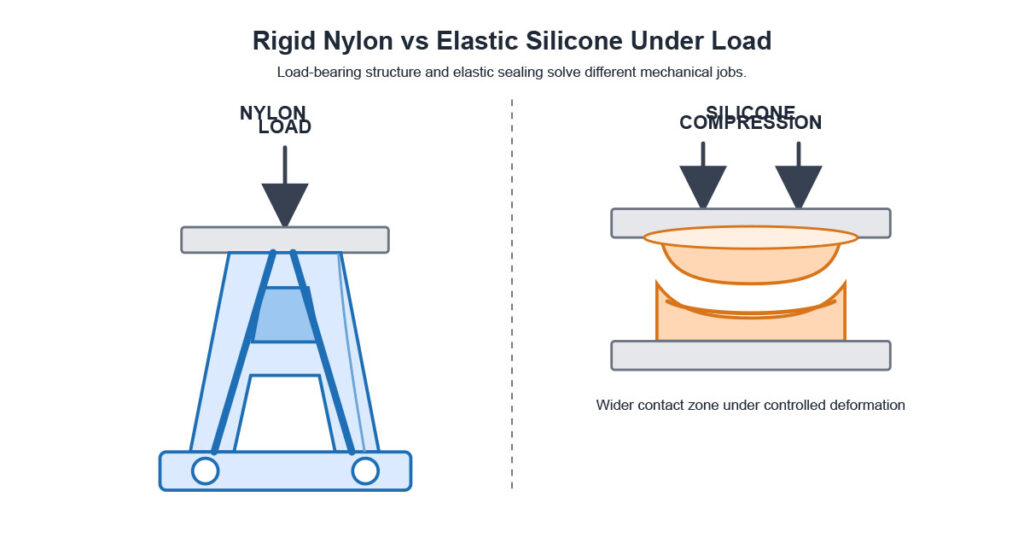
Nylon is a polyamide thermoplastic. During injection molding, the resin melts, fills the cavity, cools, and becomes solid again. This supports rigid features such as ribs, snap fits, bearing surfaces, and threaded bosses. Reinforcement can raise stiffness further, but it can also increase anisotropic shrinkage and warpage.
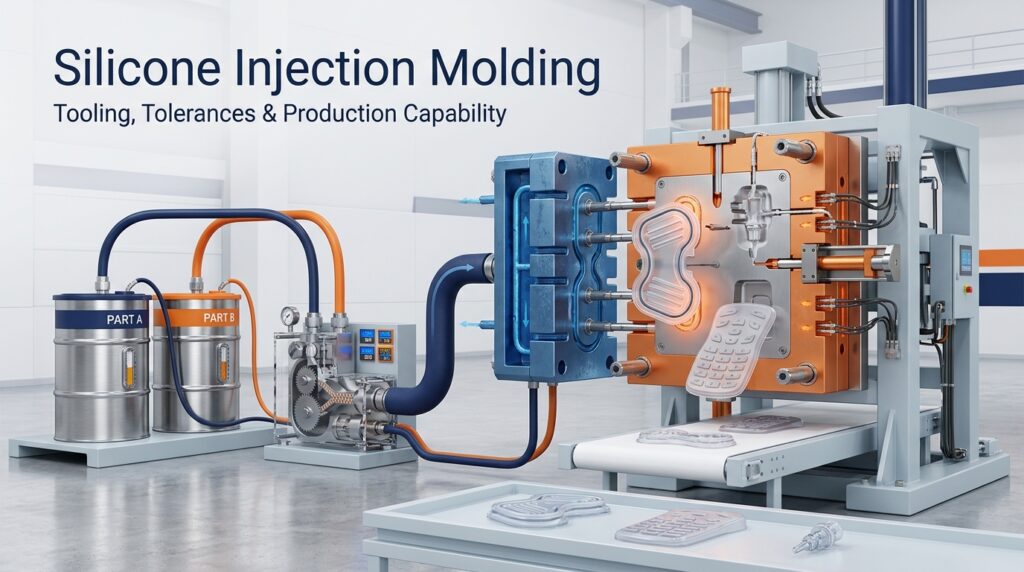
Silicone rubber cures into a three-dimensional crosslinked network. It does not behave like a meltable plastic after curing. HCR silicone is commonly compression or transfer molded. LSR is injection molded through a metering and mixing system into a heated mold. Both routes produce elastic parts, but their tooling, flash control, cycle behavior, and design rules differ.
The common buyer mistake is comparing isolated tensile-strength numbers. That misses the required function. A housing that must hold a screw needs stiffness. A gasket compressed between flanges needs recovery. Neither material can replace the other without changing the part design.
Which Material Handles Heat Better?
Silicone is usually the safer choice when the part must remain flexible during repeated heat exposure. Many general-purpose silicone rubber grades operate across roughly −50°C to 200–250°C, while specialty grades can extend beyond that range. The approved limit must come from the selected compound’s technical data sheet.
Nylon temperature performance varies sharply by polymer and reinforcement. PA6, PA66, PA12, heat-stabilized grades, and glass-filled grades have different melting points, heat-deflection temperatures, and long-term thermal ratings. A nylon part may survive a short temperature peak but still lose stiffness, creep, or distort under continuous load.
Short exposure is not continuous service
Three values must be separated:
- Maximum short-term temperature
- Continuous-use temperature under load
- Temperature at which dimensions and mechanical properties remain within tolerance
Teams often specify the highest number on a data sheet. In production, the failure appears later: a clip relaxes, a housing warps, or a sealing interface loses compression after repeated cycles. For hot seals, oven-contact products, and flexible heater-adjacent parts, silicone normally provides more design margin. For a rigid under-hood bracket, a heat-stabilized reinforced nylon may still be the correct choice.
Is Nylon or Silicone Stronger?
Nylon is stronger when “strength” means stiffness, load capacity, impact resistance, or abrasion performance. Silicone is stronger when the requirement is elastic recovery after bending, compression, or thermal cycling.
| Requirement | Preferred starting point | Reason |
|---|---|---|
| Rigid bracket or housing | Nylon | Higher modulus and structural stiffness |
| Gear, bearing cage, or sliding component | Nylon | Better wear behavior for many mechanical designs |
| Compression seal | Silicone | Elastic deformation and recovery |
| Flexible membrane or button | Silicone | Repeated deflection without a hinge mechanism |
| Outdoor flexible cover | Silicone | UV, ozone, and weathering resistance |
Silicone is not automatically durable because it is flexible. A sharp parting line, insufficient tear strength, a thin section around an undercut, or repeated rubbing against metal can start a tear. Nylon is not automatically dimensionally stable because it is rigid. Moisture conditioning and fiber orientation can move dimensions after molding.
How Does Moisture Change Nylon Performance?
Moisture is one of the most underestimated differences in a nylon vs silicone decision. Polyamides absorb water. The level depends on the nylon family, reinforcement, wall thickness, humidity, and conditioning history.
Moisture can increase toughness while reducing stiffness. It can also change dimensions. That matters for precision gears, electrical housings, snap fits, and assemblies with tight clearances. A dry-as-molded nylon part and a conditioned part may not measure or behave the same way.
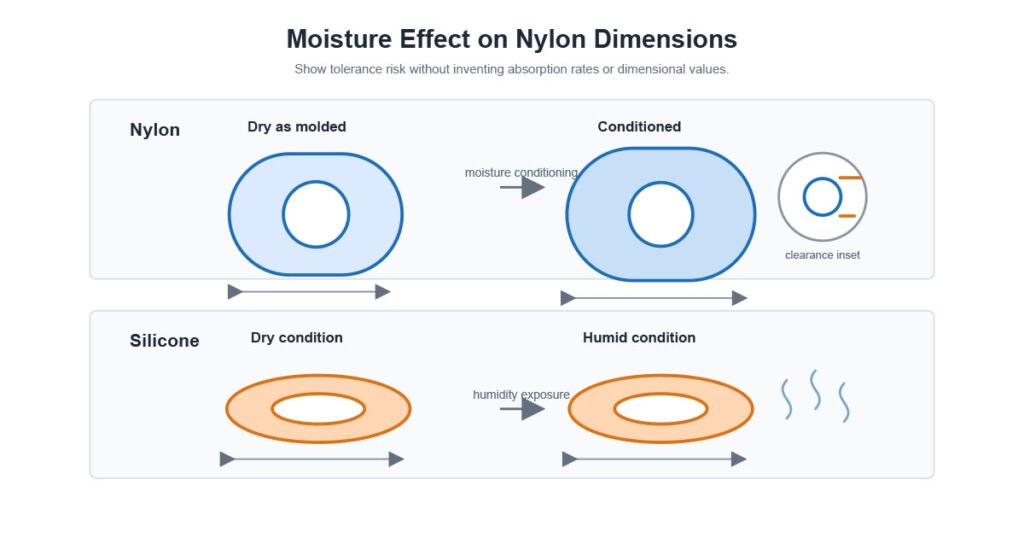
Silicone has low water absorption and maintains flexibility in wet environments, but that does not make every silicone compound suitable for steam, cleaning chemicals, or long-term immersion. Compound formulation and test conditions still matter.
For a tolerance-critical nylon component, define the measurement condition on the drawing or inspection plan. “Measure at room temperature” is incomplete if the moisture state is uncontrolled.
Which Material Resists Chemicals Better?
Neither material wins across all chemicals. Compatibility must be checked against the exact fluid, concentration, temperature, pressure, and exposure time.
Nylon performs well with many oils, greases, fuels, and hydrocarbons, but acids, strong oxidizing agents, hot water, and moisture can limit certain grades. Long-chain nylons such as PA12 generally absorb less moisture than PA6 or PA66 and are often considered for tubing and fluid-handling applications.
Silicone handles water, ozone, UV, and many environmental exposures well. However, it can swell in some fuels, oils, solvents, and non-polar chemicals. Standard silicone should not be described as having universal solvent resistance. Fluorosilicone may be a better candidate for fuel exposure, but it adds cost and has different mechanical trade-offs.
Require an immersion test when the fluid is critical
A useful compatibility check should record:
- Fluid name and concentration
- Exposure temperature
- Exposure time
- Volume, mass, or hardness change
- Tensile or elongation retention
- Visual swelling, cracking, tackiness, or discoloration
A room-temperature compatibility chart cannot validate a part that will operate in hot oil for 2,000 hours.
Which Is Better for Food-Contact and Baby Products?
Silicone is often preferred for flexible food-contact and baby products because it remains elastic at cooking temperatures and can be produced in compliant formulations. But silicone is not “naturally food-grade.” Compliance belongs to the finished formulation and intended use, not to the polymer name.
For the US market, buyers commonly reference FDA 21 CFR 177.2600 for rubber articles intended for repeated food contact. For EU or German requirements, projects may reference applicable EU food-contact rules and BfR Recommendation XV for silicones. The required declaration, extraction testing, migration testing, and use conditions must be confirmed for the destination market.
Nylon can also be used in food-contact applications when the selected grade and finished article meet the applicable requirements. The decision should consider use temperature, contact time, food type, cleaning cycle, and whether the part can touch a hot pan or heating element.
For cooking utensils, a rigid nylon core may provide control, while a silicone contact edge protects coated cookware and tolerates higher surface temperatures. A two-material design can work, but the bond, insert retention, and cleaning interface must be validated.
When Should You Choose Nylon?
Choose nylon when the part needs structure more than elastic movement.
Nylon is the stronger starting point for:
- Gears, rollers, bearings, and wear components
- Rigid housings, brackets, clips, and cable-management parts
- Components with ribs, bosses, snap fits, or threaded features
- Lightweight parts that replace metal under moderate load
- Designs that benefit from glass-fiber reinforcement
- Parts intended for conventional thermoplastic injection molding or controlled regrind use
Before releasing the material, define the nylon family and grade. “Nylon 66” is still incomplete if reinforcement, impact modification, flame rating, color, heat stabilization, and moisture conditioning are missing.
When Should You Choose Silicone?
Choose silicone when the part must deform repeatedly, seal, or stay flexible across temperature and weather exposure.
Silicone is the stronger starting point for:
- Gaskets, silicone O-rings, valve diaphragms, and flexible seals
- Baking molds, spatula edges, and hot-contact kitchen components
- Pacifiers, nipples, teethers, and flexible feeding components made to the required compliance specification
- Keypad webs, membranes, bellows, and protective covers
- Outdoor parts exposed to UV, ozone, or temperature cycling
- LSR parts with thin sections, integrated seals, or complex undercuts
The compound still needs a defined cure system, hardness, tear strength, compression set, color, post-cure requirement, and compliance package. These variables affect mold release, flash, odor, dimensions, and long-term sealing behavior.
How Do Manufacturing Costs Differ?
Raw-material price alone does not predict part cost. The process route, cycle time, tooling, scrap handling, and secondary operations usually matter more.
| Cost driver | Nylon injection molding | Silicone molding |
|---|---|---|
| Material preparation | Drying is critical for many nylon grades | HCR preparation or LSR A/B metering and mixing |
| Mold condition | Molten resin enters a cooled mold | Uncured silicone enters a heated mold |
| Cycle behavior | Controlled by filling, packing, and cooling | Controlled by filling and cure time |
| Flash control | Parting-line and gate control | Very sensitive because uncured silicone has low viscosity, especially LSR |
| Scrap route | Some clean scrap can be reground within controlled limits | Cured scrap cannot be remelted |
| Secondary work | Annealing or conditioning may be required | Deflashing and post-curing may be required |
Silicone tooling can require tighter shutoffs and more deliberate venting. Nylon tooling must account for shrinkage, fiber orientation, moisture effects, and warpage. A lower resin price can be erased by a longer cycle, unstable dimensions, manual deflashing, or rejected assemblies.
Can Nylon and Silicone Be Used in the Same Part?
Yes, but the interface must be engineered. Nylon provides the rigid frame; silicone provides grip, sealing, cushioning, or a soft-contact surface.
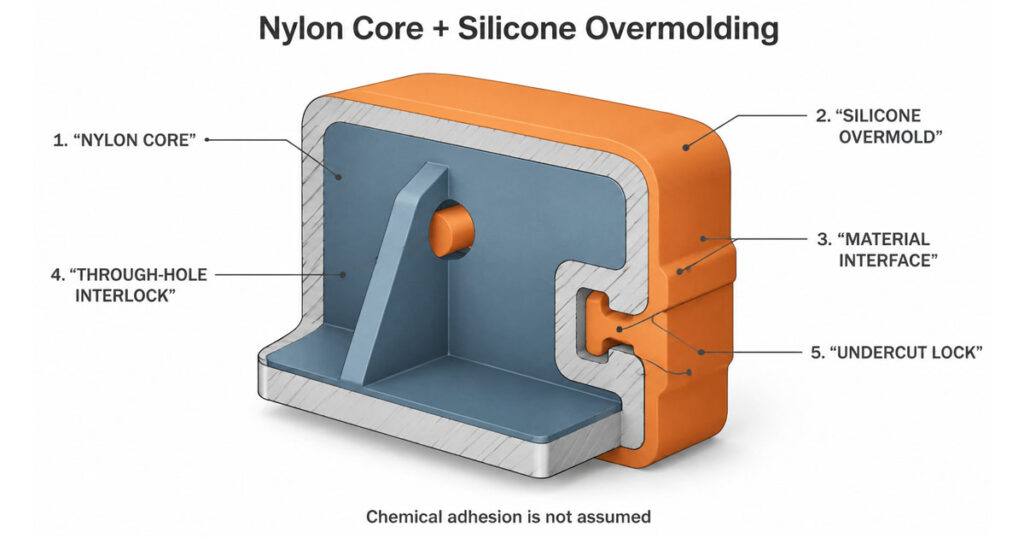
Possible routes include insert molding, mechanical interlocks, primers, or compatible overmolding systems. Silicone overmolding adhesion should never be assumed. Surface condition, nylon moisture, mold temperature, cure chemistry, undercut design, and contamination can all change bond strength.
For a two-material design, test the actual assembly after heat aging, washing, flexing, and chemical exposure. A peel test on a fresh sample does not represent years of repeated use.
A Practical Selection Checklist
Before requesting a quotation, define these inputs:
- Required rigidity, flexibility, and Shore hardness
- Continuous and peak operating temperature
- Mechanical load, abrasion, and number of cycles
- Exact chemicals, concentration, and exposure time
- Indoor, outdoor, UV, ozone, and moisture conditions
- Dimensional tolerances and measurement condition
- Food-contact, medical, electrical, or flammability requirements
- Annual volume and target process
- Color, surface texture, post-curing, and cleanliness requirements
- Expected service life and validation method
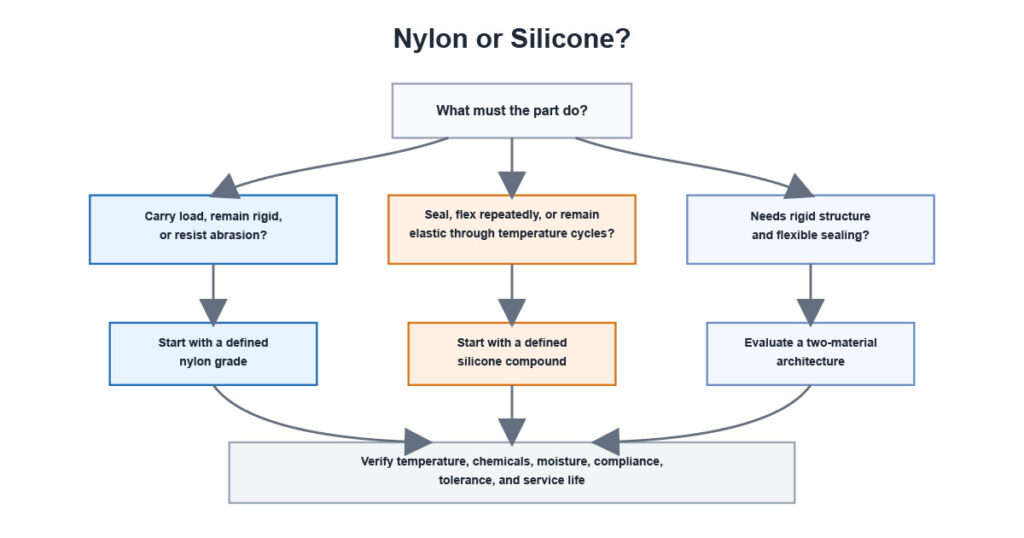
If the part must carry load and resist wear, start with a defined nylon grade. If it must seal, flex, or survive temperature cycling, start with a defined silicone compound. If it must do both, the correct answer may be a two-material architecture rather than forcing one polymer to cover incompatible functions.