Most searches for conductive silicone properties return the same two lines: “silicone plus carbon black, conducts electricity.” That is not enough to specify a part. Without resistivity grade, filler type, and hardness shift, you cannot compare quotes or predict how the part behaves after compression cycles.
Conductive silicone is standard silicone rubber (PDMS) loaded with carbon black, nickel-coated graphite, or silver-based fillers until a continuous conductive path forms. Volume resistivity runs from about 0.001 Ω·cm (silver-filled) to 10⁸ Ω·cm (antistatic grades). Heat, cold, and weather resistance stay close to the base polymer.
What Makes Silicone Conductive?
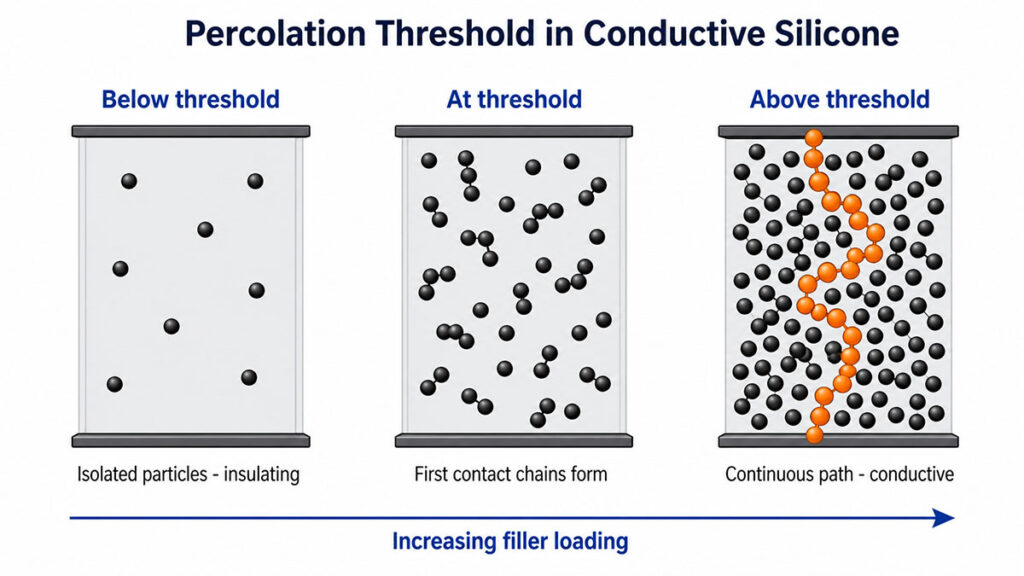
Nothing in the polymer itself. Base silicone rubber is an insulator, with volume resistivity around 10¹⁴–10¹⁵ Ω·cm and dielectric strength in the 20–25 kV/mm range. Conductivity is added mechanically, by loading enough conductive filler that particles touch and form a continuous network through the rubber.
That point is the percolation threshold. Below it, resistivity barely moves no matter how much filler you add. Cross it, and resistivity can drop several orders of magnitude with a 1–2% change in loading. This is why conductive grades are formulated, not blended on the shop floor, and why two suppliers quoting “carbon-filled silicone” can hand you parts three decades apart in resistance.
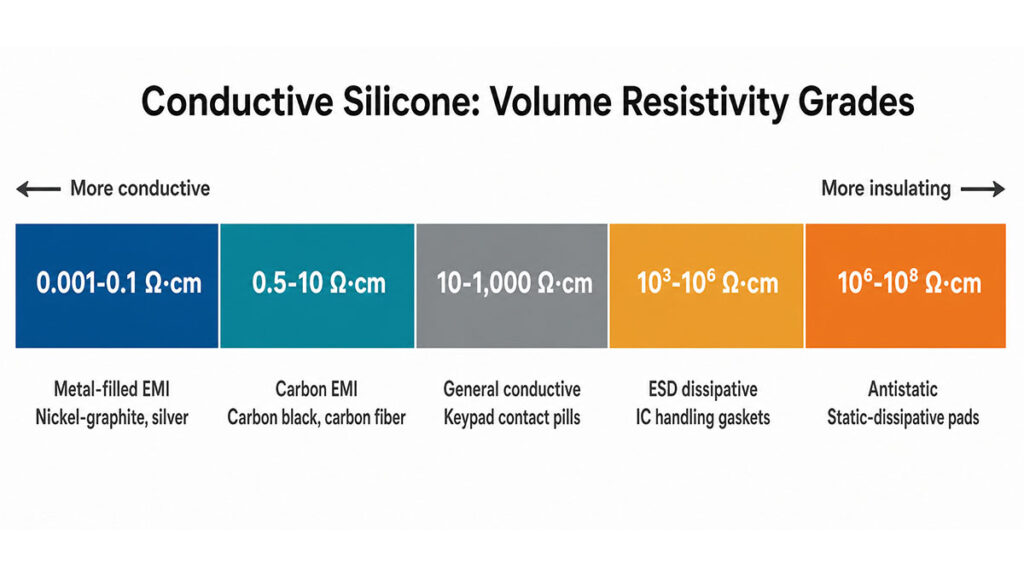
Volume Resistivity Grades and Their Typical Fillers
| Grade class | Volume resistivity | Typical filler | Typical use |
|---|---|---|---|
| Antistatic | 10⁶–10⁸ Ω·cm | Low-loading carbon black | Static-dissipative pads, handling trays |
| ESD / static dissipative | 10³–10⁶ Ω·cm | Carbon black | Burn-in oven seals, IC handling gaskets |
| Conductive (general) | 10¹–10³ Ω·cm | High-loading carbon black | Keypad contact pills, grounding pads |
| EMI shielding, carbon | 0.5–10 Ω·cm | Carbon black / carbon fiber | Low-cost enclosure gaskets |
| EMI shielding, metal-filled | 0.001–0.1 Ω·cm | Nickel-graphite, silver-aluminum, pure silver | MIL-DTL-83528 shielding gaskets |
For reference, Shin-Etsu’s standard carbon grades (EC-BL / EC-BM / EC-BH) sit at 0.009–0.05 Ω·m, i.e. roughly 0.9–5 Ω·cm. Commercially available conductive silicone is generally reliable between 0.01 Ω·m and 10 Ω·m; above 100 Ω·m, resistance swings hard with small carbon variation, and holding a consistent value in the 10 kΩ·m–100 MΩ·m band is difficult in production.
How Do Conductive Fillers Change Mechanical Properties?
They stiffen the part and cost you tear strength. Filler that is there for electrical reasons still behaves as reinforcement or as a defect, depending on loading.
| Property | Standard silicone (typical) | Carbon-filled conductive (typical) |
|---|---|---|
| Hardness | Shore A 30–70, full range available | Shore A 45–70, soft grades limited |
| Tensile strength | 6–10 MPa | ~5–6 MPa (≈776 psi) |
| Elongation at break | 300–700% | ~250–350% |
| Tear strength | 20–40 kN/m | ~85 ppi (≈15 kN/m) |
| Compression set (22 h / 175°C) | 15–30% | Higher, filler-dependent |
| Color | Any | Black, or metallic grey for metal-filled |
Two consequences for design. First, you cannot ask for Shore A 20 conductive silicone with EMI-level resistivity; the filler loading required will not let you get there. Second, sealing force and electrical contact force are coupled — a harder compound needs more compression to seal, and more compression accelerates set on a gasket that also has to keep conducting.
Does Conductive Silicone Keep the Same Temperature Range?
Mostly. Carbon-filled grades still run roughly −55°C to 200°C continuous, with short excursions to 230°C, and keep the ozone, UV, and weather resistance of the base polymer. Filler does not change the siloxane backbone.
What changes is stability of the electrical value, not survival of the part. Repeated heat cycling and long compression alter the filler network slightly, so resistance drifts upward over service life while the rubber itself looks fine. Teams testing a prototype at room temperature on day one rarely see this; it appears in field returns as intermittent contact, not as a cracked gasket. If the application has a resistance ceiling, that ceiling must be tested after thermal aging, not before.
Silver-based fillers add their own limit: galvanic compatibility with the mating housing, not temperature. Pure-silver-filled silicone against bare aluminum in a salt-fog environment corrodes the flange. That is why MIL-DTL-83528 lists silver-aluminum and nickel-graphite grades separately from pure silver.
Which Standards Define and Test These Properties?
| Standard | What it covers |
|---|---|
| ASTM D257 | Volume and surface resistivity of insulating and semi-conductive materials |
| ASTM D991 | Volume resistivity of electrically conductive elastomers |
| MIL-DTL-83528 | Conductive elastomer gasket materials for EMI shielding, by filler type |
| MIL-STD-285 / IEEE 299 | Shielding effectiveness measurement of enclosures |
| ASTM D2240 | Durometer hardness |
| ASTM D412 / D624 | Tensile, elongation, tear |
| ASTM D395 | Compression set |
| RoHS 2011/65/EU | Restricted substances, relevant for metal-filled grades |
A datasheet quoting only “conductive, 10² Ω” without a test method is not a specification. Ask which standard, at what thickness, and under what contact pressure.
Why Measured Part Resistance Never Matches the Datasheet
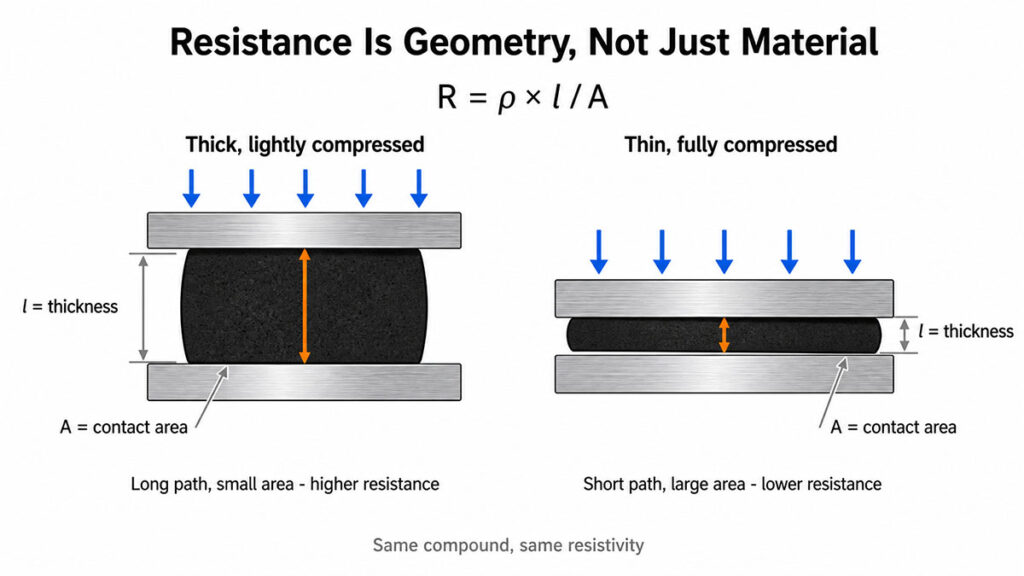
Because resistivity is a material property and resistance is a geometry result. R = ρ × l / A. A 1 Ω·cm compound in a 0.5 mm thick, 5 mm² contact pill behaves very differently from the same compound in a 3 mm gasket cross-section.
Three factors dominate in production:
- Thickness and contact area. Thinner and wider means lower resistance. Design changes to seal geometry silently change electrical performance.
- Compression. Contact resistance falls as deflection increases, typically stabilizing somewhere in the 15–30% compression band. Under-compressed gaskets read high and inconsistent.
- Surface condition. Molded skin, mold release residue, and post-mold cleaning all affect contact resistance. Carbon-filled surfaces measured immediately after demold can read differently from parts measured after post-curing at 200°C for 4 hours.
When we quote conductive parts, the incoming spec often lists a resistance value in ohms with no fixture, no compression rate, and no probe spacing. That number cannot be inspected against, and it is the most common reason first-article results get disputed.
Where the Property Limits Show Up in Real Parts
Keypad contact pills. Carbon pills in the 10¹–10³ Ω·cm class, molded into a non-conductive custom silicone keypad body. The electrical requirement is a switch closure, not current carrying, so resistance drift matters more than absolute value. See our comparison of conductive vs non-conductive silicone keypads and silicone keypad materials and grades.
EMI shielding gaskets. Metal-filled grades, specified against MIL-DTL-83528 by filler type. Here the housing material and the corrosion environment drive filler choice before resistivity does.
Grounding and ESD pads. Antistatic and ESD grades, where the point is bleeding charge slowly, not conducting. A resistivity that is too low is a defect, not a bonus. Conductive-coated silicone foam gaskets show up here when the closure has to seal and drain static at the same time.
Zebra / elastomeric connectors. Alternating conductive and insulating layers rather than a bulk conductive compound; the property that matters is pitch and compression range, not volume resistivity alone.
On the insulating side of the same material family, the baseline behavior is covered in our guides to silicone electrical properties and silicone rubber strips in electrical insulation. Thermal conductivity is a separate filler system entirely — see silicone thermal conductivity. Electrically conductive and thermally conductive are not the same compound, and asking for both in one grade usually means alumina or boron nitride loading that pushes hardness up again.
What Conductive Silicone Is Not
It is not a wire. Even silver-filled grades sit around 0.001 Ω·cm, roughly five orders of magnitude above copper. Conductive silicone exists to bridge, ground, shield, and switch — not to carry meaningful current.
It is also not a drop-in cost substitution. Carbon grades are close to standard compound pricing. Nickel-graphite runs several times higher, and silver-filled compounds are priced by silver content, which means the quote moves with the metals market and the scrap rate on your part geometry directly affects unit cost.
FAQ
Is conductive silicone the same as thermally conductive silicone?
No. Electrical conductivity comes from carbon or metal fillers forming a percolation network. Thermal conductivity typically comes from alumina or boron nitride, which are electrical insulators.
What is the lowest resistivity available in silicone rubber?
Pure-silver-filled grades reach roughly 0.001 Ω·cm. Below that you are out of elastomer territory and into metal contacts or plated hardware.
Can conductive silicone be food grade or medical grade?
Carbon black loading generally rules out FDA 21 CFR 177.2600 and LFGB compliance for direct food contact. Treat conductive grades as industrial and electronic materials unless a specific compliant compound is confirmed.
Does conductive silicone lose conductivity over time?
The part survives, but resistance tends to drift upward with heat cycling and long-term compression. Qualify after thermal aging, not on fresh samples.
What We Need Before Quoting a Conductive Part
The properties above only narrow the field. To lock a compound and a price, four inputs decide almost everything: target resistivity or resistance with its test method, hardness and sealing force requirement, mating housing material and corrosion environment, and whether the part is molded, extruded, or die-cut from silicone sheet. Filler choice follows from those, and filler choice sets both cost and the drift you will see in year three.
If the resistance requirement is still a single number with no fixture behind it, that is the first thing to resolve — before tooling, not after first article.
References
- ASTM D257-14(2021)e1, Standard Test Methods for DC Resistance or Conductance of Insulating Materials — ASTM International. https://www.astm.org/d0257-14r21e01.html
- ASTM D991-89(2020), Rubber Property—Volume Resistivity of Electrically Conductive and Antistatic Products — ASTM International. https://store.astm.org/d0991-89r20.html
- MIL-DTL-83528, Gasketing Material, Conductive, Shielding Gasket, Electronic, Elastomer, EMI/RFI — U.S. Defense Logistics Agency ASSIST, Revision J, 11 Oct 2023. https://quicksearch.dla.mil/qsDocDetails.aspx?ident_number=34009
- IEEE Std 299-2006, Standard Method for Measuring the Effectiveness of Electromagnetic Shielding Enclosures — IEEE Standards Association. https://standards.ieee.org/standard/299-2006.html
- 21 CFR 177.2600, Rubber articles intended for repeated use — U.S. FDA / eCFR, current edition. https://www.ecfr.gov/current/title-21/chapter-I/subchapter-B/part-177/subpart-C/section-177.2600
- Directive 2011/65/EU (RoHS), consolidated text of 1 Jan 2025 — EUR-Lex. https://eur-lex.europa.eu/eli/dir/2011/65/2025-01-01/eng
- Rahaman M. et al., Determining the Percolation Threshold of Electrical Conductivity for Extrinsically Conducting Polymer Composites, Polymers (2019) — NIH PMC. https://pmc.ncbi.nlm.nih.gov/articles/PMC6418723/
- Miranda I. et al., Properties and Applications of PDMS for Biomedical Engineering: A Review (2022) — NIH PMC. https://pmc.ncbi.nlm.nih.gov/articles/PMC8788510/
- Characteristic Properties of Silicone Rubber Compounds — Shin-Etsu Chemical, product catalogue (PDF). https://www.shinetsusilicone-global.com/catalog/pdf/rubber_e.pdf