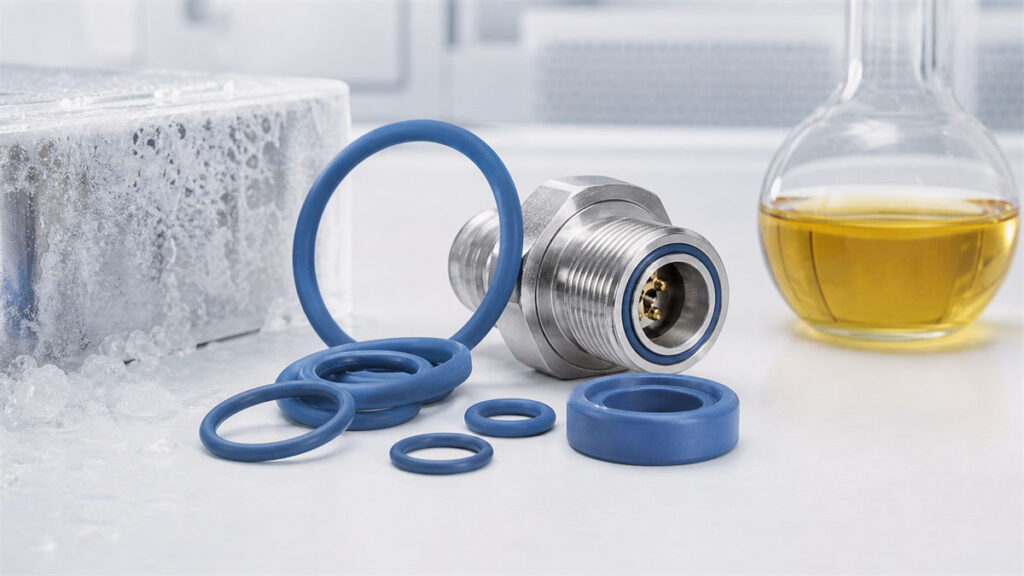
Engineers usually consider fluorosilicone when standard silicone cannot tolerate fuel or oil. The difficulty is separating the polymer’s broad reputation from the behavior of a specific compound.
Fluorosilicone properties combine silicone-like low-temperature flexibility with improved resistance to fuels, oils, and many non-polar solvents. Its main limits are abrasion, friction, tear strength, dynamic sealing, and chemical compatibility outside hydrocarbons.
What Is Fluorosilicone Rubber?
Fluorosilicone rubber is a silicone elastomer modified with fluorinated side groups, commonly trifluoropropyl groups. This modification reduces interaction with hydrocarbon fluids while retaining much of silicone rubber’s temperature flexibility and weather resistance.
The common designation is FVMQ, short for fluorovinyl methyl silicone rubber. ASTM D1418 identifies the polymer as FVMQ. Under ASTM D2000 and SAE J200, fluorosilicone compounds are generally classified as Type FK.
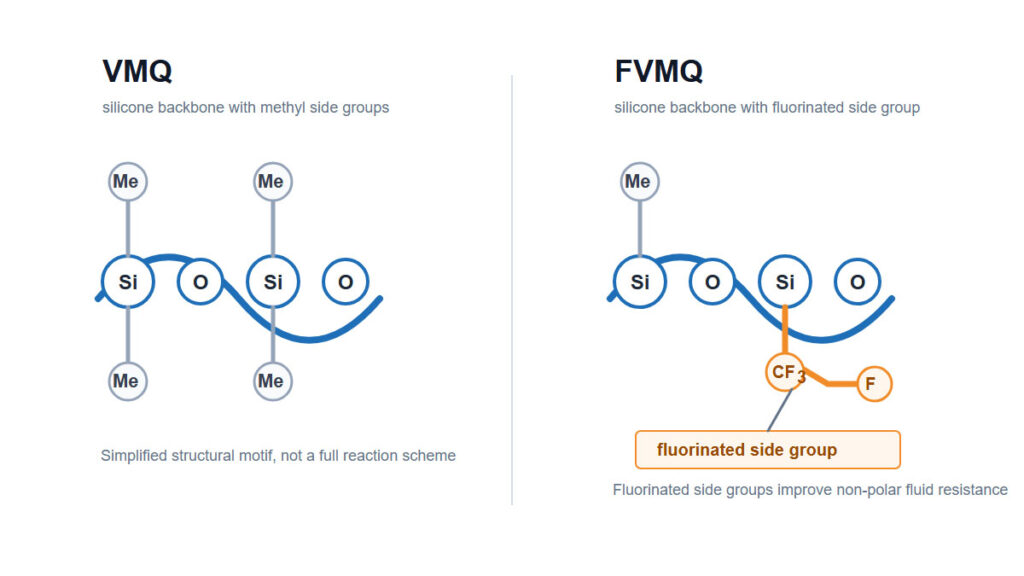
FVMQ should not be confused with FKM. Both are fluorinated elastomers, but their polymer backbones, low-temperature behavior, processing, and sealing limits are different.
Which Fluorosilicone Properties Matter Most?
The main value of FVMQ is not one isolated property. It is the combination of low-temperature elasticity and hydrocarbon-fluid resistance.
| Property | Typical behavior | Design implication |
|---|---|---|
| Service temperature | Common compound guidance is roughly -60°C to 200°C | Wide range, but fluid exposure and seal motion can reduce the usable limit |
| Fuel and oil resistance | Better than standard VMQ silicone | Suitable for many petroleum fuels, jet fuels, engine oils, and lubricants after compatibility testing |
| Low-temperature flexibility | Strong relative to many hydrocarbon-resistant elastomers | Useful for aerospace and outdoor seals exposed to cold starts |
| Compression set | Often good in static sealing compounds | Must be checked at the actual temperature, squeeze, and exposure time |
| Weather, ozone, and UV resistance | Generally strong | Suitable for exposed gaskets and connector seals |
| Abrasion resistance | Poor | Avoid sliding contact unless testing supports the design |
| Friction | Relatively high | Increases risk in reciprocating or rotary seals |
| Tear strength | Compound-dependent; often lower than tougher dynamic-seal elastomers | Thin lips, sharp corners, and rough installation surfaces require caution |
| Cost | Higher than standard silicone | Use it where fluid resistance is required, not as a default upgrade |
These are selection tendencies, not purchasing specifications. Filler system, fluorine content, cure system, post-cure, hardness, and test method can move the result significantly.
What Temperature Range Can Fluorosilicone Handle?
A practical starting range for many FVMQ compounds is about -60°C to 200°C. Specialized O-ring compounds may remain functional near -73°C in static service. Published dry-heat limits can also reach about 200°C, but the same number should not be applied automatically to a seal immersed in fuel or oil.
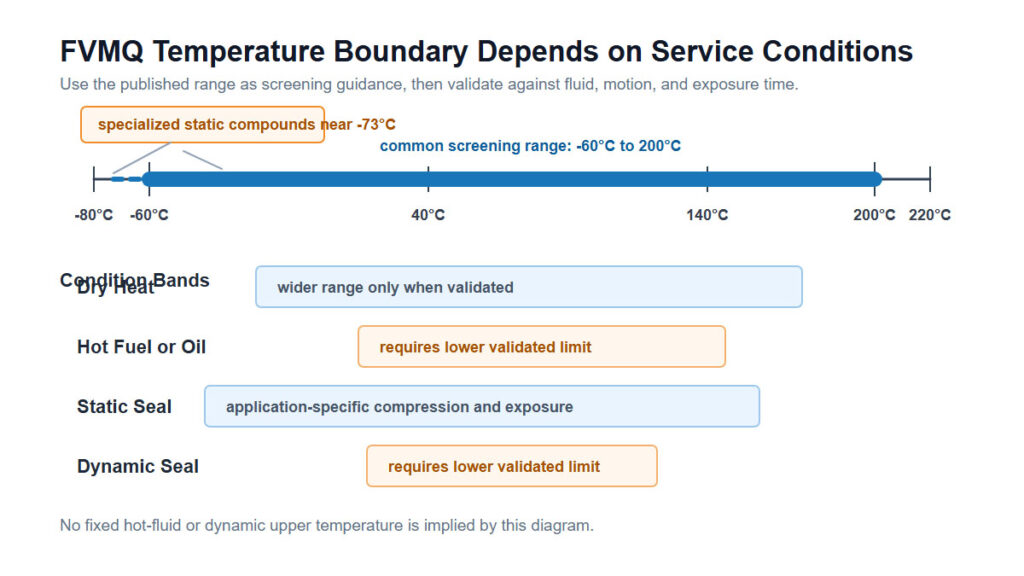
The boundary changes with:
- continuous versus intermittent exposure;
- dry air versus fuel, lubricant, or solvent immersion;
- static compression versus repeated movement;
- seal cross-section and compression;
- compound formulation and post-cure;
- the condition of the fluid after thermal aging.
At high fluid temperatures, the fluid itself may oxidize or form acidic by-products. A compound that passes dry-heat aging can still lose sealing performance in an aged lubricant. For this reason, temperature and chemical resistance should be tested together rather than approved from two separate data-sheet columns.
How Resistant Is Fluorosilicone to Fuel and Oil?
Fluorosilicone is selected primarily for resistance to gasoline, jet fuel, petroleum oils, engine oils, transmission fluids, and many non-polar solvents. It usually swells less than standard silicone in these fluids.
The word “resistant” still needs a number. Volume swell, hardness change, tensile retention, elongation retention, and mass change should be measured after a defined immersion period.
Published data from the Dow fluorosilicone product selection guide show how formulation changes the result. Selected solid FVMQ bases recorded approximately 15–23% volume swell in ASTM reference fuels under the listed conditions. Certain compounds showed about 3.5–4% swell in IRM 903 oil at 150°C. These values belong to those named materials and test conditions; they are not universal FVMQ limits.
Fluids that still require caution
FVMQ is not chemically universal. Published selection guides commonly warn against brake fluids, ketones, hydrazine, aldehydes, and amines. Mixed fluids are more difficult because a small additive package can control swelling or extraction even when the base fluid appears compatible.
Before specifying FVMQ, identify:
- the exact commercial fluid or fuel grade;
- operating and cleaning temperatures;
- continuous exposure time;
- pressure and decompression cycles;
- allowable volume swell and hardness change;
- whether the part contacts fresh or thermally aged fluid.
What Are the Typical Mechanical Properties of FVMQ?
Mechanical properties vary too widely for one “typical” data sheet to represent the polymer. A useful illustration comes from Dow’s solid FVMQ portfolio after the stated press-cure and post-cure conditions.
| Property | Published range across selected Dow FVMQ bases | Test method |
|---|---|---|
| Hardness | 25–81 Shore A | ASTM D2240 |
| Tensile strength | 7.5–12.1 MPa | ASTM D412, Die C |
| Elongation at break | 159–676% | ASTM D412, Die C |
| Tear strength | 12–46.4 kN/m | ASTM D624, Die B |
| Specific gravity | 1.40–1.55 | ASTM D792 |
| Compression set | 7–20% after 22 h at 177°C | ASTM D395, Method B |
This table shows the compound range, not a guaranteed specification. A soft 25 Shore A grade and an 80 Shore A grade should not share the same gland design, tear allowance, or assembly method.
Teams often focus on tensile strength because it is easy to compare. For a static gasket, compression set, stress relaxation, fluid swell, and sealing force are usually more relevant. Tensile strength becomes critical during demolding, assembly, stretching over hardware, or pressure extrusion—not necessarily during steady static sealing.
Is Fluorosilicone Suitable for Dynamic Seals?
Fluorosilicone is usually better suited to static seals, gaskets, diaphragms, connector seals, and cushioning parts than to continuously sliding seals.
The limitation comes from the combination of relatively low abrasion resistance, high friction, and compound-dependent tear strength. A seal may pass an initial leakage test and then wear at the contact surface after repeated strokes. That delayed change is why a static material approval should not be reused for a reciprocating or rotary application.
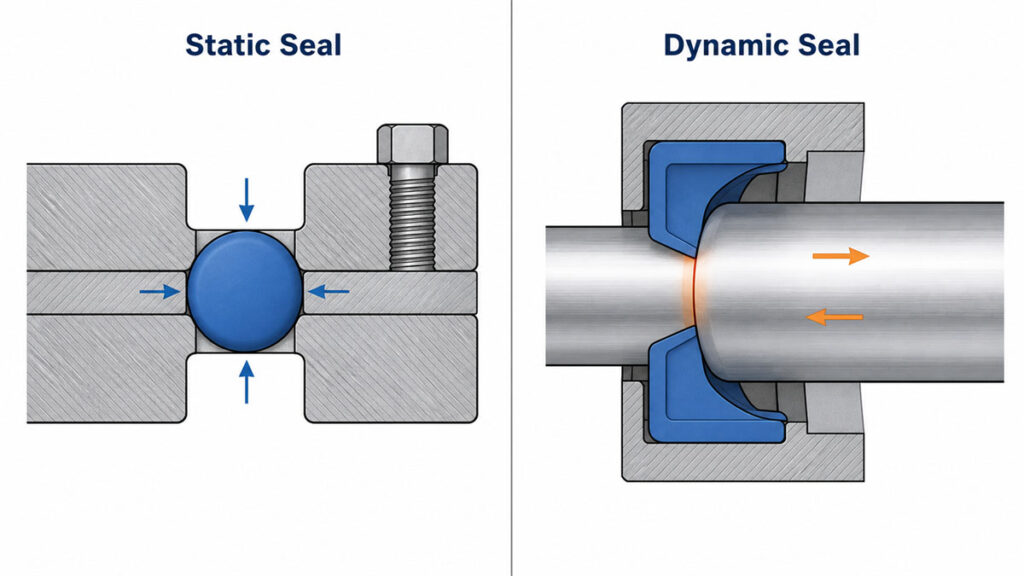
Dynamic use is possible with a purpose-designed compound, controlled surface finish, suitable lubrication, and validation testing. It should be treated as an engineered exception rather than the default.
How Does Fluorosilicone Compare with Silicone and FKM?
| Selection factor | VMQ silicone | FVMQ fluorosilicone | FKM fluoroelastomer |
|---|---|---|---|
| Low-temperature flexibility | Excellent | Excellent to very good | Usually more limited; grade-dependent |
| Fuel and hydrocarbon resistance | Limited | Good for many fuels and oils | Usually strong, but exact fluid compatibility varies |
| Dry-heat resistance | Strong | Strong, often below comparable VMQ limits | Strong; grade-dependent |
| Abrasion and dynamic sealing | Limited | Limited | Often more suitable, subject to compound and design |
| Weather and ozone resistance | Excellent | Excellent | Excellent |
| Relative material cost | Lower | High | High |
| Common use | General seals, insulation, food-contact and consumer parts | Cold-service fuel seals, aerospace gaskets, connector seals | Fuel, oil, and chemical seals where low-temperature flexibility is less demanding |
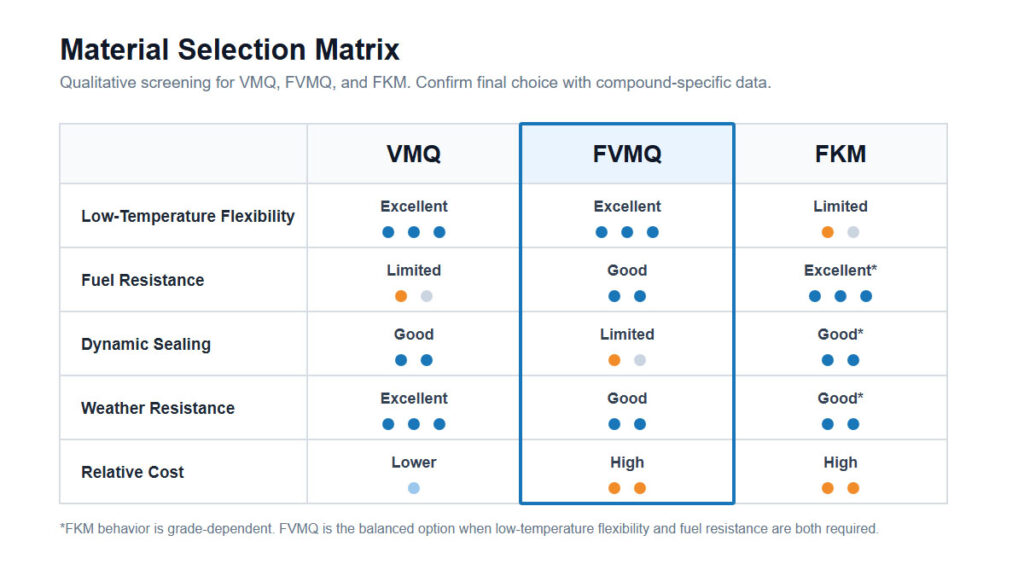
Choose VMQ when extreme temperature flexibility is needed but hydrocarbon exposure is not severe. Choose FVMQ when the part must remain flexible in cold conditions while contacting fuel or oil. Evaluate FKM when stronger chemical resistance, abrasion performance, or dynamic-seal capability matters more than very-low-temperature flexibility.
This comparison is a screening tool. Final selection requires compound-level test data because specialized grades can reverse the general ranking.
Which Tests Should Be Included in an FVMQ Specification?
A usable fluorosilicone specification connects each property to a test method and aging condition.
| Requirement | Test method | What to record |
|---|---|---|
| Hardness | ASTM D2240 | Shore A value and measurement time |
| Tensile and elongation | ASTM D412 | Original and aged values |
| Tear strength | ASTM D624 | Die type and sample thickness |
| Compression set | ASTM D395 | Method, compression, time, and temperature |
| Fluid resistance | ASTM D471 | Exact fluid, temperature, duration, volume swell, and property change |
| Specific gravity | ASTM D792 | Compound consistency and receiving-inspection reference |
| Low-temperature sealing | Application-specific or required aerospace method | Leakage or recovery at the actual minimum temperature |
| Finished-part dimensions | Drawing and inspection plan | Tolerance after post-cure and conditioning |
Do not accept a requirement such as “fuel-resistant fluorosilicone, 60 Shore A” as a complete material specification. It leaves the fluid, temperature, aging time, swell limit, cure condition, and finished-part acceptance undefined.
How Do Processing Conditions Change Fluorosilicone Properties?
FVMQ is available as high-consistency rubber for compression molding, transfer molding, injection molding, extrusion, and calendering. Fluoro-liquid silicone rubber is also available for automated liquid injection molding.
Cure and post-cure conditions affect compression set, volatile content, dimensions, and final mechanical properties. In Dow’s published solid-rubber data, many properties were measured after a 10-minute press cure at 171°C followed by 4 hours at 200°C. Those conditions describe the tested samples; they should not be copied into a production specification without reviewing part thickness, cure chemistry, oven loading, and dimensional tolerance.
Fluorosilicone compounds may also shrink differently from nitrile rubber or standard silicone. Reusing an existing mold can produce dimensional drift even when the nominal part geometry is unchanged. Tooling allowance should therefore be based on the selected compound and trial data.
Where Is Fluorosilicone Commonly Used?
FVMQ is most useful where temperature range and hydrocarbon resistance are required at the same time.
Typical parts include:
- aerospace fuel-system silicone O-rings and gaskets;
- automotive fuel-line connector seals;
- diaphragms and membranes exposed to oil or fuel;
- electrical connector inserts and environmental seals;
- turbocharger-hose liners;
- oil, gas, and petrochemical sealing elements;
- low-temperature industrial gaskets;
- conductive fluorosilicone EMI gaskets for fuel-exposed enclosures.
The material is less convincing for high-wear dynamic seals, aggressive polar solvents without compatibility data, or projects where standard silicone already meets the fluid requirement.
Fluorosilicone Properties FAQ
Is fluorosilicone the same as FKM?
No. FVMQ is a fluorinated silicone elastomer. FKM is a carbon-backbone fluoroelastomer. FVMQ generally provides better low-temperature flexibility, while FKM is often selected for stronger chemical or dynamic-seal performance.
Is fluorosilicone fuel resistant?
Yes, many FVMQ compounds resist gasoline, jet fuel, and petroleum oils better than standard silicone. Approval still requires ASTM D471 or application-specific immersion testing in the exact fluid.
What is the normal hardness range of fluorosilicone?
Commercial grades commonly fall around 40–80 Shore A, although specialized formulations can extend below this range. Hardness alone does not predict compression set, tear strength, or fuel swell.
Can fluorosilicone be used at 200°C?
Some compounds can operate near 200°C in dry heat. Continuous service in hot fuel or oil may require a lower limit because the fluid and elastomer age together.
The Selection Boundary
Fluorosilicone is justified when low-temperature sealing and hydrocarbon resistance are both required. If only one condition exists, VMQ, FKM, NBR, or another elastomer may reach the requirement at lower cost or with better wear behavior.
A final material decision needs the exact fluid, continuous and peak temperatures, seal motion, pressure, hardness target, compression-set limit, expected service life, and required standard such as MIL-DTL-25988 or an applicable AMS specification. Without those inputs, “FVMQ” is only a polymer family—not a finished-part specification.