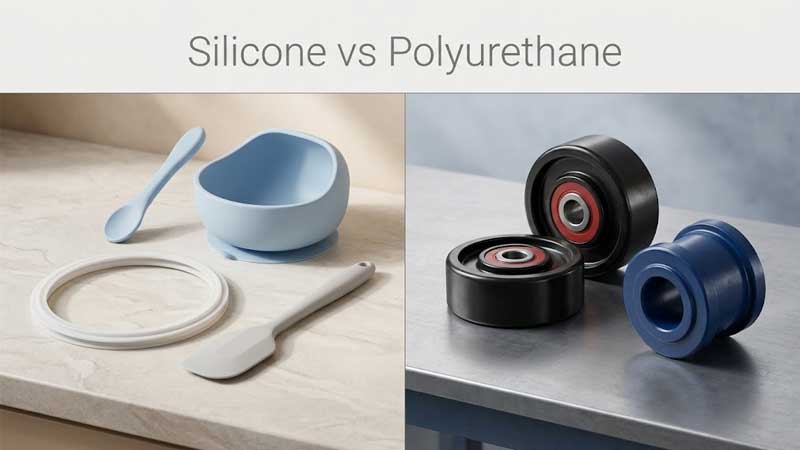
Choosing the right material is rarely a simple decision. In many projects, especially those involving sealing, flexibility, or mechanical stress, the choice often comes down to silicone or polyurethane (PU).
Both are elastomers. They can stretch, deform, and recover without breaking. At first glance, they seem similar. In practice, their behavior can be very different once you put them into real working conditions.
This article looks beyond basic definitions. It focuses on how these materials perform in actual applications, where they work well, and where they tend to fail. The goal is simple: help you make a clearer, more confident material choice.
Quick Comparison Table
| Property | Silicone Rubber | Polyurethane (PU) |
| Temperature Range | -40°C to 230°C | -30°C to 80°C |
| Tensile Strength | 5–12 MPa | 30–50 MPa |
| Elongation at Break | 150–800% | 300–600% |
| Abrasion Resistance | Low | Excellent |
| Flexibility | Excellent | Good |
| Chemical Resistance | Excellent (UV, ozone) | Excellent (oil, solvents) |
| Compression Set | Low | Medium |
| Water Resistance | Excellent | Good |
| Cost | Higher | Lower |
| Typical Use | Seals, medical, kitchenware | Rollers, wheels, industrial parts |
This table gives a quick overview, but the numbers only tell part of the story. For example, PU clearly wins in tensile strength, but that does not automatically make it better. If your part needs to flex repeatedly or handle high temperature, silicone will often last longer.
In real projects, the decision usually comes down to which stress matters more: heat, load, friction, or environment.
What Is Silicone?
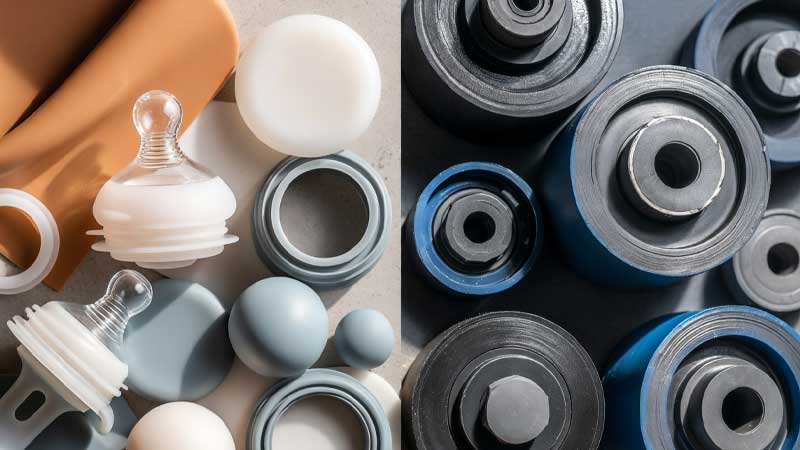
Silicone is a synthetic material made from silicon, oxygen, carbon, and hydrogen. It stays flexible across a wide temperature range and handles UV, ozone, and aging very well.
You will often see it used in seals, medical parts, kitchen products, and electronics, especially where flexibility and stability matter more than strength.
What Is Polyurethane?
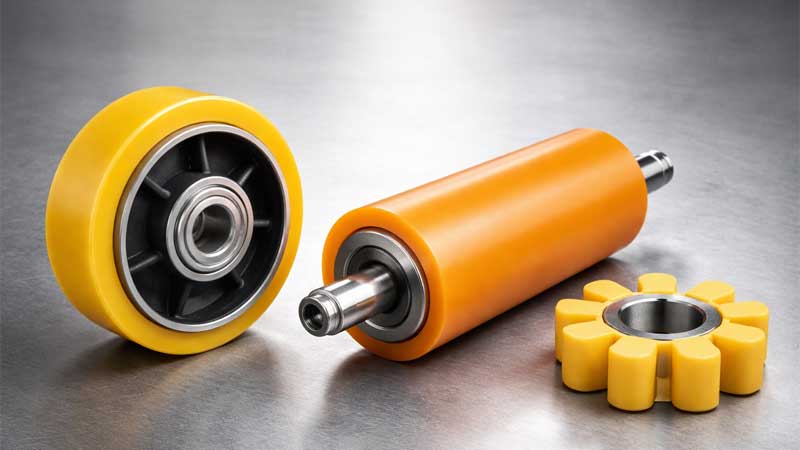
Polyurethane is a versatile polymer that can be made soft or rigid, depending on the formulation. It is known for strength, toughness, and resistance to wear.
It is widely used in rollers, wheels, coatings, bushings, and industrial components, where parts need to handle repeated stress or friction.
Key Differences Between Silicone and Polyurethane
This is where the real decision happens. Instead of looking at properties in isolation, it helps to see how they behave under different conditions.
Temperature Resistance
| Material | Working Range | Practical Impact |
| Silicone | -40°C to 230°C | Stable in extreme heat and cold |
| PU | -30°C to 80°C | Limited in high-temperature environments |
Explanation: Temperature is often the first filter. If the part sits near heat sources, silicone is usually the safer choice. PU can perform well at room temperature, but once heat builds up, it may soften or lose shape over time.
Mechanical Strength and Load Bearing
| Property | Silicone | PU |
| Tensile Strength | Lower | Much higher |
| Tear Resistance | Moderate | High |
| Load Capacity | Limited | Strong |
Explanation: PU handles force better. It resists tearing and performs well under repeated load. That is why it is commonly used in wheels, rollers, and structural parts.
Silicone, on the other hand, is not designed for heavy load. It performs better when the focus is sealing, flexibility, or temperature stability.
Abrasion and Wear Resistance
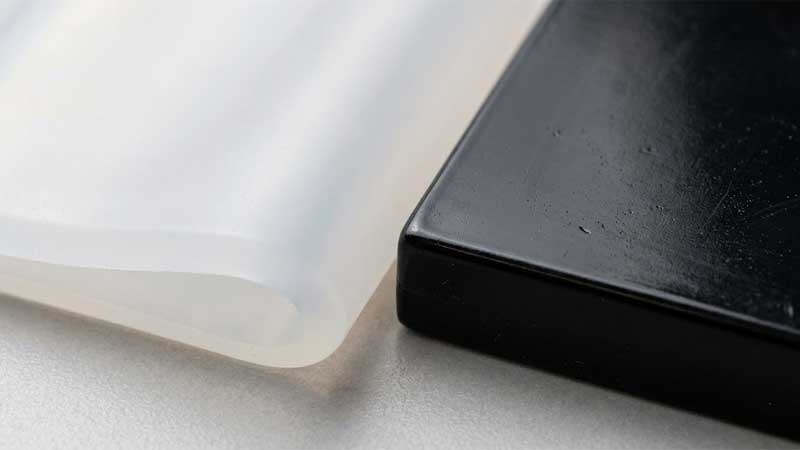
- PU performs very well in high-friction environments
- Silicone wears faster under continuous contact
In practice: If a part slides, rolls, or rubs against another surface, PU will usually last longer. Silicone can still work, but it may need replacement sooner.
Chemical and Environmental Resistance
| Condition | Silicone | PU |
| UV / Sunlight | Excellent | Moderate |
| Ozone / Aging | Excellent | Moderate |
| Oils & Grease | Good | Excellent |
| Solvents | Moderate | Good |
Explanation: Silicone holds up better outdoors. It resists UV and aging without cracking. PU performs better in oily or chemically active environments, especially in machinery.
Flexibility and Shape Recovery
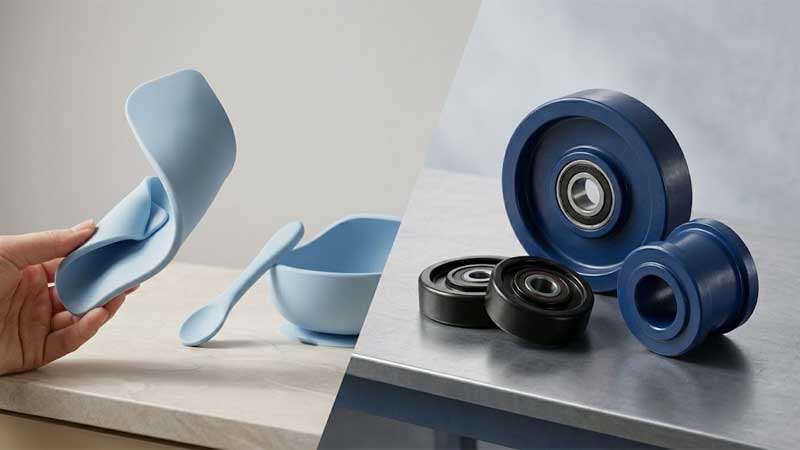
- Silicone is softer and more elastic
- PU is firmer and more supportive
What this means: Silicone works well for tight seals or parts that need to bend often. PU is better when the part needs to hold its shape under pressure.
Compression Set
Compression set refers to how well a material returns to its original shape after being compressed.
- Silicone: better long-term recovery
- PU: may deform slightly over time
Why it matters: For seals or gaskets that stay compressed for long periods, silicone tends to maintain performance longer.
Cost and Processing
- PU is generally more cost-effective
- Silicone tends to cost more and cure slower
Practical note: If budget is tight and performance requirements allow, PU is often chosen. Silicone is usually selected when performance justifies the extra cost.
Common Failure Scenarios
| Material | Typical Issues |
| Silicone | Tears under heavy load, wears under friction |
| PU | Softens under heat, may degrade under long UV exposure |
Explanation: Most material problems come from mismatch, not quality. Silicone fails when used like a structural material. PU fails when exposed to heat or outdoor aging without proper formulation.
Application Comparison
| Application | Better Choice | Reason |
| Oven seal | Silicone | Heat resistance |
| Conveyor roller | PU | Load + wear resistance |
| Medical device | Silicone | Biocompatibility |
| Industrial wheel | PU | Strength and durability |
| Flexible tubing | Silicone | Elasticity |
| Protective pad | PU | Impact resistance |
Explanation: Looking at applications often makes the decision clearer. Instead of comparing properties, ask what the part actually needs to do.
Can Silicone and PU Be Used Together?
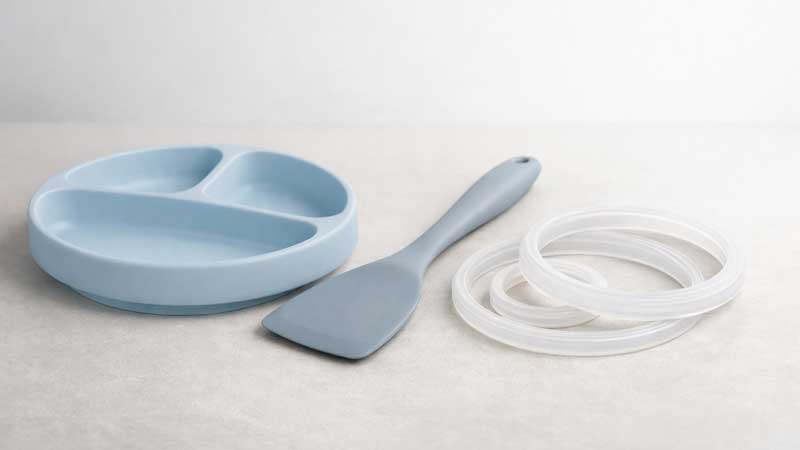
Yes, and this is more common than it may seem.
In some designs:
- Silicone is used on the surface for sealing or contact
- PU is used underneath for strength and support
This approach balances flexibility and durability without forcing one material to do everything.
FAQs
Is silicone stronger than polyurethane?
No. PU is stronger and more wear-resistant. Silicone is more flexible and heat-resistant.
Which material is better for outdoor use?
Silicone, because it resists UV, ozone, and aging better.
Which is better for sealing?
Silicone is usually preferred due to its flexibility and compression performance.
Can polyurethane be used for food applications?
Only if it is specifically formulated and certified. Silicone is more commonly used.
Which material cures faster?
PU typically cures faster than silicone, which may matter in production.
How to Choose the Right Material
Instead of asking which material is better, it helps to ask a few simple questions:
- Does the part face high temperature → choose silicone
- Does it carry load or face wear → choose PU
- Does it need flexibility or sealing → choose silicone
- Does it run in oil or under friction → choose PU
Most projects become clearer once the main stress factor is identified.
Conclusion
Silicone and polyurethane are both reliable materials, but they solve different problems. Silicone handles heat, flexibility, and aging. Polyurethane handles strength, wear, and load. The right choice depends less on the material itself, and more on how the part will be used. When the application is clear, the material decision usually follows naturally.