Shore A hardness is usually the most visible number on a silicone datasheet—and one of the most misunderstood.
Many teams treat it as a simple soft-versus-hard decision:
- Lower Shore A = softer feel
- Higher Shore A = better durability
In real applications, that linear logic often leads to sealing failures, user complaints, or parts that age far faster than expected.
Shore A hardness is not a single-performance attribute.
It simultaneously affects feel, sealing behavior, and long-term durability, and those effects frequently pull in different directions.
This guide helps engineers choose the correct silicone Shore A hardness for seals, gaskets, and consumer products.
What Shore A hardness actually measures (and what it doesn’t)
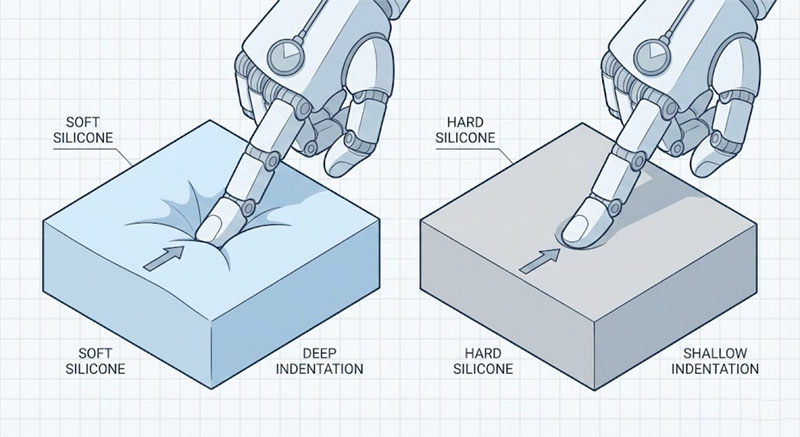
Shore A hardness measures a material’s resistance to short-duration, localized indentation under standardized conditions.
It can tell you:
- How “soft” a material feels at first touch
- Relative resistance to surface penetration
It does not directly tell you:
- Whether a seal will maintain contact over time
- How well the material recovers after long-term compression
- How it behaves after thermal aging or repeated cycling
That’s why two silicone parts with the same Shore A rating can perform very differently in real use.
How Shore A hardness affects feel
Feel is the area where Shore A is most often oversimplified.
The common mistake
“Users say it feels too hard—let’s drop Shore A by 10 points.”
Short-term, this often works.
Long-term, it frequently creates new problems.
What actually happens
- Low Shore A (20–30A)
- Very soft initial feel
- Higher risk of “skin drag” or tacky perception
- Surface chemistry and post-processing have outsized impact
- Mid Shore A (40–50A)
- Most stable perceived feel over time
- Slower user perception drift
- Common sweet spot for consumer-contact products
- High Shore A (60A+)
- Feels firm at first contact
- Can still feel compliant in thin-wall designs
- Relies more on geometry than material softness to tune feel
Key point:
Feel is the result of Shore A × geometry × surface condition, not hardness alone.
How Shore A hardness affects sealing
This is where Shore A selection causes the most expensive surprises.
Intuition vs reality
- Intuition: Softer seals better
- Reality: Too soft often fails sooner
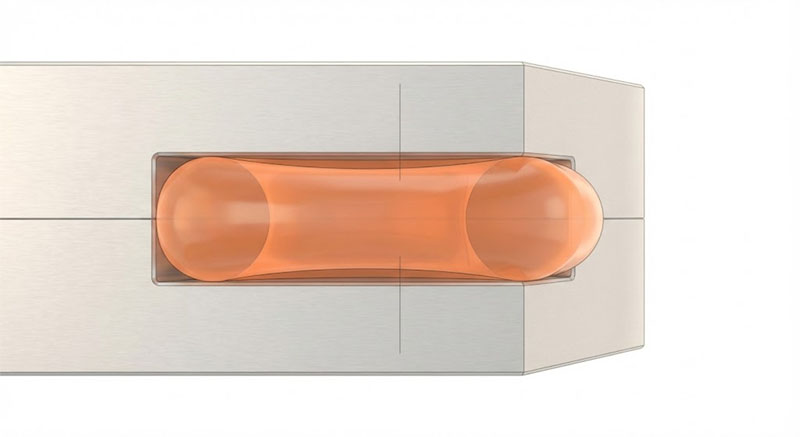
What sealing actually depends on
- Achieved compression
- Elastic recovery over time
- Tolerance to misalignment and variation
Performance by hardness range
- Low Shore A
- Excellent initial sealing
- Higher risk of extrusion, shear, or permanent set
- Seal force drops quickly after heat or aging
- Mid Shore A
- Most consistent long-term sealing
- Wider tolerance window in assembly
- Dominant range for gaskets and O-rings
- High Shore A
- Requires higher assembly force
- Maintains sealing force better over time
- Preferred for dynamic or higher-pressure applications
Rule of thumb:
Most seal failures are not caused by being “too hard,” but by not recovering after compression.
How Shore A hardness affects durability
Durability is where Shore A behavior becomes non-linear.
Two common misconceptions
- Harder always lasts longer
- Softer always wears out faster
Neither is reliably true.
What actually happens
- Low Shore A
- More prone to fatigue cracking
- Greater sensitivity to oils, sweat, and cleaning agents
- Slower shape recovery
- Mid Shore A
- Best balance of fatigue resistance and elasticity
- Aging effects are more predictable
- Widest and most forgiving process window
- High Shore A
- Strong resistance to tearing and extrusion
- More stable under high-frequency cyclic loads
- Can show brittleness sooner in thin-wall designs
Durability isn’t about surviving one cycle—it’s about behaving acceptably after hundreds of thousands or millions of cycles.
Case study 1: 30A Silicone Seal Failure in Wearable Devices
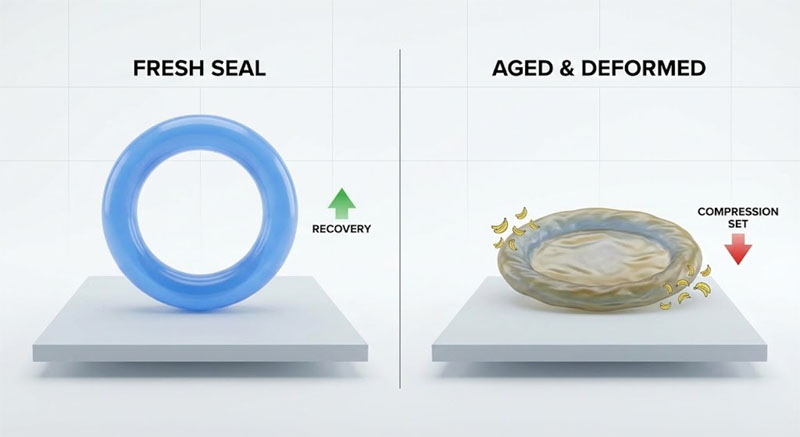
Application: Wearable device sealing ring
Initial choice: 30A (comfort-driven)
Observed issues
- Seal failure after 3–6 weeks
- User complaints of deformation and tackiness
Root cause
- Shore A too low for continuous compression
- Body temperature accelerated permanent deformation
Correction
- Increased hardness to 45A
- Minor cross-section geometry change
Result
- No noticeable loss in perceived comfort
- Service life increased by more than 4×
Case study 2: Harder fixed the seal—not the leak
Application: Reusable food container
Initial choice: 35A
Observed issues
- Leakage after hot-water use
- Loss of shape after repeated cycles
Adjustment
- Increased hardness to 55A
- Added compression preload
Result
- Stable sealing across temperature cycles
- Fewer user complaints due to reduced required closing force
How to select Shore A hardness correctly
Don’t start with hardness.
Start by answering these questions:
- What is the dominant failure mode? Leakage, collapse, fatigue, or feel complaints?
- What is the long-term mechanical state? Continuous compression, cyclic loading, thermal aging?
- Can geometry reduce material stress? Wall thickness, compression ratio, contact area?
Hardness selection should be the last step, not the first.
We prepared a table below summarizes typical Shore A trade-offs in silicone components
Silicone Shore A Hardness – Quick-Reference Selection Table
| Shore A Range | Feel & User Perception | Sealing Behavior | Durability & Aging | Typical Use Cases | Common Failure Risks |
|---|---|---|---|---|---|
| 20–30A | Very soft, compliant, high initial comfort | Excellent initial seal, poor long-term recovery | Fast compression set, fatigue cracking risk | Infant products, soft grips, low-load interfaces | Shape collapse, tackiness, seal loss after aging |
| 30–40A | Soft but more controlled feel | Good initial sealing, moderate stability | Sensitive to heat and continuous compression | Light-duty seals, comfort-driven consumer parts | Gradual sealing force decay, deformation |
| 40–50A | Balanced, stable over time | Most reliable long-term sealing | Best fatigue resistance, predictable aging | Gaskets, O-rings, wearables, consumer seals | Usually geometry-related, not material |
| 50–60A | Firm feel, still compliant in thin sections | Requires higher assembly force, stable seal | High resistance to extrusion and wear | Reusable containers, appliance seals | Assembly force complaints if geometry is wrong |
| 60–70A | Hard, precise tactile response | Strong sealing once compressed | Excellent tear resistance, may embrittle | Dynamic seals, higher pressure systems | Brittleness in thin walls, tolerance sensitivity |
The boundary most teams miss
Shore A hardness is a system variable.
It changes:
- How users perceive quality
- How sealing performance decays over time
- Whether failure is gradual—or sudden
When Shore A is wrong, problems rarely appear immediately.
They show up during validation, aging tests, or customer use—when changing hardness is already expensive.
That’s why Shore A selection is less about softness, and more about how the entire system behaves over time.
Click Silicone Shore A Hardness If you want to learn more basic information.