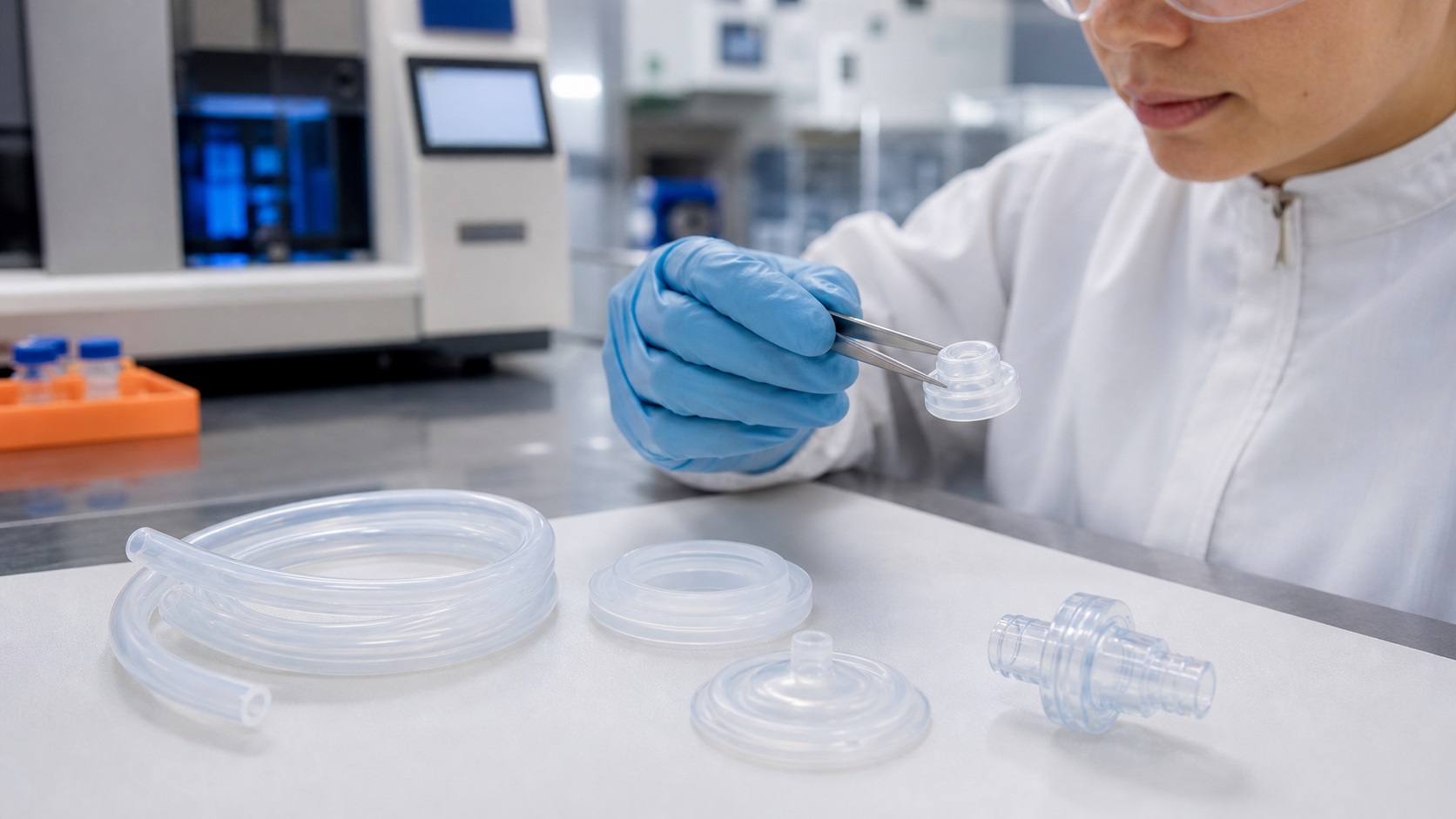
Silicone is often selected for medical devices because it is flexible, chemically stable, and available in tightly controlled formulations. The problem is that medical-grade silicone is frequently treated as a finished-device approval. It is not. Pigments, curing, post-curing, cleaning, sterilization, and contact conditions can all change the biological risk.
The biocompatibility of silicone is not an inherent pass/fail property. It is the biological safety of a specific finished device, evaluated for its formulation, manufacturing process, body-contact type, and exposure duration.
That distinction prevents a common sourcing error: approving a material certificate while leaving the molded component and its actual use conditions unevaluated.
What Does the Biocompatibility of Silicone Mean?
Biocompatibility means that a device performs its intended function without causing an unacceptable biological response under its defined conditions of use. It does not mean that the material is biologically invisible.
Silicone elastomers are based mainly on a siloxane backbone with organic side groups. These properties of silicone rubber support flexibility, thermal stability, and resistance to many aqueous environments. They explain why silicone is used in silicone tubing, gaskets, respiratory components, wound-contact products, and implantable devices.
They do not prove safety for every application. A skin-contact gasket, a fluid-path tube, and a long-term implant expose the body through different routes. The required evidence must change with the device.
Why Is Silicone Commonly Used in Medical Devices?
Silicone is useful because its mechanical and chemical behavior can remain stable across conditions that damage many organic elastomers.
Typical advantages include:
- flexibility across a broad temperature range;
- resistance to moisture and many common chemicals;
- compatibility with several sterilization methods, subject to formulation validation;
- low surface energy and easy release from tooling;
- availability as high-consistency rubber (HCR) and liquid silicone rubber (LSR).
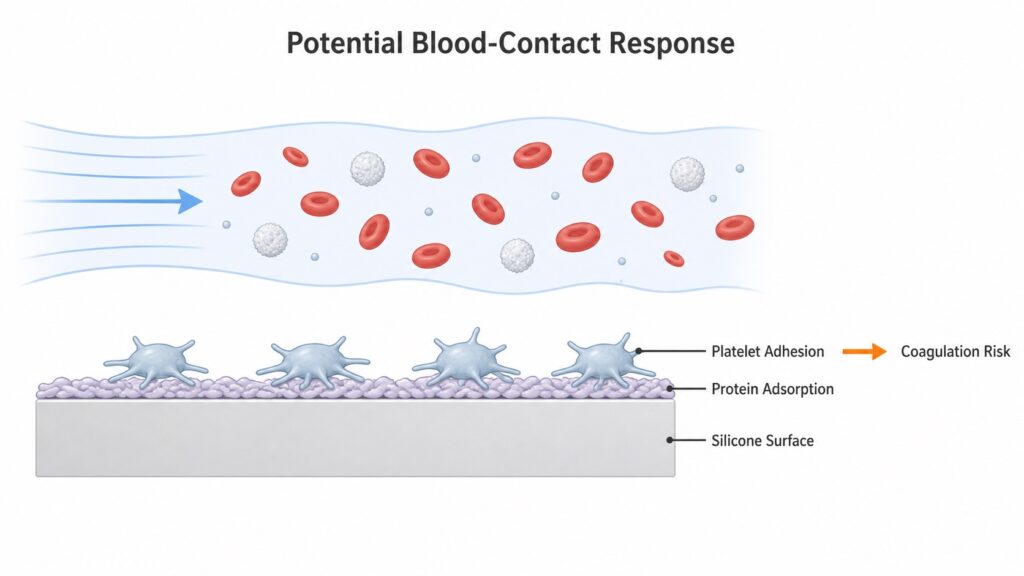
The same surface chemistry also creates limits. A review of PDMS in biomedical engineering notes that native PDMS is hydrophobic and that protein adsorption is a recurring limitation in biological applications. For blood-contacting devices, a review of material haemocompatibility describes how adsorbed plasma proteins can change conformation, promote platelet adhesion and activation, and contribute to coagulation and thrombus formation. Silicone is not automatically resistant to microbial colonization either: an ACS Omega study of silicone urinary-catheter materials observed P. mirabilis adhesion and biofilm development on conventional silicone surfaces, while showing that surface modification changed the outcome. “Inert” is therefore a useful shorthand, not a complete biological assessment.
Is Medical-Grade Silicone Automatically Biocompatible?
No. “Medical grade” normally describes a supplier-controlled formulation supported by traceability and selected test data. It does not replace evaluation of the finished device.
ASTM F2038, which covers silicone formulations used in medical applications, states that biological suitability must ultimately be assessed relative to intended use. This is the correct procurement boundary.
A previously tested silicone can produce a different risk profile after any of the following changes:
| Change | What can change biologically |
|---|---|
| Pigment or masterbatch | New colorants, carriers, or impurities enter the formulation |
| Cure cycle | Residual reactive species or incomplete crosslinking may increase |
| Post-cure | Volatile residues and extractable profile may change |
| Mold-release agent | Surface residues may be introduced |
| Cleaning process | Detergent residues or particulate contamination may remain |
| Sterilization | Polymer properties or extractables may shift after EtO, radiation, steam, or repeated cycles |
| Supplier or production site | Raw-material controls and contamination routes may change |

This is why a certificate from the raw-material supplier is supporting evidence, not a finished-device conclusion.
How Do Platinum and Peroxide Curing Affect Silicone Biocompatibility?
The platinum and peroxide cure systems affect residue control, but they do not decide biocompatibility on their own. A validated peroxide-cured component can be suitable, while a poorly processed platinum-cured component can still fail biological or chemical evaluation.
| Factor | Platinum-cured silicone | Peroxide-cured silicone |
|---|---|---|
| Main reaction | Addition cure by hydrosilylation | Free-radical crosslinking |
| Reaction by-products | No stoichiometric reaction by-products | Peroxide decomposition products can remain |
| Typical residue concern | Unreacted low-molecular-weight species, catalyst-related impurities, processing contamination | Volatile decomposition products, odor, and residual peroxide-related species |
| Post-cure decision | Application- and formulation-dependent | Commonly used to reduce volatile residues and stabilize properties |
| Selection logic | Often preferred for low-extractable fluid paths and tightly controlled medical molding | Can remain suitable where the formulation and post-cure process are validated |
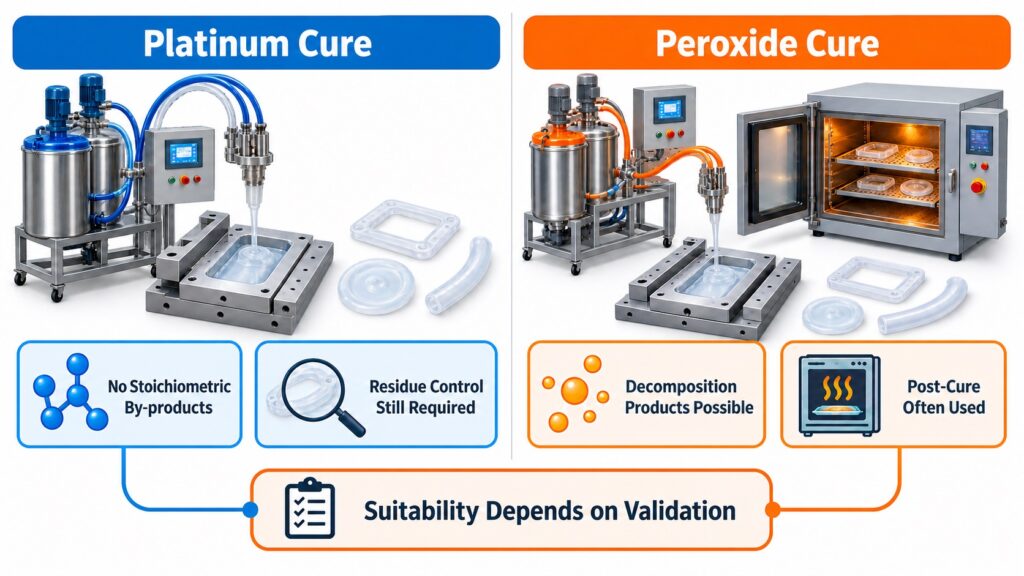
The production question is not simply “platinum or peroxide?” It is whether cure temperature, time, part thickness, oven loading, airflow, and post-cure exposure are controlled and documented.
Thick sections heat and vent differently from thin test plaques. A post-cure validated on a laboratory slab cannot be assumed to remove volatiles from a complex molded component at the same rate. Teams often miss this because the material certificate identifies the compound but does not capture the thermal history of the finished part.
How Is Silicone Biocompatibility Evaluated Under ISO 10993-1:2025?
ISO 10993-1:2025 treats biological safety as a risk-management process aligned with ISO 14971. It is not a fixed list of tests that every silicone device must complete.
For U.S. submissions, FDA partially recognized the 2025 edition on May 25, 2026. The recognition excludes specific provisions and continues to accept declarations of conformity to the 2018 edition during a transition period ending July 1, 2029. Publication of the ISO edition therefore does not mean every clause is automatically accepted by FDA.
The evaluation starts with four inputs:
- the complete material and formulation;
- the manufacturing and sterilization processes;
- the nature of body contact;
- the duration of contact.
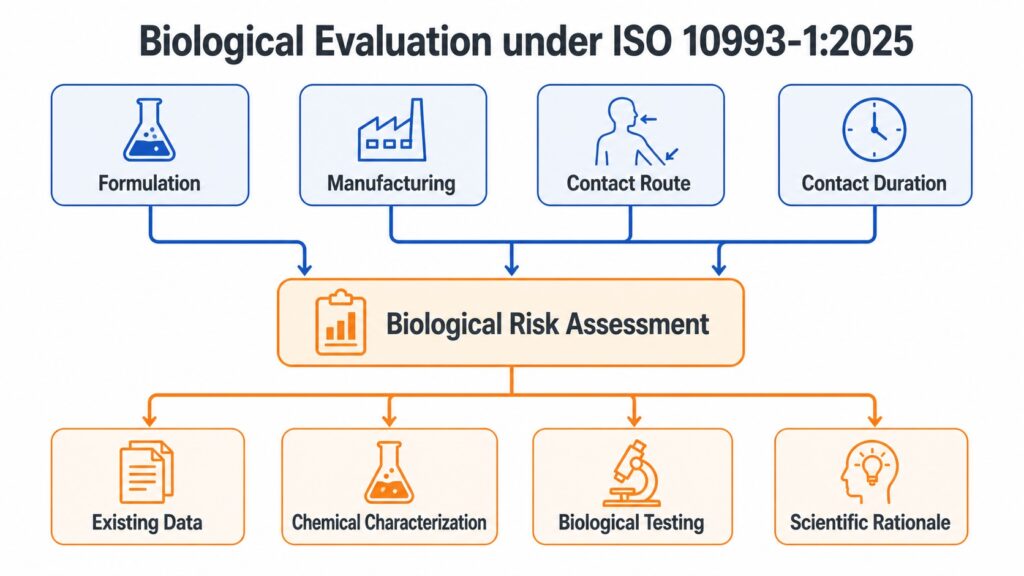
The current framework classifies devices by contact route, such as surface contact, external communication, or implantation. Contact duration and device-specific hazards then determine which biological endpoints must be addressed.
The FDA endpoint framework remains a useful U.S. planning reference, but it is based on FDA’s September 2023 guidance. Its endpoint tables are a framework, not a testing checklist. Any differences between that guidance, FDA’s partial recognition of the 2025 edition, and device-specific requirements must be resolved for the submission; existing data, chemical characterization, testing, or a scientific rationale may be used to address an endpoint.
Which ISO 10993 Tests May Apply?
The applicable endpoints depend on the device. Common references include:
| Evaluation area | Common standard | What it addresses |
|---|---|---|
| Cytotoxicity | ISO 10993-5 | Adverse effects on cultured cells |
| Skin sensitization | ISO 10993-10:2021 | Potential to cause sensitization |
| Irritation | ISO 10993-23:2021 | Irritation potential for relevant contact routes |
| Chemical characterization | ISO 10993-18:2020 • Amd 1:2022 | Identification and quantification of device constituents and extractables |
| Toxicological risk assessment | ISO 10993-17:2023 • Amd 1:2025 | Toxicological evaluation of identified constituents |
| Hemocompatibility | ISO 10993-4 | Interactions with blood |
| Implantation response | ISO 10993-6 | Local tissue response after implantation |
Cytotoxicity, sensitization, and irritation are frequently evaluated, but they are not a universal “three-test pass.” A blood-contacting tube may require hemocompatibility evidence. A long-term implant may require implantation, chronic toxicity, genotoxicity, and other endpoints. The device category controls the plan.
Why Does Chemical Characterization Come Before More Testing?
Chemical characterization helps identify what can migrate from the finished device. It can expose problems that a material name hides: low-molecular-weight siloxanes, catalyst residues, pigments, additives, cleaning residues, or sterilization-related compounds.
A practical sequence is:
- document the formulation and all processing aids;
- define clinically relevant extraction conditions;
- identify and quantify extractables under ISO 10993-18:2020/Amd 1:2022;
- assess toxicological risk under ISO 10993-17:2023/Amd 1:2025;
- use the remaining data gaps to justify biological testing.
This approach does not eliminate testing automatically. It prevents teams from running a standard panel before they understand what the device contains.
The test article must also represent production. If commercial parts are post-cured, cleaned, assembled, packaged, and sterilized, an unsterilized material plaque is usually a weak substitute. The biological evaluation should capture the processes that can alter patient exposure.
What Does USP Class VI Prove?
USP Class VI shows that a tested polymeric material met the biological reactivity requirements defined in USP General Chapter <88>. The program includes systemic injection, intracutaneous, and implantation testing under specified extraction conditions.
It does not establish complete device biocompatibility under ISO 10993-1.
| Claim | Correct interpretation |
|---|---|
| “The silicone is USP Class VI.” | A defined material or test article passed USP <88> under specified conditions |
| “The finished device is biocompatible.” | Requires device-specific evidence based on contact type, duration, processing, and intended use |
| “USP Class VI covers all contact durations.” | Incorrect; USP classification is not a substitute for an ISO 10993 endpoint assessment |
| “A supplier certificate is enough.” | Incorrect unless the regulatory strategy justifies equivalence to the finished device |
USP Class VI remains useful for material screening and supplier qualification. The common mistake is extending that result to pigments, molding, cleaning, sterilization, and final clinical exposure without a documented bridge.
Do Food-Contact Standards Prove Medical Biocompatibility?
No. GB 4806.16-2025 is a Chinese food-contact standard for silicone rubber, not a medical-device biocompatibility standard. The USDA Foreign Agricultural Service translation of the final standard confirms that it enters into force on September 2, 2026 and sets a volatile-substances limit of 0.5 g/100 g (0.5%), tested under Appendix B.
Food-contact compliance does not replace GB/T 16886, ISO 10993, or device-specific NMPA requirements. A migration result for utensils, molds, or feeding products cannot demonstrate safety for an implant or blood-contacting device.
Which Manufacturing Controls Protect the Test Result?
Biocompatibility evidence is only reusable while the tested configuration remains controlled.
Material and Mixing Controls
Record the silicone grade, lot, pigment ratio, additive identity, and mixing history. Do not substitute a color masterbatch because the base polymer is unchanged. The carrier and pigment system become part of the biological evaluation.
Cure and Post-Cure Controls
Define mold temperature, cure time, part thickness range, post-cure temperature, exposure time, oven loading, and airflow. For multi-cavity tools, confirm that all cavities receive an equivalent process window.
Cleaning and Handling Controls
Control mold-release agents, detergents, rinse quality, gloves, containers, and storage time. A clean raw material can be contaminated after demolding.
Sterilization Controls
Evaluate the actual sterilization method and maximum validated cycles. EtO residuals, radiation dose, and steam exposure introduce different questions. A device tested before sterilization may not represent the released product.
Change Control
Trigger a biological-risk review when the formulation, supplier, site, tooling, cure cycle, cleaning agent, packaging, sterilization method, or intended contact changes. A change does not always require repeating every test. It does require a documented assessment.
What Should Buyers Request From a Silicone Component Supplier?
Use a short evidence package instead of asking whether the supplier offers “medical silicone.”
- exact silicone grade and manufacturer;
- lot traceability and certificate of analysis;
- formulation disclosure or regulatory master-file support where applicable;
- cure system and validated cure/post-cure parameters;
- pigment and additive identification;
- relevant USP <87>/<88> or ISO 10993 reports, including the tested article;
- extractables and leachables data where the contact route warrants it;
- sterilization compatibility data for the intended method;
- cleaning, packaging, and contamination controls;
- written change-notification agreement.
The report should match the supplied part closely enough to support equivalence. Check the material grade, color, manufacturing process, sterilization state, extraction conditions, and report date. A report carrying the correct standard number can still be unusable if the tested sample is not representative.
Frequently Asked Questions
Is silicone always safe for skin contact?
No. Silicone safety depends on formulation, processing residues, additives, and contact conditions; the finished device still requires its own assessment.
Is platinum-cured silicone required for medical devices?
No. Platinum cure is often selected for low-extractable applications, but the requirement comes from the device specification and biological-risk assessment. A validated peroxide-cured formulation may also be suitable.
Can USP Class VI replace ISO 10993 testing?
No. USP Class VI can support material selection. It does not replace a device-specific ISO 10993-1 biological evaluation.
Should the raw material or finished part be tested?
The finished, processed device—or a scientifically justified representative test article—provides the strongest evidence. It should include relevant curing, cleaning, assembly, packaging, and sterilization steps.
Define the Contact Before Selecting the Test Plan
A supplier cannot define a defensible silicone biocompatibility package from the polymer name alone. The minimum inputs are the body-contact route, contact duration, device geometry, formulation, processing aids, sterilization method, target market, and whether the part is supplied as a component or finished device.
Without those inputs, requesting “ISO 10993 silicone” only transfers an undefined requirement into purchasing. The material may be appropriate. The evidence may still be wrong for the device.