A silicone seal can stop liquid water and still allow oxygen, carbon dioxide, or water vapor to pass through its bulk. That apparent contradiction causes specification errors in sealed housings, membranes, silicone tubing, and pressure-sensitive products.
Silicone permeability is relatively high because gas molecules dissolve into the elastomer and diffuse through free volume between its mobile siloxane chains. It is liquid-resistant, but it is not automatically a gas or vapor barrier.
This article explains the material behavior, the variables that change transmission, and the limits engineers should define before selecting a silicone compound.
What Is Silicone Permeability?
Silicone permeability is the rate at which a specific gas or vapor passes through silicone under defined conditions. It is a bulk-material property. It is not the same as leakage through a gap, parting line, damaged seal, or poorly compressed silicone O-ring.
Permeation occurs in three stages:
- The gas dissolves into the high-pressure side of the silicone.
- Molecules diffuse through free volume in the polymer network.
- The gas leaves the low-pressure surface.

For a homogeneous membrane at steady state, the relationship can be simplified as:
Gas flow ∝ permeability × area × pressure difference ÷ thickness
This equation separates two terms that are often mixed together:
| Term | What it describes | Does geometry affect it? |
|---|---|---|
| Permeability | An intrinsic property for a defined material, gas, and temperature | No, when correctly normalized |
| Permeance | Permeability divided by membrane thickness | Yes |
| Gas transmission rate | Gas volume passing through a defined specimen over time | Yes—area and thickness matter |
| Leakage rate | Flow through an opening, interface, or sealing defect | Controlled mainly by seal design and defects |
A low measured enclosure leak rate does not prove that long-term gas permeation is negligible. Leak testing and permeability testing answer different questions.
Why Is Silicone Rubber Highly Permeable?
Silicone rubber has a flexible –Si–O–Si– backbone, low intermolecular forces, and high chain mobility. These characteristics create more transient free volume than is present in many hydrocarbon rubbers and thermoplastics. Gas molecules can move from one temporary opening to another.
Permeability is the product of two material interactions:
P = D × S
Pis permeability.Dis the diffusion coefficient.Sis gas solubility in the polymer.
Molecular size affects diffusion, but size alone does not determine the result. Gas-polymer solubility can dominate. Carbon dioxide, for example, can permeate dimethyl silicone faster than smaller gases because it is substantially more soluble in the polymer.
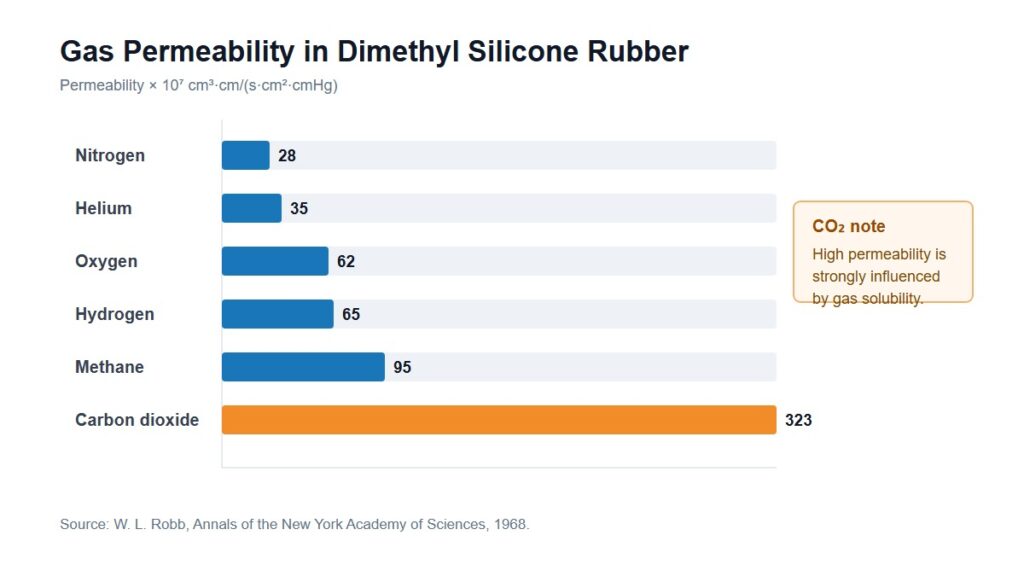
Published reference data for dimethyl silicone illustrate the difference. Values vary by formulation and test condition, so the table is useful for relative comparison—not as a finished-part specification.
| Gas | Permeability × 10⁹ cm³·cm/(s·cm²·cmHg) | Diffusivity × 10⁶ cm²/s | Solubility, cm³(STP)/(cm³·atm) |
|---|---|---|---|
| Nitrogen | 28 | 15 | 0.15 |
| Helium | 35 | 60 | 0.045 |
| Oxygen | 62 | 16 | 0.31 |
| Hydrogen | 65 | 43 | 0.12 |
| Methane | 95 | 13 | 0.57 |
| Carbon dioxide | 323 | 11 | 2.2 |
Source: W. L. Robb, Thin Silicone Membranes—Their Permeation Properties and Some Applications, Annals of the New York Academy of Sciences (1968).
The practical point is simple: “gas-tight silicone” is not a complete requirement. The gas species must be named.
Is Silicone Waterproof but Gas-Permeable?
Yes, but only if “waterproof” means resistance to bulk liquid penetration under the specified pressure and assembly conditions. Liquid water does not flow through intact silicone in the same way that a gas permeates through the polymer network.

Water vapor permeability is different. Individual vapor molecules can dissolve and diffuse through silicone. A silicone rubber sheet may therefore block rain or liquid splash while allowing moisture vapor transmission over time.
This distinction matters in:
- sealed electronics exposed to humidity cycling;
- wearable patches that need moisture management;
- medical and laboratory membranes;
- food or pharmaceutical closures requiring a defined water-vapor barrier;
- outdoor housings where internal condensation is the actual risk.
Do not use a water-immersion result as a substitute for water vapor transmission data. They measure different transport mechanisms.
Which Gases Permeate Silicone the Fastest?
Carbon dioxide commonly shows a higher transmission rate through VMQ than oxygen, nitrogen, helium, or hydrogen under comparable conditions. The sequence is compound- and temperature-dependent, but the difference is large enough to affect design decisions.
Research on silicone membrane structure shows that organic substituents along the polymer chain can materially change oxygen and nitrogen permeability. Larger alkyl, aryl, and trifluoropropyl groups generally reduce permeability relative to dimethyl silicone, although the result remains gas- and formulation-specific.
| Silicone type | Relative permeability tendency | Structural reason |
|---|---|---|
| VMQ | Generally high | Dimethyl siloxane structure retains high chain mobility and free volume |
| PVMQ | Often lower than comparable VMQ for specific gases | Phenyl substituents change chain packing, solubility, and diffusion |
| FVMQ | Commonly lower than general-purpose VMQ | Fluorinated side groups increase polarity and alter gas solubility |
The comparison shows why “silicone” is too broad for a technical drawing. VMQ, PVMQ, and FVMQ do not provide the same barrier behavior, and qualitative rankings cannot replace compound-specific test data.
What Changes Silicone Permeability?
The largest controls are gas type, silicone chemistry, temperature, thickness, exposed area, and partial-pressure difference. Compound formulation and surface treatment can also matter, but their effect must be verified on the actual material. For the broader mechanical, thermal, electrical, and chemical property envelope, see this complete guide to the properties of silicone rubber.
| Variable | Effect on permeability or total transmission | Specification implication |
|---|---|---|
| Gas species | Changes both solubility and diffusion | Test the actual gas or gas mixture |
| Silicone family | FVMQ and modified formulations can transmit less gas than general-purpose VMQ | Specify polymer family and grade |
| Temperature | Higher temperature generally increases chain mobility and transmission | Test at minimum and maximum service temperature |
| Thickness | Does not change intrinsic permeability; greater thickness reduces total flow | Control minimum finished thickness |
| Exposed area | Does not change intrinsic permeability; larger area increases total flow | Use effective exposed area in calculations |
| Partial-pressure difference | Greater differential increases gas flow | Define gas composition and pressure on both sides |
| Fillers | Can increase path tortuosity and reduce diffusion | Do not assume two compounds with the same hardness behave alike |
| Surface treatment | A silica-like oxidized surface can temporarily reduce oxygen diffusion | Define treatment, aging, and storage condition |
| Crosslink density | Often has less effect than expected within normal silicone formulation ranges | Do not use Shore hardness as a permeability proxy |

Does Higher Shore Hardness Reduce Permeability?
Not reliably. A harder compound may contain different filler levels or a different network structure, but Shore A hardness does not directly specify gas transmission.
This is a common selection error. Teams compare 40 Shore A and 70 Shore A sheets and assume the harder grade is automatically the better gas barrier. Published work on silicone rubber and untreated PDMS indicates that normal changes in crosslink density may have little effect compared with polymer chemistry, gas solubility, temperature, and fillers.
If permeability matters, request permeability or transmission data for the exact compound. Do not infer it from hardness, tensile strength, or compression set.
Does Temperature Increase Silicone Permeability?
Generally, yes. Higher temperature increases polymer-chain mobility and gas diffusivity. Lower temperature reduces free volume and molecular motion, although phase transitions and gas solubility can complicate the trend.
A room-temperature value is therefore weak evidence for a seal operating at 150°C. The part may still retain its mechanical properties while transmitting substantially more gas than expected. Material survival and barrier performance are separate requirements.
Does a Thicker Silicone Wall Stop Permeation?
A thicker wall reduces the transmission rate, but it does not turn silicone into a true barrier material. Under steady-state conditions, doubling thickness approximately halves flux when material, gas, area, temperature, and pressure difference remain unchanged.
Thickness also increases the time needed to approach steady-state flow. This can make a short test look better than long-term service. For storage, vacuum retention, or multi-day pressure hold, the test duration must be long enough to separate transient diffusion from steady-state behavior.
How Do VMQ, PVMQ, and FVMQ Compare?
The silicone polymer family changes both permeability and the other properties that justified choosing silicone.
| Material | Permeability tendency | Main reason to select it | Boundary to check |
|---|---|---|---|
| VMQ | High | General heat resistance, flexibility, electrical insulation, and broad processing availability | Weak choice when gas retention is the primary function |
| PVMQ | Lower than some VMQ grades, but still permeable | Low-temperature flexibility; phenyl groups suppress crystallization | Barrier performance remains formulation-dependent |
| FVMQ | Commonly lower than VMQ or PVMQ | Better fuel, oil, and solvent resistance with reduced gas transmission | Cost, low-temperature behavior, and mechanical properties differ from VMQ |
| Butyl rubber | Much lower gas permeability than silicone | Gas retention, bladders, inner liners | Lower high-temperature capability and different chemical limits |
| Engineered laminate | Can provide a much lower transmission path | Applications requiring silicone surfaces plus barrier performance | Bonding, flex fatigue, edges, pinholes, and process complexity |
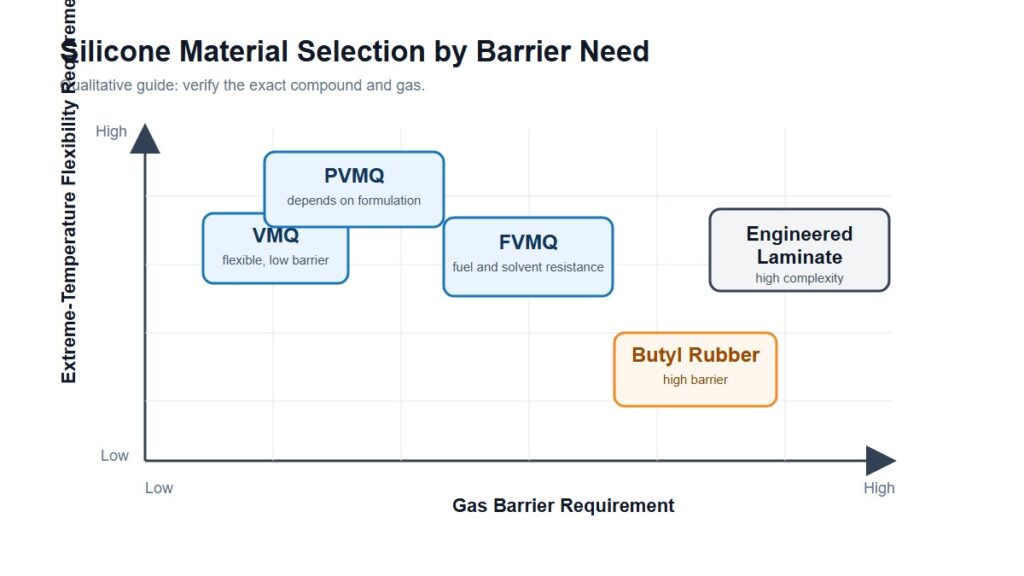
If low permeability is the first requirement, changing the geometry of a VMQ part may be less effective than changing the polymer or adding a barrier layer. If extreme temperature flexibility is the first requirement, a modified PVMQ or composite construction may be a better compromise.
When Is High Silicone Permeability Useful?
High permeability is useful when controlled gas exchange is part of the function rather than a defect.
Examples include oxygenation membranes, microfluidic cell-culture devices, gas-separation research, breathable medical components, pressure equalization, and some wearable interfaces. Thin PDMS membranes can allow oxygen and carbon dioxide exchange while containing liquid media.
The design still needs a defined transmission window. “Breathable” is not a measurable specification. The drawing or validation plan should state the gas, temperature, pressure difference, active area, thickness, and acceptable flow range.
Surface processing also needs control. Research on oxygen-plasma-treated PDMS found that the oxidized silica-like surface initially reduced oxygen diffusion—sometimes by more than 50%—but standard 10:1 PDMS stored in air recovered its original observed diffusion rate after about three days. Storage under water delayed recovery. Source: Variation in Diffusion of Gases Through PDMS.
A treatment that changes permeability on day one may not provide the same result after storage or repeated use.
When Is Silicone the Wrong Gas-Barrier Material?
Silicone is a poor default when the main function is retaining gas, maintaining vacuum, preventing oxidation, or limiting long-term vapor ingress. Typical risk cases include:
- pneumatic bladders expected to hold pressure for long periods;
- vacuum seals where permeation dominates after external leakage is controlled;
- oxygen-sensitive packaging;
- refrigerant or specialty-gas containment;
- sealed sensors with strict humidity-drift limits;
- thin diaphragms exposed to a continuous pressure differential.
In these applications, first compare butyl rubber, fluoropolymers, metal barriers, coated fabrics, or multilayer structures. Silicone may remain necessary for temperature, flexibility, biocompatibility, or processing reasons, but its barrier weakness then has to be engineered around.
How Should Silicone Permeability Be Tested?
Use a method that reports the property required by the design. ASTM D1434-23 uses a manometric method to determine gas transmission rate, permeance, and—where applicable—permeability of films and sheets. ISO 15105-1:2007 covers differential-pressure testing for plastic film and sheeting; ISO lists this edition as current but under revision as of 2026.
A usable test specification should include:
- exact compound and cure condition;
- specimen thickness and exposed area;
- target gas or defined gas mixture;
- pressure and partial pressure on both sides;
- temperature and relative humidity;
- conditioning and post-cure history;
- surface treatment and aging time;
- test duration and steady-state criterion;
- required units and acceptance limit.
Test the Material or the Finished Assembly?
Test both when the application is critical. A flat-sheet permeability test isolates bulk-material behavior. A finished-assembly pressure-decay, tracer-gas, or humidity test captures joints, compression, bonding, parting lines, and real geometry.
The two results should not be substituted for each other:
| Test level | What it reveals | What it misses |
|---|---|---|
| Material coupon | Intrinsic compound transmission under controlled conditions | Seal geometry, joints, molding variation |
| Molded part | Effects of actual thickness, cure, and local geometry | Full assembly interfaces |
| Finished assembly | Combined permeation and leakage under use conditions | May not identify which path caused the result |
For production control, dimensional inspection and Shore hardness testing are not enough when gas transmission is a critical-to-quality characteristic. A compound certificate, controlled cure process, and periodic transmission validation may be required.
What Information Is Needed Before Specifying Silicone?
The material cannot be selected from the word “silicone” alone. Define the transport problem first:
- Which gas or vapor must pass—or must be blocked?
- What is the allowable transmission rate?
- What are the operating temperature and pressure differential?
- How much surface area is exposed?
- What is the minimum wall or membrane thickness?
- Is the requirement measured after post-curing, plasma treatment, sterilization, or aging?
- Which mechanical, chemical, and regulatory requirements prevent use of a lower-permeability material?
If those inputs are missing, a permeability number from a generic datasheet has little value. It may describe a different gas, thickness, unit system, cure state, or temperature. The correct decision is not whether silicone is “permeable.” It is whether the measured transmission of the exact compound and geometry stays inside the product’s limit over its service conditions.