Most specs treat silicone as “an insulator” — one word, one property, picked off a chart. The part passes the factory hipot test. It ships. For the first year it does exactly what the datasheet promised.
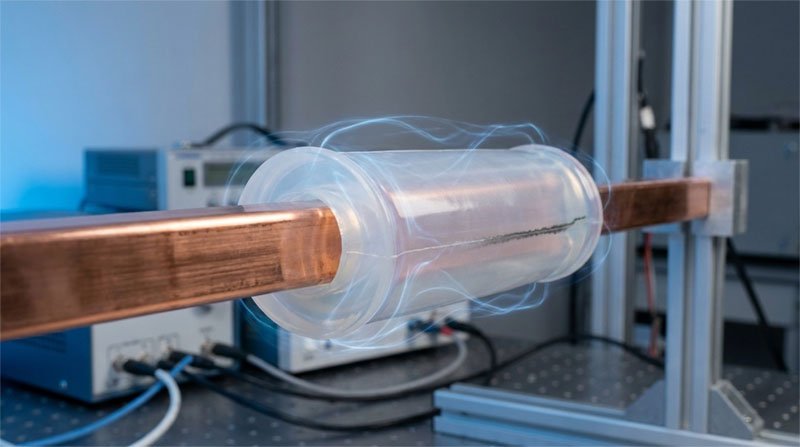
Then a high-voltage termination in a coastal substation starts tracking. A busbar boot that passed dielectric testing develops a carbon path along its surface after three winters of salt fog. Nothing in the bulk material changed. The failure was never going to show up on a bench dielectric test, because that test measures the wrong thing for the application.
Silicone is a strong electrical insulator — volume resistivity around 10¹⁴–10¹⁵ Ω·cm and dielectric strength of 18–25 kV/mm — but “insulating” is four separate numbers, not one, and the failure that ends most high-voltage parts is surface tracking, not bulk breakdown. The same base polymer also spans semi-conductive and fully conductive grades; the filler system, not the silicone, decides the electrical identity. This is where those boundaries sit and how each one is actually verified.
Executive Summary
- Dielectric strength is a thickness number, not a material constant. A grade rated 23 kV/mm on a 1 mm sample does not give you 230 kV at 10 mm — the kV/mm value falls as section thickness rises, and again as temperature climbs.
- High-voltage parts fail at the surface, not in the bulk. Tracking and erosion under contamination (IEC 60587) govern outdoor and HV life. Silicone wins here on hydrophobicity recovery, but that is a different property and a different test from bulk dielectric strength.
- The filler defines the electrical class. Unfilled VMQ insulates at 10¹⁵ Ω·cm; carbon-loaded grades conduct at 10⁰–10² Ω·cm. Specifying “silicone” says nothing about whether the part insulates or conducts.
What “Insulating” Actually Means: Four Numbers, Not One
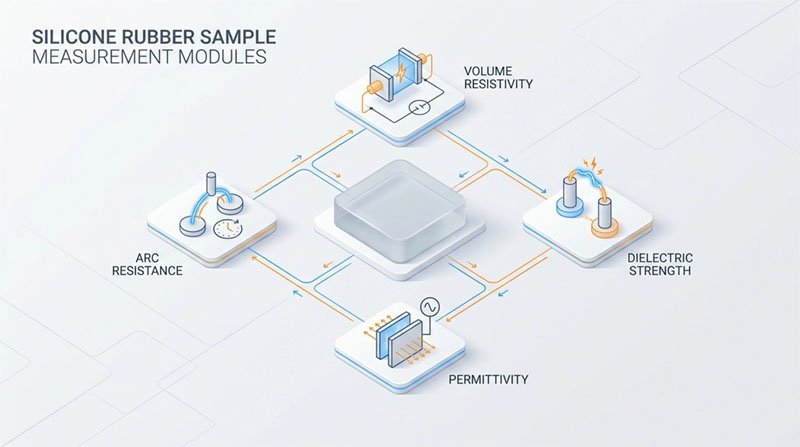
A usable electrical spec separates four properties, each with its own test and its own failure mode. Treating them as a single “insulation” rating is where most under-specification starts.
| Property | Typical VMQ range | Test method | What it tells you |
|---|---|---|---|
| Volume resistivity | 10¹⁴–10¹⁵ Ω·cm | ASTM D257 / IEC 60093 | How well the bulk blocks DC leakage |
| Dielectric strength | 18–25 kV/mm (thin section) | ASTM D149 / IEC 60243 | Voltage gradient before puncture |
| Dielectric constant (permittivity) | 2.9–4.0 | ASTM D150 / IEC 60250 | Charge storage; matters for HV stress grading and RF |
| Dissipation factor (tan δ) | ~0.001–0.01 | ASTM D150 / IEC 60250 | Energy lost as heat under AC; low is good |
| Arc resistance | High (forms non-conductive ash) | ASTM D495 | Behavior under surface arcing |
The low dissipation factor and stable permittivity are why silicone shows up in RF connectors and HV stress cones — it stores and releases charge predictably and wastes little of it as heat. But none of these bulk numbers predict the surface behavior that actually governs outdoor service.
Dielectric Strength Is a Thickness Number, Not a Material Constant
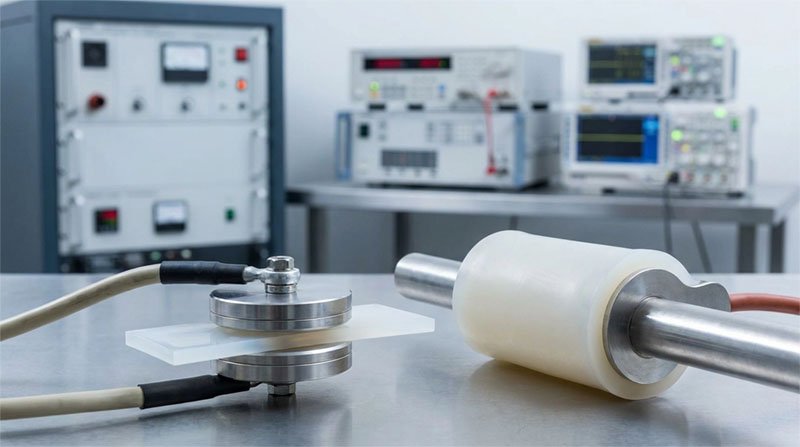
This is the single most misread figure on a silicone datasheet. Dielectric strength is reported in kV/mm, and people quietly assume it scales linearly. It does not.
As section thickness increases, the breakdown gradient drops — partly because thicker sections trap more heat during the test, partly because the statistical odds of an internal void or filler agglomerate sitting in the field go up. A grade that reads 23 kV/mm at 1 mm might effectively deliver closer to half that per millimeter in a 6 mm wall. Designing a thick insulator off a thin-sample number is how you end up with a part that punctures below its rated voltage.
Two more things move the number in production:
- Temperature. Dielectric strength falls as the part heats. A boot rated at 23°C behaves differently sitting against a 150°C busbar. Pair this with the thermal behavior of the grade.
- Voids and porosity. Air pockets from incomplete degassing or trapped flash become partial-discharge sites. They pass a short hipot and then erode the surrounding polymer over months.
ASTM D149 and IEC 60243 also let the lab choose short-time, step-by-step, or slow-rate voltage application, and the electrode geometry and surrounding medium (air vs oil) all shift the result. A dielectric strength figure without its test conditions is not comparable between suppliers.
Resistivity and the Conductive End of the Range
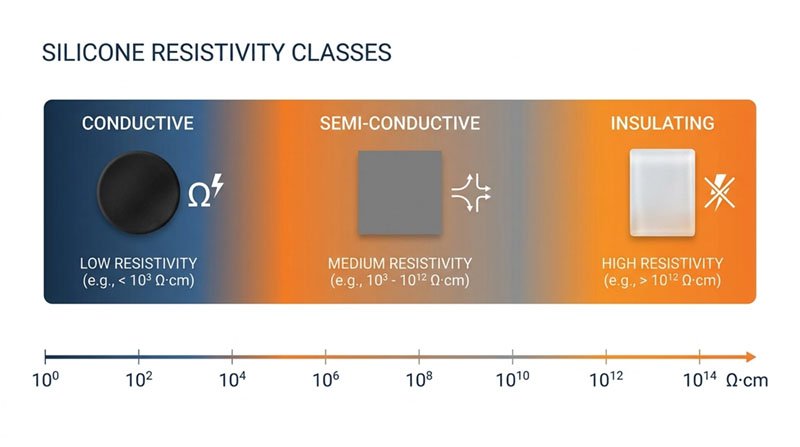
The word “silicone” tells you nothing about conductivity. The same Si–O backbone covers four decades of resistivity depending on filler:
- Insulating VMQ: 10¹⁴–10¹⁵ Ω·cm. Standard for boots, sleeves, encapsulation.
- Semi-conductive grades: ~10³–10⁶ Ω·cm, used for stress grading at HV cable terminations to control the electric field.
- Conductive (carbon-black-loaded): 10⁰–10² Ω·cm, used for EMI/RFI shielding gaskets, ESD parts, and the carbon contact pills in silicone keypads.
The filler loading that creates conductivity also changes mechanical behavior — conductive grades are generally harder, lower in elongation, and more prone to compression-set issues than unfilled silicone. You do not get conductivity for free; see conductive and antistatic silicone grades for the resistivity targets and mechanical trade-offs at each filler level. ASTM D257 / IEC 60093 cover both surface and volume resistivity, and the two diverge sharply once a part is contaminated, which is the bridge to the failure mode that matters most.
Surface Tracking and Erosion: Where High-Voltage Silicone Actually Fails
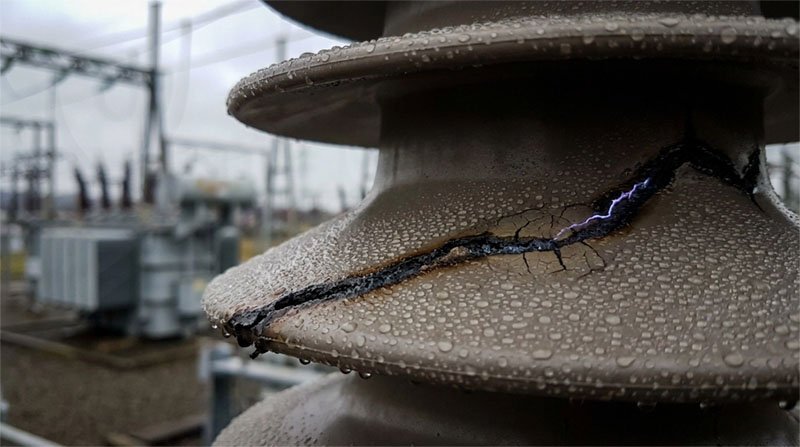
Bulk dielectric strength is rarely what kills an outdoor HV part. Surface tracking is. Under pollution and humidity, leakage current concentrates into dry bands, arcs, and slowly carbonizes a conductive path across the surface. Once that track bridges the part, bulk resistivity is irrelevant.
Silicone’s real advantage here is hydrophobicity — and specifically hydrophobicity recovery. Water beads instead of filming, which keeps leakage current low; even after the surface is temporarily wetted or contaminated, low-molecular-weight chains migrate to the surface and restore water repellency. This is why silicone rubber displaced EPDM and porcelain in HV insulators and cable accessories. It is a surface-chemistry property, not a bulk one, and it connects to the broader hydrophobic behavior of the material.
But hydrophobicity is not infinite. Under sustained dry-band arcing the surface erodes, and tracking resistance depends heavily on filler — alumina trihydrate (ATH) is added specifically to improve tracking and erosion performance by releasing water and forming a protective inorganic residue. The governing tests are different from anything above:
- IEC 60587 — inclined-plane tracking and erosion, the core HV outdoor test
- IEC 60112 (CTI) — comparative tracking index for lower-voltage creepage design
- ASTM D495 — high-voltage arc resistance
A team that specs only bulk dielectric strength for an outdoor part has tested the property least likely to fail and ignored the one most likely to.
Aging, Partial Discharge, and the Slow Drift
Silicone’s electrical properties hold across a wider temperature band than organic rubbers — roughly −50°C to 200°C with little change in resistivity or permittivity. That stability is real and is a genuine reason to choose it. The drift comes from mechanics, not chemistry.
In a sealing or potting application, compression set opens micro-gaps over time. Those gaps become partial-discharge sites. Partial discharge does not breach the part on day one; it erodes the polymer at the void wall, slowly, until a path forms — often years after a clean factory hipot. The part did not get a worse dielectric strength. It developed an internal geometry the original test never saw. This is the gap teams miss: validation captures the part as molded, not the part as aged and compressed.
Why Teams Underestimate This
The pattern is consistent. “Silicone is an insulator” is true, so it gets treated as a single binary property and the spec stops there. Three things then go unaddressed.
First, dielectric strength gets read as a scalable constant, so thick sections are designed off thin-sample data and the safety margin quietly disappears. Second, bulk breakdown is tested while surface tracking — the actual outdoor failure mode — is never specified, because it requires a different standard most buyers do not know to ask for. Third, the part is qualified as-molded, so partial-discharge erosion and compression-set gaps that take years to develop never appear in validation.
None of this is incompetence. It is that the headline property is easy to find and the governing properties are not on the front page of the datasheet.
What I Need Before Confirming a Grade
Before I commit an electrical grade, filler system, and cure, send the conditions that actually move these numbers:
- Operating voltage, waveform (DC / AC / pulse), and continuous vs transient duty
- Thinnest insulating wall section in the design
- Indoor or outdoor, pollution/contamination level, and humidity
- Operating and peak temperature at the part
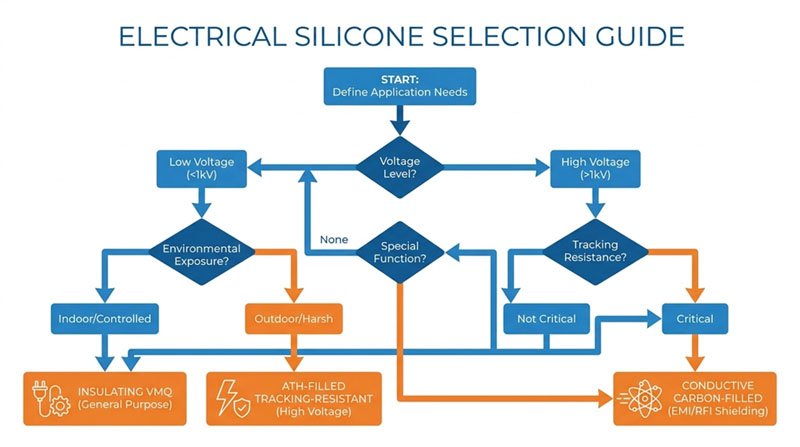
- Whether the part must insulate, stress-grade (semi-conductive), or conduct
- Compliance targets: UL 746 (RTI), IEC 60587 tracking class, and any flammability rating, which ties into the flame and fire behavior of the grade
With those, I can tell you whether a standard insulating VMQ holds, whether you need an ATH-filled tracking-resistant grade, or whether the application calls for a semi-conductive or conductive compound. Without the voltage, the wall thickness, and the environment, any dielectric number I give you describes a test coupon, not your part.
References & Standards
- ASTM D149 — Dielectric Breakdown Voltage and Dielectric Strength of Solid Electrical Insulating Materials — ASTM International
- ASTM D257 — DC Resistance or Conductance of Insulating Materials — ASTM International
- ASTM D150 — AC Loss Characteristics and Permittivity (Dielectric Constant) of Solid Electrical Insulation — ASTM International
- ASTM D495 — High-Voltage, Low-Current, Dry Arc Resistance of Solid Electrical Insulation — ASTM International
- IEC 60587:2022 — Resistance to Tracking and Erosion of Insulating Materials — International Electrotechnical Commission
- IEC 60112 — Comparative Tracking Index (CTI) — UL Solutions
- UL 746B — Polymeric Materials, Long-Term Property Evaluations (RTI) — UL Standards & Engagement
- Alumina Trihydrate (ATH) / Aluminum Hydroxide — Flame Retardant Mechanism — ScienceDirect Topics