Search “food grade silicone” and most of what comes back is the same encyclopedic loop — silicone is safe, silicone is heat resistant, silicone is BPA-free. None of it tells you where the compliance line actually sits, or what changes when an EU buyer asks for LFGB instead of FDA.
That gap costs projects. A kitchenware SKU that passes 21 CFR 177.2600 can still fail an LFGB sensory panel, and the post-cure cycle that fixes it adds four hours per batch on our side. A baby pacifier built on peroxide-cured material will hold odor for weeks after washing. These are not edge cases. They are weekly conversations on our factory floor.
Food grade silicone is a platinum-cured silicone rubber that meets FDA 21 CFR 177.2600 migration limits — under 20 mg/in² on first extraction and under 1 mg/in² on subsequent extractions — or the stricter LFGB §30 & §31 sensory and migration tests for direct, repeated food contact.
The rest of this article is the boundary version of that answer: what each standard covers, where it stops, and which process variables decide whether your part actually meets it.
What “Food Grade” Covers, and What It Does Not
Food grade is a compliance status, not a material grade. The polymer is still vinyl-methyl siloxane reinforced with fumed silica. What separates a food grade part from an industrial gasket is three production decisions, not the chemistry of the gum itself.
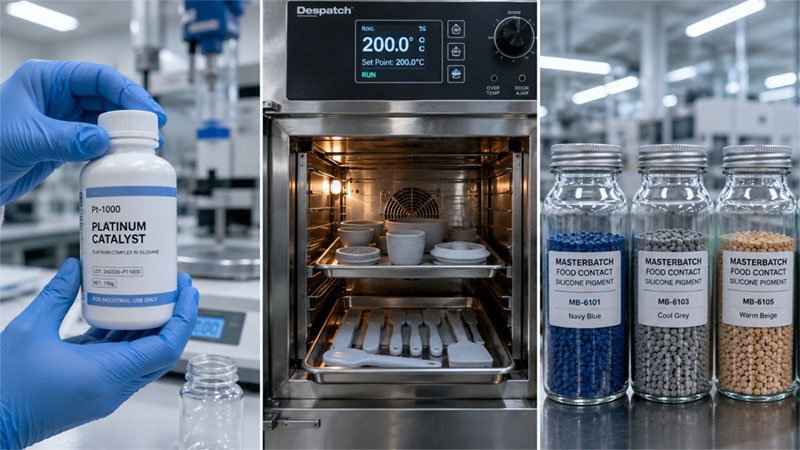
- Curing system. Platinum (addition) cure leaves no peroxide residue and no acid byproducts. Peroxide cure is cheaper but carries residual odor that survives basic washing.
- Post-cure. A four-hour bake at 200°C drives off low-molecular-weight siloxanes (D4–D6). Skip it and the part will fail an LFGB sensory panel even if it passes FDA migration.
- Pigment and filler control. Any pigment in contact with food has to be food-contact certified on its own. Calcium carbonate fillers are common in cheap silicone — they whiten under stretch and shift migration numbers.
A part can be labeled “food grade” with any of the three done badly. That is why a supplier-issued certificate alone is not enough — the test report has to match the finished part, not the raw gum stock.
FDA, LFGB, and EU 1935/2004 Side by Side
These three frameworks cover most global trade in food-contact silicone. Their scope is not interchangeable.
| Standard | Region | What It Tests | Migration Limit | Sensory Panel | Cost Delta vs FDA-only |
|---|---|---|---|---|---|
| FDA 21 CFR 177.2600 | United States | Repeated-use rubber articles; extractives in water, 8% ethanol, n-heptane | ≤ 20 mg/in² first / ≤ 1 mg/in² subsequent | No | Baseline |
| EU 1935/2004 + 2023/2006 | European Union | Framework: no health risk, no food composition change, no taste or smell impact | ≤ 10 mg/dm² overall migration | Optional (national rules decide) | +5 – 10% |
| LFGB §30 & §31 | Germany (de facto EU premium) | Migration plus sensory evaluation after high-heat exposure; harsher food simulants | Aligned with EU plus sensory threshold | Yes — trained panel | +20 – 30% |
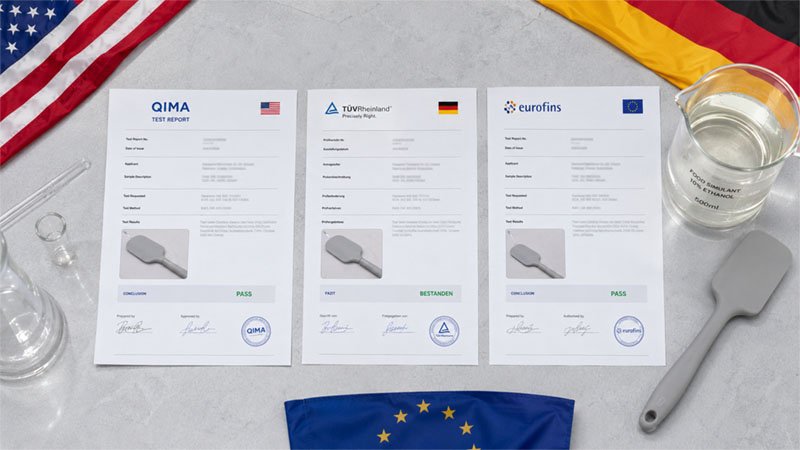
The LFGB cost delta is not marketing math. It traces to raw material grade and the longer post-cure cycle needed to clear the sensory threshold. If a quote for “LFGB silicone” comes in at the same price as a generic FDA quote, the part has not been built to LFGB.
Where Each Standard’s Scope Ends
Picking a standard is also a matter of knowing what it does not do.
- FDA 21 CFR 177.2600 says nothing about odor or taste. A part can satisfy migration limits and still smell strongly enough to trigger returns. Acceptable for many US-only kitchen tools, not acceptable for infant feeding products.
- EU 1935/2004 is a framework, not a test. Compliance depends on national implementation. LFGB is what most German and Austrian retailers ask for by name.
- LFGB does not replace USP Class VI or ISO 10993. A silicone pacifier passing LFGB is still not medical grade until it clears biocompatibility testing in a Class 100,000 cleanroom.
Most underestimation happens at the FDA-only step. Buyers assume the certificate covers their EU listing, then lose months when a German retailer rejects the part on smell at retail QC.
Process Variables That Decide Compliance
These are the parameters we hold during production. They are also the first questions to ask a candidate supplier.
| Variable | Production Range | Why It Matters |
|---|---|---|
| Curing system | Platinum (addition) or peroxide | Platinum is mandatory for LFGB and any infant product |
| Post-cure | 200°C, 4 hours minimum | Drives off D4–D6 siloxanes; controls sensory result |
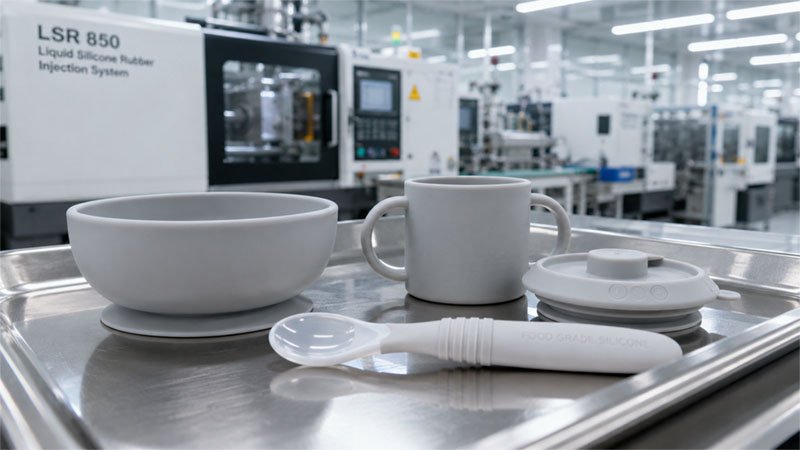
| Process | HTV compression (±0.05 – 0.1 mm) vs LSR injection (±0.02 mm) | LSR closes flash and dimensional risk on high-volume parts |
| Shore A hardness | 10 – 80 working range | 20 – 30A for pacifiers; 60 – 70A for spatula handles |
| Working temperature | −40°C to +230°C standard; 250 – 300°C short-burst grades | Decides oven and steam-sterilizer compatibility |
| Pigment | Food-contact certified only | An untested pigment will fail migration regardless of base polymer |
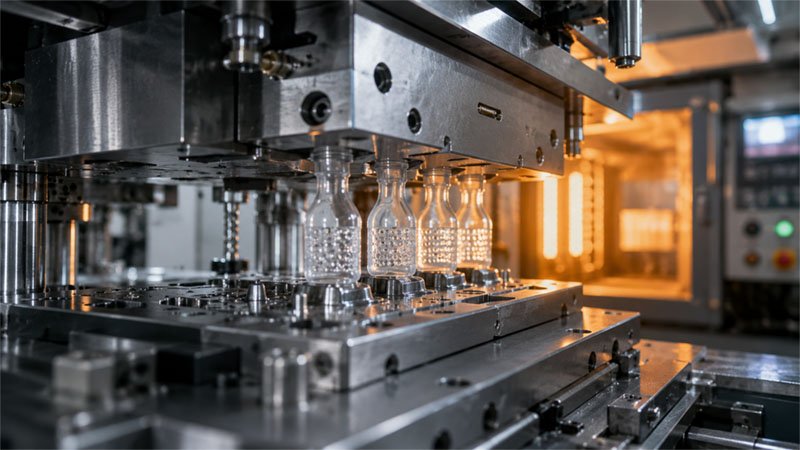
A part shipped with platinum cure, a 200°C/4h post-cure, and food-grade pigment will clear LFGB sensory in production. Drop any one of the three and the part regresses to “FDA only” at best.
Visual Checks Before You Send a Sample to the Lab
Lab testing is the only definitive answer. These three checks rule out obvious failures inside a minute.
- Smell after a 30-second hand cup. A clean part is nearly odorless. A burnt or chemical note means under-cured material or peroxide residue.
- Stretch and look for whitening. Pure silicone may lighten slightly. Chalk-white whitening means calcium carbonate filler.
- Surface dust. Premium silicone wipes clean with a dry cloth. Static-loaded surfaces that grab lint trace back to filler content and incomplete curing.
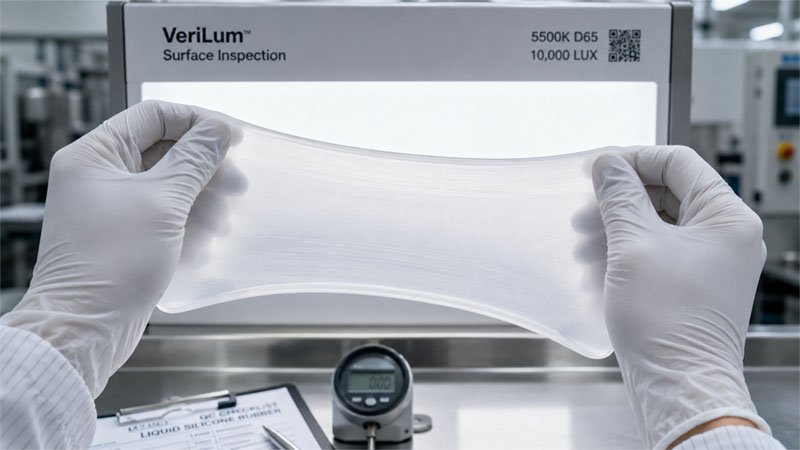
These are screening tests, not compliance evidence. They flag samples that should not even go to a lab. They do not replace a current test report.
Food Grade Silicone FAQs
Is food grade silicone safe for oven use?
Yes, up to 230°C for standard grades and 250 – 300°C for short-burst high-temp formulations. Confirm the specific working temperature against the product’s material datasheet — generic claims are not enough.
Is food grade silicone BPA-free?
Yes. BPA is a plastics monomer and is not used in silicone polymerization. A BPA-free claim on silicone is technically accurate but marketing-driven; the substantive question is migration and sensory compliance.
FDA or LFGB — which do I need?
FDA for US-only food contact. LFGB if you sell into Germany, Austria, Switzerland, or premium EU retail, or if odor and taste are part of the product experience (baby and beverage products).
Is food grade silicone dishwasher safe?
For solid silicone parts with no bonded plastic or metal, yes — standard cycles and heated dry sit within working temperature. Assembled parts follow the lowest-rated component, not the silicone.
What You Still Need to Confirm Before Sourcing
A test certificate on file is the starting point, not the finish line. Before placing a PO, confirm:
- [ ] The test report is issued to the finished part, not just the raw gum stock.
- [ ] The curing system is platinum, in writing, for any infant or LFGB-targeted SKU.
- [ ] Post-cure cycle length and temperature are documented on the production traveler.
- [ ] Pigment certificates are on file separately from the base polymer COA.
- [ ] Batch numbers on the gum stock are traceable to the finished part lot.
Anything below this line is where projects fail in month three, not on day one.