Teams buy “optical-grade silicone” the way they buy a clarity number off a datasheet. Transmittance over 91%, water-clear, done. The first molded lot looks perfect under the bench light.
Then the haze shows up. A batch comes off the press slightly cloudy on one cavity. An LED encapsulant that measured water-clear at the incoming check is faintly yellow after 2,000 hours at junction temperature. Nothing in the material certificate changed. The clarity was never a fixed property of the resin — it was an outcome of how the part was cured, kept clean, and aged.
Optical-grade silicone delivers >91% light transmittance and a tunable refractive index of 1.40–1.55, and its defining advantage is photothermal stability — it resists the yellowing that degrades epoxy and polycarbonate under heat and blue/UV light. But that clarity is a process result. Contamination, cure completeness, mold finish, and air entrapment decide whether you actually get the datasheet number, and thermal aging decides whether you keep it. This is where clarity is won and lost on the floor.
Executive Summary
- Clarity is a process outcome, not a grade you can purchase. The same optical LSR yields water-clear or hazy parts depending on cure poisoning, degassing, and tool finish — the resin sets the ceiling, the process sets the result.
- Silicone’s real optical edge is time, not peak clarity. Day-zero transmittance is similar across encapsulants; the divergence appears after thousands of hours of heat and blue light, where silicone holds and epoxy/PC yellow.
- Refractive index is a design lever, not just a spec. Phenyl content moves RI from ~1.41 to 1.55+; matching it to the LED chip and phosphor is how you recover light-extraction efficiency you would otherwise lose.
For the broader material-property context behind these optical tradeoffs, see the complete guide to silicone properties.
What “Optical Grade” Actually Buys You
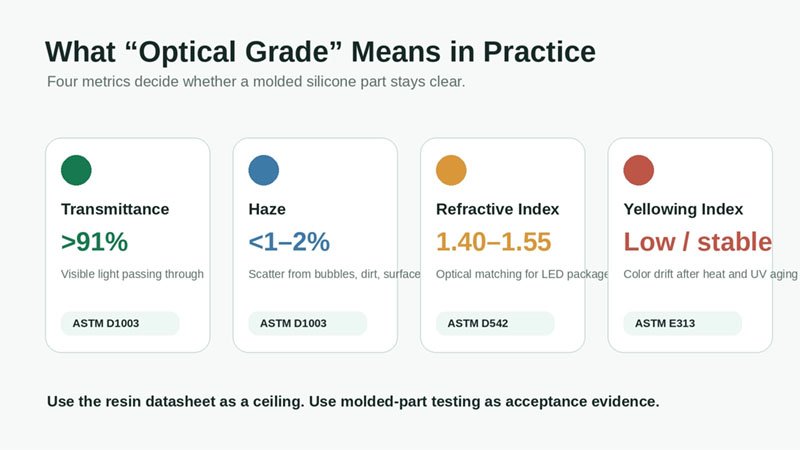
Optical grade is a cluster of properties, each measured differently and each lost differently in production. It sits inside the wider physical properties of silicone discussion, but optical parts punish small process errors more visibly than most molded components.
| Property | Optical-grade range | Test method | Why it matters |
|---|---|---|---|
| Luminous transmittance | >91% (visible band) | ASTM D1003 | Total light through the part |
| Haze | <1–2% | ASTM D1003 | Scatter; the property contamination kills first |
| Refractive index | 1.40–1.55 | ASTM D542 | Light extraction / RI matching |
| Yellowing index | Low, stable over aging | ASTM E313 / D1925 | Color shift under heat and UV over time |
The transmittance and refractive index come from chemistry: dimethyl silicones sit near the low RI end, and phenyl groups raise both refractive index and — in optical formulations — maintain clarity at the high-temperature end. Haze and yellowing index, on the other hand, are where the process and the service life write the real story.
Refractive Index Is a Formulation Lever
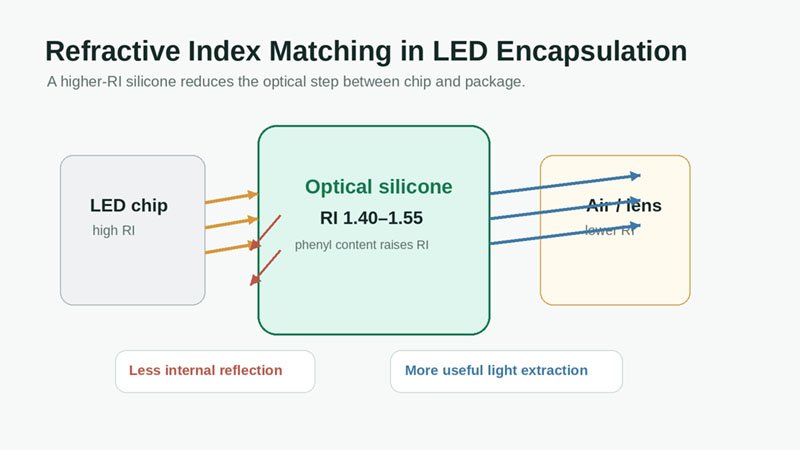
Refractive index is the one optical property buyers most often treat as fixed when it is actually a tool. Standard dimethyl silicone sits around 1.41. Adding phenyl content pushes it to 1.50, 1.54, and higher.
That range exists for a reason. In LED encapsulation, light leaving a high-RI semiconductor chip loses efficiency at every interface where the index drops sharply; optical modeling studies also treat encapsulant refractive index as a direct light-extraction variable. A higher-RI phenyl silicone reduces that mismatch and pulls more light out of the package. The trade is cost and formulation complexity, and high-phenyl grades behave differently in cure and aging, so RI is not a free dial. For the formulation side of that tradeoff, see how additives and processing can modify silicone properties. But specifying “clear silicone” without an RI target means leaving light-extraction performance on the table that the application was paying for.
Where Clarity Is Won or Lost: the Process
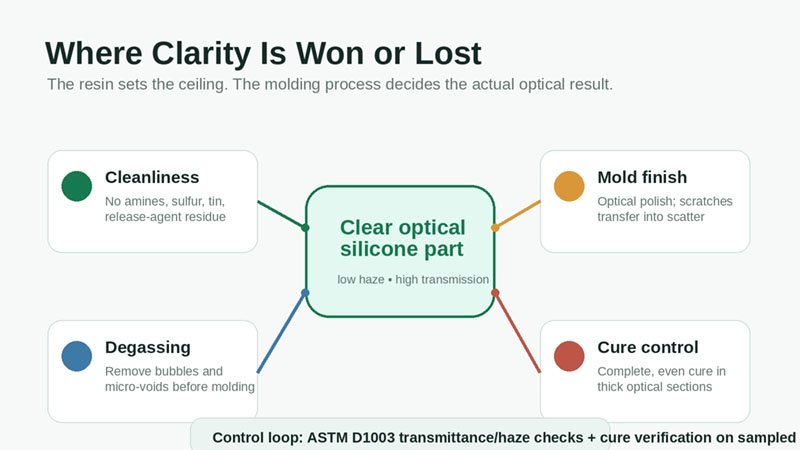
This is the part datasheets cannot cover, because it happens in the mold. Optical silicone is unusually sensitive, and most clarity defects trace to four process points.
Platinum-Cure Poisoning
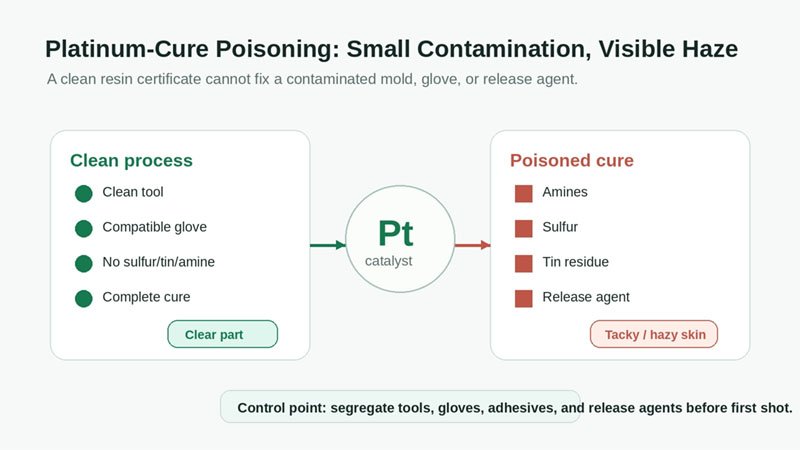
Optical silicone is platinum-cured — it has to be, because peroxide systems leave byproducts and color. Platinum catalysts are poisoned by amines, sulfur, tin (including condensation-cure silicone residue), and certain plastics and adhesives. A poisoned cure leaves a tacky, hazy surface or an uncured skin. This is the single most common optical defect, and it usually comes from contamination upstream — a glove, a release agent, a previous run on the same tool — not from the resin. It is also the hardest to diagnose after the fact, because the certificate of the incoming material is clean.
Air Entrapment and Degassing
Bubbles and micro-voids scatter light and read directly as haze or visible defects. Optical molding requires vacuum degassing of the material and often a vacuum-assisted mold; injection profile and venting decide whether trapped air shows up in a thick lens section.
Mold Surface Finish
An optical part can only be as clear as the cavity that formed it. The tool needs a polished, optical-quality finish (SPI A-level or better), and any scratch, tooling mark, or wear transfers 1:1 to the part surface as scatter. Tool maintenance is an optical spec, not just a cosmetic one.
Cure Completeness and Thermal History
Under-cure leaves residual haze and surface tack; over-cure or uneven heating in thick sections can introduce stress and color. Thick optical sections cure non-linearly — the outside vulcanizes before the core, and the detection point is a transmittance/haze check on a sectioned part, not a surface glance. If the terminology is unclear, this guide explains curing vs. vulcanization in silicone.
The practical control loop is in-line: transmittance and haze (ASTM D1003) on sampled parts under controlled lighting, plus a cure check. Clarity drift on one cavity is an early signal of contamination or tool wear, not a material problem.
Yellowing and Thermal Aging Over Time
This is where silicone earns its place, and it is a time-based property, so a day-zero comparison hides it.
The Si–O backbone does not absorb in the visible or near-UV the way the aromatic and carbonyl groups in epoxy and polycarbonate do. That stability comes from the same chemistry covered in the chemical properties of silicone. Under a high-power blue LED — high junction temperature plus high short-wavelength flux — epoxy encapsulants yellow within hundreds to a few thousand hours, and polycarbonate optics haze and yellow under sustained UV. Optical silicone holds its transmittance far longer under the same load; one open-access study on optical silicone exposed to harsh environments found strong stability under UV and blue-light exposure, while heat/salt conditions drove more severe degradation. Pair this with the broader UV and weathering behavior of the polymer.
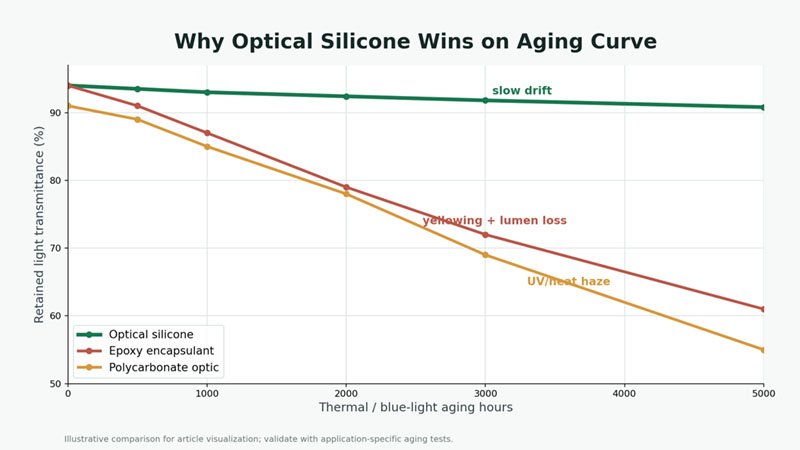
The boundary worth stating: silicone is not immune. At extreme junction temperatures, and depending on phenyl content and additives, transmittance does decline slowly, and the curve is what matters — two encapsulants that read identically at hour zero can diverge by several percent transmittance and a visible yellowing index by hour 3,000. Temperature studies on optically clear silicone encapsulants show that thermal exposure can still degrade optical transmission, so specifying retained transmittance after a defined thermal-aging protocol, not initial transmittance, is the only honest way to compare. The thermal side of this ties directly to the grade’s heat behavior.
Application Boundaries
Where the optical-plus-stability combination actually pays:
- High-power LED encapsulation and lenses — RI matching plus yellowing resistance at junction temperature
- Automotive lighting optics — sustained UV and heat with a clarity-retention requirement over vehicle life
- Medical light guides and endoscope optics — clarity plus biocompatibility and repeated sterilization
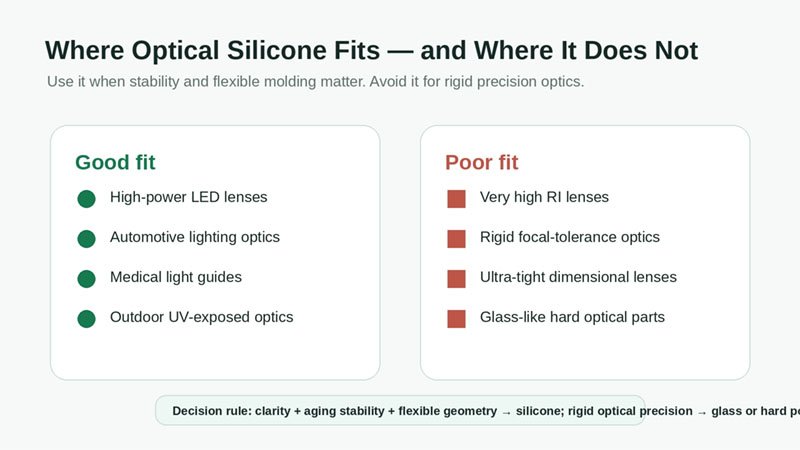
Where silicone is the wrong choice: applications needing a very high refractive index beyond the phenyl range, or a rigid, dimensionally precise lens with tight focal tolerance. Silicone is an elastomer — it flexes, and that disqualifies it from precision rigid optics regardless of clarity; the mechanical properties of silicone explain that tradeoff in more detail. For those, glass or a hard polymer is the base material, sometimes with a silicone secondary optic.
Why Teams Underestimate This
The miss is consistent. Clarity gets treated as a number on the resin datasheet, so the process variables that actually produce it — cure poisoning, degassing, tool finish — never make it into the part spec or the supplier conversation. When a hazy or tacky lot appears, the instinct is to blame the material, when the cause is almost always contamination or tooling.
The second miss is judging an encapsulant on day-zero transmittance. The whole reason to pay for optical silicone over epoxy is the aging curve, and that advantage is invisible in a fresh-part comparison. Teams that do not specify a thermal-aging or UV-aging acceptance criterion are buying silicone’s durability without ever verifying they got it.
The third is ignoring refractive index, then wondering why light output came in below the optical model. None of these are competence gaps — they are the difference between reading a resin spec and controlling a molded optic.
What I Need Before Confirming a Grade
Before I commit an optical grade, cure system, and molding process, send:
- Target transmittance and the wavelength band that matters
- Refractive index target, or the chip/phosphor system to match
- Operating and peak/junction temperature, plus expected service hours
- UV exposure and any aging/retention acceptance criteria
- Part geometry, thickest optical section, and surface/tolerance requirement
- Any secondary materials, adhesives, or release agents in contact — the platinum-cure poisoning risk has to be cleared before the first shot
With those, I can tell you whether a dimethyl or phenyl optical grade fits, what cleanliness and tooling the part demands, and what aging protocol should gate acceptance. Without the temperature, the service hours, and the contact materials, an initial transmittance number describes a fresh coupon, not the optic you will field.