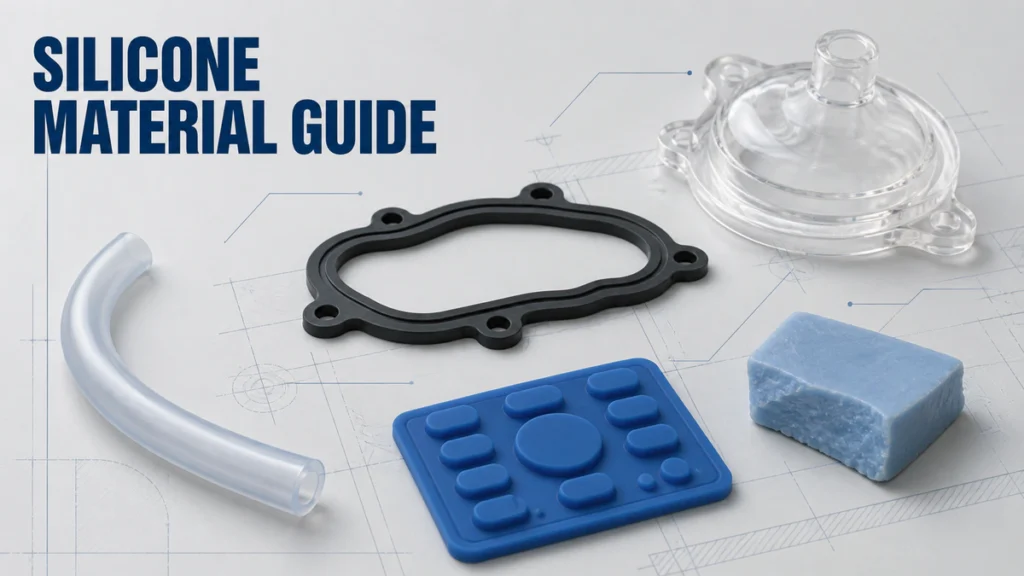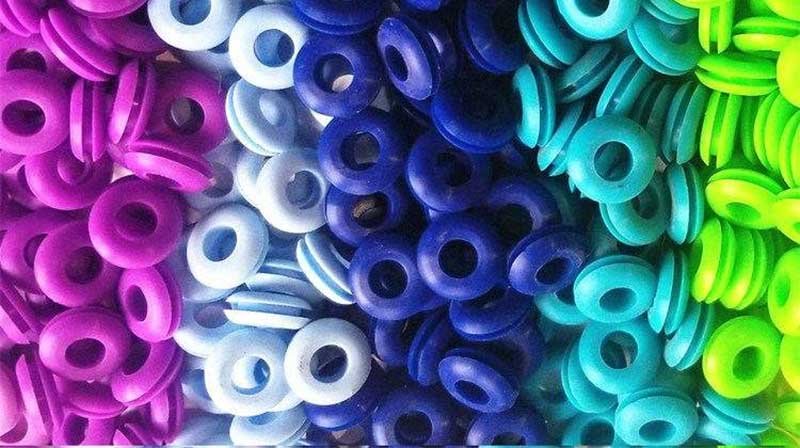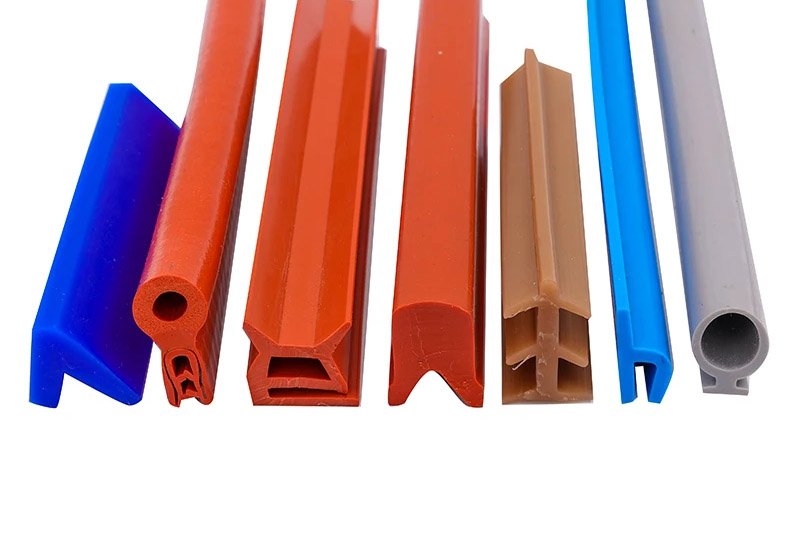
Search “physical properties of silicone” and most results read like a chemistry textbook — fine for an exam, useless for speccing a part. You still don’t get the density, the hardness range, the temperature ceiling, or which test standard backs each number.
Standard silicone rubber sits inside a defined envelope: density 1.10–1.50 g/cm³, hardness from Shore 00-5 to Shore A-90, and a continuous working range of −60 °C to +230 °C, with stable electrical insulation and unusually high gas permeability. The full sheet is below, every value tied to its ASTM or ISO test method.
These figures describe general-purpose silicone (HCR and LSR). Filler loading, cure system, and grade shift the exact numbers — noted per property.
The Silicone Physical Properties Spec Sheet
Silicone physical properties spec sheet showing density, hardness, temperature range, electrical, optical and permeability values with their ASTM and ISO test standards

| Property | Typical Range / Value | Test Standard |
|---|---|---|
| Appearance | Translucent base; pigmentable; opaque when filled | — |
| Density (specific gravity) | 1.10–1.50 g/cm³ (filled up to ~2.0) | ASTM D792 |
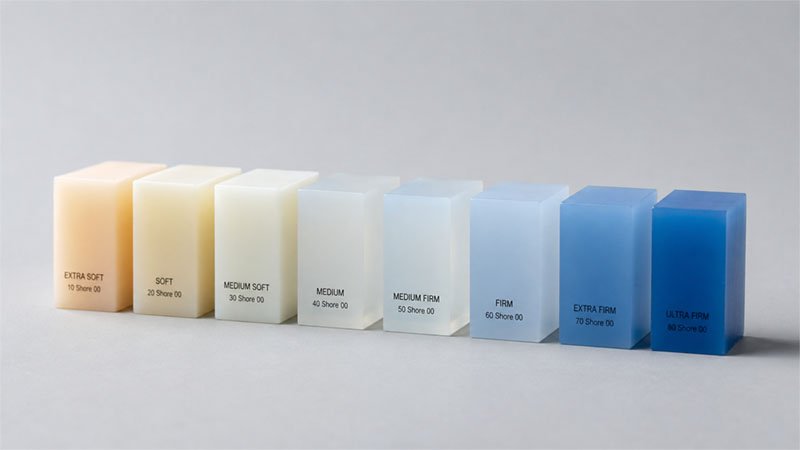
| Hardness | Shore 00-5 to Shore A-90 | ASTM D2240 |
| Tensile strength | 4–11 MPa (high-strength to ~13) | ASTM D412 |
| Elongation at break | 200–800% | ASTM D412 |
| Tear strength | 10–55 kN/m | ASTM D624 |
| Compression set | Low across the temperature range | ISO 815 / ASTM D395 |
| Working temperature | −60 °C to +230 °C (short-term to +300 °C) | ASTM D573 / D746 |
| Thermal conductivity | ~0.2 W/m·K | — |
| Coefficient of thermal expansion | 200–400 ×10⁻⁶ /K | ASTM E831 |
| Water absorption | Under 0.5% | ASTM D471 |
| Water contact angle / surface energy | ~110° / ~22 mN/m (hydrophobic) | — |
| Gas & vapor permeability | High vs other elastomers | — |
| Dielectric strength | 18–25 kV/mm | — |
| Volume resistivity | ~10¹⁵ Ω·cm | — |
| Optical transmission | Over 91% (optical-grade LSR) | — |
| Flammability | Self-extinguishing; FR to UL 94 V-0 | UL 94 |
The spec sheet above is built to be copied or saved as a reference card. The deeper number behind each property lives on its dedicated page, linked under each section below.
Appearance and State
Silicone is naturally translucent and takes pigment cleanly, turning fully opaque once filled or colored. Surface finish is set by the mold and post-processing, not by the polymer. This is a cosmetic property, not a performance one — it does not bound temperature, hardness, or compliance.
Density, Weight, and Water Behavior
Silicone is denser than water (1.10–1.50 g/cm³), so it does not float, and it absorbs under 0.5% water by weight — it is not porous in the way that question usually implies. Filled compounds climb toward ~2.0 g/cm³. The surface is hydrophobic, with a water contact angle near 110°, which is why water beads rather than wets.

→ Read more: Density, Weight & Hydrophobicity of Silicone
Hardness and Mechanical Behavior
Production silicone spans Shore 00-5 (gel-soft) to Shore A-90 (rigid), with tensile strength of 4–11 MPa and elongation of 200–800%. Hardness is the first spec to lock because it trades against tear strength and elongation — softer grades stretch further but tear sooner.
→ Read more: Silicone Hardness & Durometer Guide
Silicone Mechanical Properties

Temperature Range and Thermal Behavior
Silicone holds its properties from −60 °C to +230 °C continuously, with high-temp grades taking short excursions to +300 °C. Thermal conductivity is low (~0.2 W/m·K) and the coefficient of thermal expansion is high (200–400 ×10⁻⁶ /K), which matters for tight tolerances on hot parts.
→ Read more: Silicone Thermal Conductivity & Heat Resistance

Electrical Properties
Silicone is a strong dielectric — 18–25 kV/mm dielectric strength and around 10¹⁵ Ω·cm volume resistivity — unless deliberately compounded with carbon to conduct. This dual capability is why the same base polymer serves both HV insulation and EMI-shielding keypads.
→ Read more: Silicone Electrical Properties
Optical Properties
Optical-grade LSR transmits over 91% of visible light and resists yellowing far better than epoxy or polycarbonate. Refractive index sits in the 1.40–1.55 range, which is why it shows up in LED encapsulation and lens optics.
→ Read more: Silicone Optical Properties
Gas and Vapor Permeability
Silicone is far more gas-permeable than other elastomers — the reason it is chosen for oxygen tubing and breathable membranes, and the reason it is the wrong seal for a gas barrier. This is the property most often confused with porosity; the material is solid but lets gases diffuse through.

→ Read more: Silicone Gas & Vapor Permeability
Flammability
Standard silicone is self-extinguishing, and FR grades reach UL 94 V-0 with low smoke and no halogen output. Combustion leaves a non-conductive silica ash rather than dripping flame, which is why it qualifies for rail and transit standards.
→ Read more: Silicone Fire & Flammability Behavior
Where These Numbers Stop Applying
Every range above assumes general-purpose silicone. The boundaries move with three choices:
- HCR vs LSR — sets achievable tolerance and surface cleanliness, not the property envelope itself.
- Filler loading — pushes density and hardness up, and can pull elongation and tear strength down.
- Cure system — platinum-cured grades stay odorless and clear; peroxide-cured grades are cheaper but need post-curing to clear residual odor.
These are applicability limits, not defects. A datasheet value only holds for the specific compound it was measured on.
Common Questions
Does silicone float?
No. Its density of 1.10–1.50 g/cm³ is higher than water, so it sinks.
Is silicone porous?
No — water absorption stays under 0.5%. It is, however, highly gas-permeable, which is a different property.
How much does silicone weigh?
Roughly 1.1–1.5 times the weight of water for the same volume; heavily filled compounds can reach about 2.0 g/cm³.
What temperature can silicone withstand?
−60 °C to +230 °C continuously, with high-temperature grades handling short excursions to +300 °C.
What We Need to Spec Your Part
These ranges describe standard silicone. The exact numbers for your part depend on grade, target hardness, compliance target (FDA 21 CFR 177.2600, LFGB, or USP Class VI), and operating temperature — and those four choices also lock cost and lead time. Send them and we will return a property sheet for the actual compound.