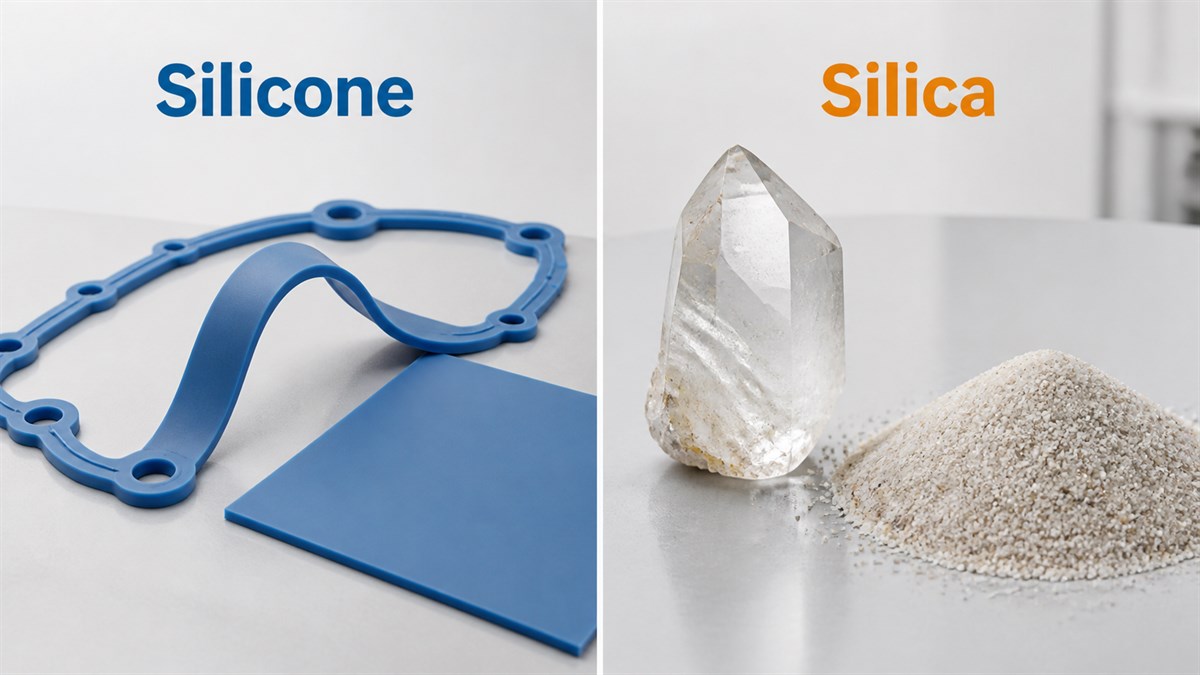
The names look interchangeable on drawings, packing lists, and ingredient tables. They are not.
Most silicone vs silica explainers stop at “one is natural, one is synthetic.” That does not tell you whether the white beads in a carton are a desiccant, whether the molded part is an elastomer, or why a silicone compound is loaded with silica powder.
Silicone is a synthetic polymer with a Si–O–Si backbone and organic side groups. Silica is silicon dioxide (SiO₂). They share silicon. They are not interchangeable.
What Does Silicone vs Silica Mean on a Spec?
Silicone is the polymer you mold, extrude, or coat. Silica is an inorganic chemistry: SiO₂.
If the part must stretch, seal, or recover after compression, the material is silicone. If the drawing means a powder, a desiccant pack, glass, or a mineral filler, it is silica.
| Silicone | Silica (SiO₂) | |
|---|---|---|
| Material class | Synthetic polymer | Inorganic mineral / compound |
| Typical formula | (R₂SiO)ₙ | SiO₂ |
| Physical behavior | Elastic, flexible | Rigid, hard, or brittle |
| Common factory forms | HCR gum, LSR, RTV, molded parts, tubing | Quartz, sand, fumed or precipitated powder, silica gel beads |
| Job in a silicone part | The polymer network | Reinforcing filler — not the rubber itself |
Elemental silicon (Si) is a third entity. That mix-up is covered in Silicon vs Silicone.
Is Silicone Made from Silica?
Upstream, yes. Quartz silica is reduced to silicon metal, then reacted with methyl chloride to build siloxane polymers. The molded part is not “processed sand.”
Calling silicone “natural because it comes from sand” is a sourcing error. The polymer is fully synthetic.
What arrives as a finished part is a compounded elastomer: polymer, filler, and a cure system. The silica in that compound is added later as powder. It is not leftover mineral from the first process step.
Are Silica Gel and Silicone Rubber the Same?
No.
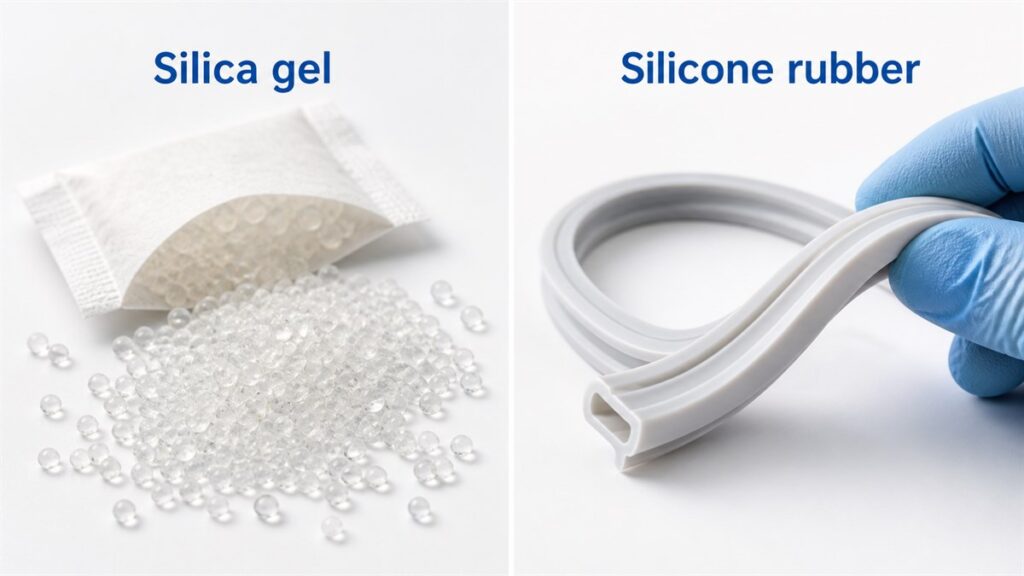
Silica gel is porous amorphous SiO₂. It is sold as beads or packets to take up moisture. It is brittle. It does not stretch.
Silicone rubber is an elastomer. It seals, flexes, and recovers. It does not replace a desiccant.
The confusion is linguistic. In Chinese, 硅胶 is used for both silica gel and silicone rubber. English does not. If a packing list says “silica gel” and the 3D model is a gasket, stop and re-specify the material class before tooling.
They fail in opposite ways: silica gel crushes; silicone rubber tears or takes a compression set.
Why Is Silica Added to Silicone Rubber?
Unfilled silicone gum is weak. Production compounds use fumed or precipitated silica as a reinforcing filler.
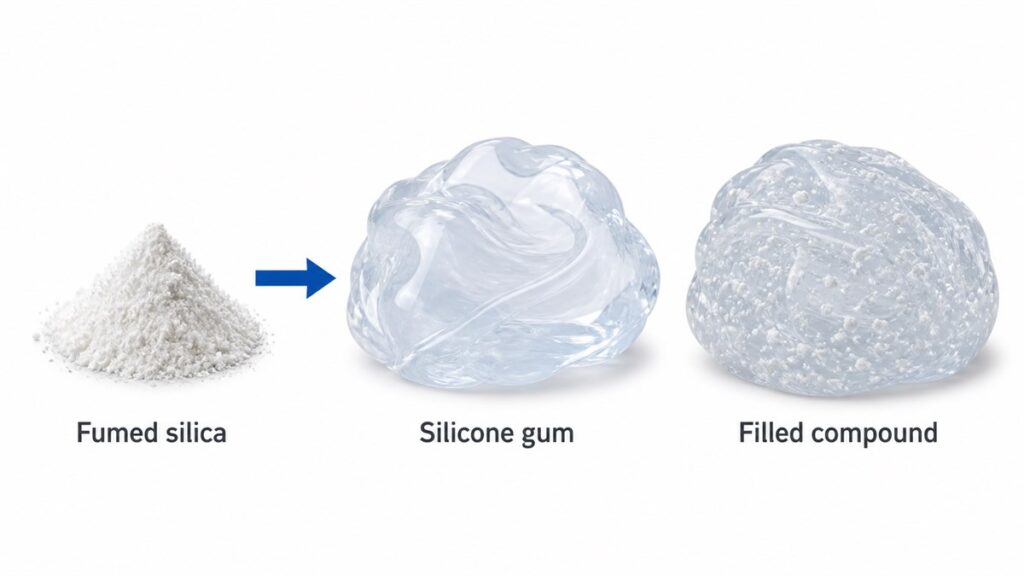
On the property reference, solid silicone density sits around 1.10–1.25 g/cm³, driven mainly by that filler loading. Higher silica loading raises tensile strength and hardness. It also cuts transparency and elongation. That is a trade-off, not an upgrade.
Do not treat “silica-filled” as a grade name. Filler type, surface treatment, and loading change mill behavior and tear. Those details belong in compounding, not here — see Properties of Silicone and Silicone Additives.
When silicone burns or decomposes at high temperature, the residue is silica ash. That is a combustion product, not a reason to specify silica as the part material.
Silicone vs Silica: Which One Is in Your Product?
This is not a “pick A or B for the same part” decision. Treating them as substitutes — flexible consumer goods versus rigid construction material — is the wrong frame.
- Molded gasket, keypad, tubing, bakeware, baby product: silicone rubber. Then specify HCR vs LSR, hardness, cure, and compliance.
- Moisture packet in the carton: silica gel.
- Reinforcing powder inside the compound: fumed or precipitated silica.
- Glass, quartz, or mineral filler outside rubber: silica, not silicone.
If you are comparing silicone with another elastomer or plastic, use Silicone vs Other Materials. For polymer families and process routes, use the Complete Silicone Material Guide.
What This Page Does Not Decide
Naming the class does not lock a compound.
You still need Shore A, cure system (platinum vs peroxide), food-contact or medical evidence, and process route. “Silicone” on a drawing is not a spec. “Silica” on a drawing is not a spec either — it can mean gel, fumed filler, or quartz.
For food-contact articles, compliance sits on the finished part and the test method, not on the word silicone. Start with Food-Grade Silicone.
FAQ
Is silicone the same as silica?
No. Silicone is a polymer. Silica is SiO₂. Many silicone rubbers contain silica filler, which is why the names get mixed.
Are silica gel and silicone rubber the same?
No. Silica gel is a desiccant. Silicone rubber is an elastomer. They are not interchangeable in packaging or in molded parts.
Is silicone made from silica?
Upstream, yes: silicon is extracted from silica, then polymerized. The molded part is a synthetic elastomer, not processed sand.
Why does silicone rubber contain silica?
As a reinforcing filler. It raises strength and hardness and changes density, clarity, and elongation. It is not the rubber itself.
References
- Silicon dioxide — Wikipedia, 2026-08-11
- Silica — Encyclopaedia Britannica
- Direct process (Müller–Rochow) — Wikipedia, 2025-07-17
- Methyl Chloride — NIH PubChem, 2026-08-08
- Silica gel — Wikipedia, 2026-08-11
- Silica gel — Encyclopaedia Britannica, 2026-08-08
- Fumed silica — Wikipedia, 2025-10-06
- Precipitated silica — Wikipedia, 2025-12-13