Looking for a clear comparison of silicone and TPU? Most searches return either material datasheets or vague “it depends” articles. Neither tells you where one material stops and the other starts.
Silicone is a heat-stable thermoset for food, medical, and high-temperature use. TPU is a tough, abrasion-resistant thermoplastic for sports, electronics, and high-volume parts. They are not interchangeable.
Silicone runs from −60 °C to +230 °C and qualifies for FDA 21 CFR 177.2600, LFGB §30/31, and USP Class VI. TPU runs from −40 °C to +80 °C, delivers 3–5× better abrasion resistance (DIN 53516: 20–80 mm³ vs. silicone’s 100–300 mm³), higher tensile strength, and 30–60 s injection cycles vs. silicone’s 2–5 min.
What Is Silicone?
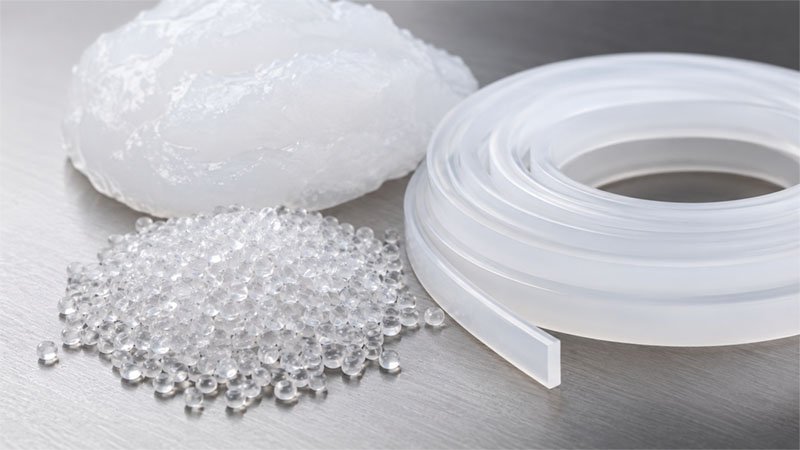
Silicone (formally polydimethylsiloxane, PDMS) is an inorganic thermoset elastomer with a silicon–oxygen (Si–O) backbone derived from silica. Once cured, its molecular network is permanent — it does not soften or reflow under heat.
Key properties at a glance:
- Temperature range: −60 °C to +230 °C (continuous), up to +250 °C short-term for heat-stabilized HCR grades.
- Hardness range: Shore A 10 to 80.
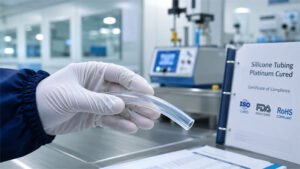
- Curing systems: platinum-cured (no byproducts, odor-free, food/medical grade) or peroxide-cured (lower cost, industrial applications). See Silicone Vulcanization for how each system actually crosslinks.
- Regulatory path: FDA 21 CFR 177.2600, LFGB §30/31, USP Class VI, ISO 10993-5/-10 — all with mature supplier documentation.
- Sterilization: autoclave 121 °C, boiling water, steam — all compatible.
- Molding process: HTV compression molding or LSR (Liquid Silicone Rubber) injection molding (±0.02 mm tolerance).
If you need the full silicone-side baseline (types, properties, and process fit), start here: Complete Silicone Material Guide.
What Is TPU?
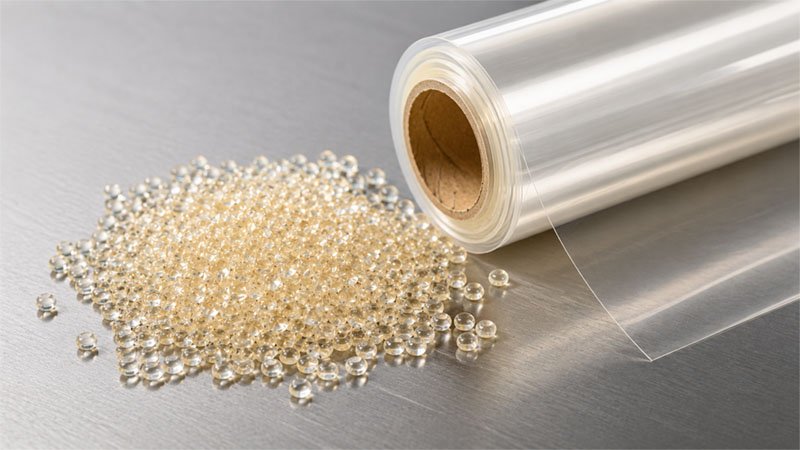
TPU (Thermoplastic Polyurethane) is an organic thermoplastic elastomer with alternating hard and soft polyurethane segments. It softens and reflows under heat, which enables injection molding at short cycle times and mechanical recycling of production scrap.
Key properties at a glance:
- Temperature range: −40 °C to +80 °C (continuous). Heat-stabilized grades reach +120 °C short-term.
- Hardness range: Shore A 60 to Shore D 75.
- Abrasion resistance: DIN 53516 mass loss 20–80 mm³ — 3 to 5× better than silicone.
- Regulatory path: FDA and USP Class VI available for specific aliphatic polyether grades; LFGB qualification is rare and project-specific.
- Sterilization: not compatible with autoclave or steam above 80 °C.
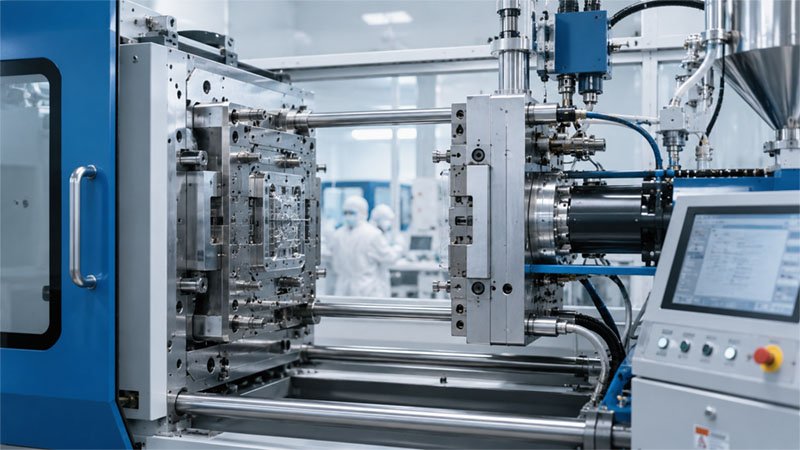
- Molding process: standard thermoplastic injection molding, 30–60 s cycle, regrind tolerant, no post-cure oven.
- Sub-types: polyester TPU (better oil/abrasion, sensitive to hydrolysis) vs. polyether TPU (better hydrolysis and low-temperature flexibility).
Note that TPU is only the thermoplastic branch of the polyurethane family. Thermoset cast polyurethane elastomers are a separate route — poured rather than injected, better suited to low-volume and large parts, and compared against silicone on different terms.
How Silicone and TPU Differ at the Material Level
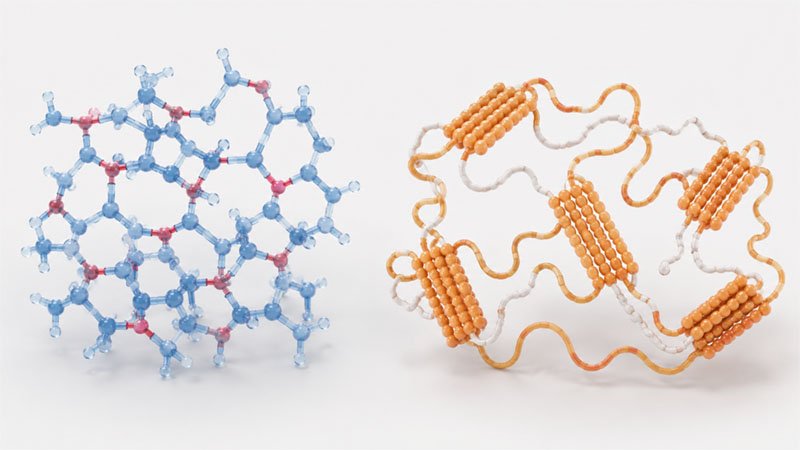
The core difference is thermoset vs. thermoplastic — which drives almost every downstream property.
Silicone — inorganic thermoset
- Backbone: silicon–oxygen (Si–O), no carbon in the main chain.
- Curing: chemical crosslinking with platinum or peroxide forms a permanent 3D network.
- Behavior under heat: does not soften or melt. Decomposes only above ~300 °C.
- Consequence: high thermal stability, no reshaping after cure, no mechanical recycling.
TPU — organic thermoplastic
- Backbone: carbon-based polyurethane with alternating hard and soft segments.
- Curing: no chemical crosslinking. Hard segments form physical (reversible) bonds.
- Behavior under heat: softens at 80–120 °C, melts around 180–230 °C, can be remolded.
- Consequence: short cycle times, mechanically recyclable, but limited heat envelope.
This one distinction explains why silicone handles autoclave sterilization while TPU does not, why TPU can be reground and silicone cannot, and why silicone needs a post-cure oven while TPU does not.
Silicone vs. TPU: Full Property Comparison
Baseline grades: this comparison uses platinum-cured LSR as the silicone reference and standard injection-grade aliphatic TPU as the TPU reference. Specialty grades (high-tear silicone, fluorosilicone, polyester TPU, glass-filled TPU, etc.) can deviate up to ±30 % on individual axes.
| Property | Silicone (Platinum-cured) | TPU |
|---|---|---|
| Material class | Thermoset elastomer | Thermoplastic elastomer |
| Density | 1.10–1.25 g/cm³ | 1.10–1.30 g/cm³ |
| Hardness range | Shore A 10–80 | Shore A 60 – Shore D 75 |
| Tensile strength | 6–11 MPa | 25–55 MPa |
| Elongation at break | 300–800% | 400–700% |
| Tear strength | 10–40 kN/m | 30–140 kN/m |
| Compression set (22h / 70 °C) | 10–25% | 30–50% |
| Abrasion (DIN 53516) | 100–300 mm³ loss | 20–80 mm³ loss |
| Continuous temperature | −60 °C to +230 °C | −40 °C to +80 °C |
| UV stability (no additive) | Excellent | Yellows within months |
| Ozone resistance | Excellent | Good |
| Food contact (FDA / LFGB) | Standard path | FDA: narrow grades; LFGB: rare |
| Medical (USP / ISO 10993) | Standard path | Specific medical grades only |
| Autoclave / steam sterilization | Yes (121 °C) | No |
| Mechanical recyclability | No | Yes (regrind) |
| Typical molding cycle | 2–5 min (LSR cure) | 30–60 s |
| Tooling cost | Higher (LSR) | Lower |
| Per-unit cost at high volume | Higher | Lower |
Reading the table:
- TPU wins on mechanical axes: tensile, tear, abrasion, compression behavior at room temperature.
- Silicone wins on environmental axes: temperature, UV, ozone, steam, chemical inertness.
- TPU wins on cost and recyclability.
- Silicone wins on regulated contact paths (food, skin, medical).
Indicative raw material cost (USD/kg, 2025 reference market range):
- Commodity injection-grade TPU (polyester or polyether): $4–10/kg
- Medical / aliphatic / FDA-qualified TPU: $12–25/kg
- Industrial peroxide-cured HCR silicone: $6–12/kg
- Platinum-cured LSR (food/medical-grade): $10–25/kg
Finished-part cost depends more on tooling amortization, cycle time, certification, and annual volume than on pellet price. TPU’s resin-cost advantage narrows — and can reverse — once medical or food-contact qualification is required.
Indicative tooling cost (production mold, 2025 reference):
- TPU steel injection mold (2-cavity): $15–40k
- HCR silicone compression mold: $5–25k
- LSR cold-runner injection mold (2-cavity): $40–80k
- LSR multi-cavity high-precision mold: $80–150k+
Chemical and Environmental Resistance
Real-world durability depends on chemical exposure as much as on mechanical numbers.
| Exposure | Silicone | Polyester TPU | Polyether TPU |
|---|---|---|---|
| Water, mild detergents | Excellent | Excellent | Excellent |
| Cooking oils and fats | Good (some swelling) | Excellent | Good |
| Mineral oils, fuels | Fair (silicone swells) | Excellent | Fair |
| Dilute acids and bases | Good | Fair | Fair |
| Polar solvents (alcohols) | Good | Fair | Fair |
| Hot water and steam (above 80 °C) | Excellent | Poor | Poor |
| UV / outdoor weathering | Excellent | Poor without UV stabilizer | Poor without UV stabilizer |
| Ozone | Excellent | Good | Good |
| Humid environments / hydrolysis | Excellent (inert) | Poor (hydrolysis-sensitive) | Excellent |
Practical note: polyester TPU delivers the strongest oil, fuel, and abrasion resistance but degrades in humid environments through ester-bond hydrolysis — service life in tropical or wash-heavy conditions can drop sharply. Polyether TPU trades a bit of oil resistance for excellent hydrolysis resistance and better low-temperature flexibility, making it the default for outdoor straps, IV tubing, and wearables. Silicone is chemically inert across most environments but does swell in non-polar hydrocarbons (gasoline, hexane).
Surface, Feel, and Appearance
For consumer products, how a material looks and feels often weighs as much as the datasheet.
| Attribute | Silicone | TPU |
|---|---|---|
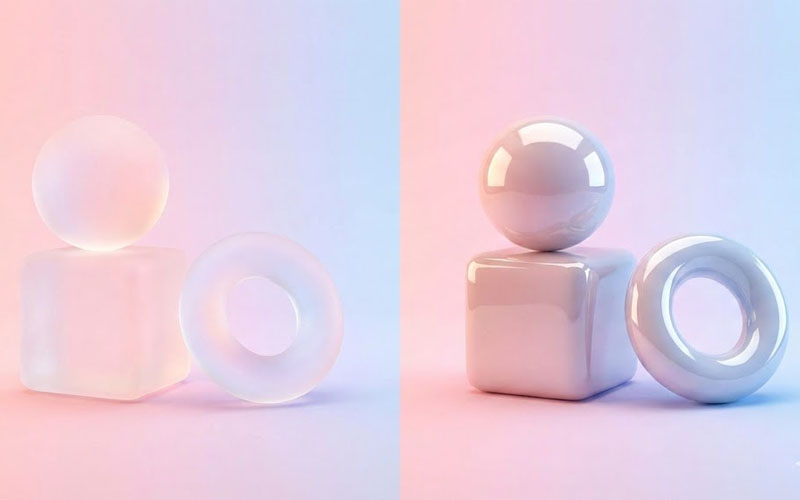
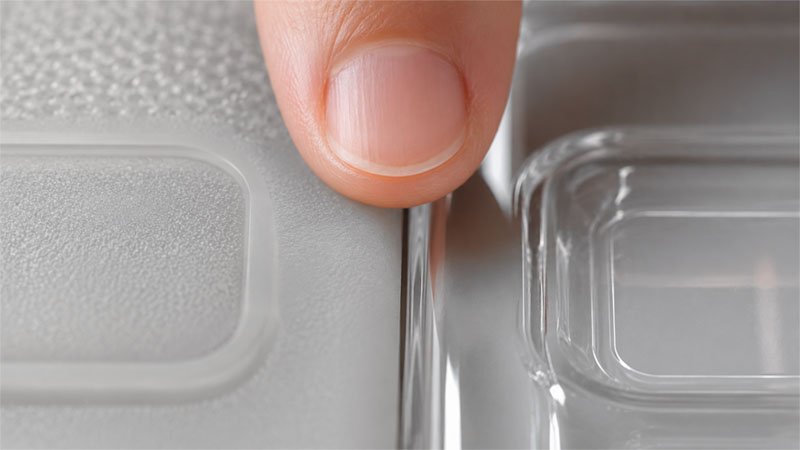
| Default surface | Matte to satin, “soft skin” feel | Glossy and smooth, “rubbery” feel |
| Tackiness | Slightly tacky / grippy | Smooth, non-tacky |
| Color range | Full range; translucent and pastel grades clean | Full range; transparent and deep colors excellent |
| Color stability under UV | Excellent | Yellows visibly without UV additive |
| Printability (logos, ink) | Requires plasma or primer | Accepts standard inks |
| Bonding to other materials | Needs primer or co-mold | Bonds via adhesives and overmolding |
Default tactile read: silicone signals “baby, kitchen, medical, premium soft.” TPU signals “sport, tough, transparent, technical.” Both can be tinted, textured, or finished, but the baseline brand cue is different.
Biocompatibility and Skin Contact
For products that touch skin, mouth, or body tissue, biocompatibility is the deciding axis.
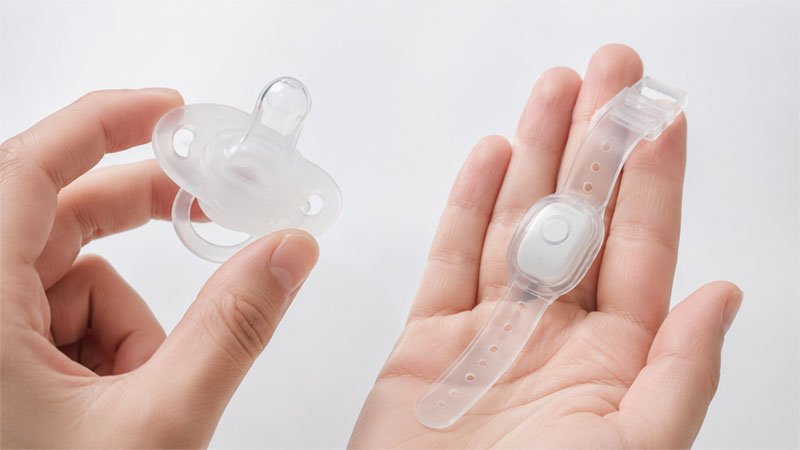
- Platinum-cured medical-grade silicone: passes USP Class VI and ISO 10993-5 / -10. Standard for surgical implants, catheters, baby nipples, menstrual cups, CPAP masks. Hypoallergenic and chemically inert. See Food Grade Silicone for the food-contact qualification path in detail.
- Medical-grade polyether TPU: also passes USP Class VI and ISO 10993 in specific grades. Standard for IV tubing, wound dressings, and wearable medical sensors. Generally hypoallergenic, but the qualified grade list is narrower.
For prolonged direct skin, oral, or body-tissue contact in regulated markets, silicone has the more established documentation path. For short-term or surface contact products (sensors, films, straps, packaging), medical-grade TPU is widely accepted.
Where Each Material Applies
Use this checklist as the working decision rule. Each bullet pairs a selection criterion with concrete product examples in that bucket.
Use silicone when:
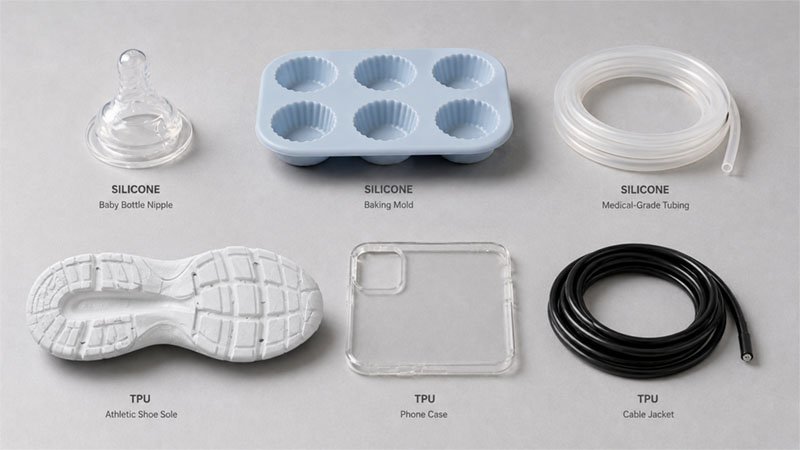
- The product contacts food, skin, or body tissue and requires FDA 21 CFR 177.2600, LFGB §30/31, USP Class VI, or ISO 10993 certification. (Examples: baby pacifiers, bottle nipples, kitchen bakeware, menstrual cups, CPAP masks, catheters, wound contact layers.)
- Operating temperature exceeds 80 °C continuously, or sterilization by autoclave / boiling water / steam is part of normal use. (Examples: oven mats, baking molds, automotive gaskets, surgical tubing, food storage seals.)
- UV, ozone, or multi-year outdoor exposure is part of the service environment. (Examples: outdoor seals, solar-panel gaskets, marine cable insulation.)
- High-temperature electrical insulation or vibration damping is the dominant load case. (Examples: high-voltage wire jackets, motor encapsulation, automotive dampers.)
- The brand cue depends on a soft, matte, “premium skin” tactile read. (Examples: makeup applicators, premium watch straps, baby feeding sets, skincare brushes.)
Use TPU when:
- Abrasion, tear, or impact resistance is the primary load case. (Examples: shoe outsoles and midsoles, phone cases, cable jackets, conveyor belts, hydraulic seals, abrasion-resistant linings, shin guards.)
- The product operates at room temperature with peak exposure under 80 °C.
- High-volume injection molding with annual volume high enough to amortize tooling (typically 30k+ parts per cavity) and low per-unit cost are the primary constraints. (Examples: fitness bands, transparent phone cases, garment films, earphone strain relief.)
- Production scrap recyclability is required by ESG mandate or customer specification.
- Deep transparent color or glossy finish is part of the brand cue. (Examples: clear inflatable bladders, drybags, paddleboard skins, fashion garment films, transparent watch straps.)
How to Choose: Quick Decision Tree
Three questions decide most projects.
1. Will the product see continuous heat above 80 °C, or steam/autoclave sterilization?
→ Yes: silicone.
→ No: continue to Q2.
2. Does it need FDA, LFGB, USP Class VI, or ISO 10993 documentation for food, skin, or body contact?
→ Yes: silicone (faster qualification path).
→ No: continue to Q3.
3. Is abrasion, tear, or impact the primary load case, with annual volume high enough to amortize injection tooling (typically 30k+ parts per cavity) and unit cost as the main constraint?
→ Yes: TPU.
→ No: the spec is incomplete — define the dominant load axis before locking material.
If a part answers “yes” to both Q1/Q2 and Q3, the constraints contradict. Either re-scope (split into a multi-material assembly with silicone contact surfaces over a TPU body) or pick the non-negotiable standard.
Sustainability and End-of-Life
| Sustainability axis | Silicone | TPU |
|---|---|---|
| Mechanical recycling (regrind) | No | Yes |
| Chemical recycling | Emerging (depolymerization R&D) | Emerging (glycolysis for some grades) |
| Bio-based feedstock | Limited | Bio-TPU grades available (30–70% bio-content) |
| Typical service life | 10+ years | 3–8 years |
| End-of-life | Inert, non-biodegradable in landfill | Slow degradation; polyester grades hydrolyze |
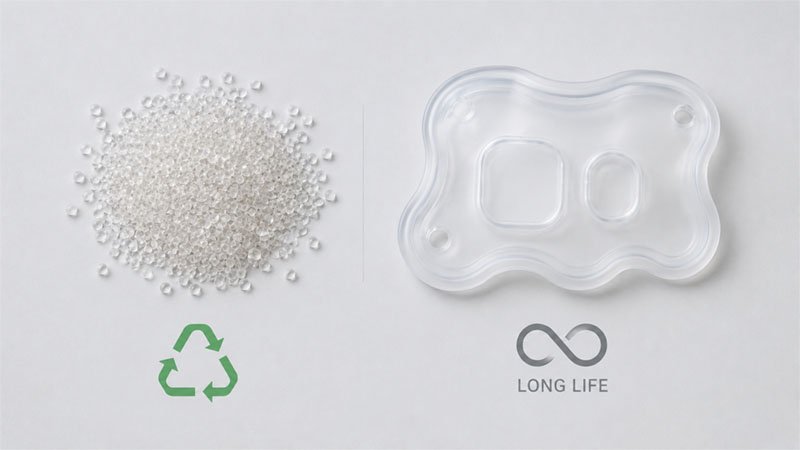
TPU has the cleaner circular-economy story (regrind, bio-content). Silicone has the longer single-life durability story. Neither is biodegradable in practical timeframes; both are inert in landfill conditions.
Where the Comparison Misleads
Three common mistakes when comparing silicone and TPU:
- Comparing on Shore A alone. The two materials overlap in Shore A 60–80, but identical hardness numbers do not predict tear strength, compression set, or thermal behavior.
- Treating “food grade” as one standard. It is not. Name the regulation by target market and the clause: USA FDA 21 CFR 177.2600, EU/Germany LFGB §30/31 and BfR XV, China GB 4806.11, Japan JHOSPA / JFSL 370, India BIS IS 9873. Each has different migration limits, test methods, and accepted additive lists.
- Comparing pellet cost instead of part cost. TPU pellets are cheaper per kilogram, but landed cost per part depends on tooling, qualification, sterilization, and annual volume.
Silicone vs. TPU: FAQ
Is silicone safer than TPU for food contact?
Yes, for most applications. Platinum-cured silicone has a well-established path to FDA 21 CFR 177.2600 and LFGB §30/31. TPU can qualify for FDA in specific aliphatic grades, but LFGB compliance is uncommon. For baby products and kitchenware sold in Europe, silicone is the standard choice. See Food-grade silicone VS Other silicone for grade-level differences within silicone itself.
Can TPU withstand dishwasher temperatures?
Generally no. Standard dishwasher cycles reach 60–75 °C, close to or above the upper service limit of most TPU grades. Silicone handles dishwasher temperatures without dimensional change. See Dishwasher vs. Hand-Washing Silicone Baby Products for cleaning-cycle effects on silicone over multi-year service.
Which is more durable, silicone or TPU?
Depends on the load type. TPU has 3–5× better abrasion resistance and 3–5× higher tensile strength. Silicone has far better UV, ozone, and thermal durability. For wear-driven parts, TPU wins. For heat or outdoor exposure, silicone wins.
Is TPU cheaper than silicone?
Per-unit, usually yes — TPU cycles in 30–60 s vs. silicone’s 2–5 min, with lower tooling cost. The gap narrows when regulatory qualification and sterilization are required, because those costs hit TPU programs harder than silicone programs.
Is silicone or TPU better for skin-contact products like watch straps?
Both work. TPU is the default for sport and fitness straps (abrasion, sweat resistance, glossy finish, lower cost). Silicone is preferred for medical-monitoring wearables and premium “soft feel” straps. For continuous body-contact wearables in regulated markets, medical-grade silicone has the cleaner documentation path.
Can silicone and TPU be combined in one product?
Yes, via overmolding or assembly. A common combination: a TPU structural body (abrasion + impact) with silicone gaskets, seals, or contact surfaces (heat + food/skin contact). Adhesion between the two requires primer or mechanical interlock.
Which material is better for outdoor use?
Silicone, by a wide margin for default grades. Unmodified TPU yellows and embrittles under UV within 6–12 months. Silicone is UV- and ozone-stable for years without additives. Aliphatic UV-stabilized TPU (typically MDI-based aliphatic polyether) holds color and mechanical properties for 2–3 years outdoors, but costs 2–3× standard TPU and remains a specialty path — not the volume default.