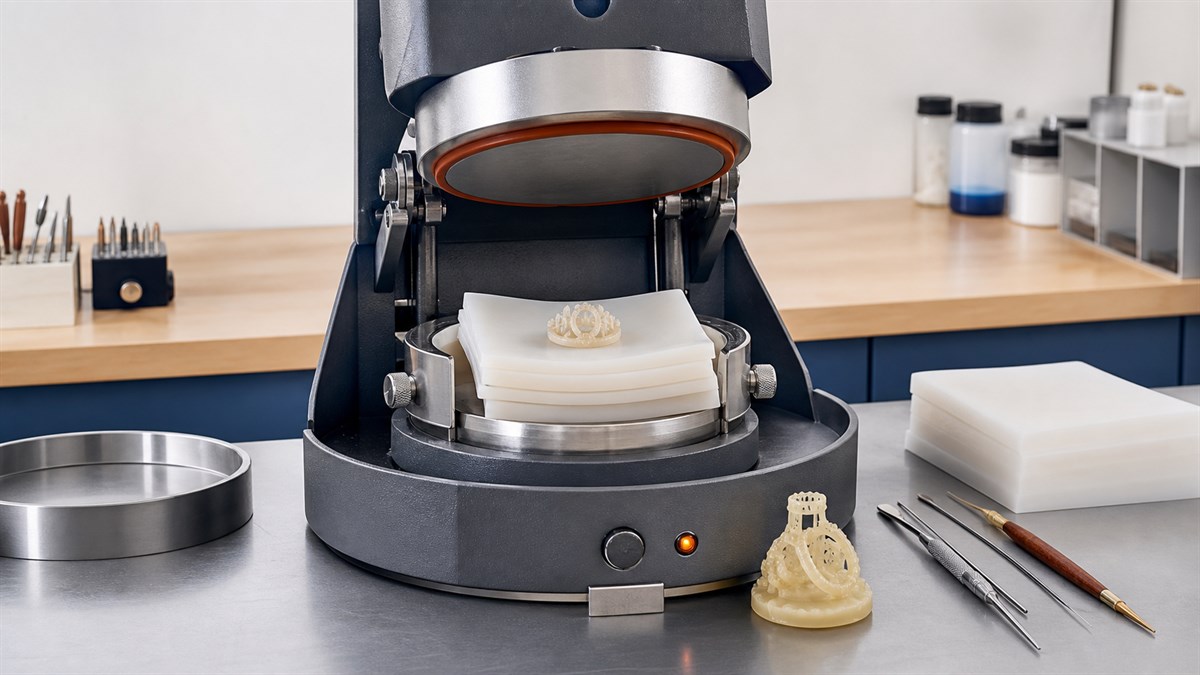
The term “low temperature” causes a basic specification error. It may describe the curing process, but buyers often read it as the material’s service-temperature performance. Those are separate properties and must be verified separately.
Low temperature vulcanized silicone rubber is a silicone compound formulated to cure at a lower mold temperature than conventional heat-cured rubber. The term is application- and supplier-specific; it does not automatically mean the cured part is designed for sub-zero service.
What Does Low Temperature Vulcanized Silicone Rubber Mean?
Low temperature vulcanized silicone rubber, usually shortened to LTV silicone rubber, is defined by how it is cured. During vulcanization, crosslinkers convert the uncured silicone compound into an elastic three-dimensional network. A lower curing temperature can protect heat-sensitive masters and reduce thermal exposure during mold production.
LTV is not used as consistently as RTV, LSR, or HTV. Major silicone suppliers commonly classify silicone elastomers as RTV-1, RTV-2, liquid silicone rubber, and high-temperature vulcanizing silicone rubber. In jewelry and model-making supply chains, however, LTV often refers to solid silicone mold rubber cured in a heated press at a temperature below that used for conventional heat-vulcanized mold rubber.
This is why the supplier’s technical data sheet matters more than the acronym.
| Term | Typical material form | Curing route | Common use |
|---|---|---|---|
| LTV | Often solid sheets or mold compound | Heated cure at a supplier-defined lower temperature | Jewelry molds and heat-sensitive master patterns |
| RTV-1 | One-part paste or sealant | Moisture cure at room temperature | Sealing, bonding, and coating |
| RTV-2 | Two-part pourable or kneadable compound | Condensation or addition cure, normally near room temperature | Mold making, potting, and encapsulation |
| LSR | Two-part pumpable liquid | Platinum addition cure in a heated injection mold | High-volume precision molded parts |
| HTV/HCR | High-consistency solid rubber | Peroxide or platinum cure at elevated temperature | Compression molding and extrusion |
For the underlying crosslinking process, see What Is Silicone Vulcanization.
How Is LTV Silicone Rubber Cured?
The exact cycle comes from the material supplier. There is no universal LTV curing temperature or curing time.
A commercial Nicem LTV mold-rubber grade, for example, lists a vulcanization temperature of 90°C (194°F) and a cure time of 19 minutes per 6.35 mm (1/4 in.) thickness. Those figures describe one product, not the whole LTV category. Another formulation may require a different temperature, pressure, or cycle.
In production, four variables need to be controlled together:
- Actual mold temperature: The controller setting is not proof that the rubber interface has reached the specified temperature.
- Section thickness: A thick mold takes longer to heat through than a thin test slab.
- Pressure and mold closure: Uneven pressure can affect cavity filling, parting lines, and dimensional consistency.
- Master-pattern stability: Wax, resin, polymer, or 3D-printed masters can soften, distort, or inhibit cure at different temperatures.
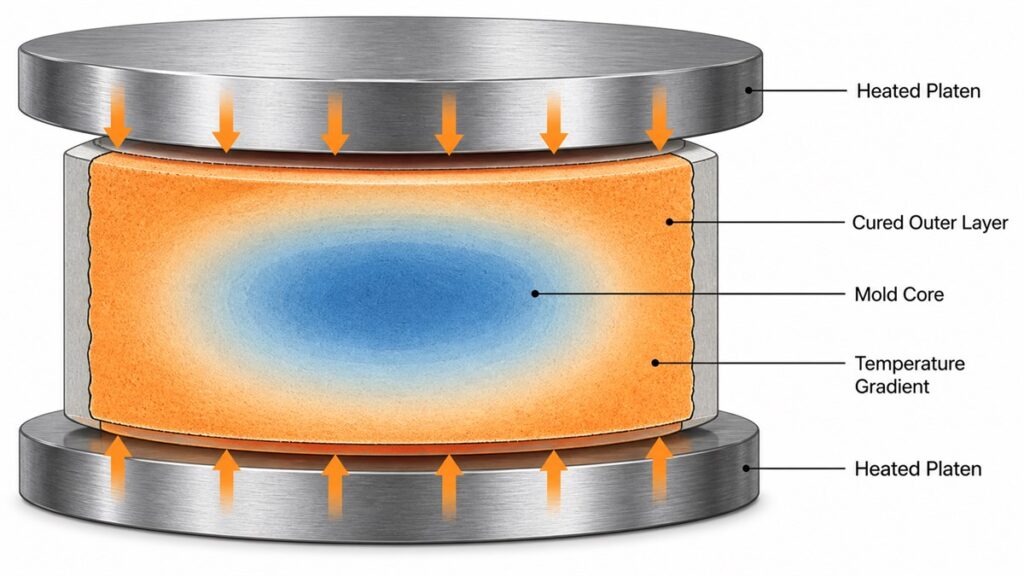
A lower setpoint does not automatically mean a shorter cycle. If the core of the mold remains below the required curing temperature, the surface may appear finished while the center remains under-cured.
Does LTV Silicone Rubber Perform Better in Cold Environments?
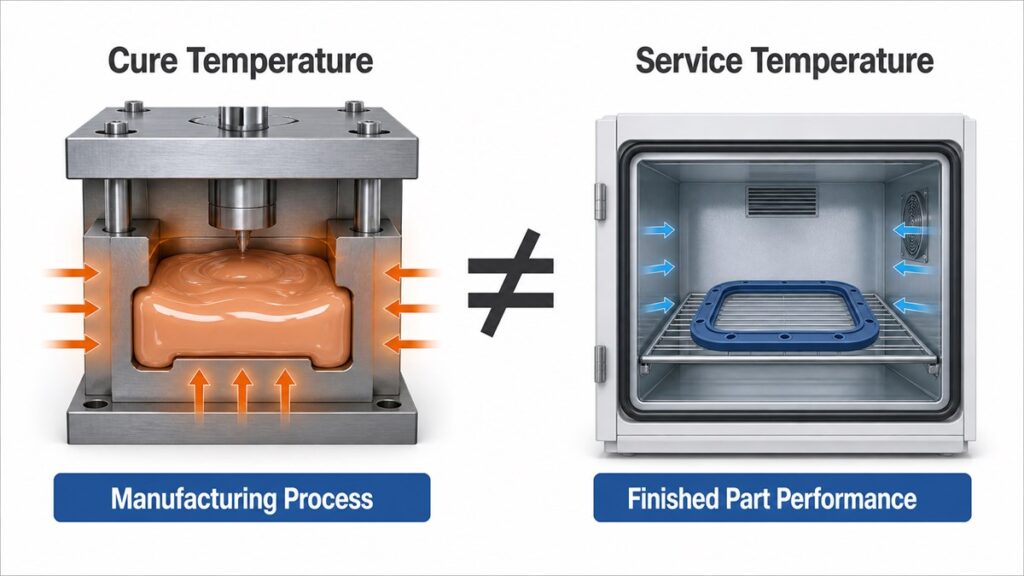
Not necessarily. Cure temperature and service temperature are different specifications.
Low-temperature flexibility depends on the silicone polymer, phenyl content, crosslink density, fillers, and the finished compound. It cannot be inferred from the letters “LTV.” Silicone elastomers generally retain flexibility over a wider temperature range than many organic rubbers, but the usable limit must still come from grade-specific test data.
For a cold-service seal, gasket, cable component, or electronic encapsulant, request data for the property that controls the application:
| Application concern | Relevant evidence |
|---|---|
| Retraction after low-temperature exposure | ISO 2921 temperature-retraction data |
| Sealing recovery under compression | ISO 815-2 low-temperature compression-set data |
| Flexibility at a specified temperature | Brittleness, modulus, or application-specific flex testing |
| Repeated hot/cold cycling | Thermal-cycling test on the finished geometry |
| Electrical protection | Dielectric data before and after environmental aging |
Do not approve a cold-service material only because its manufacturing cure is described as “low temperature.”
When Should You Choose LTV Silicone Rubber?
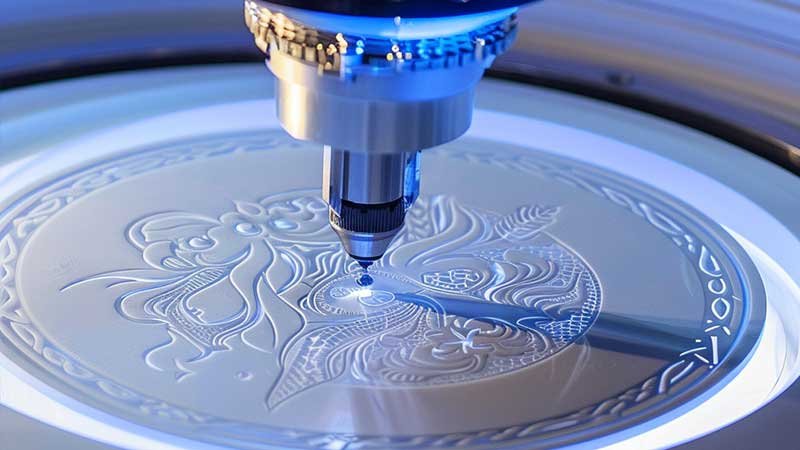
LTV silicone rubber is most relevant when the master pattern cannot tolerate a conventional mold-vulcanizing cycle but a pressed solid-silicone mold is still preferred.
Typical cases include:
- Jewelry molds made from wax or heat-sensitive resin masters
- Detailed patterns with undercuts or fine filigree
- Mold-making processes where dimensional change must be tightly controlled
- Workshops that need a heated, press-cured mold rather than a pourable RTV system
One commercial grade reports 0.3% shrinkage, but shrinkage is formulation- and process-specific. The figure should not be copied into a drawing or purchasing specification without confirming the exact grade, mold thickness, cycle, and measurement method.
For automotive, electronics, food-contact, or medical parts, “LTV” alone is not a useful approval criterion. Those projects normally start by selecting the silicone manufacturing process—RTV potting, LSR injection molding, HCR compression molding, or extrusion—and then confirm mechanical, thermal, electrical, and compliance data.
LTV vs. RTV: Which One Fits Mold Making?
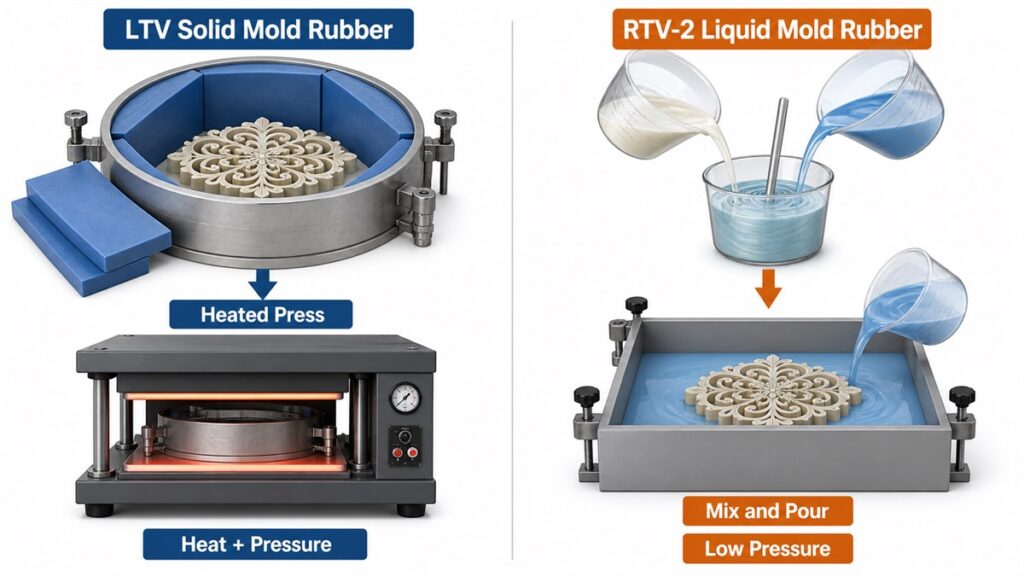
Choose based on the master, mold geometry, production method, and required cycle—not on which acronym sounds more advanced.
| Decision factor | LTV solid mold rubber | RTV-2 liquid mold rubber |
|---|---|---|
| Material handling | Sheets or kneadable compound packed into a mold frame | Two components metered, mixed, and poured |
| Equipment | Heated press and mold frame | Mixing tools; vacuum degassing may be required |
| Heat on the master | Elevated, but lower than conventional hot-vulcanized cycles for some grades | Often room-temperature cure; heat may be used to accelerate suitable grades |
| Pressure on the master | Press pressure is part of the process | Normally low pressure during casting |
| Complex undercuts | Depends on hardness, tear strength, and mold-cutting method | Often suitable when a flexible poured mold is needed |
| Main control risk | Temperature through the full mold thickness | Mix ratio, air entrapment, cure inhibition, and moisture sensitivity |
If the master is damaged by either heat or press pressure, an RTV-2 system may be the safer route. If the shop already uses vulcanized rubber molds and needs lower thermal exposure with a short, controlled press cycle, an LTV grade may fit better.
What Must Be Confirmed Before Ordering?
Do not specify only “LTV silicone.” Send the supplier a process and performance window.
- Exact master material and its maximum safe temperature
- Maximum dimensions and thickest mold section
- Available press temperature, pressure, and platen size
- Required Shore hardness and tear resistance
- Maximum acceptable mold shrinkage
- Number of expected casting cycles
- Casting material and peak contact temperature
- Release-agent and contamination restrictions
- Required food-contact, medical, electrical, or other compliance documentation
The supplier should return a grade-specific technical data sheet, recommended cure cycle, storage conditions, shelf life, and test method for each quoted property.
Frequently Asked Questions
Is LTV the same as RTV silicone rubber?
No. RTV is formulated to cure at or near room temperature. LTV normally describes a lower-temperature heated vulcanization process, but suppliers do not use the term uniformly.
Is LTV silicone suitable for sub-zero seals?
Only if the selected grade has supporting low-temperature test data. The curing label does not establish cold-service performance.
Does lower-temperature vulcanization reduce shrinkage?
It can reduce thermal exposure, and some commercial LTV mold compounds publish low shrinkage values. Actual shrinkage still depends on formulation, mold geometry, pressure, temperature, and cure time.
The correct next step is not to ask whether LTV silicone is “better.” Confirm the master material, maximum safe processing temperature, mold thickness, expected casting cycles, and required dimensional change. Without those inputs, the acronym is too broad to support a material decision.