Most buyers ask for a “test report” without naming a standard. What comes back is a PDF with numbers that cannot be compared to anything. Silicone testing methods only mean something when the standard, the specimen die, and the test conditions are all written into the spec — a Shore A value without ASTM D2240, or a compression set number without ASTM D395 Method B time and temperature, is not data. This page lists the methods we actually run and quote against, what each one measures, and where the results stop being valid.
What Do Silicone Testing Methods Actually Measure?
They measure the cured compound, not the finished part. That distinction causes more disputes than any other point in this article.
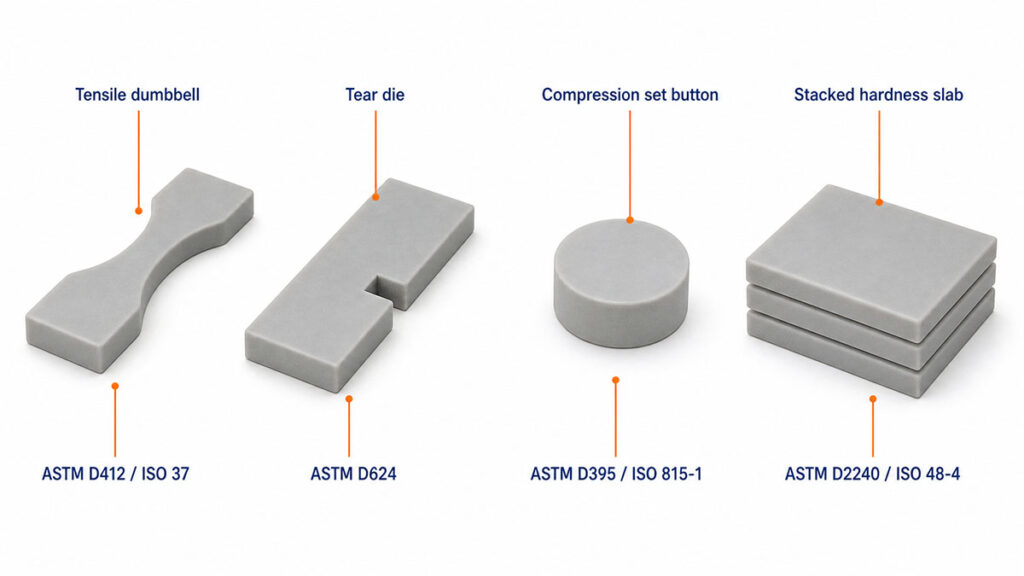
Test specimens are slabs or dumbbells molded and post-cured under controlled conditions. Your part has flow lines, knit lines, wall transitions, and a different cure history in thick sections. A compound that hits 9.0 MPa tensile on a 2 mm slab can fail at a gate on a 6 mm boss. Material tests qualify the compound; part-level tests qualify the tooling and the process.
Three categories cover almost everything requested in a silicone RFQ:
- Physical / mechanical: hardness, tensile, elongation, tear, compression set, specific gravity
- Environmental / aging: heat aging, low-temperature brittleness, fluid immersion, ozone, UV
- Compliance / contact safety: FDA 21 CFR 177.2600, LFGB, ISO 10993, USP Class VI, RoHS/REACH
Which ASTM and ISO Standards Cover Physical Properties?
These are the six that appear on nearly every silicone technical data sheet.
| Property | ASTM method | ISO equivalent | What it reports | Common condition |
|---|---|---|---|---|
| Hardness | ASTM D2240 | ISO 48-4 | Shore A durometer, 1 s or 15 s reading | 6 mm stacked slab, 23°C |
| Tensile & elongation | ASTM D412 (Die C) | ISO 37 (Type 1/2) | MPa at break, % elongation | 500 mm/min crosshead |
| Tear strength | ASTM D624 (Die B / Die C) | ISO 34-1 | kN/m | Die geometry must be stated |
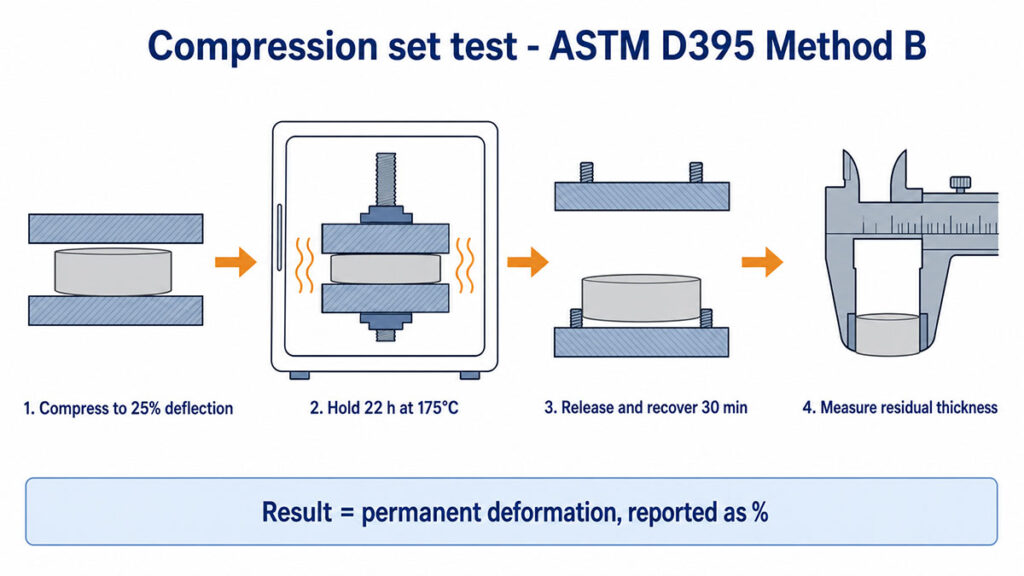
| Compression set | ASTM D395 Method B | ISO 815-1 | % permanent deformation | 22 h @ 175°C, 25% deflection |
| Specific gravity | ASTM D792 | ISO 2781 | g/cm³ | Water displacement |
| Rebound / resilience | ASTM D2632 | ISO 4662 | % | Vertical rebound |
Two traps here.
First, ASTM D412 and ISO 37 are not interchangeable numbers. Different specimen geometry and gauge length produce different elongation results on the same compound. If your incoming inspection uses ISO 37 and the supplier’s TDS uses D412, you will argue about a material that is fine.
Second, tear strength without a die callout is meaningless. Die B (angle, nicked) and Die C (unnicked) give different values on the same silicone, often by a wide margin. Write the die into the drawing.
Compression set is the number that matters most for seals and gaskets, and it is the one most often quoted at the wrong condition. 22 h at 175°C is the classic ASTM D395 Method B condition; a compound tested at 70°C will look dramatically better and tell you nothing about a 200°C application. Post-cure state also changes it — see silicone post cure and our detail page on compression set testing.
For background on what these values mean in service, see silicone mechanical properties and Shore hardness selection.
How Is Silicone Hardness Tested Correctly?
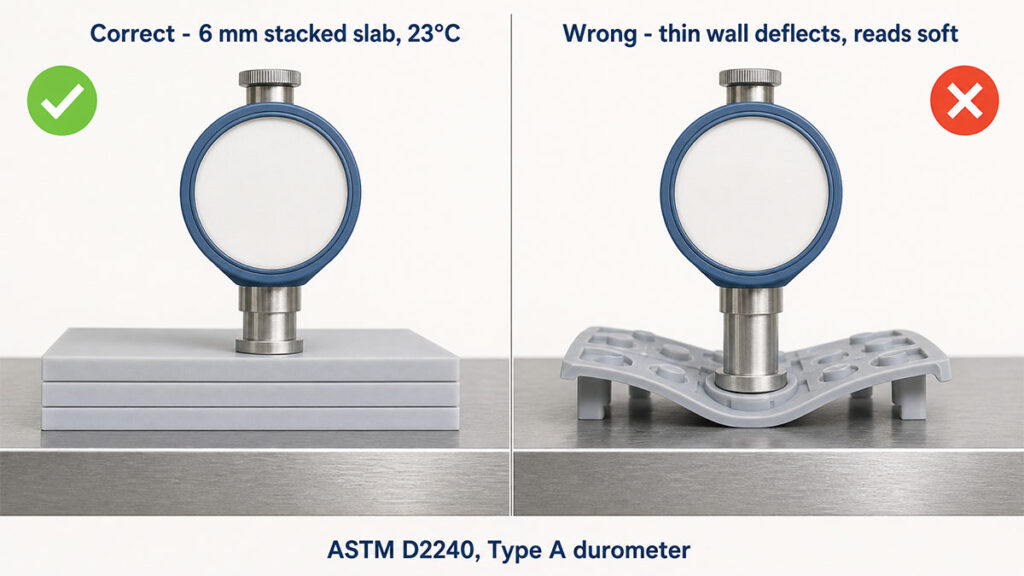
With a Type A durometer per ASTM D2240, on a specimen at least 6 mm thick, at 23 ± 2°C.
The common field error is measuring hardness on the part itself. A 2 mm keypad web or a curved tube wall reads soft because the durometer foot deflects the geometry, not just the material. Stack slabs or test a molded plaque. Also state whether the reading is instantaneous or after 15 s dwell — silicone relaxes, and the 15 s value can be 2–3 points lower.
Tolerance discipline: ±5 Shore A is standard for silicone. Anyone promising ±2 across a full production run on a textured or thin-walled part is quoting a lab, not a factory.
What Aging and Environmental Tests Should You Specify?
Specify aging tests when the part sees heat, oil, steam, or outdoor exposure for years — not when it sits in a drawer.
| Test | Standard | Purpose | Typical silicone condition |
|---|---|---|---|
| Heat aging | ASTM D573 / ISO 188 | Property retention after oven exposure | 70 h @ 200°C or 225°C |
| Low-temperature brittleness | ASTM D2137 / ISO 812 | Brittle point | -55°C to -70°C for VMQ |
| Fluid resistance | ASTM D471 / ISO 1817 | Volume swell, hardness change | Oil / solvent, 70 h |
| Ozone resistance | ASTM D1149 / ISO 1431-1 | Surface cracking | 50 pphm, 40°C, 72 h |
| Weathering / UV | ASTM G154 / ISO 4892-2 | Color and surface change | Cycle-dependent |
| Flammability | UL 94 / FMVSS 302 | Burn rate, self-extinguishing | Grade-dependent |
Heat aging is where silicone earns its price against organic rubbers, and where a badly post-cured compound gets exposed. Residual peroxide by-products and low-molecular-weight siloxanes drive weight loss, hardening, and odor. A compound that passes 70 h at 200°C after a proper 4 h post-cure at 200°C can fail the same test when the post-cure was cut to save oven time. Related reading: silicone aging, UV and weathering resistance.
How Is Food-Grade and Medical Silicone Tested for Compliance?
By extraction and migration testing against a named regulation — not by a supplier’s word.
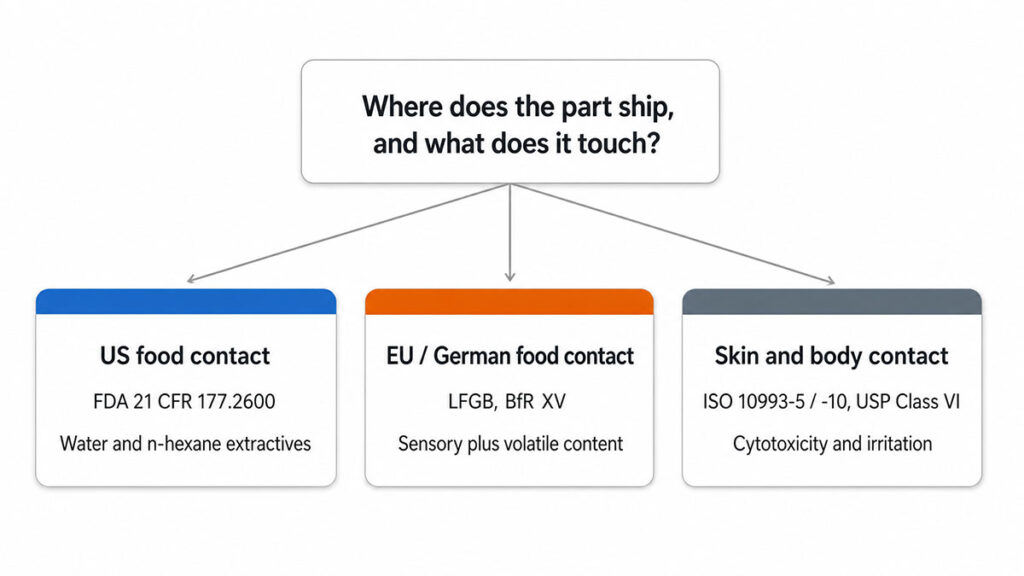
FDA 21 CFR 177.2600
This is the US rule for rubber articles in repeated food contact. Testing is extraction-based: the cured article is refluxed in water and in n-hexane, and the extractives are weighed. Limits apply to both the initial extraction and the subsequent extraction, and the second one is the tighter of the two. A compound only complies as a cured, post-cured article — the raw gum alone does not carry the claim.
LFGB / BfR XV
The German route, and the one most EU buyers ask for. It combines sensory testing (odor and taste transfer) with a volatile content requirement measured after oven exposure at 200°C. Under-post-cured parts fail the volatiles check first, and they fail on smell before they fail on chemistry. If you have ever received a shipment of silicone bakeware with a distinct odor, that is the same defect the LFGB test is designed to catch.
ISO 10993 and USP Class VI
For skin- and body-contact products. ISO 10993-5 covers in-vitro cytotoxicity, -10 covers irritation and sensitization, and -18 covers chemical characterization of extractables. USP Class VI is a pass/fail in-vivo battery still requested widely in medical purchasing. Both are tied to the exact formulation, cure system, and sterilization route — a color change or a new pigment invalidates the certificate.
| Requirement | Standard | Test basis | What invalidates it |
|---|---|---|---|
| US food contact | FDA 21 CFR 177.2600 | Water and n-hexane extractives | Formulation or cure change |
| EU/German food contact | LFGB, BfR XV | Sensory + volatile content | Insufficient post-cure |
| Skin/body contact | ISO 10993-5 / -10 | Cytotoxicity, irritation | New pigment, new sterilization |
| Medical legacy | USP Class VI | In-vivo, pass/fail | Any material substitution |
| Substance restriction | RoHS, REACH SVHC | Elemental / chemical analysis | Pigment and filler changes |
For the material-side distinction behind these tests, see food-grade vs medical-grade silicone and food grade silicone. For migration behavior in sheet form, see material migration and leaching tests.
Which Tests Belong in Production Rather Than in the Lab?
Cure-state and dimensional tests. They catch drift; the material tests do not.
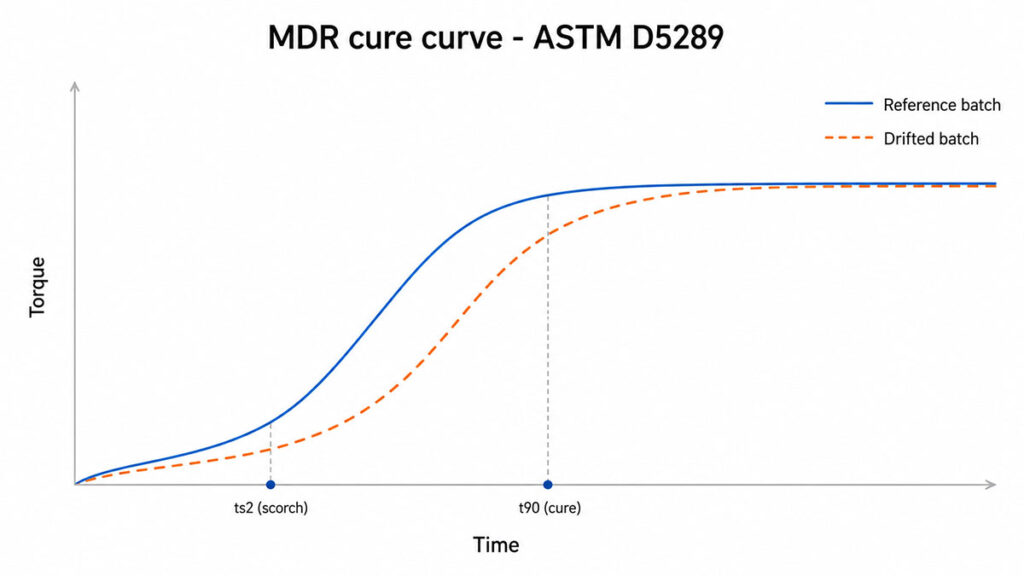
- Rheometer / MDR (ASTM D5289): ts2 and t90 per incoming batch of compound. This is the single most useful incoming test we run — it detects a compound change before it becomes a molding problem.
- Mooney viscosity (ASTM D1646) for HCR gum consistency batch to batch.
- Specific gravity (ASTM D792) as a fast filler-loading check. A drifting SG usually means the compound is not what the last shipment was.
- Dimensional check against shrinkage: silicone shrink is typically in the 2–4% range and moves with durometer, filler load, and post-cure. First-article dimensions must be measured after post-cure, never before.
- Hardness sampling per shift on a molded plaque, not on the part.
The reason batch-level rheometry matters: a compound supplier can change a filler lot without changing the datasheet. Nothing on the TDS moves, but t90 shifts, the molder keeps the old cure time, and parts come out under-cured in the thick sections. It shows up three weeks later as compression set failures or odor complaints — never as a molding defect on day one. Our shipment inspection checklist covers what that looks like downstream.
Electrical Testing for Insulation and Keypad Applications
| Property | Standard | Reported as |
|---|---|---|
| Dielectric strength | ASTM D149 / IEC 60243 | kV/mm |
| Volume resistivity | ASTM D257 | Ω·cm |
| Dielectric constant / dissipation | ASTM D150 | Dimensionless / tan δ |
| Arc resistance | ASTM D495 | Seconds |
| Tracking (CTI) | IEC 60112 | Volts |
Dielectric strength is thickness-dependent and drops sharply with voids or trapped air. Test on the actual thickness you will ship, not on a 1 mm reference slab. More context in silicone electrical properties.
Carbon- and silver-filled compounds run the same ASTM D257 method in the opposite direction, where the target is low resistance rather than high — see how conductive silicone resistivity is tested for the volume and surface resistivity conditions to specify.
How to Write Testing Requirements Into a Purchase Spec
A usable spec line has four parts: property, standard, condition, limit.
- Weak: “Compression set must be low.”
- Usable: “Compression set ≤ 25%, ASTM D395 Method B, 22 h @ 175°C, 25% deflection.”
- Weak: “Food safe.”
- Usable: “FDA 21 CFR 177.2600 extraction report on the cured, post-cured article; LFGB report including sensory.”
ASTM D2000 line callouts do the same job in one string for industrial rubber, and most silicone grades can be described that way. If your engineering team already works in D2000, use it — it removes the ambiguity that free-text specs create.
FAQ
Is ASTM D412 the same as ISO 37?
No. Both measure tensile strength and elongation, but specimen geometry and gauge length differ, so results are not directly comparable. Pick one standard and use it on both sides of the transaction.
Do I need both FDA and LFGB testing?
Only for the markets you ship to. FDA 21 CFR 177.2600 covers US food contact; LFGB is the German/EU route and adds sensory testing. Products sold in both markets need both reports.
Can you test the finished part instead of a slab?
Some tests, yes — hardness on thick sections, dimensional checks, and function tests. Tensile, tear, and compression set require standard specimens, so those are always run on molded slabs from the same batch.
How long does a full test package take?
Physical properties are typically a few days. Heat aging at 70 h and biocompatibility work run considerably longer, and ISO 10993 pathways are measured in weeks. Build that into the schedule before you commit to a launch date.
What We Need From You to Quote Testing
Testing cost is driven by the standard list, not by the part. Before we quote, we need: the target market and its regulation, the service temperature range, contact type (food, skin, implant, none), and whether reports must come from a third-party lab or from in-house QC.
Where it usually stalls: buyers ask for “full testing” and then decline a third-party ISO 10993 package once they see the cost and lead time. Decide early which reports are contractual and which are internal — that choice locks both price and timeline, and it is hard to reverse once tooling is cut.
References
- ISO 815-1:2019 — Determination of compression set, ISO
- ASTM D412-16(2021) — Vulcanized Rubber and Thermoplastic Elastomers: Tension, ASTM International
- ISO 48-4:2018 — Indentation hardness by durometer method (Shore), ISO
- ASTM D2000-18(2024)e1 — Classification System for Rubber Products in Automotive Applications, ASTM International
- IEC 60112:2020 — Proof and comparative tracking indices, IEC
- UL 94 — Flammability of plastic materials (plastics testing and certification), UL Solutions