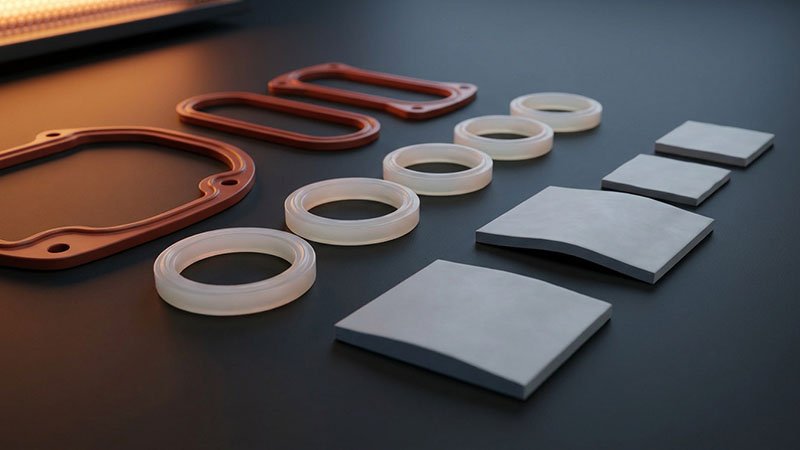
If you are speccing silicone for a part that gets hot or cold, you need two numbers and a boundary, not a chemistry lecture. Most pages bury those numbers under encyclopedic filler, so buyers waste a call asking us what they could have read in one line.
Silicone has low thermal conductivity — around 0.2 W/m·K — and a standard continuous working range of -60°C to +230°C. It insulates heat rather than conducts it, unless it is filled with ceramic or metal additives.
Everything below is the detail behind that sentence: the values, where the limits actually sit, and how silicone compares to the rubbers it usually competes with.
What Is Silicone Thermal Conductivity?
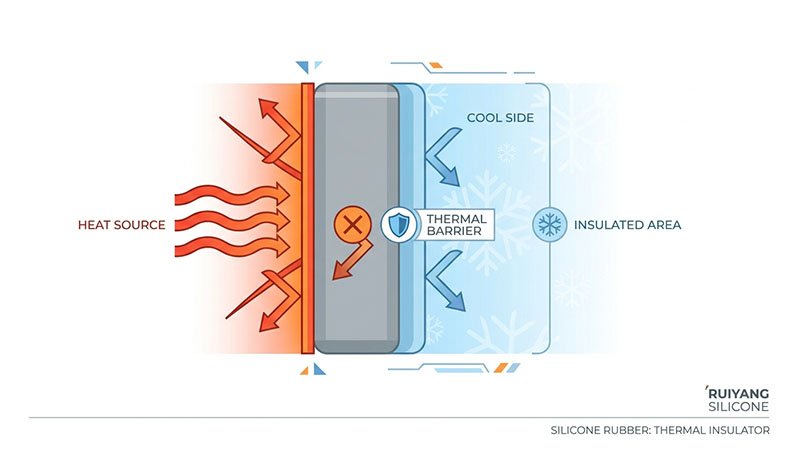
Unfilled silicone rubber (VMQ) sits around 0.2 W/m·K, typically quoted in the 0.1–0.4 W/m·K band depending on grade and filler load. The base polymer, PDMS, measures about 0.15 W/m·K, and lab measurements across a -50 to 150°C range keep it in that low band. For reference, copper is roughly 400 W/m·K and aluminum around 200. So silicone is not a heat conductor. It is a heat insulator that happens to survive temperatures most plastics cannot.
That is the point buyers miss: when a drawing calls for “silicone for heat,” it almost always means heat resistance, not heat transfer. Those are opposite requirements, and they pull material selection in different directions.
One quick orientation on the unit: thermal conductivity in W/m·K is how fast heat passes through a material. A low number means heat moves slowly, so the surface you touch stays cooler while the other side heats up. That is exactly the behavior you want in a handle or a gasket, and exactly the behavior you have to engineer around with fillers when you actually need to move heat.
Thermally Conductive Silicone (Filled Grades)
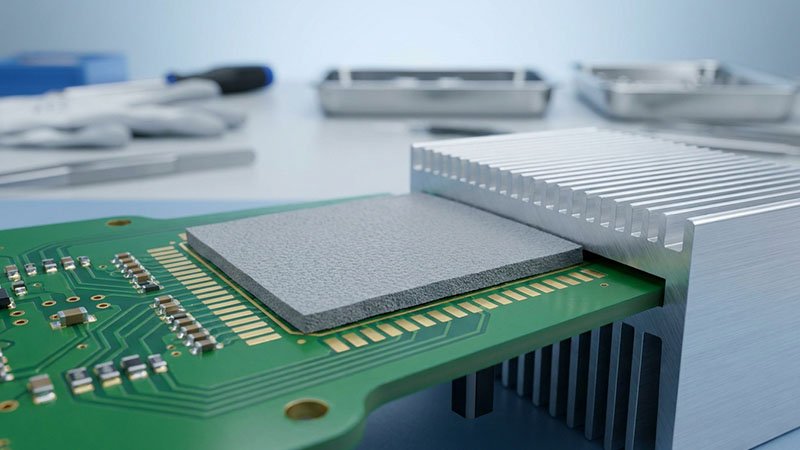
When the job actually is to move heat — thermal pads, gap fillers, thermal interface materials (TIM) under a CPU or a power module — we do not use base silicone. We load it with alumina, boron nitride, or metal-oxide fillers.
| Silicone type | Thermal conductivity (W/m·K) | Typical use |
|---|---|---|
| Unfilled VMQ | ~0.2 | Seals, gaskets, insulation, general molded parts |
| Lightly filled | 0.5–1.0 | Basic thermal pads |
| Thermally conductive (heavily filled) | 1.0–5.0+ | TIM, gap fillers under power electronics |
The trade-off is mechanical: the more conductive filler you pack in, the harder and less elastic the part gets. You buy conductivity with flexibility. That tension drives the grade choice, not a single spec line.
Filler chemistry sets the ceiling. Alumina (aluminum oxide) is the workhorse — cheap, stable, and good for roughly 1–3 W/m·K at practical loadings. Boron nitride reaches higher, about 3–6 W/m·K, while staying electrically insulating, which is why it shows up in thermal interface material under power electronics. Where electrical isolation is not required, graphite- and metal-loaded grades push higher still, but they give up the dielectric strength that made silicone attractive in the first place. The selection rule is short: pick the lowest conductivity that clears your thermal budget, because every extra point of W/m·K costs you elongation, tear strength, and tooling life.
Silicone Temperature Range & Heat Resistance
This is the second number, and it is where silicone earns its place over cheaper rubbers. Heat resistance is really three questions in one: how hot the part runs continuously, how hot it spikes, and how cold it gets at the other end. A grade has to clear all three, and the gap between them is exactly where the wrong material gets specified.
Standard Continuous Working Range
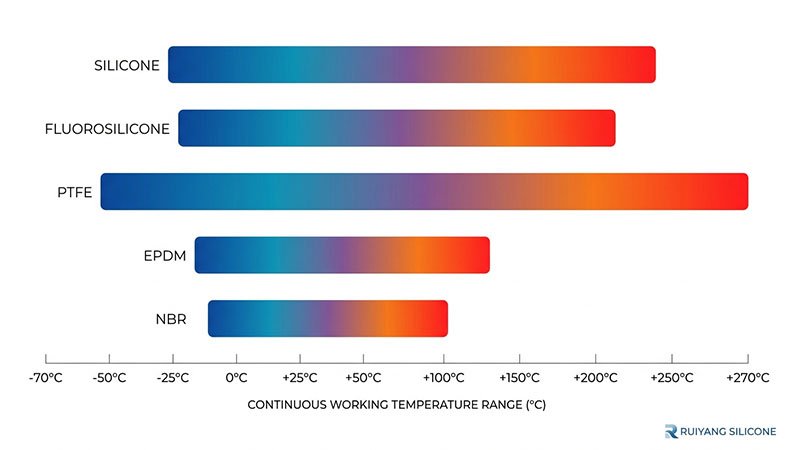
Standard silicone runs -60°C to +230°C continuously. That range is stable enough that we quote it for most sealing, gasket, and kitchenware work without a second thought. “Continuous” is the key word: it is the temperature the part can hold for its full service life without the hardness, tensile strength, or sealing force drifting out of spec. It is a conservative, datasheet-backed number, not a one-time survival figure.
High-Temperature Behavior
High-temperature grades take short excursions to 250–300°C. “Short” matters: a gasket can see 280°C in a brief spike and recover, but hold it there continuously and you trade away service life. Always separate peak temperature from continuous service temperature on the datasheet. Buyers who read the peak number as a working number are the ones who call back about hardened, brittle parts.
| Grade | Continuous service | Short peak |
|---|---|---|
| Standard VMQ | -60 to +230°C | ~250°C |
| High-temperature VMQ | +230 to +250°C | ~300°C |
| Heat-stabilized VMQ | up to +260°C | ~315°C |
Heat-stabilized grades use iron-oxide and other thermal additives to push continuous service toward 260°C. They cost more, and they are worth it only when the part genuinely sits in that band for thousands of hours — not for a process that spikes hot and then cools back down.
Low-Temperature Behavior
Silicone stays flexible far colder than most elastomers. Standard grades hold to around -60°C; fluorosilicone (FVMQ) pushes to roughly -73°C. Below that, the material stiffens and eventually goes brittle. Low-temperature brittleness is measured under ASTM D746, and it is the number to check for any cold-chain, aerospace, or outdoor-winter application. The failure mode at the cold end is not cracking on day one — it is a gradual loss of rebound. A seal that has gone glassy in the cold stops springing back, and a static joint quietly starts to leak. That is why the brittleness point, not the catalog minimum temperature, is the number that belongs on the drawing.
Thermal Aging
Heat resistance is not a single moment — it is how the part behaves after thousands of hours hot. Long-term heat aging is evaluated under ASTM D573, which measures changes in hardness, tensile strength, and elongation after sustained exposure. This is what separates a grade rated “230°C” from one that merely survives 230°C once. In practice we read three aging outputs together: a rise in hardness (the rubber turning glassy), a drop in elongation (it cracks instead of stretching), and loss of tensile strength. When a buyer reports parts going brittle in service, it is almost always an aging-versus-temperature mismatch, not a bad batch.
Silicone vs Other Elastomers: Thermal Comparison
Where does silicone’s thermal envelope actually beat the alternatives, and where does it not? Typical indicative values:
| Material | Thermal conductivity (W/m·K) | Max continuous temp | Low-temp limit |
|---|---|---|---|
| Silicone (VMQ) | ~0.2 | 230°C (peaks ~300°C) | -60°C (FVMQ ~-73°C) |
| NBR (nitrile) | ~0.25 | 100–120°C | -30°C |
| EPDM | ~0.35 | 130–150°C | -50°C |
| PTFE | ~0.25 | 260°C | -200°C |
| FKM (Viton) | ~0.20 | 200–230°C | -20°C |
| Natural rubber | ~0.15 | 70–90°C | -50°C |
Reading the table by application boundary:
- Wide temperature span is silicone’s real advantage. No common rubber holds both the hot and cold ends as well. If a part sees both a cold start and a hot soak, silicone is usually the default.
- For pure heat resistance alone, PTFE goes higher and shrugs off chemicals silicone cannot — but it is stiff, not elastic, so it is no substitute where you need a flexible seal.
- For heat transfer, none of these are conductors. Filled silicone is the practical route precisely because the base polymer survives the heat it is asked to move.
- NBR and EPDM lose on temperature, not on conductivity. Buyers switch to silicone for the range, then discover the conductivity is essentially the same — which is fine, because that was never the reason to switch.
- FKM (Viton) trades cold for chemistry. It holds heat almost as well as silicone and resists fuels and aggressive media that silicone does not, but its cold limit is poor — around -20°C — so it loses wherever low-temperature flexibility matters. Natural rubber is the opposite case: good elasticity, but it softens by 70–90°C and is out of the conversation for anything that runs hot.
Thermal Expansion and Dimensional Stability
Silicone expands more than metal when heated. Its coefficient of thermal expansion (CTE) sits around 200–400 × 10⁻⁶ /K, measured under ASTM E831 by third-party labs using thermomechanical analysis. For a standalone molded part this rarely matters. It matters when silicone is bonded or clamped to a metal housing: the two materials grow at different rates, and the joint design has to absorb that movement. This is a design-boundary note, not a defect — but it is the kind of thing that should be settled on the drawing, not on the production floor. The practical fixes are familiar to anyone who has bonded rubber to metal: design in a compliant geometry, choose an adhesive system that tolerates shear, or allow a clearance that absorbs the growth. None of that is exotic — it just has to be decided before tooling, because a CTE mismatch is a designed-in problem, not one you can inspect out later.
Where Silicone’s Thermal Behavior Actually Matters
- Electronics: thermal pads and TIM use filled silicone to pull heat off CPUs, GPUs, and power modules while staying electrically insulating.
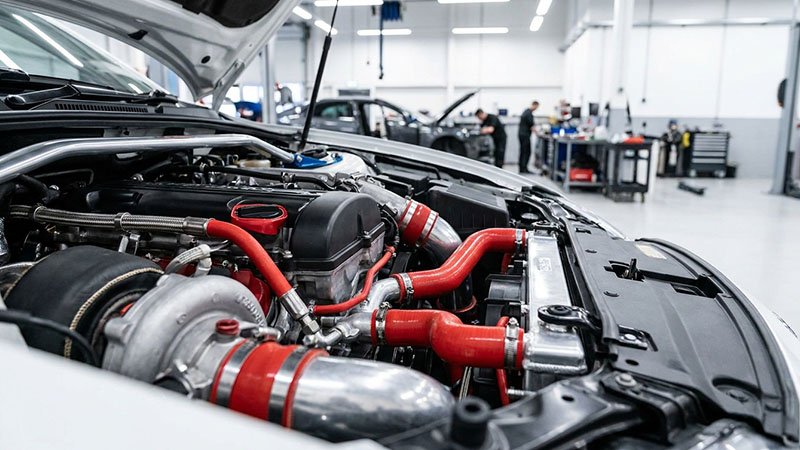
- Automotive: gaskets, hoses, and seals rely on the -60 to +230°C range near the engine bay, where NBR would harden.
- Kitchenware and bakeware: handles, mats, and molds use silicone’s insulation — it stays touchable next to heat instead of conducting it into your hand.
- Medical and outdoor: the low-temperature flexibility and aging stability carry the load more than conductivity does.
| Application | Key thermal property | Typical grade |
|---|---|---|
| CPU / power-module TIM | High conductivity (1–5+ W/m·K) | Boron-nitride filled |
| Engine-bay gasket | Continuous 230°C + oil resistance | High-temp VMQ / FVMQ |
| Bakeware and handles | Low conductivity (insulation) | Standard VMQ |
| Cold-chain / outdoor seal | Low-temp flexibility to -73°C | Fluorosilicone (FVMQ) |
If you are matching a specific application to a grade, the high-temperature selection logic deserves its own walkthrough rather than a bullet here.
FAQ
Does silicone conduct heat?
Not well. Unfilled silicone is about 0.2 W/m·K — it insulates. Only ceramic- or metal-filled grades (1–5+ W/m·K) are made to conduct heat.
What is the maximum temperature silicone can handle?
230°C continuous for standard grades, with short peaks to 250–300°C for high-temperature grades. Treat the peak as an excursion, not a working point.
Is silicone a good thermal insulator?
Yes. Low conductivity plus a wide -60°C to +230°C range is exactly why it is used for handles, gaskets, and electrical insulation.
Silicone or PTFE for high heat?
PTFE handles higher continuous heat (about 260°C) and far harsher chemicals, but it is rigid. Choose silicone when you need an elastic seal across a wide hot-and-cold range; choose PTFE when you need chemical resistance and can live without elasticity.
What to Confirm Before You Spec
The two numbers — ~0.2 W/m·K and -60°C to +230°C — answer most searches, but they do not finish a spec. Before we quote a grade, we need to know whether you are insulating or conducting, your continuous (not peak) working temperature, the cold-end limit, and whether the part bonds to metal. Thermal behavior is one slice of the full physical properties of silicone — the material’s density and water resistance and its place in the overall properties of silicone framework each move the spec in their own direction. Tell us the application and the temperature profile, and the grade, filler, and compliance level fall out from there.