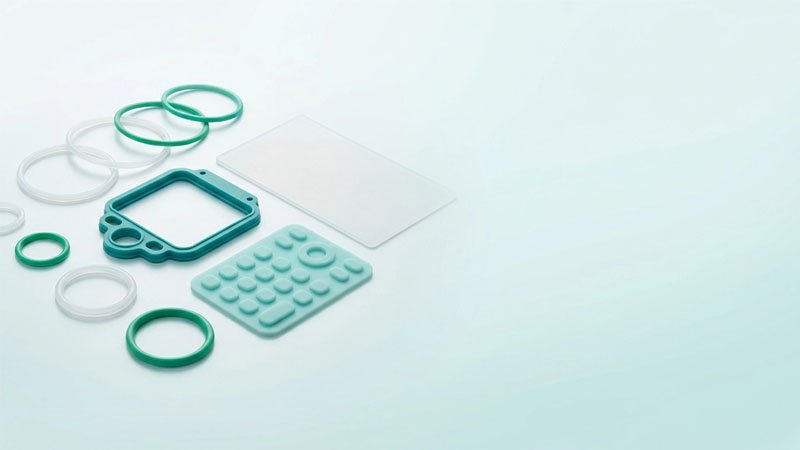
Most mechanical data on silicone gets buried in encyclopedic noise — broad adjectives like “flexible” and “durable,” with no numbers and no test method behind them. If you are specifying a gasket, keypad, seal, or molded part, that gap costs you time and risks locking in the wrong durometer or tear spec before tooling.
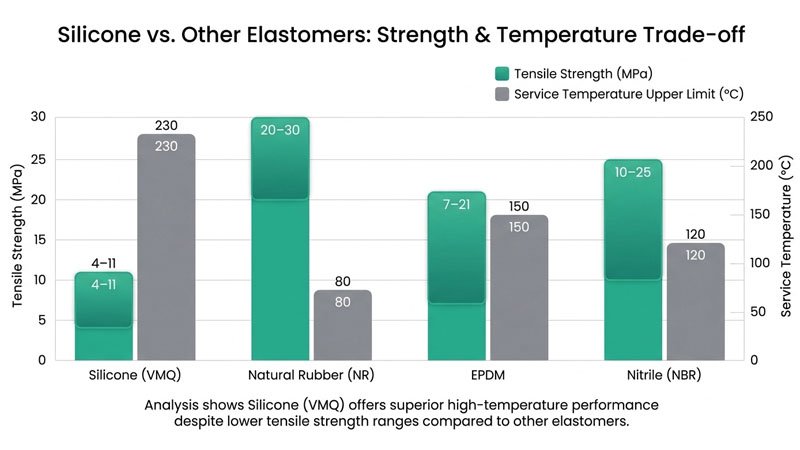
Silicone rubber (VMQ) runs lower on raw tensile strength than nitrile or natural rubber — typically 4–11 MPa — but holds elongation of 200–800% and keeps that mechanical behavior across −60 °C to +230 °C. That trade-off, not peak strength, is why it gets specified.
The sections below give the working numbers, the ASTM method behind each one, and where those numbers stop applying.
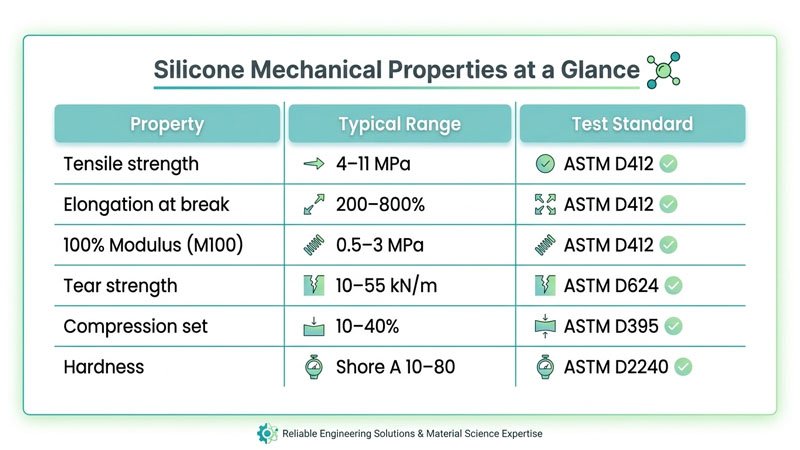
Silicone Mechanical Properties at a Glance
These are general-purpose silicone rubber ranges that sit within silicone’s broader physical property envelope — see the complete properties guide for the full picture. Actual values depend on the base polymer, filler loading, cure system, and post-cure. Treat them as the starting envelope, not a datasheet substitute.
| Property | Typical Range (General-Purpose Silicone) | Test Standard |
|---|---|---|
| Tensile strength | 4–11 MPa (high-strength grades up to ~13 MPa) | ASTM D412 |
| Elongation at break | 200–800% | ASTM D412 |
| 100% modulus (M100) | 0.5–3 MPa | ASTM D412 |
| Tear strength | 10–55 kN/m | ASTM D624 |
| Compression set | 10–40% (lower after full post-cure) | ASTM D395 |
| Hardness | Shore A 10–80 | ASTM D2240 |
Tensile Strength
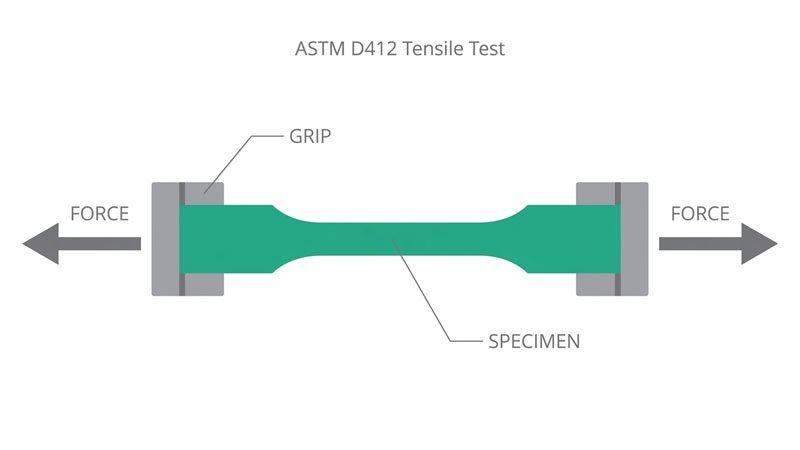
Tensile strength is the stress a silicone part withstands before it breaks in tension, measured on a dumbbell specimen per ASTM D412. General-purpose silicone lands at 4–11 MPa. High-strength and high-tear grades reach roughly 13 MPa.
That is lower than natural rubber or nitrile, and it is rarely the limiting factor in practice. Silicone is specified for sealing, insulation, and soft-touch parts, where elongation, compression set, and temperature stability matter more than peak pull strength. Filler type and loading move the number most: reinforcing fumed silica raises tensile strength, while heavy extending fillers lower it to cut cost.
If a part is genuinely load-bearing in tension, silicone is usually the wrong material — that is a design boundary, not a grade you can tune your way out of. See when a rigid material is the better choice for where an engineering thermoplastic takes over.
Elongation at Break (Elasticity & Flexibility)
Elongation at break is how far silicone stretches before failure, expressed as a percentage of original length and pulled on the same ASTM D412 specimen as tensile strength. Typical silicone runs 200–800%, with softer low-durometer grades sitting at the high end.
This is the property behind silicone’s “elasticity and flexibility.” It lets a 30 Shore A pacifier, a stretch lid, or a bellows deform repeatedly and return to shape. Elongation and hardness move inversely: as you go up in durometer for a stiffer part, elongation drops.
100% Modulus (M100 / M300)
Modulus is the stress needed to stretch the specimen to a set elongation — M100 at 100% stretch, M300 at 300% — also read off the D412 test. Silicone M100 typically falls at 0.5–3 MPa.
Modulus matters more than tensile strength for parts under repeated low-strain flexing, such as keypads and membranes. It describes the force-to-deflect, which is what a designer actually feels and specifies. Two grades can share a tensile number and behave very differently in service because their modulus curves differ.
Tear Strength
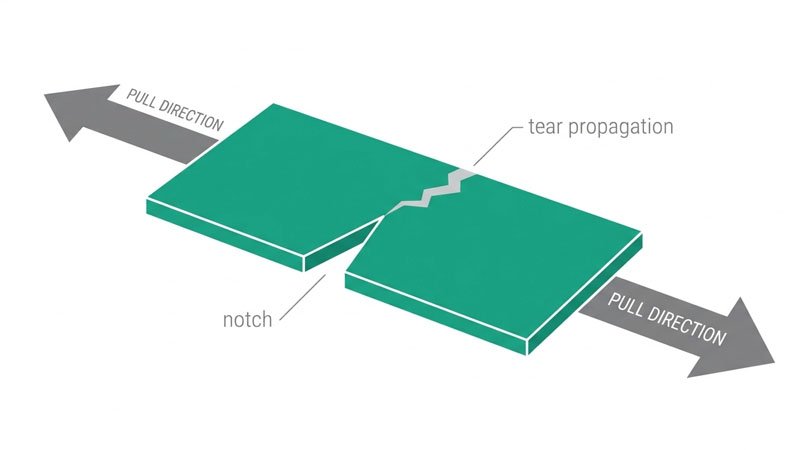
Tear strength is resistance to a propagating cut or nick, measured per ASTM D624 (commonly Die B or Die C) and reported in kN/m. Silicone ranges from 10–55 kN/m: general-purpose grades sit low, while high-tear silicone formulations occupy the upper band.
Tear strength, not tensile strength, is the spec that decides whether thin-wall parts and parts with sharp internal corners survive demolding and field use. Baby products, thin membranes, and parts with tight radii should be quoted against a high-tear grade. A nick that would be cosmetic on a thick part becomes a tear-initiation point on a thin one.
Compression Set
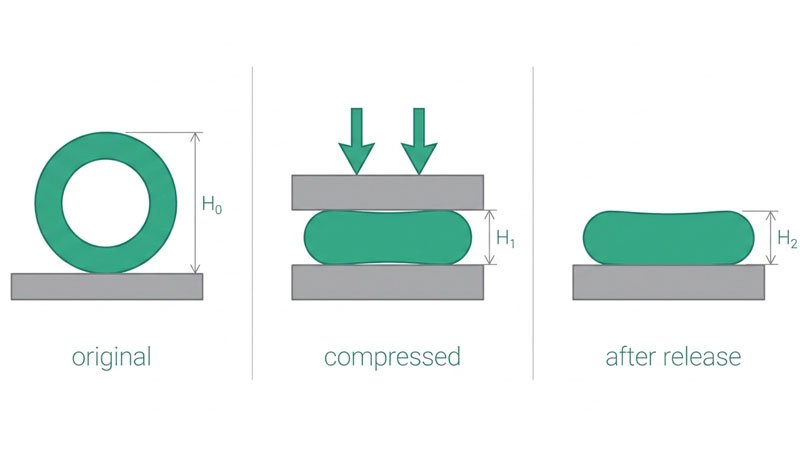
Compression set measures how much permanent deformation remains after a silicone part is held compressed, then released — tested per ASTM D395 (Method B, constant deflection). A lower percentage is better. Silicone runs 10–40%, and a full post-cure pushes it toward the low end.
This is the property that defines a silicone gasket or seal. Low compression set is the main reason silicone outperforms most elastomers in static sealing across wide temperature swings: it stays compressed and keeps sealing instead of taking a set and leaking.
Cure system and post-cure drive the number. Platinum-cured silicone with a proper post-cure delivers low compression set; under-cured or peroxide-cured material without adequate post-cure does not. If long-term sealing is the function, compression set after post-cure is the value to demand on the datasheet — not the as-molded figure.
How Hardness Connects to the Mechanical Numbers
Hardness (durometer) is measured per ASTM D2240 on the Shore A scale, with silicone commonly available from Shore A 10 to 80. Hardness is not a strength value, but it is the fastest predictor of the others: softer grades stretch further (higher elongation) and feel more compliant (lower modulus); harder grades resist deformation but lose elongation.
For most sourcing conversations, durometer is the first lever. The tensile, tear, and modulus numbers shift with it.
Related: Silicone Shore A Hardness: Effects on Feel, Sealing & Durability — the full soft-vs-hard silicone and durometer-by-application selection guide.
Silicone vs. Other Elastomers
Mechanical numbers only mean something in comparison. Against common rubbers, silicone trades raw strength for temperature range, compression set, and aging resistance.
| Property | Silicone (VMQ) | Natural Rubber (NR) | EPDM | Nitrile (NBR) |
|---|---|---|---|---|
| Tensile strength | 4–11 MPa | 20–30 MPa | 7–21 MPa | 10–25 MPa |
| Elongation at break | 200–800% | 400–700% | 200–600% | 300–600% |
| Tear strength | Low–moderate | High | Moderate | Moderate |
| Compression set | Excellent (low) | Poor | Good | Moderate |
| Service temperature | −60 to +230 °C | −50 to +80 °C | −50 to +150 °C | −30 to +120 °C |
| UV / ozone / aging | Excellent | Poor | Excellent | Poor |
The takeaway is narrow: if the part needs peak tensile or tear strength at room temperature, NR or NBR wins on the mechanical line items, , and wear-driven parts usually point to polyurethane for abrasion-driven parts rather than any silicone grade. If it needs to seal reliably, resist heat and weathering, and hold its shape over years, silicone’s lower strength is an acceptable trade.
Where These Numbers Stop Applying
Every range above is grade- and process-dependent. Filler system, cure chemistry, and post-cure can move tensile strength, tear, and compression set across the full band — two parts both labeled “silicone” can differ by 2× on tear strength. The published figure also reflects lab specimens, not your wall thickness, geometry, or demolding stresses — knowing how these values are measured is what makes two datasheets genuinely comparable.
Before these numbers become a real spec, three inputs are needed: the target Shore A hardness, the controlling function (static seal, dynamic flex, or structural), and the service temperature range. With those, the mechanical grade narrows quickly. Without them, any single tensile or tear number is just a data point, not a specification.
FAQ
What is the tensile strength of silicone rubber?
General-purpose silicone is 4–11 MPa per ASTM D412, with high-strength grades up to about 13 MPa. It is lower than nitrile or natural rubber.
How much can silicone stretch before breaking?
Elongation at break is typically 200–800%. Softer, low-durometer grades stretch the most.
Does silicone have good compression set?
Yes. At roughly 10–40% (lower after a full post-cure), silicone holds its shape under sustained compression better than most elastomers, which is why it is used for seals and gaskets.
Which is stronger, silicone or EPDM?
Which is stronger, silicone or EPDM?
Why does silicone have low tensile strength but high elongation?
Silicone’s flexible siloxane (Si–O) backbone stretches readily, giving 200–800% elongation, but the same low intermolecular forces cap tensile strength at 4–11 MPa. Reinforcing fillers like fumed silica raise tensile strength without sacrificing much flexibility.
What ASTM standard is used for silicone tear strength?
Tear strength is measured per ASTM D624 (commonly Die B or Die C) and reported in kN/m. General-purpose silicone runs 10–55 kN/m, with high-tear grades at the upper end.
What is the 100% modulus (M100) of silicone?
M100 is the stress needed to stretch a specimen to 100% elongation, typically 0.5–3 MPa for silicone per ASTM D412. It predicts force-to-deflect better than tensile strength for parts under repeated low-strain flexing, such as keypads and membranes.