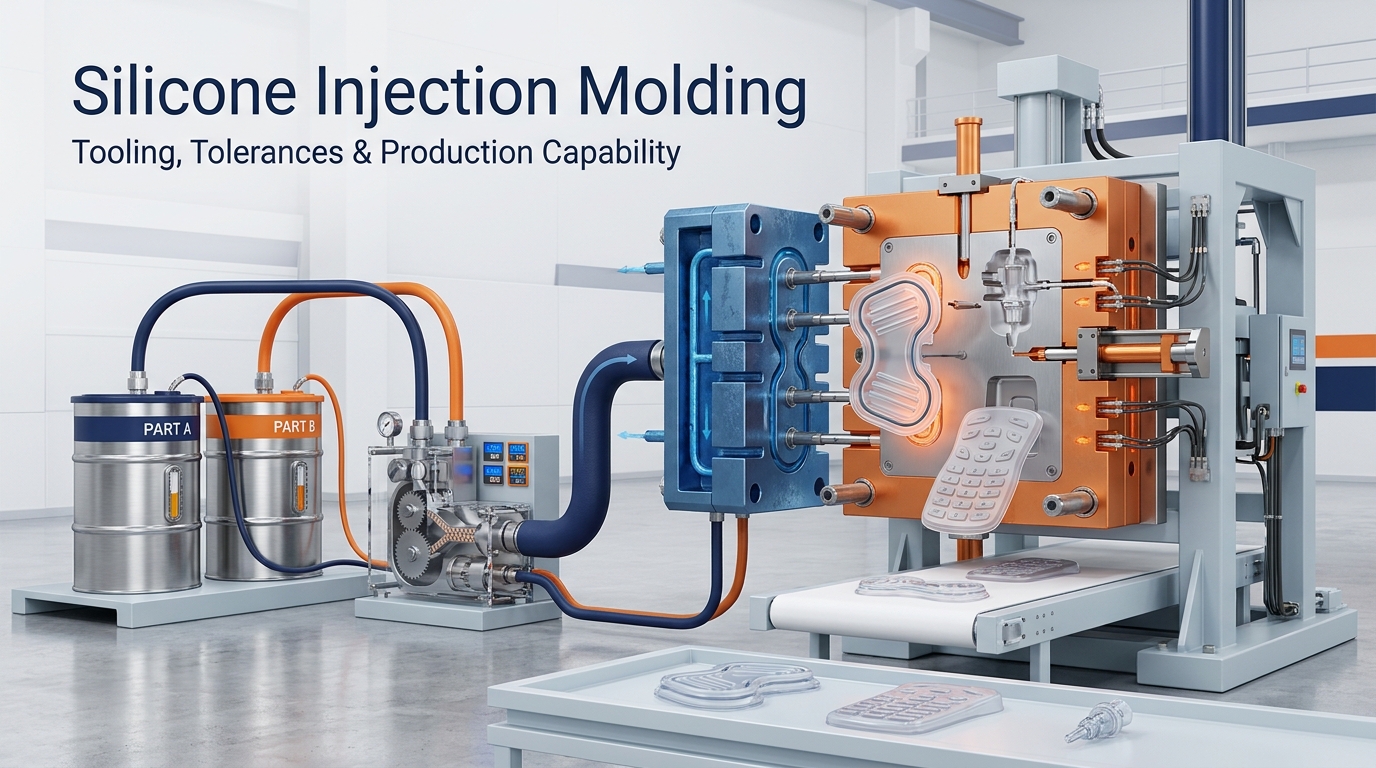
Most silicone parts that need repeatable geometry at volume end up in a heated steel tool with a cold runner. We run silicone injection molding in-house for LSR parts from consumer feeding products to sealing and keypad components, and we quote tooling, cavitation and cycle time from the 3D file rather than from a catalog price list.
What We Run for Silicone Injection Molding
Use the four groups below for initial supplier screening. Verified means an established company capability; project-dependent means the final value is fixed only after review of the drawing, material, annual volume and validation requirements.
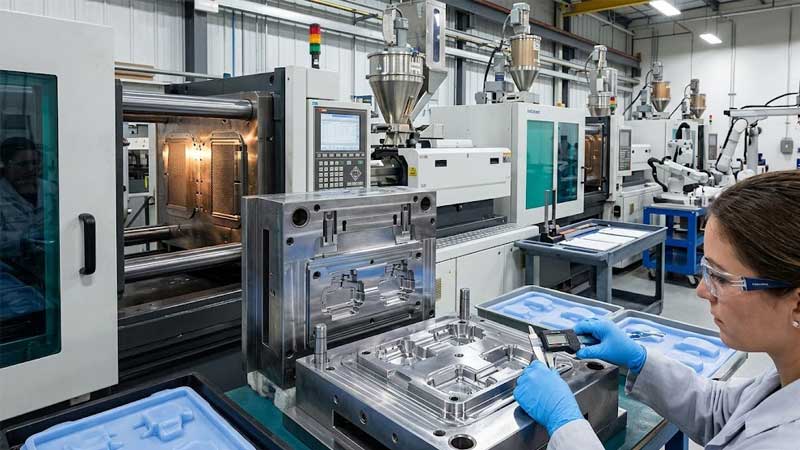
Equipment and Process
| Procurement question | RY Silicone capability | Confirmation status |
|---|---|---|
| What press capacity is available? | LSR injection presses from 50–200 T; up to 300 T for large multi-cavity tools | Verified equipment range; press selected after projected-area review |
| Can the line handle inserts or automated high-cavitation work? | Horizontal presses for cavitation; vertical presses for insert loading | Verified configurations; automation scope is project-dependent |
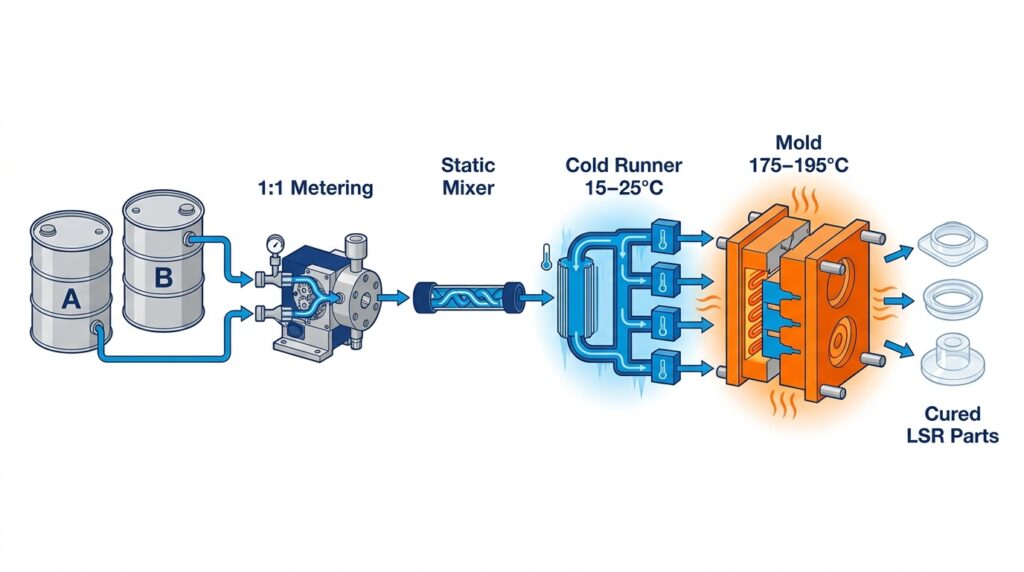
| How are the two LSR components and pigment metered? | 1:1 A/B pump, static mixer and pigment through a controlled third stream | Verified standard setup |
| Which tool and feed systems are supported? | P20, H13 or S136 steel; open sprue, cold runner and valve-gated cold deck | Tool steel and feed system selected after shot-count and cost review |
Part and Tooling Envelope
| Procurement question | Working capability | Confirmation status |
|---|---|---|
| What part size and weight can be quoted? | 0.5–300 g per part in a standard cell | Project-dependent; geometry and shot volume determine the press |
| What hardness range is supported? | Shore A 5–80; Shore A 30–70 covers most regular production | Exact grade and cure system confirmed before quotation |
| How many cavities are practical? | 1–32 cavities; 2–8 covers most production parts | Quoted after flow, balance, annual-volume and maintenance review |
| What processing window is used? | Mold temperature 160–210°C, typically 175–195°C; injection pressure 200–1,200 psi | Starting window only; validated by material grade and part geometry |
| What cycle time should purchasing assume? | 15–60 s for walls under 3 mm; thicker sections scale non-linearly | Estimate only until T1 process validation |
| Is LSR-to-plastic overmolding available? | Insert-loaded overmolding and index-plate two-shot configurations | Substrate grade, bond system and peel-test plan require validation |
Quality and Documentation
| Procurement question | RY Silicone capability | Confirmation status |
|---|---|---|
| Which dimensional tolerance framework is used? | ISO 3302-1 M2 / M3 for general dimensions; tighter CTQs reviewed separately | Drawing-specific; measurement method and fixture must be agreed |
| Is controlled-environment production available? | ISO Class 7 / Class 8 for specified medical and food-contact programs | Cleanroom scope confirmed in the quotation and quality plan |
| Which quality systems can support the project? | ISO 9001 baseline; ISO 13485 for medical programs; IATF 16949 for automotive programs | Applicable certificate and site scope supplied during qualification |
| What inspection record is supplied at T1? | Dimensional report covering drawing dimensions on 3–5 samples per cavity | Sampling level and CTQs agreed before tool release |
| Can material and compliance records be traced? | Material declaration, supplier batch traceability and applicable third-party reports | Exact report scope depends on material, color, finished article and market |
Commercial Screening
| Procurement question | Typical term | Confirmation status |
|---|---|---|
| What is the production MOQ? | 3,000–5,000 pcs per order once the tool exists | Part size, color changes, packaging and annual demand can change the MOQ |
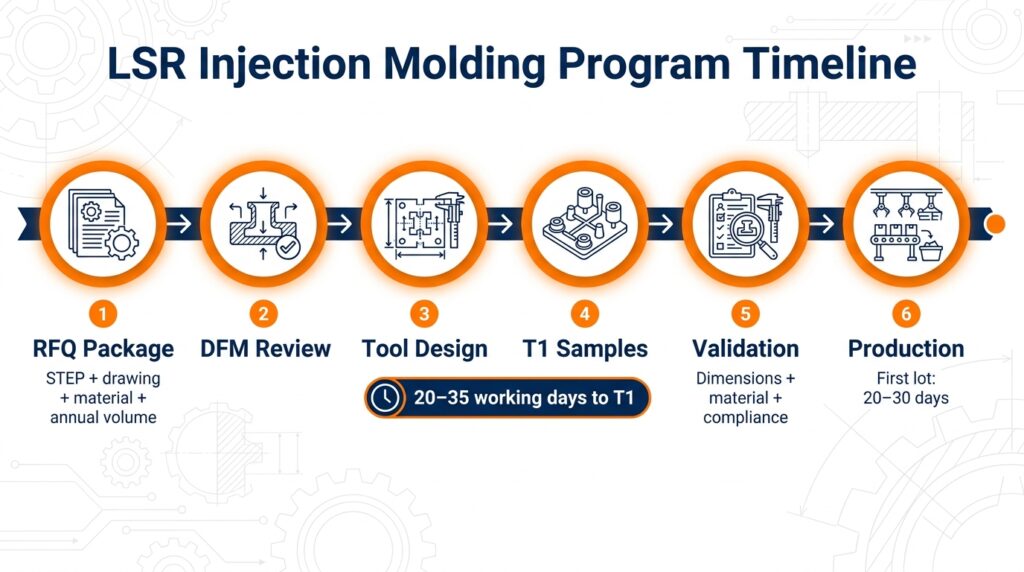
| How long does tooling take? | 20–35 working days (4–6 weeks) from approved DFM to T1 | Final schedule issued after tool design and material availability review |
| How long does a T1 revision take? | 7–10 working days per revision round | Depends on steel change, testing and customer feedback time |
| How long does the first production lot take? | 20–30 days after sample approval | Order quantity, secondary operations and documentation can change the schedule |
Which LSR Grades and Cure Systems We Process
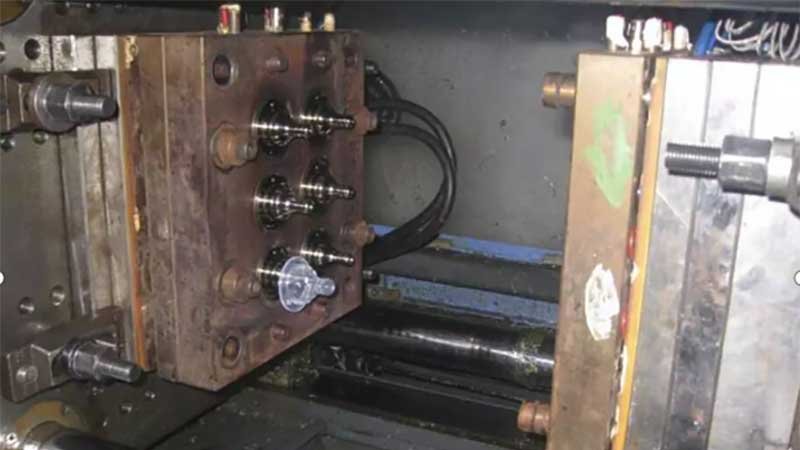
We run platinum-cured LSR as the default for injection molding. Peroxide-cured HCR does not run in an injection cell without a different feed system, so it stays on compression and transfer lines.
Grades in regular production:
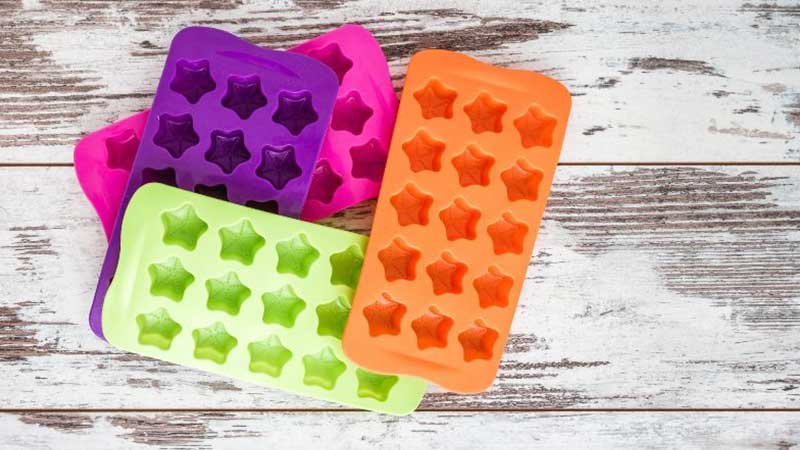
- General purpose LSR, Shore A 30–70, for kitchen, pet and gift parts
- Food-contact LSR selected and tested against the applicable extractives requirements of FDA 21 CFR 177.2600 for repeated-use rubber articles, and against the relevant LFGB requirements and BfR Recommendation XV when specified
- Medical-grade LSR with material-level testing to ISO 10993-5 / -10 or USP Class VI where required; final biological evaluation remains specific to the finished device, manufacturing process, contact type and duration
- Self-lubricating, oil-bleed and low-friction grades for seals and closures
- Self-adhesive LSR for bonding to PC, PA, PBT and PEEK substrates
- Electrically conductive and flame-retardant grades on request
Pigment is added as a third stream at the mixer, not pre-mixed by hand. Color drift across lots comes from pigment dosing, not from the base polymer, which is why we hold a signed color chip per SKU. Additive packages also change flow and cure behavior, not only the datasheet numbers — see liquid silicone rubber additives.
Tooling: Cold Runner, Cold Deck and Waste
Our tools run a chilled feed at 15–25°C against a cavity at 175–195°C. That temperature split keeps the runner uncured and is what makes runnerless molding possible.
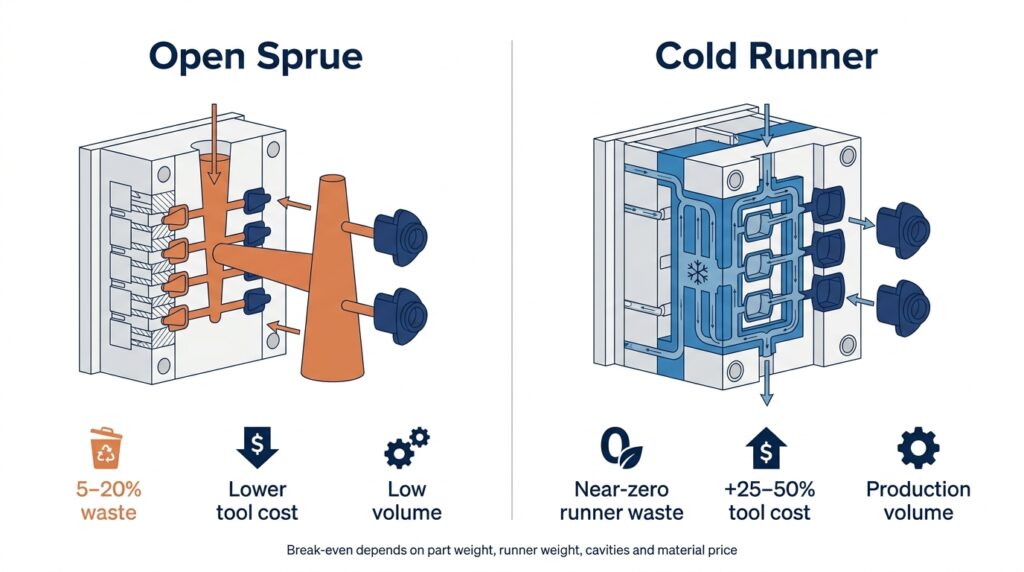
| Feed system | Material waste per shot | Tooling cost | Where we use it |
|---|---|---|---|
| Open sprue / cold sprue | 5–20% | Lowest | Prototype and low-volume tools |
| Cold runner block | Near zero | +25–50% over open sprue | Production tools above roughly 50,000 pcs/year |
| Valve-gated cold deck | Near zero, gate vestige controlled | Highest | Cosmetic parts, multi-cavity balance |
A cold runner pays for itself on material alone when annual volume passes roughly 50,000 pcs at current LSR pricing of USD 8–20/kg and 5–20% sprue waste. Below that, the sprue waste is cheaper than the block. We show both numbers in the quote instead of pushing the more expensive tool. The full cold runner versus open sprue cost comparison sits here.
Tool steel selection follows expected shot count: P20 up to roughly 250,000 shots, H13 or S136 from 500,000 shots upward and for grades with aggressive fillers. Draft, wall transitions, venting and shrink allowance are set at DFM, not after T1 — the working rules are in our silicone mold design guide.
Tolerance and Flash Control
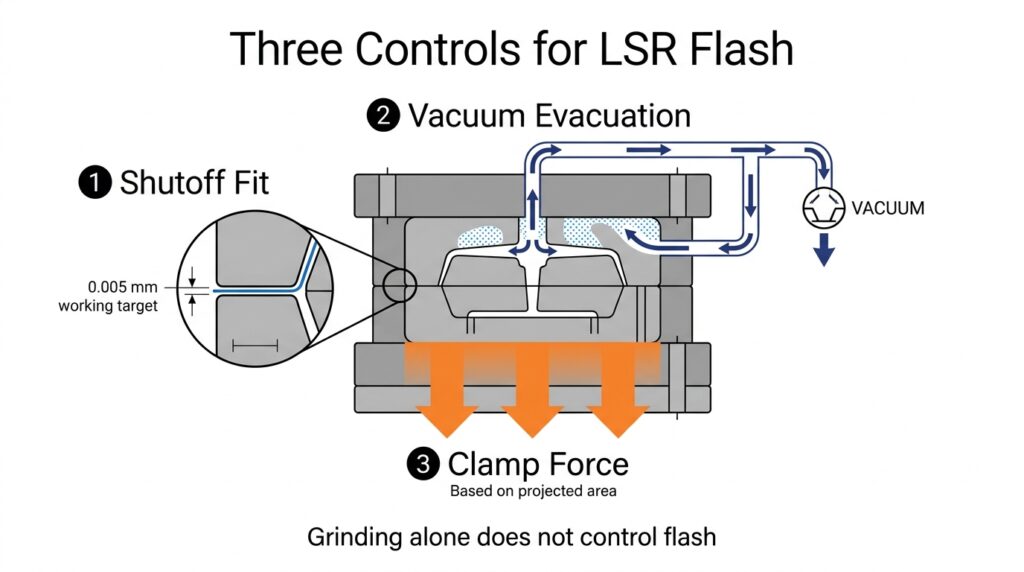
Under production pressure, LSR can enter extremely small parting-line gaps; 0.002 mm is the working risk threshold we use during tool review, not a universal flash specification. No parting line holds one nominal gap across every cycle, so flash control is never one number on a drawing. It requires shutoff condition, vacuum and clamp force to work together, and grinding alone will not control it.
What we control:
- Parting-line shutoff fitted to a 0.005 mm working target before T1, then verified against the drawing’s agreed flash limit and re-checked for steel wear after the first production lot
- Vacuum evacuation of the cavity before injection, which removes the trapped air whose back-pressure otherwise pushes silicone into the parting line rather than through the vents
- Clamp tonnage calculated from projected area, not from machine size; an under-clamped tool opens under injection pressure and flashes even with a perfect parting line
- Shrinkage allowance of 1.5–3.5% depending on grade, durometer and section thickness, confirmed against the T1 CMM report
Dimensional acceptance follows ISO 3302-1. M2 is achievable on most geometries; M1 is a case-by-case discussion tied to gate position and cavity count. Tighter than that usually means the drawing is asking a soft material to behave like a machined part. The flash mechanics are covered in achieving zero flash in LSR molding, and undercut geometry — which LSR tolerates far better than thermoplastics — in undercut design rules for LSR parts.
Post-Cure, Testing and Documentation
Parts leaving the press are cured but still carry volatiles and residual siloxanes. Standard post-cure in our ovens is 200°C for 4 hours, adjusted by grade and wall thickness. Food-contact and medical parts run post-cure as a fixed step; industrial seals may not need it. Details in silicone products post cure.
Documentation we can issue with a shipment:
- Material declaration and lot traceability to the LSR supplier batch
- Third-party test reports scoped to the exact material, color, finished article and intended market: FDA 21 CFR 177.2600, relevant LFGB / BfR XV requirements, RoHS and REACH SVHC
- Dimensional report covering every drawing dimension, 3–5 samples per cavity
- Hardness, tensile, tear and compression set per ASTM D2240 / D412 / D624 / D395
Test method scope and what each report does and does not cover is set out in silicone testing methods.
Two-Shot and Overmolding Capability
LSR bonds to engineering thermoplastics either through a self-adhesive grade or through mechanical interlock. Substrate choice and exact material grade decide which. Selected grades of PC, PA66, PBT and PEEK can bond with a compatible self-adhesive LSR system, but adhesion must be validated on the specified resin. PP and PE generally require plasma, primer treatment or a mechanical interlock.
We run overmolding either by loading the molded thermoplastic as an insert, or as two-shot on an index plate. Bond strength is verified by a project-defined 180° peel test on T1 samples. For qualified self-adhesive LSR and PC or PA66 combinations, 3–8 N/mm with cohesive failure is our working benchmark; the drawing and validation plan set the final acceptance value. Clean interfacial release triggers a review of the substrate grade, surface preparation and molding conditions before tool release.
Part Families We Support
These four families illustrate the product and documentation requirements we support across silicone molding programs. The selected manufacturing process—LSR injection, compression, transfer or another route—is confirmed from the actual geometry, material and volume rather than inferred from the product category.
| Part family | What drives the tool | Related product experience |
|---|---|---|
| Seals, gaskets, connectors | Compression set per ASTM D395 and a flash-free parting line; cosmetics are secondary | O-rings, rubber sheet, elbows and hose connectors |
| Keypads and control panels | Actuation force held within ±20 gf across the panel, and force stability after 1 million cycles | waterproof keypads, high-tactile keypads |
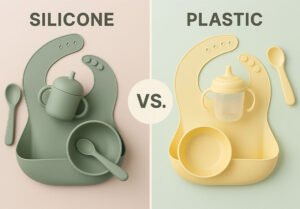
| Food-contact and baby products | FDA 21 CFR 177.2600 and LFGB documentation, post-cure as a fixed step, no odor carryover | feeding sets, teethers, baby plates |
| Medical and personal care | ISO 10993 / USP Class VI material file, cleanroom molding, lot traceability | menstrual cups |
Small high-cavitation parts pull the tool toward a cold deck; large single parts stay single-cavity with an open sprue no matter what the annual volume says.
Volume, MOQ and Lead Time
Injection molding is a tooling-first process. The unit price falls with cavitation, so the decision that locks your cost is cavity count at kickoff, not negotiation at PO.
Two different numbers get confused here. MOQ is how small a single order can be once the steel exists. The table below is annual volume, which decides whether cutting that steel makes sense at all.
| Annual volume (not order size) | Typical tool | Comment |
|---|---|---|
| Under 10,000 pcs | Single-cavity, open sprue | Compression molding often lands cheaper |
| 10,000 – 100,000 pcs | 2–8 cavity, cold runner | Standard injection window |
| Above 100,000 pcs | 8+ cavity, valve gate | Cycle and automation dominate cost |
Our MOQ for injection molded LSR is 3,000–5,000 pcs per order. That is not the same question as whether you should buy an injection tool: below roughly 10,000 pcs a year, compression molding usually lands cheaper overall even though its unit price is higher, because the tool costs a fraction and absorbs design changes. Tooling runs 20–35 working days to T1, with 7–10 working days per revision round. Mass production after sample approval is 20–30 days for the first lot. Cost structure across processes is broken down in what is the cost of silicone molding.
When We Recommend Against Silicone Injection Molding
We quote the process that fits the part, not the process with the highest tooling value.
- Annual volume below the tooling break-even: silicone compression molding uses cheaper tools and absorbs design changes without a new steel block
- Thick solid sections above roughly 10–12 mm: cure time scales with the square of thickness and the cycle stops being economical
- Parts with metal inserts in low volume: transfer molding is usually the better fit
- Continuous profiles, cord and tubing: extrusion, not injection
- Design still moving: every geometry change after steel is cut costs tool rework, so we hold the project at 3D print or compression prototype until the drawing is frozen
A broader map of the alternatives is in our silicone products manufacturing process guide.
What to Send with an RFQ
We can quote from a photo, but the number will carry a risk margin. To get a firm price:
- 3D file (STEP or IGES) plus a 2D drawing with critical dimensions and tolerance class
- Target durometer and color, Pantone reference if matching is required — see how to prepare CAD drawings for your manufacturer
- Compliance target: food contact, medical, RoHS, or none
- Annual volume and order frequency, not just the first order
- Cosmetic requirements: acceptable parting line, gate vestige location, surface finish (SPI or VDI)
If your part sits close to one of the four families above, we can reuse relevant material, tooling and quality-planning experience; the final process and mold design are still confirmed during DFM.
FAQ
Is the tooling cost credited back against production?
Tooling is quoted separately and invoiced before steel is cut. Whether any part of it is credited back, and at what cumulative volume, belongs in the written quotation. Ask for that schedule in writing before the PO, from us or from any supplier.
What tolerance can you hold?
ISO 3302-1 M2 or M3 on most geometries. M1 depends on gate position, cavity count and wall uniformity, and is confirmed on the T1 report.
Do you have a minimum order quantity?
Yes — 3,000–5,000 pcs per order once the tool is built. Annual volume is the separate test: under about 10,000 pcs a year we will quote compression molding instead.
Can you supply FDA and LFGB documentation?
Yes. The quotation identifies the applicable FDA 21 CFR 177.2600 and German LFGB / BfR XV testing scope for the exact material, color and intended use. Material certificates and available third-party reports are linked to the relevant production lot; new finished-article testing is quoted when the project requires it.
Before You Lock the Tool
The two decisions that are expensive to reverse are cavity count and gate location. Cavity count sets your unit price for the life of the tool; gate location sets where the cosmetic vestige lands and which side of the part can be A-surface. Both are cheap to change in CAD and costly to change in steel.
Send the 3D file, the tolerance class, the compliance target and a realistic annual volume, and we will come back with tooling cost, cavitation options and the break-even point against compression molding. If the volume does not justify an injection tool, we will say so in the quote. Sample evaluation criteria before you release mass production are listed in how to evaluate sample quality before mass production.
Request a Quote
Send your 3D file and annual volume through the RFQ form.
Include in the first email: STEP file, tolerance class, target durometer, compliance requirement, annual volume. We come back with tooling cost, cavitation options, unit price at two volume points, and the break-even against compression molding.
References
- LFGB § 31, Transfer of substances to food — Bundesministerium der Justiz, current consolidated text: gesetze-im-internet.de/lfgb/__31.html
- USP General Chapter 〈 88 〉 Biological Reactivity Tests, In Vivo (basis of the Class I–VI plastics classification) — United States Pharmacopeia: doi.usp.org/USPNF/USPNF_M98834_01_01.html